
All images © by Roberto Piperno, owner of the domain. Write to romapip@quipo.it.


Notes:
Page revised in July 2021.
All images © by Roberto Piperno, owner of the domain. Write to romapip@quipo.it.
Notes:
Page revised in July 2021.
 in Ancient Rome
Introduction: art or engineering?
During the last decades of the XVIIIth century and for almost the
whole XIXth century
the views of J. J. Winckelmann (Reflections on the Painting and Sculpture of the Greeks) were regarded as absolute truth; according to them,
Greek art of the period 480-323 BC (Classical period) was
the peak reached by the Ancient World: what came after was called Hellenistic and dismissed as decadent.
This negative view included the works of art of the Roman Empire which were thought to be just copies of the patterns established during the Classical period. When they departed from those patterns they were
labelled as extravagant and lacking harmony.

Funerary inscription from Pompeii depicting land surveying (a "groma" an aligning instrument, resembling a surveyor's cross) and construction equipment (Ist century BC)
(Book XXXVI:24) The aqueducts (..) completed by Claudius (..) were brought from a distance of forty miles, and at so high a level that all the hills were supplied with water, on which the City is built. (..) If we only take into consideration the abundant supply of water to the public, for baths, ponds, canals, household purposes, gardens, places in the suburbs, and country-houses; and then reflect upon the distances that are traversed, the arches that have been constructed, the mountains that have been pierced, the valleys that have been levelled, we must of necessity admit that there is nothing to be found more worthy of our admiration throughout the whole universe.
(Book XXXVI:51) All building should be done by line and rule, and ought to be strictly on the perpendicular.
Pliny the Elder - The Natural History - Translation by J. Bostock and H. J. Riley
The recognition Roman architects did not receive from art historians came from modern engineers who investigated
and admired the construction techniques the Romans used to build roads, aqueducts, baths, tribunals, circuses, walls and obviously temples and houses.

Structure of an arch (Porta Asinaria)
The Romans learned from the Etruscans the use of arches to make large openings in a wall; the gates of the Etruscan towns (e.g. Arco Etrusco at Perugia) show the first examples of arch. The laws of Physics explaining the conditions required for an arch not to collapse were not fully understood until the XIXth century; yet the Etruscans, and after them the Romans, developed empirical methods for designing arches which still stand more than 2,000 years later.

The key element for building an arch is the solidity of its side walls which have to withstand the pressure discharged by the keystone through
the voussoirs to the springers.
Centina (centring) is the wood structure upon which the stones of an arch were laid during construction.

Arch included in an "opus quadratum" structure at Arco dei Pantani with SS. Luca e Martina and the Capitoline hill in the background
An important aspect the Romans paid attention to was the choice of materials: travertine proved to resist stress with limited strain and was widely employed to build arches. Roman architects found also a way to link the arch to the wall which was both effective from a structural viewpoint and decorative from an aesthetic one.

Travertine arches in Colosseo
Pontifex (builder of bridges) was the title the Romans gave to their highest priests and later on to the emperors; this because the Romans were the greatest bridge builders of antiquity due to the widespread application of arches; using the same technique they achieved impressive results in the construction of aqueducts. Stadiums, circuses and theatres were other buildings where the Romans showed their awareness of the strength of arch-based structures.
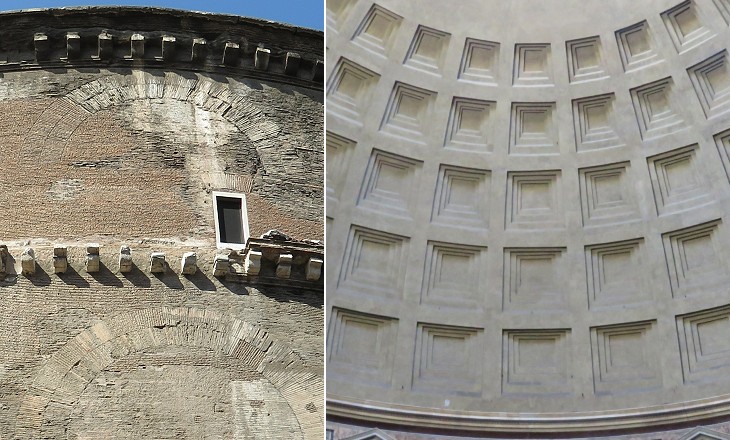
Pantheon: (left) exterior: discharging arches; (right) interior: "lacunari" (coffers/sunken panels) reducing the weight of the ceiling
Arches were used even in buildings where their presence is not immediately visible. The Pantheon rests on eight pillars and "discharging" arches ensure the pressure is directed towards them; the sunken panels of its ceiling have no doubt a very decorative effect, but they also reduce the weight of the structure; to this purpose Roman engineers also used vases or hollow bricks (e.g. in Tor Pignattara). The structures supporting the Roman market at Smyrna show interesting examples of both barrel and rib vaults.

Influence of Roman arches on Renaissance (left: Palazzo Lancellotti) and Neoclassic (right: Palazzo Braschi) architecture
Walls

"Opus quadratum" at Mura Serviane and at Foro di Augusto (right)
The earliest walls built in Europe were constructed placing stones one upon the other without any mortar to bind
them together (dry-stone walls). Near Rome examples of such walls can be seen at Alatri, Segni and at other locations south of the city:
they are called cyclopean, because the first archaeologists felt that only the mythical Cyclopes could have moved the enormous boulders which made up these walls.
Improvements in the tecnique used for cutting stones led to the
construction of walls with stones having the same size (Isodomum - Vitruvius - De Architectura).
In order to strengthen the wall, blocks were placed alternately with the longer side (stretchers) or the shorter side (headers) on the
face of the wall (opus quadratum).
Romans were so fond of the texture effect of opus quadratum that they
continued to use this technique even after having developed more effective kinds of masonry. The wall built at Foro di Augusto with the blocks projecting from the surface
inspired Renaissance architects in designing the bugnato (rustication) of many Florentine palaces.

"Opus caementicium" at Tomb of Marcus Virgilius Eurysaces (left) and near Piramide di Caio Cestio (right)
The Romans developed a very effective kind of mortar by mixing pozzolana, a volcanic ash of the region around Naples, with lime; they obtained a cement which was resistant to water.
In his work De Architectura (a treatise on architecture dedicated to Emperor Augustus) Vitruvius so described pozzolana:
There is a species of sand which, naturally, possesses extraordinary qualities. It is found about Baiæ and the territory in the neighbourhood of Mount Vesuvius;
if mixed with lime and rubble, it hardens as well under water as in ordinary buildings. This seems to arise from the hotness of the earth under these mountains,
and the abundance of springs under their bases, which are heated either with sulphur, bitumen, or alum, and indicate very intense fire.
The inward fire and heat of the flame which escapes and burns through the chinks, makes this earth light;
the sand-stone (tophus), therefore, which is gathered in the neighbourhood, is dry and free from moisture.
Since, then, three circumstances of a similar nature, arising from the intensity of the fire, combine in one mixture, as soon as moisture supervenes, they cohere and
quickly harden through dampness; so that neither the waves nor the force of the water can disunite them.
Translation by Joseph Gwilt, London: Priestley and Weale, 1826.
Most Roman buildings are made up of opus caementicium, a sort of concrete which was laid into timber structures until it hardened.
The resulting walls were very solid, but not nice to see, so very often some sort of facing was applied.

(left) Roman bricks at S. Saba; (centre) walls supporting the Imperial Palaces; (right) brick decoration at Anfiteatro Castrense
The Romans made use of fired bricks; the manufacturing of bricks was perfected during the first century AD: factories branded their products as they were responsible for their quality; bricks were generally longer and narrower than the bricks we use today. There were also round and triangular bricks which were used to imitate columns and other architectural motifs.

Brickwork (opus latericium) at Pantheon (left) and at Palazzo Madama (right)
The way the bricks were laid is often associated with a specific period: the texture of course-laid brickwork at the time of Emperor Hadrian impressed Renaissance architects who imitated it in many buildings. Contemporary architects have used "Roman brick" too.

"Opus reticulatum" at Villa Adriana (left) and near S. Saba (right)
An unusual kind of facing was based on specially-shaped tufa stones: the points of the stones were inserted into opus caementicium, while their square bases formed a diagonal pattern resembling a fishing net (reticulatum). Today many streets of Rome are paved with stones which create a similar diagonal pattern.

(left) "Opus listatum" at Porta S. Paolo;
(right) "Opus mixtum" at Delphi
Bricks were relatively expensive and their laying required a lot of manpower: for these reasons in the last centuries of the Roman Empire new facing patterns were developed to reduce the use of bricks; they were replaced by tufa pieces or by other materials including pieces of marble and other stones coming from ruined buildings. This resulted in a stripe design which characterized the buildings of the Late Empire as showed by the walls of Constantinople. These stripes passed on to Byzantine Art; they then influenced the design of Muslim mosques to finally return to Italy, where many medieval cathedrals (e.g. Orvieto) were decorated with black and white stripes.


