
All images © by Roberto Piperno, owner of the domain. Write to romapip@quipo.it.


Notes:
Page revised in January 2026.
All images © by Roberto Piperno, owner of the domain. Write to romapip@quipo.it.
Notes:
Page revised in January 2026.
 Porta Latina
Links to this page can be found in Book
1, Map A4, Day 5, View C10 and Rione Campitelli.
The page covers:
The plate by Giuseppe Vasi
Today's view
Porta Latina
S. Giovanni in Oleo
S. Giovanni a Porta Latina
Along Via Latina
Tombe di Via Latina
Antiquarium di Via Lucrezia Romana
The Walls between Porta Latina and Porta S. Sebastiano
The Walls between Porta Latina and Porta Metronia

Porta Latina was a minor gate both at the time of ancient Rome and in 1747 when Giuseppe Vasi depicted it in this etching. Via Latina, the road going through the gate, branched off Via Appia at S. Cesareo in Palatio and eventually joined it again at Casinum (Cassino), halfway between Rome and Naples. Because of the limited importance of the road, Porta Latina was closed for long periods. The plate shows very clearly that the tower to the right of the gate was built above an existing square construction, most likely a tomb.
In the description below the plate Vasi wrote that Phyllis, wet nurse of Emperor Domitian had a house along Via Latina, where she cremated the Emperor's body after he was murdered in his palace. The view is taken from the green dot in the 1748 map here below which shows:
1) Porta Latina;
2) S. Giovanni in Oleo; 3) S. Giovanni a Porta Latina. The adjoining 1924 map shows 1) Torre dell'Angelo; 2) Roman fountain in Via Cesare Baronio;
3) Mausoleo dei Cessati Spiriti; 4) Tombe della Via Latina.


The view in August 2016
The area outside the gate was intensively developed after WWII, but traffic flows through modern openings at Porta Metronia and Porta Ardeatina , so Porta Latina retains the rather quiet appearance it has in the plate; the level of the ground has risen since the XVIIIth century and therefore the height of the entrance is lower than it was.

(left) Porta Latina; (centre) the view from the gate towards Rome; (right-above) keystone decorated with a Chi-Rho, one of the earliest forms of Christ's monogram, combined with Alpha and Omega in a circle; (right-below) "apotropaic" bumps which can be noticed also at Porta S. Sebastiano
The original entrance built by Emperor Aurelian was modified at the time of Emperor Honorius when a sliding door was added to strengthen the gate: the door was operated from a specially built room above the entrance. The towers were reinforced by Belisarius and Narses, the Byzantine generals who conquered Rome in the VIth century.

(left/centre) Via di Porta Latina towards Rome; (right) Museo Nazionale Romano: smaller than life statue of Isis found at Villa Grandi (IInd century AD); the knotted piece of cloth and the headdress are typical of Isis
Via di Porta Latina has retained the aspect it had in the XVIIIth century, but in the 1930s farms and kitchen gardens which were hidden by high walls at the sides of the street were replaced by luxury villas. Among them that built for Dino Grandi, an important member of the Fascist Party. Ettore Muti, another Fascist politician, turned nearby Porta San Sebastiano into his private residence.

Temporary exhibition at the museum of Bagni di Erode Attico (Pagus Tropius): The beginning of Via di Porta Latina opposite S. Cesareo in Palatio in a 1929 watercolour by Maria Barosso, an archaeologist who was involved in many of the excavations of the 1920s and 1930s

(left) S. Giovanni in Oleo; (right-above) inscription, coat of arms and motto (Au Plaisir de Dieu/God Willing) of Benoît Adam; (right-below)
heraldic symbols of Pope Alexander VII
and coat of arms of Cardinal Francesco Paolucci
According to tradition St. John the Evangelist spent his last years in Ephesus and Patmos. Tertullian, a Christian historian of the IIIrd century, reports that St. John was brought to Rome at
the time of Emperor Domitian. He was thrown into a cauldron of boiling oil, but he was not harmed; the episode is portrayed
in a fresco at SS. Nereo ed Achilleo. A small chapel was built in medieval times on the assumed site of the miracle
(in Oleo means in oil).
The current building was said to have been designed by Donato Bramante in 1509, but today it is thought to
be a work by Antonio da Sangallo the Younger or Baldassarre Peruzzi; it was built at the expense of Benoît Adam, a French prelate at
the court of Pope Julius II.
In 1658 Francesco Paolucci, titular cardinal of nearby S. Giovanni a
Porta Latina, commissioned Francesco Borromini a restoration of the roof.

Frieze
The decoration of the new roof was based on the flower which was part of the cardinal's coat of arms; Borromini wrapped with flowers also the very unusual central cap of the roof (which you can see in the image used as background for this page) maybe because he had seen an illustration of the Lantern of Demosthenes in Athens.

(left) S. Giovanni a Porta Latina; (right) well between two ancient columns; the frieze and the inscription (In the name of the Father, of the Son, and of the Holy Spirit. All you who are thirsty come to the water) are a very rare IXth century work
Today the church has a XIIth century appearance, but its history dates back to the Vth century and goes forward to the XVIIIth century. It was probably built before the Byzantine conquest of Rome when this part of the city was still supplied with water by many aqueducts; after these were broken the area fell into abandonment and the church was taken care of by hermits; in the XIIth century it was restored and decorated with paintings and a Romanesque bell tower was added.

(left) The portico with four ancient columns of different size, material and shape; (right) ancient tomb which stands behind the church
In 1517 S. Giovanni a Porta Latina became the titular see of a cardinal and this ensured its survival. You may wish to see it in an illustration from a 1588 Guide to Rome where the tomb behind the church is shown. In 1780 the underground Tomb of the Scipios was discovered by chance in a vineyard between Via Latina and Via Appia.

In the portico: (left-above) fragment of a relief portraying Apollo holding the tripod of Delphi; (left-below) inscription of a lost funerary monument; (right-above) fragment of a XIIth century fresco perhaps portraying people listening to St. John the Baptist; (right-below) fragment of sarcophagus depicting a lion
The portico is a small museum because it houses ancient inscriptions and reliefs which were used as building material or, in the case of the round end of a sarcophagus, as part of the "wheel" through which hermits received offerings. The walls were painted with frescoes that are almost entirely lost.

Interior with ten ancient columns of six different stones (see a page on the Stones of Rome)
In the early XXth century medieval paintings on the walls of the main nave were discovered behind later additions: it was the starting point of a long restoration process which ended in the 1940s and which returned the whole interior of the church to its assumed XIIth century appearance.

Frescoes with scenes from the Book of Genesis (above) and of the Life of Jesus Christ (below)
The frescoes are dated late XIIth century and were made by a team of at least four painters. Their outlines have lost preciseness and in some places one can only distinguish patches of colour, yet the cycle of paintings is interesting for its complexity and the orderly depiction of nearly fifty scenes. Eighteen are taken from the Old Testament and the others portray events of the Life of Jesus Christ. Because of humidity the frescoes require periodical and lengthy restorations.

(left) Collegio Antonio Rosmini along Via di Porta Latina; (right) an ancient column at the corner of the short street leading to the church
The small monastery adjoining the church was rebuilt in the XVIIIth century and enlarged in the 1940s. It houses the Institute of Charity of the Missionary College (Rosminian Fathers).
S. Giovanni a Porta Latina is situated behind it in a very evocative small square.

(two left images) Torre dell'Angelo and a detail of its brick decoration; (three right images) fountain in Via Cesare Baronio and details of its pipes
Via Latina had limited importance, but nevertheless it was chosen by the ancient Romans as a site for erecting funerary monuments or building countryside residences.
Today its initial stretch runs through a highly
populated neighbourhood; some of the modern blocks hide in their cellars parts of tombs which were uncovered when their foundations were excavated. Yet a walk along modern Via Latina (which broadly follows the route of the ancient one) leads to seeing some interesting memories of the past.
Torre dell'Angelo is a IIIrd century AD three-storey brick tomb and it was used as a tower during the Middle Ages; the wall near the lower entrance retains niches where urns containing the ashes of the dead were kept.
In 1980 excavations made for the opening of a new street uncovered the pool of a IInd century AD Roman villa; it had at its centre a circular fountain with holes to be used by fish during spawning.

(above) View of Valle della Caffarella from Via Latina; (below) Mausoleo dei Cessati Spiriti
Modern Via Latina borders the eastern side of Valle della Caffarella where it flanks the ruins of a large Republican tomb, with traces of travertine decoration. Its name (Cessati Spiriti means "gone away ghosts") is not referred to a tale of ghosts living in the tomb, but to a nearby inn where XIXth century travellers were often robbed of their horses or carriages while they were having some food and drink. The thieves were called spiriti because they disappeared into the reed bed of Valle della Caffarella. The papal government placed a police station near the inn and the spiriti left the area.

Museo Nazionale Romano: Late IInd century AD sarcophagus found in 1953 near Via Latina
At the time of its discovery this sarcophagus retained faint traces of blue and red paints which highlighted the central inscription and some details of the relief, e.g. the wings of the Victories. The sarcophagus was dedicated by four freedmen and their wives to their deceased patroness Ulpia Domnina. They referred to themselves as alumni, a word which was usually associated with children/pupils. They were perhaps orphans adopted by Ulpia Domnina or she had a motherly affection for them.

Museo Nazionale Romano: Late IIIrd century AD sarcophagus found in 1877 near Via Latina
The sarcophagus retains evidence of colour and gilding. It portrays allegorical characters of Porto, Annona, Concordia (behind a married couple making a dextrarum iunctio), Genius Senati, Abundantia (or Fortuna Annonaria), and Africa. The allegory of Porto supports a lighthouse with her left hand. Annona indicated the grain-supply to the City of Rome which was based on Ostia and the allegorical character is a representation of that town; she holds a sort of ration card where the distributions of grain were recorded. The allegory of Africa shows the importance of that province as a granary of Rome. The dead man most likely had been a praefectus annonae, the magistrate in charge of the supply chain.

Collezione Torlonia: sarcophagus of the centurion Lucius Pullius Peregrinus (ca 250 AD): the dead is portrayed among philosophers and muses; the face of the wife was not finely sculptured most likely because she was still alive; it was found in the large Torlonia estate between Via Latina and Via Appia

Parco delle Tombe di Via Latina
May 8th (1858). Just two miles beyond the gate is a space on the green Campagna where, for some time past, excavations have been in progress, which thus far have resulted in the discovery of several tombs, and the old, buried, and almost forgotten, church or basilica of San Stefano. It is a beautiful spot, that of the excavations, with the Alban hills in the distance, and some heavy, sunlighted clouds hanging above, or recumbent at length upon them, and, behind, the city and its mighty dome.
Passages from the French and Italian note-books of Nathaniel Hawthorne - 1902
A section of Via Latina at its fourth mile was excavated in 1857 and a number of tombs were identified. They recall some of those along Via Appia Antica and today they are the main monuments of a small archaeological area.

Tomba Barberini (IInd century AD) and details of its brick decoration
The best period for ornamental brick-carving in three shades of
color - yellow, red, and brown - includes the second half of the
second century and the beginning of the third. The tomb attributed to Annia Regilla, the
tombs of the Via Latina, (..) the temple at S. Urbano
alla Caffarella are the best
specimens of this kind of work.
Rodolfo Lanciani - The Ruins and Excavations of Ancient Rome - 1897
The tomb is called Tomba Barberini because in the XVIIIth century the area belonged to this family, that of Pope Urban VIII. The building was used as a hayloft.

Tomba Barberini: (left) engraving by Pirro Ligorio (ca 1550) showing fragments of inscriptions referring to the "gens Cornelia" (of whom the Scipios were a branch); (right) short side of a sarcophagus which was found in the tomb by Pietro Santi Bartoli, a XVIIth century antiquarian and engraver; it shows Protesilaus taking leave from Laodamia, whom he had married that same day, to join the Greek expedition to Troy; he was killed by Hector immediately after having landed on the Asian shore (learn more about this tale)
The excavations are an object of great interest both to the Romans and to strangers, and there were many carriages and a great many visitors viewing the progress of the works, which are carried forward with greater energy than anything else I have seen attempted at Rome. A short time ago the ground in the vicinity was a green surface, level, except here and there a little hillock, or scarcely perceptible swell. Hawthorne
The excavations were undertaken on the assumption that the Roman tomb which was used as a hayloft was not the only one in the area.

Tomba Barberini: rear side with the entrance
The fate of the tombs and mausolea which lined the highroads has been well described by Francesco Ficoroni, an eighteenth century antiquary and excavator of no classic culture, but a keen observer of facts and gatherer of archaeological evidence (see one of his findings). Roman family vaults, he remarks, contained a funeral banqueting-hall, level with the road, and a crypt below, where the ashes were kept in urns, or the bodies laid to rest in sarcophagi. The former standing above ground, within easy reach of the passer-by, must have been stripped of their marbles and bronzes at a very early period. The custom of burning the marbles of abandoned tombs for lime became so common in the fourth century that the Emperors had to enact capital punishment as a penalty for the offence.
Rodolfo Lanciani - Wanderings in the Roman Campagna - 1903
Tomba Barberini had two storeys above ground, unlike many other tombs, and because it was not decorated with marbles it was less damaged than others. The crypt received light and air from small openings around the whole building.

Tomba Barberini: floor mosaics of the corridor surrounding the funerary chamber
The tombs were accessible by long flights of steps, going steeply downward, and they were thronged with so many visitors that we had to wait some little time for our own turn. (..)
The inner tomb was found without any earth in it, just as it had been left when the last old Roman was buried there; and it being only a week or two since it was opened, there was very little intervention of persons, though much of time, between the departure of the friends of the dead and our own visit. It is a square room, with a mosaic pavement. Hawthorne
Access to this and other tombs is restricted to small groups to ensure visitors do not cause further damage to them. Similar to what can be seen in many buildings of ancient Rome, the tomb was decorated with black and white floor mosaics having an optical effect (see other examples at Villa di Livia and at Villa Adriana).

Tomba Barberini - interior: (left) niche for cinerary urn; (right) graffiti on the wall of the upper chamber
The underground rooms, or hypogea, suffered less damage, and many escaped discovery altogether. Search was made in them for jewelry and gold; but the cinerary urns and the sarcophagi were left undisturbed. This is the reason why so many beautiful crypts are brought to light at no rare intervals in the Campagna, notwithstanding the active search made for them in past centuries. Lanciani
The use of the tomb as a hayloft led to pulling down the vaults of the underground room and of the ground storey in order to obtain a very tall brick building which had inside a timber structure suited to its function.

Tomba Barberini: fragments of frescoes in the upper chamber
The roof and upper walls are beautifully ornamented with frescos, which were very bright when first discovered, but have rapidly faded since the admission of the air, though the graceful and joyous designs are still perfectly discernible. The room must have been anything but sad and funereal; on the contrary, as cheerful a saloon, and as brilliant, if lighted up, as one could desire to feast in. Hawthorne
The remaining vault was covered in plaster with frescoes and and stucco decorations; on a red background with blue bands are groups of figures, animals, panels with mythological subjects inside stucco frames. You may wish to see a page on how the Romans remembered their dead.

Temporary exhibition at the museum of Bagni di Erode Attico (Pagus Tropius): Via Latina and Tomba dei Valerii aka degli Stucchi in a watercolour by Maria Barosso
We went down also into another tomb close by, the walls of which were ornamented with medallions in stucco. These works presented a numerous series of graceful designs, wrought by the hand in the short space while the wet plaster remained capable of being moulded; and it was marvellous to think of the fertility of the artist's fancy, and the rapidity and accuracy with which he must have given substantial existence to his ideas. These too - all of them such adornments as would have suited a festal hall - were made to be buried forthwith in eternal darkness. Hawthorne

(left) Sepolcro dei Valerii aka degli Stucchi (late XIXth century reconstruction of its upper chamber with an original "cipollino" column); (right) illustration showing its underground funerary chamber (from "Rodolfo Lanciani - The destruction of Ancient Rome - 1899")
Most of the sepulchral chambers discovered in my time had been plundered. The best instance can be seen in the beautiful crypt at the second mile-stone of the Via Latina, called "Sepolcro degli stucchi", from the well-preserved bas-reliefs in plaster, representing nymphs and nereids driving sea-monsters, which ornament its vaulted ceiling. The door leading into this chamber was found to be undisturbed; but a hole could be seen in the ceiling, hardly two feet in diameter, by means of which the plunderers had effected their descent, and carried away the spoils.
Rodolfo Lanciani - The destruction of Ancient Rome - 1899.
The vestibule leading to the underground funerary chamber was accessed via two staircases in front of the portico. A similar stucco decoration was found in a tomb along Via Portuense and an even finer one decorated an underground basilica near Porta Maggiore.

(left) A section of ancient Via Latina; (centre) upper chamber of a tomb; (right) remaining brick wall of a large tomb (Sepolcro Baccelli)
A field track leads to the Via Latina, of which a certain portion, paved with huge polygonal blocks of lava, is now laid bare. Here are some exceedingly interesting and well-preserved tombs, richly ornamented with painting and stucco.
Augustus J. C. Hare - Walks in Rome - 1875
In the text accompanying the etching Vasi quoted an epigram written by Decimus Magnus Ausonius, a Latin poet of the IVth century AD from Burdigala (Bordeaux):
These words were echoed in several funerary inscriptions of the XVIIth century (see a page on Memento Mori - Remember that you will die).

(above) Mosaic at Tomba dei Pancrazi; (below-left) view towards Aqua Claudia and Acqua Felice; (below-right) Antiquarium di Via Lucrezia Romana: relief from Tomba Barberini
Now they have dug into the depths of several tombs, bringing to light precious marbles, pillars, a statue, and elaborately wrought sarcophagi; and if they were to dig into almost every other inequality that frets the surface of the Campagna, I suppose the result might be the same. You cannot dig six feet downward anywhere into the soil, deep enough to hollow out a grave, without finding some precious relic of the past; only they lose somewhat of their value when you think that you can almost spurn them out of the ground with your foot. Hawthorne
The view, looking back upon Rome, or forward to the long line of broken arches of the Claudian aqueduct, seen between these ruined sepulchres, is most striking and beautiful. Hare
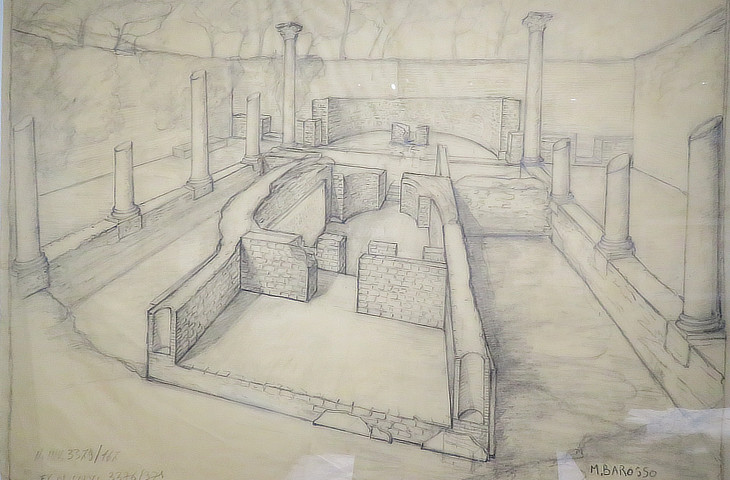
Temporary exhibition at the museum of Bagni di Erode Attico (Pagus Tropius): Basilica di S. Stefano in a 1941 drawing by Maria Barosso
Here also, in 1858 (on the left of the Via Latina), Signor Fortunati discovered the long buried and forgotten Basilica of S. Stefano. It is recorded by Anastasius that this basilica was founded (..) by Demetria, a lady who escaped from the siege by the Goths (in 410), with her mother, to Carthage, where she became a nun. It was restored by Leo III. at the end of the eighth century. The remains are interesting, though they do little more than show perfectly the substruction and plan of the ancient building. Hare

Capitals and columns of Basilica di S. Stefano
Among the Roman churches whose origin can be traced to the hall of meeting, besides those of Pudens and Prisca already mentioned, the best preserved seems to be that built by Demetrias at the third milestone of the Via Latina. Demetrias, daughter of Anicius Hermogenianus, prefect of the city, 368-370, and of Tyrrania Juliana, a friend of Augustine and Jerome, enlarged the oratory already existing in the tablinum of the Anician villa, and transformed it into a beautiful church. (..)
Church and villa were discovered in 1857, and, together with the tombs of the Via Latina, are now the property of the nation.
Rodolfo Lanciani - Pagan and Christian Rome - 1892

Museo dell'Alto Medioevo: metric funerary inscription of the Roman officer Maurianus, buried in the Basilica of S. Stefano on the Via Latina in 530-533
The inscription is of particular interest because it ends by saying that the dead was buried in peace on the 7th day before the ides of September, under Lampadius and Orestes, consuls, of clarissimus rank, thus confirming that the appointment of (mainly honorary) consuls continued during the Ostrogothic rule.

(above) Fountain near Sepolcro dei Valerii; (below) private baths (Ist-IInd century AD) of the Anician villa
Recent archaeological studies near Sepolcro dei Valerii brought to light an extremely complex context: a network of water pipes fed a fountain at the centre of a porticoed courtyard. These structures were partially altered in the IVth century. Perhaps Sepolcro dei Valerii was surrounded by other later buildings belonging to an inn where travellers along Via Latina could rest.
Gens Anicia was an important family of the late Roman Empire.

Fragment of a Ist century AD fresco, see a similar one at the House of Augustus
GRA is the acronym of Grande Raccordo Anulare, a ring road encircling Rome which was completed in 1970. A that time the city was entirely comprised within GRA, but eventually new developments were built beyond the road, especially in its south-eastern section. Many of them are named after a medieval tower (e.g. Tor Tre Teste) and during their construction a number of ancient statues, mosaics, coins etc. were found. Eventually it was decided to house some of these findings in a small museum near GRA.

Small statues (IInd/IIIrd century AD)
The museum was inaugurated in March 2015 and it is housed in two buildings, one of which belonged to a farm. It is in the middle of nowhere, but it is not very far from the entrance to Villa dei Quintili along Via Appia Nuova and there is a bus service between the two locations. At the moment (2016) it is open only on Tuesday and Thursday mornings. Via Lucrezia Romana is a modern street named after Lucretia, wife of Tarquinius Collatinus. You may wish to see a small statue of Hermaphroditus, perhaps the finest exhibit of the museum.

(left) Terracotta head; (right) floor mosaic similar to those at Villa dei Volusii

XIIth century tower and a section of the walls which was restored in the XVth century
In the etching Vasi shows a third circular tower in addition to the two protecting the gate. It is different from the others, although it has approximately the same size because it was built in the XIIth century with flints rather than with bricks. The ancient Romans had advanced brick making knowledge which fell into disuse during the Middle Ages.

Other views of the walls
This section of the walls is very charming because of the presence of trees, especially stone pines (which were not very common at Vasi's time). Many towers were repaired by the popes, who did not miss the opportunity to place their coats of arms on them.

(left) Coat of arms of Pope Urban VIII; (centre) coat of arms
of Pope Pius II; (right) coat of arms of Pope Alexander VII; the small and long image shows an ancient relief (probably the lid of a sarcophagus) placed above an arrow slit of the walls

(left) Towers to the right of Porta Latina; (right) bell tower of S. Giovanni a Porta Latina
By distancing oneself from the walls to the right of Porta Latina it it possible to catch a view of the bell tower of S. Giovanni a Porta Latina (you may wish to see a page on the bell towers of Rome).

Walls in Viale Metronio
This section of the walls was recently turned into a small park by reducing the width of the modern street which runs along it. It is used by those who cannot go to Valle della Caffarella to walk their dog there.
Next plate in Book 1: Porta S. Sebastiano.
Next step in Day 5 itinerary: Porta S. Sebastiano.
Next step in your tour of Rione Campitelli: Porta S. Sebastiano.
Excerpts from Giuseppe Vasi 1761 Itinerary related to this page:
Porta Latina, e chiesa di s. Giovanni Evangelista
Prese un tal nome questa porta dalla Via, che porta al Lazio celebre provincia de' Romani, ed è antica,
ne' mai ha mutato sito o nome, sebbene in oggi il Lazio dicesi Campania. Appresso a questa si vede la
chiesa di s. Giovanni, che dagli Scrittori Ecclesiastici si dice ante portam latinam, la quale bisogna dire,
che sia molto antica, mentre fu ristaurata da Adriano I. che fu del 772. Da prima fu collegiata, e però nel
1044. essendovi Arciprete un tale Giovanni, secondo altri, di Graziano, fu eletto Papa: indi vi stettero
le monache Benedettine, e poi i frati Trinitarj scalzi; oggi però vi abitano i frati Minimi di s. Francesco di
Paola. |


