
All images © by Roberto Piperno, owner of the domain. Write to romapip@quipo.it.


Notes:
Page revised in January 2026.
All images © by Roberto Piperno, owner of the domain. Write to romapip@quipo.it.
Notes:
Page revised in January 2026.
 Chiesa di S. Maria in Campo Carleo
 Links to this page can be found in Book 6, Day 1 and Day 3, Map B3, View C8 and Rione Monti.
The page covers:
The plate by Giuseppe Vasi
Today's view
Tempio della Pace (Basilica di Massenzio)

In his choice of subjects for his 1756 book on the parish churches of Rome, Giuseppe Vasi included S. Maria in Campo Carleo on the grounds that it had been one of the first parish churches of the city. The unassuming building however was not an ancient one and it is not known to have contained ancient columns or capitals. In retrospect we must thank Vasi for his choice because his etching depicts a neighbourhood which does not exist any longer.
The origin of Campo Carleo is uncertain: it is thought that either a Byzantine officer named Kaloleon or a Carolo Leonis had their residence in the area.
The view is taken from the green dot in the small 1748 map here below.
In the description below the plate Vasi made reference to: 1) Strada dei Conti;
2) Tower of Palazzo del Marchese del Grillo; 3) Strada Alessandrina; 4)
Walls of Monasterio della SS. Nunziata; 5) Ruins of Tempio della Pace (at the end of the street);
6) Chiesa di S. Urbano. 2) and 4) are shown in detail in other pages. The small map shows also 7) S. Maria in Campo Carleo.


The view in June 2009. On the left Mercati di Traiano, in the centre the loggia of Casa dei Cavalieri di Rodi and in the foreground two reconstructed columns of Basilica Ulpia. The inset shows the name of the short street (yellow dot) between Mercati di Traiano and Casa dei Cavalieri di Rodi. It is the only remaining reference to the neighbourhood shown in the plate
The Parish of S. Maria in Campo Carleo was abolished by Pope Leo XII in 1825 and the church was pulled down in 1884. Strada Alessandrina is still there, but all the buildings, including S. Urbano, which flanked it were demolished in 1932. The street was named after Cardinal Michele Bonelli, known as Cardinal Alessandrino because he came from Alessandria, a town in northern Italy. He lived in a nearby palace; between 1567 and 1570 he promoted the draining of a swamp at Arco dei Pantani and the opening of a new street between Piazza della Colonna Trajana and Tempio della Pace.

Aerial view before 1932; the red dot is the point from
which Vasi took his view; 1) Colonna Traiana; 2) SS. Luca e Martina; 3) Arco dei Pantani; 4) Tempio di Pallade. The green line shows Strada Alessandrina and the yellow lines indicate the approximate route of the first section of Via dell'Impero (today Via dei Fori Imperiali)
A number of buildings in this part of Rome were demolished in order to allow archaeological excavations, but the decision to pull down the whole neighbourhood was taken for political purposes. A new large avenue was opened to link Palazzo Venezia, from which Prime Minister and Fascist Duce (Leader) Benito Mussolini delivered his most important speeches, with Colosseo, the symbol of Ancient Rome. Via dell'Impero was inaugurated on the tenth anniversary of the Fascist seizure of power (October 28, 1922).

Temporary exhibition at Centrale Montemartini: S. Urbano and other buildings on the eastern side of Strada Alessandrina in the process of being pulled down in a 1933 watercolour by Maria Barosso, an archaeologist. This and some other paintings were made at the request of Antonio Munoz, the Superintendent in charge of the opening of Via dei Fori Imperiali
According to Munoz the churches and houses which were pulled down had no significant historic or artistic value, although the church of S. Urbano ai Pantani (swamps) retained parts of the original 1264 building.

Temporary exhibition at Centrale Montemartini: Casa di Flaminio Ponzio and other buildings on the western side of Strada Alessandrina in the process of being pulled down in a 1930 watercolour by Maria Barosso
Munoz made an exception for the Late Renaissance house of Flaminio Ponzio (the building with a balcony on the left side of Strada Alessandrina in the etching by Vasi). Its façade was reassembled in Piazza di S. Maria in Campitelli.

(above) Junction between Via dei Fori Imperiali (left) and Strada Alessandrina (right) where the City of Rome has made use of Vasi's etching to show the neighbourhood which was pulled down; (below) Via dei Fori Imperiali with Monumento a Vittorio Emanuele II on the left
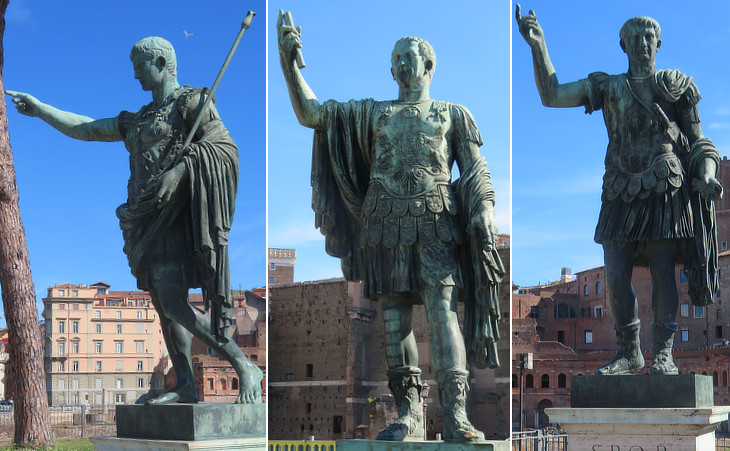
Modern bronze cast of statues of emperors along Via dei Fori Imperiali: (left) Augustus; (centre) Nerva; (right) Trajan; a fourth statue portrays Caesar

Rear view of Basilica di Massenzio and behind it the bell tower of S. Francesca Romana (in the foreground Tempio di Pallade)
Hard by (S. Francesca Romana) stands the Temple of Peace, that is, some remnants of that Temple. It was once the most noble of all the Temples (as the pillar before St. Mary Majors great Door, which belonged to this Temple, sheweth) it was 200 Foot
large, and 300 long: but now little signs of its
Beauty remain: Wars and time defacing the
monuments of Peace.
Richard Lassels' The Voyage of Italy, or a Compleat Journey through Italy in ca 1668

Villa della Farnesina - Agostino Chigi's bedroom: detail of a XVIth century fresco showing Basilica di Massenzio with two remaining columns
In the same Place are the Ruins of the Temple of Peace, built by the Emperor Vespasian. (..) That was the most magnificent and the largest of all the Temples in old Rome; supported by eight Pilasters; at each Pilaster was a vast fluted Column of white Marble; the only one whereof then remaining Pope Paul V, remov'd and set up in the Street of St. Mary Major, with the Brass Statue of the Blessed Virgin on it. (..) Hither was brought all the Treasure and Precious Vessels of the Temple of Jerusalem, and it was lin'd throughout on the inside with gilt Brass Plates. (..) In the Days of the Emperor Commodus many suffered by its being burnt . The Portico of this Temple , which consisted of six Columns, of the Ionick Order, is to be seen in Vespasian's Coins.
The Travels of the Learned Father Montfaucon from Paris thro' Italy - 1712

1765 Grand View of Campo Vaccino by G. Vasi: detail showing Basilica di Massenzio and other monuments
The three vaults would certainly seem part of the Temple of Peace. (..)
Even Nardini has no doubts here. But the modern antiquaries are
determined to dispute about what part of the
temple these huge vaults may be said to represent; a treasury, a Pinacotheca, perhaps a bath,
or any other building of the Forum of Peace.
The great excavations in 1812 discovered immense masses of marble, but nothing to assist
conjecture. This part of Rome must have been abandoned for many centuries, in order to form the accretion of soil at the back of these vaults, which slopes into an embankment of hanging gardens.
John Cam Hobhouse - Dissertations on the Ruins of Rome - 1818

Monastero dei SS. Cosma e Damiano (left) and Basilica di Massenzio (right) seen from Orti Farnesiani
The large building which until the early XIXth century was called Tempio della Pace is now thought to be a basilica built by Emperor/Usurper Maxentius in 306-312 and completed by Emperor Constantine. The actual Templum Pacis has been identified in the foundations of Monastero dei SS. Cosma e Damiano and some of its columns have been re-erected.
The basilica was divided into three naves by four gigantic pillars. Each of them was decorated with a column. In 1613 the only standing column was removed by Pope Paul V who placed it opposite S. Maria Maggiore. The remaining part of the basilica corresponds to the northern nave, which included a side apse.

The basilica seen from its eastern end
Constantine, completed the building, with certain changes of plan, however. The main entrance was originally on the side toward the Colosseum, and the apse for the tribunal on the side opposite (toward SS. Cosma e Damiano); but later a second entrance was made, from the Sacra Via, and corresponding to this a second apse in the middle of the north aisle. We can still see clearly that the back wall, which was originally straight, was afterwards broken through in the centre, and a semi-circular apse adorned with niches was built into it at that point. (..) The general effect is powerful, and very different from that produced by the older basilicas with their columns and pillars. We must seek the model for this sort of basilica rather in the great central rooms of the imperial baths (cf. especially those in the baths of Diocletian, at present the church of S. Maria degli Angeli). Four huge piers support the barrel-vaulting of the side-aisles and the cross-vaulting of the central nave. The space roofed over is more than 7000 square yards (S. Maria degli Angeli is scarsely than 2300 square yards). (..) The huge columns which stood against the piers were merely ornamental and did not support the vaulting.
Christian Hülsen - The Roman Forum, its history and its monuments - 1909

Apse (tribunal)
In the middle of the semi-circular wall is preserved the foundation for the seat of the emperor, or of the magistrate who presided over the proceeding. Besides this a strip of marble is still in situ, to which was fastened the rail which separated the space reserved for the judges from that open to the public. The remains of architectural ornaments (brackets with victories, richly sculptured cornices) bear witness to the decadent and fulsome style of the IVth century A.D. (..) In the early middle ages the destruction of the gigantic building began: Pope Honorius I (625-638) took the plates of bronze from the roof and used them on the roof of St. Peter's. The enormous size of the building precluded its use for Christian worship or practical purposes. Shortly after this time the building had fallen into neglect and was much injured by an earthquake. (..) From the XVth century on it was generally known as the templum Pacis, until Nibby (1819) gave it its correct name. Hülsen

Marble corbels of the apse which are very similar to those which decorate Casa di Pilato and architectural fragments from a small shrine to Bacchus; (inset) illustration from Hülsen's book
Opposite on the right a large number of marble fragments are heaped up together, notably an architrave, with an inscription, which belonged to a small but elegant circular structure (about 12 ft. 6 in. in diameter). (..) It is probable that the building was a chapel of Liber Pater (Bacchus). According to a statement in Martial such a chapel stood on the height of the Sacra Via at the point road to the imperial palaces branched off. The chapel appears on coins of Antoninus Pius; accordingly this emperor, whose name occurs also on the inscription, probably restored the chapel. Hülsen

(left) Fragments of porphyry columns at the southern entrance to the basilica; (centre/right) Musei Capitolini: marble parts of a colossal statue of Emperor Constantine which stood in the basilica (a hand was found at Circus Maximus and you can see it in the image used as background for this page, the holes in the head indicate the presence of a bronze crown; see a modern reconstruction of the statue)
After the second apse had been built in the transverse axis, a colossal seated figure of Constantine was placed in the original apse on the west wall; the head of this statue, and fragments of the arms and legs, were dug up here about the year 1490, and are at present in the courtyard of the Palazzo dei Conservatori. Hülsen
It is generally believed that the statue of Constantine was an acrolith (from the Greek words meaning height/extremity and stone) i.e. the head, the arms and the legs were made of marble, whereas the clothed parts of the body were made of wood or bronze. It was not a new development in sculpture because this technique had been used by Phidias at Olympia in the Vth century BC; you may wish to see another colossal (bronze) statue inside Musei Capitolini, a statue of a goddess at Centrale Montemartini and other colossal heads at Djemila in Algeria.

(left) Maps highlighting the expansion of the Roman Empire on the back of Basilica di Massenzio; (right) detail of the vaults, with a pattern which can be noticed also in halls of the Baths of Diocletian; the coffered ceiling was a construction technique aimed at reducing the weight of the vault (see that of Pantheon)
The colossal vaults and their decoration were a source of inspiration for many artists (you may wish to see the ceiling of S. Carlo alle Quattro Fontane by Francesco Borromini). The maps showing the expansion of the Roman Empire were added in the 1930s (there used to be also another map showing the short-lived Italian Empire which was declared after the conquest of Ethiopia in 1936).
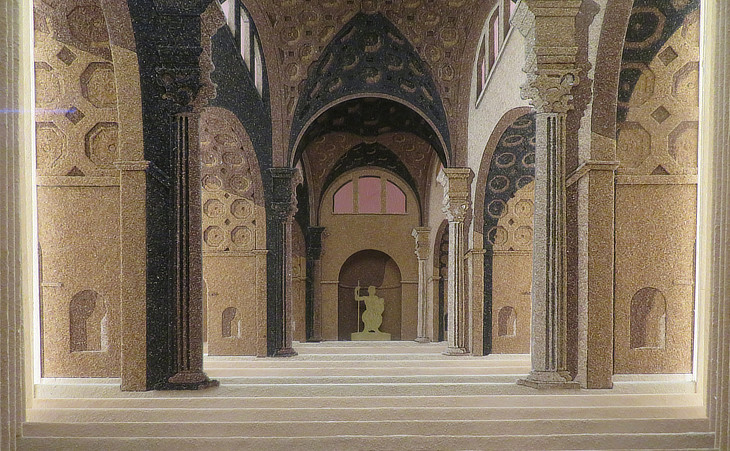
A visual reconstruction of the basilica at the new Underground Station of Colosseo
Next plate in Book 6: S. Agnese fuori delle mura.
Next step in Day 1 itinerary: Orti Farnesiani.
Next step in Day 3 itinerary: Tempio Antico di Pallade.
Next step in your tour of Rione Monti: Tempio Antico di Pallade.
Excerpts from Giuseppe Vasi 1761 Itinerary related to this page:
Chiesa di s. Maria in Campo Carleo, e quella di s. UrbanoDue strade si aprono ai fianchi di questa piccola, e antica chiesa parrocchiale; una a destra dicesi; de' Conti, e l'altra a sinistra, si chiama Alessandrina.Tempio della PaceTre soli arconi spogliati di ogni ornamento rimangono in piedi del celebre e magnifico tempio della pace, che fu una delle maggiori fabbriche di Roma. Principiollo Claudio Imperatore e poi terminollo Vespasiano, dopo aver soggiogata la Giudea, e per dargli quella vastità di sito, che conveniva, atterrò la casa di Giulio Cesare, ed altre fabbriche, che impedivano la superba idea di quel tempio. In esso conservò tutti i vasi e ornamenti preziosi, che portò nel suo trionfo dal tempio di Gerusalemme, e oltre le ricchezze delle provincie lontane, vi si portavano a conservare anco quelle di Roma, e vi erano delle statue e pitture fatte da' più eccellenti artefici di quei tempi. Per una saetta arse poi tutto quel tesoro in tempo di Commodo con grave danno de' Romani: onde mai più fu riattato. Una sola colonna delle otto, che sostenevano la nave di mezzo, rimasta in piedi, da Paolo V. fu drizzata sulla piazza di s. Maria Maggiore, collocandovi sopra la statua della ss. Vergine di metallo dorato, e di un tronco di quelle, ne fu formata la maravigliosa statua di Alessandro Farnese, che si vede in questo salone. |


