
All images © by Roberto Piperno, owner of the domain. Write to romapip@quipo.it.


Notes:
Page revised in July 2020.
All images © by Roberto Piperno, owner of the domain. Write to romapip@quipo.it.
Notes:
Page revised in July 2020.
 Giardino e Casino del Belvedere
Links to this page can be found in Book 10, Map D2, Day 8, View C2 and Rione Borgo.
The page covers:
The plate by Giuseppe Vasi
Today's view
Cortile della Pigna
Casino del Belvedere (Museo Pio-Clementino)
Corridoi del Bramante
Torre dei Venti
Fontana del Cortile del Belvedere and Fontana del Vascello

In 1761, when Giuseppe Vasi engraved this etching, Casino del Belvedere, a papal summer retreat, was about to being turned into a modern museum; it is not without significance that in this plate the vast courtyard is shown empty whereas in the view of the gardens of Palazzo del Quirinale the pope and his assistants are portrayed while having a leisurely walk. The popes of the XVIIIth century, exception made for Benedict XIII, preferred to live in Palazzo del Quirinale, rather than in Palazzo Apostolico which adjoins Casino del Belvedere; when they wanted to escape the heat of the Roman summers they went to their palace at Castelgandolfo, rather than to the Renaissance casino built by Pope Innocent VIII in 1487 and named Belvedere because of its fair view.
The view is taken from the green dot in the small 1748 map here below.
In the description below the plate Vasi made reference to: 1) Porticoes aka corridors leading to Palazzo Apostolico;
2) Pigna (fir cone) and bronze peacocks; 3) Door leading to Fontana del Vascello. The map shows also: 4) Torre dei Venti; 5) Fontana del Cortile di Belvedere; 6) Rear side of Palazzo Apostolico.


The view in March 2010
Today the large courtyard shown in the plate is the site where guides brief their groups about what they are going to see in Cappella Sistina with the help of placards showing Michelangelo's frescoes.
The fountain at the centre of the courtyard was replaced in the XIXth century by a huge statue of St. Peter (today in the Vatican Gardens) and subsequently by Sphere inside a Sphere, a bronze statue by Arnaldo Pomodoro (other works by this sculptor can be seen at modern la Farnesina and EUR).

Niche by Pirro Ligorio in January 2020 (see the colour many monuments of Rome had until recent years)
The building with the niche at the end of the courtyard was erected in 1560-1565 by Pirro Ligorio for Pope Pius IV in order to correct the alignment between the Renaissance part of Casino del Belvedere and the rear side of Palazzo Apostolico (the former was askew when seen from the latter).

Museo di Castel Sant'Angelo: detached fresco from the demolished Tower of Pope Paul III showing a mock naval fight in the gardens between Palazzo Apostolico and Casino del Belvedere in ca 1545
In 1560 there was only one very long courtyard/garden (Cortile del Belvedere) between the two buildings and therefore Pirro Ligorio designed a very large niche. The architect built also a small casino in the gardens to the west of the courtyard.

Staircase designed at the time of Pope Clement XI to house "la Pigna"; the Pope added his "flying"
coat of arms in the niche
We descended into the
Vatican gardens, called Belvedere, where entering first into a kind of court, we were showed those incomparable
statues of Laocoon with
his three (!) sons embraced by a huge serpent. (..) We were likewise showed the relics of the Hadrian
Moles, viz. the Pine, a vast piece of metal which stood on
the summit of that mausoleum; also a peacock of copper.
John Evelyn's Diary and Correspondence - 1644-1645
Occasionally Evelyn and other travellers of the past are unaccurate about some details and report data which later art historians and archaeologists have corrected.
After the long courtyard was divided into two sections by Biblioteca Vaticana in 1587 its northern part became known as Cortile della Pigna because Pope Paul V relocated there a gigantic bronze fir cone which previously stood in the portico of S. Pietro Vecchio and was mentioned by Dante in describing Nimrod, a giant: La faccia sua mi parea lunga e grossa/ Come la pina di San Pietro a Roma (His face appeared to me as long and large/ As is at Rome the pine-cone of Saint Peter's - Divina Commedia - Inferno XXXI - translation by Henry Wadsworth Longfellow).
The southern section of the courtyard is still called Cortile del Belvedere.

(left) La Pigna: the bronze statue is placed above a capital showing the crowning of an athlete; (right) one of the original peacocks now in Braccio Nuovo
Pigna is the name of the rione where this bronze sculpture was found; it was part of a fountain and it spouted water from holes on its top. It was probably placed in front of a Temple to Isis in Iseo Campense; the gilded peacocks decorated Mausoleo di Adriano (Castel Sant'Angelo). A modern (small) fountain celebrates it in that rione.
The two basalt statues of lions were most likely another embellishment of Iseo Campense. They were found at the time of Pope Eugenius IV and Pope Clement VII placed them at the entrance to the Pantheon. Pope Sixtus V turned them into spouts for Mostra dell'Acqua Felice; Pope Gregory XVI replaced them with copies. They have a particular historical interest because they were made for a temple built by Pharaoh Nectanebo II, the last pharaoh of Egyptian descent. He was defeated by Achaemenid king Artaxerxes III in 343 BC and Egypt returned to be a province of the Persian Empire. A few years later it was conquered by Alexander the Great and eventually it was ruled by pharaohs of Macedonian descent.

Details of Cortile della Pigna which were decorated with the heraldic symbols of Pope Clement XI (three mountains and a star); (inset) coat of arms of Pope John Paul II
You may wish to see a gigantic head of Augustus as Alexander the Great from Collezione Mattei now at Cortile della Pigna.

(left) Galleria delle Statue; (right) coats of arms of Pope Clement XIV and of Pope Innocent VIII and some heraldic symbols of the latter
The conversion from villa to museum (Musei Vaticani) was mainly due to three successive popes in the period 1769-1823: Clement XIV, Pius VI and Pius VII; the first two popes completed Museo Pio-Clementino which is housed in the casino while the last one built Braccio Nuovo, a new gallery aka Museo Chiaramonti (the Pope's surname). During the pontificate of Pope Clement XIV the casino designed for Pope Innocent VIII was modified in order to house the collection of ancient statues owned by the popes; in some rooms one can see the coats of arms of the two popes. In the XXth century new facilities were built outside the historical part of the museums to house Pinacoteca Vaticana and collections of antiquities which were kept at Palazzo del Laterano.

Museo Pio-Clementino: Cortile Ottagono (see two of the colossal theatrical masks from Villa Adriana which decorate it)
A small square garden with orange trees was turned into an octagonal courtyard where four masterpieces were given special relevance: Apollo del Belvedere, which you can see also in the image used as background for this page, Laocoon, Antinous (Hermes) del Belvedere and a statue of Augustus (of minor interest, now at Sala Rotonda) which was replaced by that of Perseus by Antonio Canova. Most of the changes to the museum were designed by Michelangelo Simonetti.

Museo Pio-Clementino: Apollo del Belvedere (you may wish to see some details of its feet)
November 9, 1786. The Apollo Belvedere drawn me out of reality. For even the most correct engravings furnish no adequate idea of (..) the marble original of this statue, as compared with the plaster models of it, which,
however, I formerly used to look upon as beautiful.
J. W. Goethe - Italian Journey - Translation by Charles Nisbet
In November 1787 Goethe criticized the new set up:
The custom of visiting the great Roman museums by torchlight seems to have still been fairly recent in the eighties of the last century, but I do not know when it first started.
There are several things to be said in favour of this kind of illumination: first, each work of art is seen by itself, isolated from all the others, so that the spectator's attention is exclusively focussed on it; second, in the bright light of a torch, the finer nuances of the work become more distinct, the confusing reflections (particularly annoying on highly polished statues) disappear, the shadows become more marked and the illuminated parts stand out clearer. But the greatest advantage of all is that only such illumination can do justice to statues which are unfavourably placed. Laocoon in his niche, for example, can only be seen properly by torchlight, for no direct light falls on him, only a reflected light from the small circular Cortile del Belvedere, which is surrounded by a colonnade. (translation by W. H. Auden and Elizabeth Mayer).
At Goethe's time, also the monuments of ancient Rome were visited by torchlight or in the moonlight.

Museo Pio-Clementino: Sala Rotonda (see a detail of its central floor mosaic and the statue of Hercules)
Simonetti continued his activity during the pontificate of Pope Pius VI; this Pope however, more than his predecessor, was very keen on placing his name on each statue or work of art which was included in the new museum; he also wanted his heraldic symbol placed everywhere in the decoration of the new halls (see a page with some examples).
Simonetti made also some additions to the casino and in particular a large circular hall based on the design of the Pantheon; the criteria followed in assembling and displaying statues, floor mosaics (see one which was found along Via Cassia) and other ancient findings were aimed at obtaining the most spectacular effect and did not bother about grouping them according to the period they were made and the site where they were found.

Museo Pio-Clementino: (left) Vestibolo Rotondo with a pavonazzetto cup which was found at Valle dell'Inferno during the pontificate of Pius VI; (right) Sala delle Muse and Torso del Belvedere, a fragment of a statue of Hercules which was studied by all Renaissance artists
Built at different periods, by various architects and for many purposes, it has no unity of plan and no uniformity of character. But no edifice presents so many fine architectural pictures; for such they may indeed be called, so wide are the spaces, so lofty the heights, so boundless the perspectives. (..) We learn here how noble is the effect produced by mere space. There is a perfect relation between the Vatican and its contents.
George Stillman Hillard - Six Months in Italy in 1847-1848
Simonetti designed some halls with the purpose of calling attention on some of the masterpieces of the papal collections or to some recent additions to them which were labelled "Munificentia Pii VI", i.e. were due to the munificence of the Pope.

Museo Pio-Clementino: Fresco showing Scala Simonetti and Sala a Croce Greca
Hall of the Greek Cross. This noble hall is built from the designs of Simonetti and it gives admission to the museo Pio. (..) The centre-piece of the pavement is a beautiful mosaic found at Tusculum in 1741, and representing in coloured pietre dure Pallas with the aegis. (..) Returning to the Hall of the Greek Cross, we meet to our left the stairs leading up to the Etruscan museum, erected by Simonetti to form a communication between the two floors of the museum of Pius VI, on two different levels, caused here by the
skirt of the Vatican hill. The steps and balustrade
are of white marble: the first flight is decorated with
twenty granite columns; its second, with as many
marble pilasters; and its third, which leads directly to the Etruscan museum, with eight exquisite columns of breccia corallina (a reddish limestone from Turkey).
Rev. Jeremiah Donovan - Rome Ancient and Modern - 1843

Museo Pio-Clementino: (left) Scala Simonetti; (right) Sala della Biga
This hall was erected by Pius VI and is so called
"Biga" from the ancient two-wheeled, two-horsed white marble chariot in its centre. The seat of the car, which had
served at one time as an episcopal chair in the church
of S. Mark and the body of one of the horses are
the only parts which are ancient. Donovan
You may wish to see two ancient chairs/thrones, e.g. Sedia Corsini and St. Gregory's Chair, and a page covering Sala degli Animali, another spectacular hall of Museo Pio-Clementino.
In 1792 Pasquale Massi, curator of the museum, published an Italian-French guide book to Museo Pio-Clementino which by and large could still be used today, but not in 1797-1816: Who, but a Frenchman, can enter the present museum without some regret? I should have thought the very beauty of these galleries and halls a protection to the treasures for which they were erected. Here ancient and modern art seem to contend for pre-eminence - storied pavements assembled from distant ruins, and bordered with the mosaic of the present day - columns, once the ornament of temples, arranged in rotondos which emulate those temples, and lately embellished, like them, with the statues of gods and of deified emperors. Thinned as it is, we may still trace through this museum the sculpture of ancient Rome from its dawn to its decline, from the old Doric tomb of Scipio Barbatus in plain Alban stone, to the porphyry sarcophagi of St. Constantia and St. Helen, where men stand erect under horses' bellies. (..) What this museum has lost it is now too late to deplore. (..) The present pope, has also placed here the Perseus (..) of Canova. The statue of Perseus stands fronting the cast of the departed Apollo, and seems to challenge comparison.
Joseph Forsyth - Remarks on Antiquities, Arts, and Letters in Italy in 1802-1803
In 1797 the Treaty of Tolentino established that some of the finest works of art of the museum should be given to France, including the Apollo and the Torso.

(left) Atrio dei Quattro Cancelli by Giuseppe Camporese (1793); the room above is Sala della Biga; (right) Braccio Nuovo by Raffaele Stern (1822); its Roman floor mosaics were found at Tor Marancia
This noble hall is upwards of two hundred feet in length, and admirably lighted from a roof supported by Corinthian columns. It is impossible for works of sculpture to be better disposed, and, out of seventy-two busts and forty-three statues which are here, there is hardly one which is not excellent. Hillard
The museum was enlarged by Pope Pius VII after he recovered most of the works of art taken by the French. He built Braccio Nuovo at the other end of Cortile della Pigna, the courtyard shown in the plate; grand staircases, passages, vestibules were built to connect the various parts of the museum, but The first few visits to the Vatican leave the mind of the traveller in a state of whirl and confusion, producing at last entire exhaustion. (..) He naturally wishes to make a general survey of the whole, before descending to study the several details. He walks with resolute purpose right onward, hardly glancing at the innumerable objects of attraction around him, which are all postponed to a more convenient season; but, long before the great circuit is completed, his knees knock together with fatigue, and his worn brain refuses to receive any new impressions. But time and patience, which conquer all things, conquer the Vatican. At each visit something is gained. Hillard
A number of works of art which are displayed at Museo Pio-Clementino and Museo Chiaramonti are shown in this website in pages covering the location where they were found, e.g. Augusto di Prima Porta and statues of Antinous from Villa Adriana and Palestrina.
Atrio dei Quattro Cancelli was the entrance to Musei Vaticani until 1932 when a new access from Viale Vaticano was built by Giuseppe Momo.

Galleria delle Mappe Geografiche (decorated by Girolamo Muziano and others for Pope Gregory XIII in 1580). You may wish to see some details depicting Ancient Porto and as it was in 1580, Ravenna, Rimini, Loreto, Ancona, Macerata, the Marches, Abruzzo, Spoleto, Avignon, Comtat Venaissin, Rome, The Pontine Marshes, Syracuse, Corfu, The Battle of Canne, Malta, The 1565 Siege of Malta and The Battle of Lepanto
The long Gallery of the Maps of Italy painted upon the Walls on both sides, by Paul Brillus, a Flemming and others, and that so distinctly, that you see plainly every State, Province, City, River, Village, Castle, high way of Italy, and where any famous battle was fought,
either in the Romans time or since: A Gallery
which I wish I had spent as many hours in, as I
spend days in going up to Rome.
Richard Lassels' The Voyage of Italy, or a Compleat Journey through Italy in ca 1668
For the Museum of the Vatican, I confess I was totally unprepared; and the first and second time I walked through the galleries, I was so amazed so intoxicated, that I could not fix my attention upon any individual object. (..) Gallery beyond gallery, hall within hall, temple within temple, new splendours opening at every step! of all the creations of luxurious art, the Museum of the Vatican may alone defy any description to do it justice, or any fancy to conceive the unimaginable variety of its treasures. (..) I have been told and can well believe, that the whole giro of the galleries exceeds two miles.
Anna Jameson - Diary of an Ennuyée - 1826
Pope Julius II charged Donato Bramante with the task of
building two long porticoes to link Palazzo Apostolico with Casino del Belvedere. In the following three centuries the porticoes were gradually closed and turned into long corridors which were finely decorated.
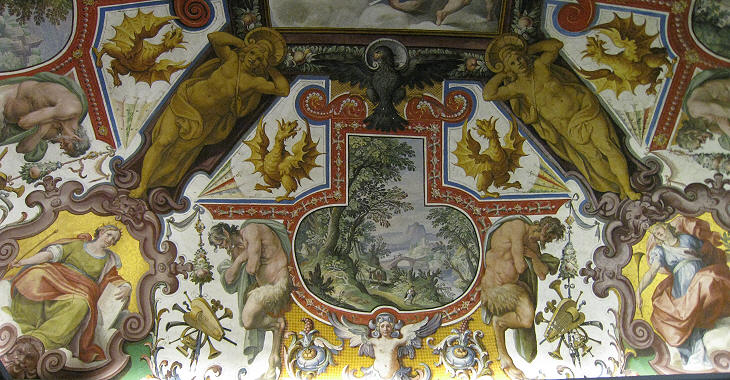
Biblioteca Vaticana: detail of the ceiling of Sala Paolina with references to the heraldic symbols (eagles and dragons) of Pope Paul V
This library is the most nobly built, furnished, and
beautified of any in the world; ample, stately, light, and
cheerful, looking into a most pleasant garden. The walls and roof are painted. (..) As to the ranging
of the books, they are all shut up in presses of wainscot,
and not exposed on shelves to the open air, nor are the
most precious mixed amongst the more ordinary, which are showed to the curious only. Evelyn
In 1587 Pope Sixtus V commissioned Domenico Fontana the construction of a new building which cut into two sections the long courtyard; the new space was used to relocate there the Vatican Library.
The dramatic scenes depicting martyrdoms which were recommended for the decoration of churches, were not felt appropriate for a sovereign's palace; the decoration of the corridors was very elaborate, it made use of brilliant colours and it had references to the heraldic symbols of the popes who commissioned it.

Biblioteca Vaticana: Pope Benedict XIV's accomplishments: (above) Oratorio di S. Maria Annunziata; (below) Fabbrica delle Polveri
The celebration of major events in the history of the Roman Church, e.g. the Vision of Constantine before the Battle of Ponte Milvio, was a recurring theme in the decoration of the corridors, together with views of churches, fountains and palaces built by a pope. Many of them show major accomplishments (e.g. the completion of the dome of S. Pietro), but in some cases minor buildings which have been subsequently modified are shown and these views have a great interest from a historical point of view.
You may wish to see some more images of these and other ceilings of the Vatican palaces.

(left) Overall view of Cortile della Pigna (from the dome of S. Pietro) showing the location of Torre dei Venti at its south-western corner; (right) Torre dei Venti seen from Cortile della Pigna
In 1582 Pope Gregory XIII introduced a change in the calendar by reducing the number of leap years. He followed the recommendations of a team of astronomers; in order to allow them careful observations of the sky, in 1578 the Pope had asked Ottaviano Mascherino, one of his preferred architects, to build a terraced tower upon the western corridor. This terrace, called Torre dei Venti (Winds) served as astronomical observatory until a new one was built at Collegio Romano.

(left) Fontana del Cortile del Belvedere by Carlo Maderno; (centre/right) Fontana del Vascello aka Fontana della Galera by Giovanni Vasanzio; it was modified by Pope Pius VI, but engravings as that by Domenico Parasacchi in 1637 show its original aspect (it opens in another window)
In the garden (..) are many stately fountains; (..) some fair grots and water-works, that noble cascade
where the ship dances. Evelyn
A flight of steps leads to the narrow
Terrace of the Navicella, in front of the palace, so called from
a bronze ship with which its fountain is decorated. The visitor should beware of the tricksome water-works upon
this terrace.
Augustus J.C. Hare - Walks in Rome - 1875
In 1612 the restoration of an ancient Roman aqueduct by Pope Paul V (Acqua Paola) provided the Vatican with an ample supply of water at a rather high pressure. Several decorative fountains spouting water at remarkable heights were built in the following years, such as that (lost) shown in the plate, the two in the photos above and others in the Vatican Gardens and in Piazza S. Pietro.
Next plate in Book 10: Giardino e Casino Pontificio nel Vaticano.
Next step in Day 8 itinerary: Porta Angelica.
Excerpts from Giuseppe Vasi 1761 Itinerary related to this page:
Biblioteca VaticanaDa Sisto V. fu principiata, e da altri Pontefici accresciuta con uno stupendo numero di libri, e codici manoscritti rarissimi, e antichi di tutte le lingue, e diverse Bibbie Ebraiche, Siriache, Arabiche, e una Greca secondo li 70. Interpetri, e varj monumenti scritti in scorza di alberi chiamati papiri. Gli antichi pugillarj espressi in alcune tavolette, moltissimi manoscritti con miniature antiche, ed una infinità di altre rarità si vedono in questa vasta biblioteca lunga 400. passi ornata di pitture, ed arricchita collo spoglio di moltissime librerie di Europa, e di altre ancora: tanto che in oggi non vi è una simile. Si vede in essa una colonna di alabastro orientale trasparente lavorata a spira, ed un sarcofago rosso, e poi una cassetta, in cui si conserva un lenzuolo tessuto di una pietra chiamata Amianto, nel quale i Gentili bruciavano i cadaveri. Ed ancora un museo sagro fatto ultimamente da Benedetto XIV. Segue dopo ilCasino del Belvedere
Da Niccolò V. era stato fatto sopra una punta del colle Vaticano un casino col disegno di
Antonio Pollajolo, lungi dal divisato palazzo 500. passi, affinchè godesse l'amenità della
vasta campagna verso settentrione, onde fu detto fin d'allora di Belvedere. Dipoi essendo
cresciuto di comodi, e delizie da Innocenzo VIII. e da Alessandro VI. il Pontefice
Giulio II. perchè potesse andarci comodamente senza uscire di palazzo, fecevi due
lunghissimi corridori con magnifico disegno di Bramante Lazzari, il quale nel vacuo
formovvi un cortile sì magnifico e grande, che non vi è il pari, e ne' corridori vi
furono poste L'armeria nel primo piano, la suddetta Biblioteca nel secondo, e nel
terzo una galleria dipinta mirabilmente con paesi a fresco. Pio IV. avendovi fatto
un nuovo appartamento, vi dipinsero i Zuccheri, il Pomaranci, il Baroccio ed altri.
Si conservano in questo varj modelli della basilica Vaticana e de' palazzi Apostolici, e
nel gran nicchione del giardino evvi la pina di metallo in mezzo a due pavoni similmente di
metallo, che come si dice, stette sulla mole Adriana, racchiudendo le ceneri di quel Cesare.
Tra le fontane, che adornano questa delizia, evvi quella del vascello
fattavi da Clemente IX. lavorato tutto di rame con sommo artifizio, poichè in un medesimo
tempo spicca il giuoco di 500. zampilli, formando le vele, e imitando i tiri del cannone,
fa quasi spavento il mormorio di tanta acqua, che si vede saltare e rimbombare in aria;
altresì fanno paura i bagnatori, e zampilli nascosti, che all'improvviso ci assaltano furiosi
per le scale, e porte.
|


