All images © by Roberto Piperno, owner of the domain. Write to romapip@quipo.it.


Notes:
Page revised in January 2023.
All images © by Roberto Piperno, owner of the domain. Write to romapip@quipo.it.
Notes:
Page revised in January 2023.
 Metà della Piazza di S.
Pietro in Vaticano
Metà della Piazza di S.
Pietro in VaticanoLinks to this page can be found in Book 2, Map D2, Day 8, View D2 and Rione Borgo.
The page covers:
The plate by Giuseppe Vasi
Today's view
Obelisco Vaticano
Fontane di Papa Paolo V e Papa Clemente X
Colonnato del Bernini

When Giuseppe Vasi published his second book of etchings which covered the squares of Rome in 1752 he was already preparing the third one on the greatest churches of the city; this may explain why his view of Piazza S. Pietro does not depict the basilica; he already planned to show the traditional sight of the square in Book 3 which was published in the following year. An interesting aspect of this particular view is that it shows the obelisk leaning slightly towards the basilica.
The view is taken from the green dot in the 1748 map below. In the description below the plate Vasi made reference to: 1) Obelisk of Egyptian granite; 2) fountains; 3) amphitheatre, i.e. the colonnade; 4) Giardino Barberini; 5) section of the square towards S. Pietro. 4) is covered in another page.

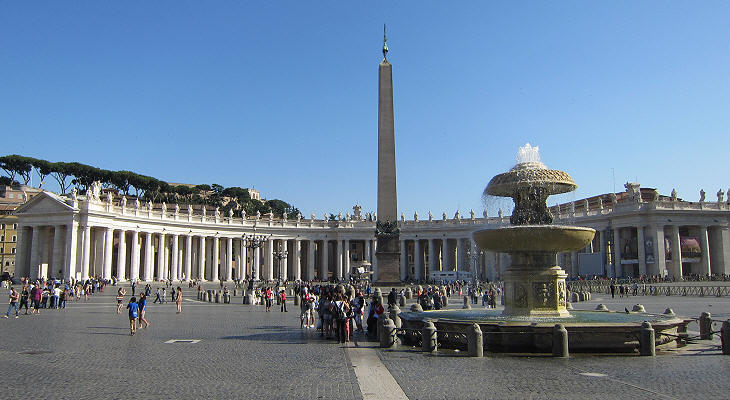
The view in June 2013 (late afternoon)
Vasi chose to show the southern half of Piazza S. Pietro, less
known than the northern one with Palazzo Apostolico in the background and much more difficult to photograph.
The morning of this happy day I must endeavour to perpetuate by a few lines, and at least by description to impart
to others what I have myself enjoyed. The weather has been
beautiful and calm, quite a bright sky, and a warm sun. Accompanied by Tischbein, I set off for the Piazza of St. Peter's,
where we went about first of all from one part to another; when it became too hot for that, we sat in the
shade of the great obelisk, which is just wide enough for two
abreast, and ate grapes which we purchased in the neighbourhood.
J. W. Goethe - Italian Journey - Nov. 22, 1786 - translation by Charles Nisbet.
The architectonic value of Piazza S. Pietro has never been challenged, not even when all the works by Gian Lorenzo Bernini were regarded as decadent and an expression of bad taste, so, exception made for the XIXth century lights and the paving of the square, nothing else has changed.

The view in April 2015 at 8:00 am
I have seen this incomparable piazza under all conditions; in the blaze of an Italian noon; at the silence of midnight; swarming with carriages and foot-passengers; occupied by soldiers at their drill; and, under all, it retained the same aspect and character. It never seemed crowded: it never seemed desolate.
George Stillman Hillard - Six Months in Italy in 1847-1848
If you say, when you drive into its piazza between the sublime colonnades which stretch forth their mighty embrace as if to take the whole world to the church's heart, that here is the best of St. Peter's, you will not be wrong. If you say that here is grandeur, and that there where the temple fronts you grandiosity begins, you will be rhetorical, but, again, you will not be wrong. The day of my furtive visit was sober and already waning, with a breeze in which the fountains streamed flaglike, and with a gentle sky on which the population of statues above the colonnades defined themselves in leisure attitudes, so recognizable all that I am sure if they had come down and taken me by the hand we could have called one another by name without a moment's hesitation.
You may wish to read more of William Dean Howells' account of his 1908 visit to Piazza S. Pietro.
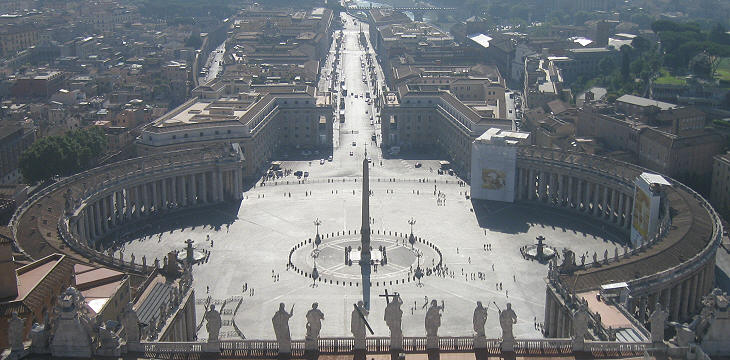
The view in July 2010 at 9:00 am from the dome of S. Pietro
A way to look at Piazza S. Pietro without being distracted by the basilica is from the top of its dome; the morning light reflection isolates the square from its surroundings and emphasizes its architectonic components (in chronological order):
a) the obelisk which was placed in front of the unfinished basilica in 1586;
b) the façade of the basilica and the fountain to the north of the obelisk which were designed by Carlo Maderno and were completed by 1614;
c) the two colonnades which were designed by Bernini and were completed by 1667;
d) the second fountain which was added in 1670;
e) Via della Conciliazione, the grand access to the square which was opened for the Jubilee Year 1950.

(left) The obelisk and behind it Palazzo Apostolico; (right) bronze heraldic symbols of Pope Sixtus V (lions) and of Pope Innocent XIII (eagles) at the base of the obelisk and a dedicatory inscription to Emperors Augustus and Tiberius; the lion is shown also in the image used as background for this page
The obelisk was erected in Heliopolis most likely by Pharaoh Amenhemat II (it does not have any inscription in hieroglyphics); it was relocated to Alexandria at the time of Emperor Augustus. It was brought to Rome by Emperor Caligula who placed it in the private circus he had built at the foot of the Vatican hill (the circus was later on named after Emperor Nero). The obelisk was the only one which did not fall down and in the Middle Ages this fact was attributed to the reputation of Nero as a sorcerer. It was topped by a (lost) bronze globe which was thought to contain the ashes of Julius Caesar.
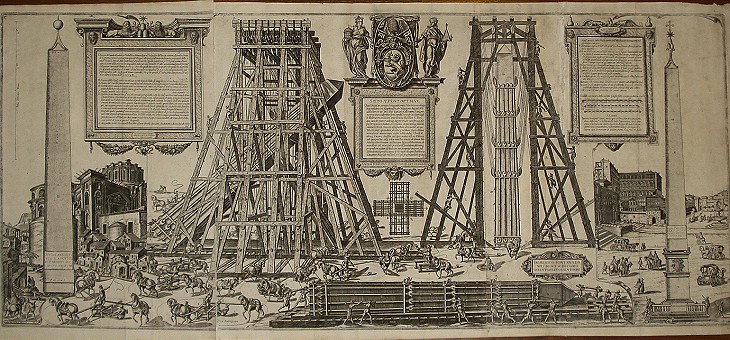
1586 etching by Giovanni Guerra showing the move of the obelisk
In 1586 Pope Sixtus V ordered Domenico Fontana, his preferred architect, to move the obelisk from the southern side of the old basilica, near Rotonda di S. Andrea to the square in front of it. The relocation of the obelisk was successful and it was regarded as a major technical achievement which paved the road to the erection of other obelisks or tall columns (e.g. at S. Maria Maggiore) in the squares of Rome. It was included among the wonders of Rome in a 1588 guide to the city.
You may wish to see a page covering all the obelisks of Rome.
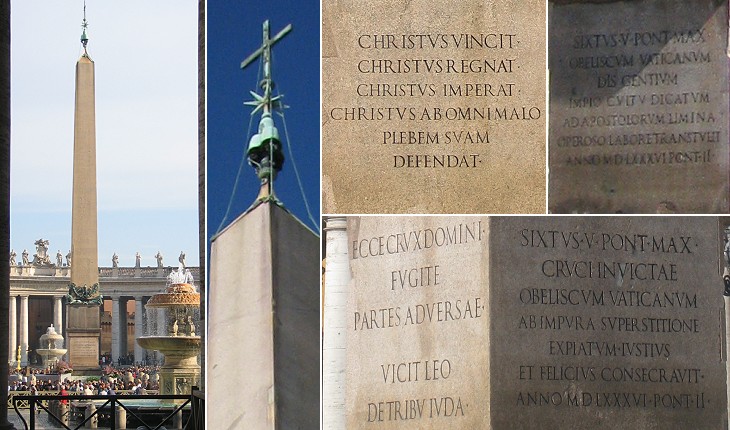
(left) The obelisk seen from the southern colonnade; (centre) bronze tip of the obelisk; (right) inscriptions dictated by Pope Sixtus V
The top of the obelisk was decorated with a bronze cross above a star and three mountains (other heraldic symbols of Pope Sixtus V); in four inscriptions the Pope celebrated the relocation of the obelisk and its change from being a symbol of the pagan world (ab impura superstitione) to being the pillar which supported the Holy Cross; the inscription Ecce Crux Domini. Fugite Partes Adversae. Vicit Leo de Tribu Iuda ("Behold the Cross of the Lord. Flee Ye Adversaries! The Lion of the Tribe of Juda has Won") is known as St. Anthony's Brief and was used in exorcisms. The Pope eventually turned Colonna Traiana and Colonna Antonina into Christian symbols by placing statues of St. Peter or of St. Paul on their tops.

The sundial seen from its last mark (left) and from its initial mark (right); the photos show that the fountains and the central points of the two colonnades are not perfectly aligned with the obelisk, the latter is slightly to the east of them
In 1817, in imitation of Augustus' sundial in Campo Marzio, the shadow of the obelisk was measured and since then it serves as a gnomon and its shade at noon indicates the day of the year. The starting days of the zodiacal months are indicated by circular slabs of marble; similar slabs were also used to indicate the cardinal points and the central points of the two colonnades. It is likely that the leaning of the obelisk was corrected at this time.

(left-above) Inscription on the northern side of the obelisk stating that sundial measurements were taken in 1817; (left-below and centre) marks of the sundial at noon; (right-above) mark of the southern colonnade central point; (right-below) one of the eight marks showing the cardinal points and the direction of winds
Dan Brown made reference to the wind mark shown above in his novel Angels and Demons; you may wish to read some comments on the accuracy of his statements.
Rome had other modern sundials at Piazza di Montecitorio and inside S. Maria degli Angeli.
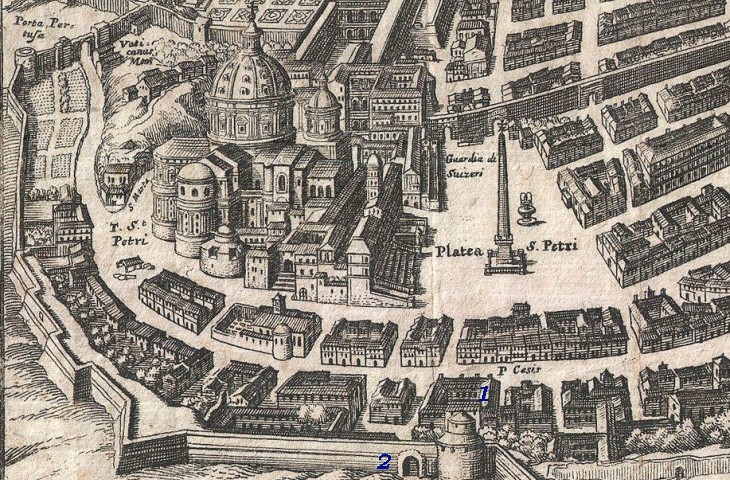
Detail of a map by Antonio Tempesta showing Piazza S. Pietro in ca 1593. 1) indicates the site of a palace owned by the Cesi which was reduced in size when the design of the square was completed; its rear garden housed a collection of antiquities; in 1904 it was totally demolished to enlarge the street leading to Porta Cavalleggeri which is marked by 2. The Cesi had another palace in Borgo
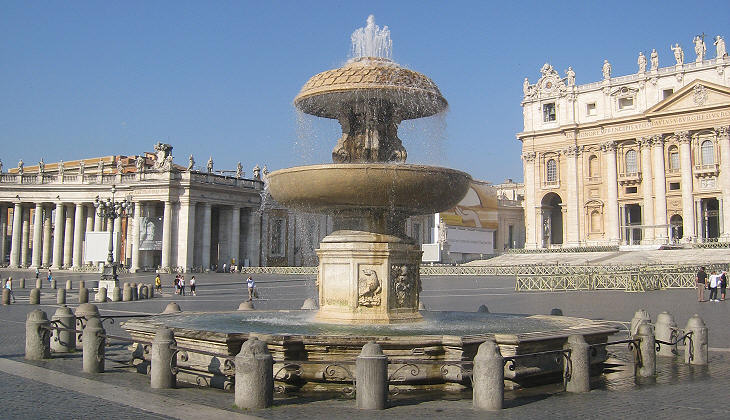
Fountain of Pope Paul V
The fountains are magnificent. Christina, Queen of Sweden, thought they were made to play in honour of her visit, and begged they might cease; -at least so says the guide,- but this is the kind of story, which is told of every royal head down to Prince Leboo (one of the first people from the Pacific Islands to visit Great Britain); who, when he first entered London, thought it was lighted up, as a particular compliment to him.
Henry Matthews - Diary of an Invalid - 1817/1818
A fountain was built by Pope Innocent VIII in 1490 for the pilgrims on their way to the old basilica; during the pontificate of Pope Paul V it was entirely redesigned by Carlo Maderno and it was linked to Acqua Paola, the aqueduct built by the Pope to supply water to Trastevere and Borgo; the spout of the fountain was very high and Vasi did not exaggerated it in the plate.
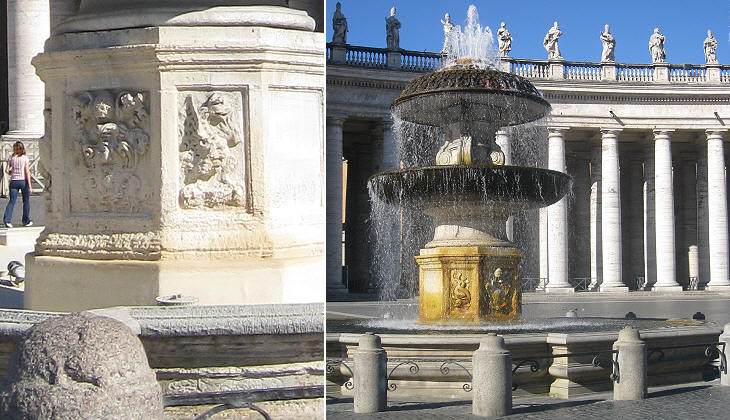
(left) Detail of the fountain of Pope Paul V showing his heraldic symbols (also on the small column in the foreground); (right) fountain of Pope Clement X
On each side of this Guglia is to stand fair Fountains, one wherefore is that which is seen there now; which throweth up such a quantity of water, that it maketh a mist always about it, and oftentimes a rainbow when the Sun strikes
obliquely upon it.
Richard Lassels' The Voyage of Italy, or a Compleat Journey through Italy in ca 1668
When Bernini redesigned Piazza S. Pietro he initially thought of relocating the fountain in front of the obelisk (a similar arrangement existed for the obelisks of Piazza S. Giovanni in Laterano and Piazza del Popolo), but he eventually decided to have two identical fountains at the sides of the obelisk, but slightly closer to the colonnades.
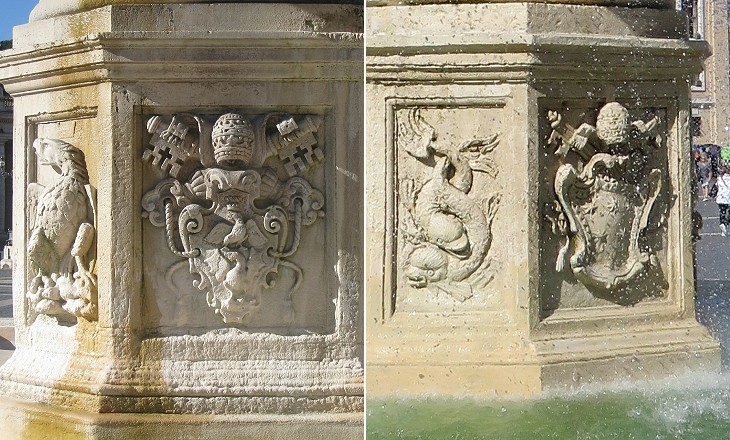
Details of the fountains of Pope Paul V (left) and Pope Clement X (right)
On Easter Sunday (..) the Pope bestows his benediction on the people, from the balcony in front of St. Peter's. This Easter Sunday was a day so bright and blue: so cloudless, balmy, wonderfully bright. (..) Sulky Romans, lively peasants from the neighbouring country, groups of pilgrims from distant parts of Italy, sight-seeing foreigners of all nations, made a murmur in the clear air, like so many insects; and high above them all, splashing and bubbling, and making rainbow colours in the light, the two delicious fountains welled and tumbled bountifully.
You may wish to read more of Charles Dickens's account of Easter Sunday in this square in 1845.
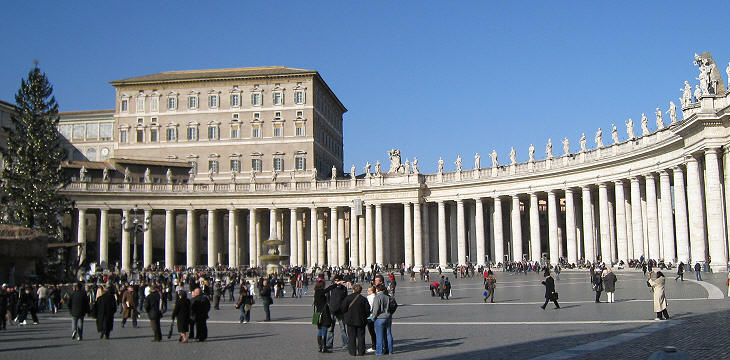
Northern colonnade at Christmas' time
January the 6th 1659. Before a man enters into this Church we may behold
a very fine fountaine in the same place wherein a Prince
is building a very stately and magnificent walke, and
for the Building of which the Pope hath given him
7 yeares tyme.
Francis Mortoft's Journal of his travels in France and Italy
You come to the Piazza of St. Peter, built round about with a noble Portico of Free-stone, born up by four rows of stately round Pillars, under which, not only the Procession upon Corpus Christi day, marched in the shade but also all People may go dry, and out of the Sun in Summer of Winter, unto S. Peter's
Church, or the Vatican Pallace. This Portico is
built in an oval form, and fetcheth in the great
Piazza which is before S. Peter's Church, and
therefore can be no less than half a Mile in compass. This noble Structure was begun by Alexander the VII, and half of it finished, and the other half is now almost finished. I never saw any thing more stately than this. The number
of the Pillars and of the Statues on the top, I do not justly remember. Lassels
Pope Alexander VII could rightly request to be included among the greatest Roman architects; he worked closely with Bernini to find a way to redesign Piazza S. Pietro in order to minimize some disharmonies between the façade (too wide) and the dome (too far from the façade) of the basilica. According to Bernini and the Pope, the final design of the square had a metaphoric meaning: the colonnades were the arms of the Roman Church which embraced the believers, attracted the heretics and convinced the infidels; from a practical point of view this meant a very large elliptical area placed at a great distance from the façade to allow the view of the dome; the section of the square between the ellipse and the basilica was given a trapezium shape to create an optical effect which reduced the width of the façade.
The elliptical area is not geometrically speaking an ellipse, but the result of two overlapping circles having their centres between the obelisk and the fountains.
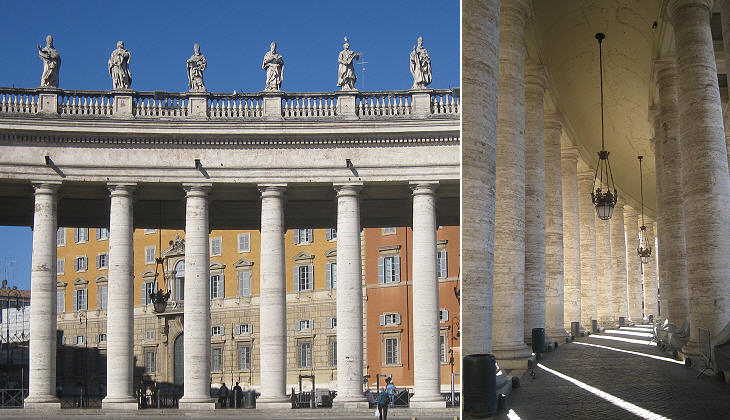
(left) Section of the southern colonnade seen from the central point of the circle, from which the colonnade seems to have a single row of columns instead of four (behind it Palazzo del Sant'Uffizio); (right) central passage for processions
Bernini proposed a last minute change to the project which was endorsed by the Pope without consulting the commission in charge of assisting him; they replaced the Corinthian order of the original project with the Doric order, thus giving the colonnades a classic appearance which balances the theatrical effect of the statues and of the coats of arms placed on their top.
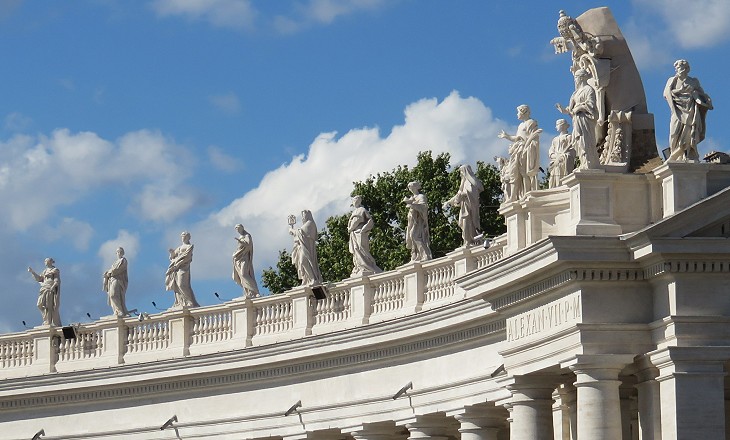
Statues of the southern colonnade on the summer solstice
For the pleasure of this sumptuous array, we are indebted to the architectural taste of the sculptor Bernini, whose statues, with those of his pupils, ornament this and many other places in Rome; and to the genius which enabled him to fascinate those who held the public purse-strings, into such schemes of costly magnificence.
Rembrandt Peale - Notes on Italy, written during a tour in the years 1829 and 1830.
The 90 statues on the colonnades are by assistants of Bernini, mainly by Lazzaro Morelli and Giovanni Maria de' Rossi. In 1702 Pope Clement XI decided to put 50 statues also on the walls linking the colonnades to the basilica. You may wish to see Close to Heaven, a page on these and other statues on top of Roman churches and palaces.
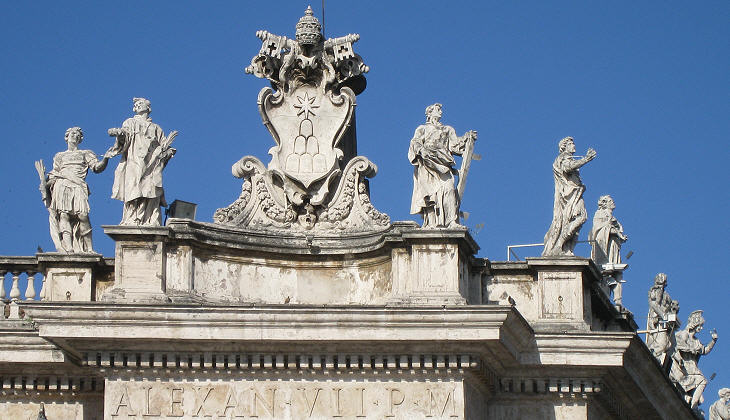
Coat of arms of Pope Alexander VII by Bernini
Pope Alexander VII celebrated the completion of Piazza S. Pietro with six gigantic coats of arms and inscriptions; the coat of arms shown in the picture above was included by Filippo Juvarra in his selection of the finest coats of arms of the Popes.
Next plate in Book 2: Campo di Fiore.
Next step in Day 8 itinerary: Basilica Vaticana.
Excerpts from Giuseppe Vasi 1761 Itinerary related to this page:
Piazza di s. Pietro in VaticanoNell'antico campo Trionfale, ove i Gentili apparecchiavano i vani e superstiziosi trionfi, si vede la sorprendente piazza della Basilica Vaticana, la quale tanto per la vastità e magnificenza, quanto per la distribuzione e decoro de' portici, delle colonne, delle statue, delle fontane, e dell'ammirabile obelisco egizio, che in mezzo alla gran piazza tiene inalberato il segno della ss. Croce, fa restare sorpesa l'immaginazione, sembrando opera non umana: perciò volendo io dar conto di ogni sua parte, principieremo dall'Obelisco EgizioNocereo Re di Egitto fece erigere questo obelisco in Eliopoli, e conforme scrive Plinio, di là lo fece condurre in Roma Cajo Caligola l'anno III. del suo Impero, ponendolo nel Circo Vaticano, che poi fu detto di Nerone per i suoi orti, che quivi erano. Stette in piedi presso la sagrestia di s. Pietro fino al Pontificato di Sisto V. il quale quì dirimpetto alla Basilica lo trasportò per opera di Dom. Fontana, ed invece della gran palla di metallo, che aveva nella sua cima, ci pose tre monti, ed una stella, che sono le sue armi, e sopra collocò il segno della ss. Croce, tutte formate di metallo, la quale avendo per il corso degli anni in qualche parte patito, nel 1740. fu scesa e ristaurata, ed in tale occasione ci fu posta una particella del legno della ss. Croce; perciò furono concedute varie indulgenze ai fedeli, che passando la salutassero con un Pater, ed Ave. Questo maraviglioso sasso è di granito rosso senza cifre, ed è l'unico, che sia rimasto intero dopo le rovine de' barbari, e l'ingiurie de' tempi; è alto palmi 113. e mezzo, e col piedistallo, e croce di metallo palmi 152. Paolo V. per accrescere ornamento fecevi il fonte a destra, e Clemente X. quello a sinistra, i quali sono ammirabili non solamente per la copia e deliziosa comparsa delle acque perenni: ma ancora per le tazze superiori di granito egizio fatte tutte d'un sol masso. Alessandro VII. finalmente col disegno del Cav. Bernini fecevi i maravigliosi portici in forma di Anfiteatro di ordine dorico, ornato di 320. grosse colonne di travertino con cornici, balaustri, e 136. statue rappresentanti vari Santi e Sante, di cui la Basilica tiene reliquie, e varj Fondatori di ordini religiosi. |