All images © by Roberto Piperno, owner of the domain. Write to romapip@quipo.it.


Notes:
Page revised in May 2024.
All images © by Roberto Piperno, owner of the domain. Write to romapip@quipo.it.
Notes:
Page revised in May 2024.
 Piazza di S. Giovanni in Laterano
Links to this page can be found in Book 2, Map A4, Day 1, View C9 and Rione Monti.
The page covers:
The plate by Giuseppe Vasi
Today's view
The Obelisk
Palazzo del Laterano
S. Giovanni in Laterano
Scala Santa

The plate shows the western square of S. Giovanni in Laterano (the eastern square with the main façade is shown in plate 46). It was designed during the pontificate of Pope Sixtus V. The plate shows a procession coming from Santa Maria Maggiore (you may wish to see the grand procession which accompanied the Pope to S. Giovanni in Laterano after his election). The two basilicas were linked by a straight street which was opened in 1575.
The square is shown in two other plates by Vasi: 101 - Battisterio Lateranense and 172 - Spedale di S. Giovanni Laterano.
The view is taken from the green dot in the 1748 map here below. In the description below the plate Vasi made reference to: 1) Obelisco e fontana; 2) Campanile e portico laterale della Basilica di S. Giovanni in Laterano;
3) Palazzo Pontificio; 4) Scala Santa; 5) a second obelisk (Obelisco Sallustiano) lying on the ground.
At Vasi's time this second obelisk (which had been found at Horti Sallustiani) was planned to be placed in front of the main façade, but eventually it was decided to relocate it to Trinità dei Monti.


The view in May 2009
If only the square were not a focal point of Rome's traffic, the view would almost exactly match the plate by Vasi. As a matter of fact some changes actually occurred in the 1880s when the apse of the basilica (which is visible on the far right part of the plate) was pulled down to make room for a larger one. Other facilities of the basilica (which is an extraterritorial property of the Holy See) were built at the side of the façade.

(left to right): The obelisk; one of the inscriptions dictated by Pope Sixtus V; detail of its reliefs; bronze top
I went to visit that ancient See and Cathedral
of St. John di Laterano, and the holy places thereabout. (..) We saw before the church the obelisk,
which is indeed most worthy of admiration. (..) It is full of hieroglyphics, serpents,
men, owls, falcons, oxen, instruments, etc., containing (as Father Kircher the Jesuit will shortly tell us in a book
which he is ready to publish) all the recondite and abstruse
learning of that people. The vessel, galley, or float, that brought it to Rome so many hundred leagues must needs
have been of wonderful bigness and strange fabric.
John Evelyn's Diary and Correspondence in November 1644
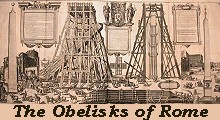
This is the oldest and tallest obelisk of Rome and also the last to be brought from Egypt (you may wish to see all the obelisks of Rome in one page). It was originally built to decorate the Temple to Amun at Karnak near Thebes and it was dedicated to Pharaoh Thutmose IV. Emperor Constantine
considered using it for embellishing Nova Roma (Constantinople) and the obelisk was brought to Alexandria together with a second obelisk which was dedicated to Pharaoh Thutmose III. Of the two obelisks the latter was eventually brought to Constantinople and placed in its Hippodrome,
while the former was assigned to Rome by Emperor Constantius II; the transportation occurred in 357 on a specially built ship.
In 1587 this obelisk was found in the Circus Maximus and in the following year it was relocated to Piazza S. Giovanni. It is
very well preserved, with easily readable hieroglyphics. Pope Sixtus V placed the whole array of his heraldic symbols on its top: not only the three
mountains with the star, but also the lion holding the pears. The fountain near the obelisk is covered in another page.

Façade towards S. Maria Maggiore and detail of its cornice (you may wish to compare it with that of the eastern façade which was built by Pope Clement XII)
The Lateran stands close to the patriarchal church of that name, and was appointed for the residence of the Bishops of Rome, at the same time as the adjoining Basilica was converted into a church by Constantine. It had fallen into ruin, and was rebuilt by Sixtus Quintus. A part only is now reserved for the accommodation of the pontiff, when he comes to perform service at St. John's. The main body of the building was turned into an hospital for the reception of two hundred and fifty orphans, by Innocent XI. It presents three fronts of great extent and simplicity, and strikes the eye by its magnitude and elevation.
John Chetwode Eustace - A Classical Tour through Italy in 1802
The Lateran Palace is a hymn to Pope Sixtus V. His heraldic symbols are everywhere from the entrance to the cornice.
It was designed by Domenico Fontana who coped with all the challenging tasks the Pope commissioned him (reconstruction of aqueducts, relocation of obelisks, a net of conduits and fountains, the opening of new streets, etc.).
It was completed in 1589, but his successors preferred to live at Palazzo del Quirinale and eventually this large building was used as a hospital
or a hospice; at the time of the etching it was a Conservatorio di povere zitelle, one of many institutions caring for unmarried women.

Portal and coat of arms on the main façade (peer inside and have a look at its ceilings)
Today the palace (which belongs to the Holy See) houses a historical museum of the Papal State. See some of its ceilings.

(left) Transept façade of S. Giovanni in Laterano; (right) medieval bell towers
According to tradition the basilica was built on land belonging to Emperor Constantine; although the area was located inside the walls of Rome, it was remote from the centre of the city; the layout of the church was based on an east-west axis: this meant that its entrance was oriented towards Porta Asinaria, in other words the basilica turned its back to the city. For this reason Pope Sixtus V decided to build a large loggia on the northern arm of the transept, the part of the building which faced the city. A few years later Pope Clement VIII lavishly decorated the transept and placed a great altar at its southern end: in this way two churches coexisted: the east-west one (in very poor condition) and the south-north one which was entirely modernized. Later on the former was redesigned by Francesco Borromini for the 1650 Jubilee Year and it was given a new façade by Pope Clement XII in 1735. The façade of the transept retains part of its medieval structure, because the two bell towers, notwithstanding the coats of arms of Pope Pius IV, were built during the pontificate of Pope Innocent II in the XIIth century.
The loggia was used for the papal blessings (SIXTUS PP V AD BENEDICTIONES EXTRUXIT) and it was designed by Domenico Fontana. You may wish to see this side of the basilica before and after the changes made by Pope Sixtus V in a 1588 Guide to Rome. The portico beneath the loggia houses a statue of King Henry IV of France by Nicolas Cordier, the basilica being under the patronage of France, whereas S. Maria Maggiore is under that of Spain.

Fresco in the loggia depicting The Baptism of Constantine (the porphyry columns are those of the nearby Baptistery); (right) coat of arms of Pope Clement XII on a railing which closes the portico. It can be seen in the image used as background for this page

(left) Façade (the portico was closed in 1853); (right) the staircase
1st Jan 1825. The pilgrims are informed that it
will be for them still better if they go up the Scala Santa on their knees. This
Scala Santa is on the left of the Cathedral of St. John Lateran, & is represented
to have been that of Pilate's Judgement Hall, down wh. our Saviour was pushed;
consequently it is held in great Veneration & from within the iron Gate, you see
Crowds of people labouring on their knees up a number of steps, probably 50 at
least, the noise the knees make is pretty considerable.
The Stair is crowded with old & young, but generally, with the poor, to whom
chiefly the superstitious Observances of the Catholic Religion are now matters of
Respect, at least those of them wh. demand labour - all sign with the cross on
entering the Church with Holy Water, bow & genuflect to the Images of
Madonna &c., perhaps kiss St. Peter's Toe, & kneel in apparent thoughtfulness
for a certain period before that altar that is fashionable, or convenient - but you
will not see many well dressed people crawling up a Stair on their knees, or
parting it from one extreme of the City to the other, reciting nonsensical Latin.
These are pleasures left to the Poor.
Sir Charles Fergusson - Travel Journal in Italy 1824-1825
Domenico Fontana built this palace to house the staircase of Pontius Pilate's house, which according to one account was brought to Rome by St. Helena, mother of Emperor Constantine. Its 28 steps may
be ascended only by worshippers on their knees. Today many do it to pray for the recovery of one of their next of kin, but in the past they did it to gain indulgences, i.e. the total or partial remission of the time to be spent in Purgatory by their souls or those of their relatives.

(left) Grill at the end of the main staircase through which one can see Cappella del Sancta Santorum (Holies of Holies, because it houses many relics); (right) Cappella di S. Lorenzo (it was enlarged and modified in 1936)
There were such odd differences in the speed of different people, too. Some got on as if they were doing a match against time; others stopped to say a prayer on every step. This man touched every stair with his forehead, and kissed it; that man scratched his head all the way. The boys got on brilliantly, and were up and down again before the old lady had accomplished her half-dozen stairs. (..) Most of the penitents came down, very sprightly and fresh, as having done a real substantial deed which it would take a good deal of sin to counterbalance.
Read more of Charles Dickens's account of his visit in 1845 and about Fynes Moryson's 1594 visit.
Domenico Fontana modified an existing medieval complex which included a private papal chapel dedicated to St. Lawrence.
The building was decorated with marbles and frescoes by Pope Nicholas III in 1277. Fontana redesigned it and created a new chapel
dedicated to St. Lawrence, but occasionally some of the ancient walls with fragments of their frescoes have been identified.

(left) S. Lorenzo, fresco by Baldassarre Croce; (right) Angels carrying the staircase, fresco on the ceiling of the entrance hall (it recalls paintings and reliefs related to angels carrying the Holy House of the Virgin Mary to Loreto, a sanctuary Pope Sixtus V had in his heart)
Stairs which are/were ascended by worshippers on their knees can be seen in other churches, e.g. at Sacro Speco and at SS. Michele e Magno and also in Greek Orthodox shrines, e.g. at Our Lady of the Annunciation at Tinos.

Centrale Montemartini: Roman floor mosaic found in 1958 near Scala Santa: it depicts the Labyrinth inside a walled town, similar to a mosaic at Italica
Next plate in Book 2: Piazza di Termini.
Next step in Day 1 itinerary: Chiesa de' SS. Pietro e Marcellino.
Next step in your tour of Rione Monti: Chiesa di S. Stefano Rotondo.
Excerpts from Giuseppe Vasi 1761 Itinerary related to this page:
Obelisco Egizio sulla Piazza di S. Giovanni in LateranoObelisco Egizio sulla Piazza di S. Giovanni in Laterano
Molto celebre, e maraviglioso è il grande obelisco, che si vede inalzato in mezzo a questa
vastissima piazza, poichè da Ramise Re di Egitto era stato eretto in Tebe entro un vastissimo
tempio in onore del Sole, e dipoi da Cambise fu sottratto dalle rovine di quella Città con
grande industria, per conservare la sua mole, che come Ammiano dimostra, era assai maggiore di
quella, che è oggidì; perciò Augusto considerando la di lui eccessiva grandezza non ebbe
coraggio di rimuoverlo: ma Costantino Magno levandolo dal proprio sito, per il Nilo lo fece
condurre ad Alessandria, e mentre preparava una nave di 300. remi per condurlo a Roma, egli
morì prima di effettuare la sua impresa, che poi da Costanzo suo figliuolo fu compita
felicemente; indi portato per il Tevere fu introdotto in Roma per la porta Ostiense, e poi
nel mezzo del Circo massimo fu alzato. E quello di granito rosso ornato tutto di segni
egizj, ed è lungo 115. piedi in circa senza la base, e piedistallo, ed è largo nel suo
piantato piedi nove e mezzo da un lato, e dall'altro piedi otto. Il Pontefice Sisto V.
l'anno 1588. lo fece disotterrare dalle rovine del detto Circo massimo, nel quale giaceva
14. palmi sotterra, insieme con quello, che poi il medesimo Pontefice drizzò, come dicemmo,
nella piazza del Popolo. E perchè era rotto in tre pezzi, fecelo raggiustare, e quivi
incontro al portico della benedizione, e al palazzo, che egli aveva fatti fabbricare con
disegno del Cav. Domenico Fontana, a' 10. di Agosto fu drizzato in onore di Gesù Cristo
vero Sole di giustizia, ponendovi in cuna il segno della ss. Croce di metallo, alta
palmi 9: e mezzo: sicchè dal piano della piazza fino alla sommità della Croce è alto
palmi dugento quattro. A piè di questo maravigliosa sasso fu poi fatto un fonte di
acqua perenne.
|