
All images © by Roberto Piperno, owner of the domain. Write to romapip@quipo.it.


Notes:
Page revised in September 2023.
All images © by Roberto Piperno, owner of the domain. Write to romapip@quipo.it.
Notes:
Page revised in September 2023.
 Piazza di Termini
Links to this page can be found in Book 2, Map A2, Day 2, View B7 and Rione Monti.
The page covers:
The plate by Giuseppe Vasi
Today's view
S. Maria degli Angeli
Certosa di S. Maria degli Angeli
Terme di Diocleziano
Papal Granaries and S. Isidoro in Thermis
Fontana delle Naiadi

Termini is today the word used by the Romans to designate the Central Railway
Station of Rome. The name comes from the baths (in Latin Thermae) built at the beginning of the IVth century by
Co-emperor Maximian and dedicated to Emperor Diocletian.
Piazza di Termini actually stands on the site of the gardens of the
baths, which were closed by a large exedra, a semicircular wall. In the late XVIth century Pope Sixtus V built a villa on the eastern side of Piazza di Termini which Vasi shows in plate 194. In 1596 a detached circular hall of the baths was turned into Chiesa di S. Bernardo, which Vasi shows in plate 127 - ii.
The view is taken from the green dot in the 1748 map here below. In the description below the plate Vasi made reference to: 1) Rovine (ruins) delle Terme Diocleziane; 2) Chiesa di S. Maria degli Angeli;
3) the site of excavations made in 1750; 4) Granaries.
The small map shows also 5) the approximate location of Fontana delle Naiadi; 6) S. Isidoro in Thermis; 7) Certosa di S. Maria degli Angeli.


The view in August 2009
Today Piazza di Termini is a key traffic roundabout. Its current name is Piazza
della Repubblica, but it is more commonly known as Piazza Esedra because its south-western side retains the semicircular shape of the ancient exedra (as you can see at the end of this page).
In 1911 the XVIIIth century façade of S. Maria degli Angeli
was demolished to uncover the remaining walls of the calidarium (the heated hall of the ancient baths).

Interior: transept, previously main nave, inside a large hall of the baths
All the rest of the baths have been entirely dismantled of their magnificent columns and splendid marbles; but the great hall of these, the Pinacotheca, as it was called, - has been converted into a church by Michael Angelo; and the superb granite columns, each hewn out of a single block, 43 feet in height, still remain as they stood in the days of Diocletian. (..) This magnificent hall is now the church of S. Maria degli Angeli; - the work of Michael Angelo. The form of the church is the Greek cross; so much more favourable than the Latin, for displaying at one coup d'ceil all the grandeur of the building. This church shews what St. Peter's would have been, if Michael Angelo's plan had been followed; and it is by far the finest church in Rome, - except St. Peter's, which must always be incomparable.
Henry Matthews - Diary of an Invalid - 1817/1818
In 1561, at the request of Antonio del Duca, a Sicilian priest, Pope Pius IV agreed to turn some halls of the baths into a church dedicated to Mary and the Seven Archangels.
Michelangelo developed a project based on the utilization of the enormous rectangular aula basilicale which stood between the natatio (cold pool) and the tepidarium, where the bathers rested at an agreeable temperature.
The hall was embellished by eight gigantic granite columns which Michelangelo restored; he also decorated it with coloured marbles which were still easy to find in XVIth century Rome.
You may wish to see the interior of the church as it appeared in a 1588 Guide to Rome.

XVIIIth century changes: (left) passage between the "tepidarium" and "aula basilicale"; (right) apse
S. Maria degli Angeli was modified by Luigi Vanvitelli in 1749, just before the time of Vasi's plate, by changing its orientation from SE-NW to SW-NE. He opened a new entrance in the tepidarium and a grand passage between the latter and aula basilicale; he also used part of the natatio to build there the apse and the main altar. Aula basilicale became the out of proportion transept of the new church.

Interior of the church: (left) fake (left) and real (right) granite columns; (centre) real marble decoration; (right) fake marble decoration
Another Art they have, of imitating
Marbles, that the Difference is hardly to be perceived. It is
done with what they call Scagliola, which is not unlike what
I have seen here in England, called Spar, and by some Mater Metallorum, which is found in the Lead-Mines. With
this Material, burnt and powder'd, and made into a Paste or Plaister, and so mixt up with proper Colours, they imitate Marble
to a great Nicety and with this Mixture, in several Variations,
some of the Churches are incrusted, and make much the same
appearance as if they were incrusted with real Marble.
Edward Wright - Some Observations made in France, Italy etc. in the years 1720, 1721 and 1722, [1730].
Vanvitelli could not rely on other granite columns and marbles, so walls and columns of the new parts are painted brickwork.
One can easily identify the real granite columns and marble walls by touching them because they have a lower temperature than that of the painted ones. In 1751 Vanvitelli moved to the court of the King of Naples for whom he designed the Royal Palace of Caserta.

(left) Monument to Cardinal Francesco Alciati, perhaps designed by Giovan Battista della Porta; (centre) Monument to Carlo Maratta by the painter himself; (right) Cappella di S. Brunone: altar with an oil painting by Giovanni Odazzi (ca 1700)
Carlo Maratti or Maratta (1625-1713). His paintings contain
no riddles, nothing to puzzle the beholder, nothing to stir violent emotions. His glib
handling of the current allegorical language, the impersonal generalizations with which
his work abounds, admission of just the right dose of festive splendour - all this predestined his grand manner to become the accepted court style in Louis XlV's Europe.
Maratti was not an artist given to speculation and theory (..) yet it must be admitted that he was an artist of
extraordinary ability. (..) What impressed his contemporaries most was that he reestablished a feeling for the dignity the human figure
seen in great, simple, plastic forms and rendered with a sincerity and moral conviction without parallel at this moment. (..) By the end of the
century Rome had to all intents and purposes surrendered to Maratti's manner. At his
death in 1713 his pupils were in full command of the situation (see some of his paintings at Palazzo Corsini and Fondazione Roma).
Rudolf Wittkower - Art and Architecture in Italy 1600-1750
S. Maria degli Angeli does not have family chapels and therefore it does not house many funerary monuments. It was assigned by Pope Pius IV to the Carthusian Order which was founded in 1084 by St. Bruno of Cologne whose life is depicted in many paintings inside the church.

(left) Point of origin of the sunbeam and coat of arms of Pope Clement XI; (right) another coat of arms of the Pope on the
floor at the beginning of the meridian line
In 1703 Pope Clement XI built a sundial, where it is not the shadow of a gnomon which tells the time, but the light of a sunbeam which enters S. Maria degli Angeli from a point near the ceiling. At the astronomical noon it crosses a meridian line drawn on the floor. The intersection point changes according to the various periods of the year; these are indicated by inscriptions and by marble inlays showing the signs of the zodiac and the stars of the related constellation. According to Francesco Bianchini, the astronomer who made the calculations for the sundial, the choice of S. Maria degli Angeli, at the time a church rather remote from the centre of Rome, was due to the stability of its walls, then some 1,400 years old.

(left) Meridian bronze line with marks; (right) zodiacal signs (Aries is shown in the image used as background for this page); a similar meridian line was made in 1841 at Catania in S. Nicolò l'Arena
It is interesting to note that Vasi wrote in his 1761 itinerary of Rome that in oggi non corrisponde più al segno (today the meridian line is no longer accurate). In 1789 the obelisk in Piazza di Montecitorio was utilized for a sundial and the same occurred to the obelisk in Piazza S. Pietro in 1817. In 1847 Pope Pius IX abandoned the Italian hour and a few years later decreed that the exact noon time should be determined by the observatory of Collegio Romano and made known to the public by a cannon shot fired from Castel Sant'Angelo (today from Janiculum).

View of Chiostro Grande aka Chiostro di Michelangelo (and of Ministero delle Finanze behind it) with four colossal heads of animals which were found at Palazzo Bonelli in 1586
The convent of the Certosa, with its spacious cloisters running round four sides of a square, and enclosing an open space of considerable extent. These cloisters are among the things for which we have reason to envy the old world. They are merely arcades, or piazzas, round a quadrangle, and seem to have been designed for the benefit of monastic institutions in hot climates; so that their inmates might have the advantage of air and exercise, without exposure to the sun. They are a proof of how much may be done in architecture by adherence to simplicity and loyalty to nature. (..) In the centre of the square around which the cloisters of this church are built, is a fountain; and, overshadowing the fountain, is a group of three cypresses, which are said to have been planted by the hands of Michael Angelo. There were originally four, but one has been destroyed by lightning. They are of immense size, and strikingly picturesque; all the more so from the fact that they begin to show, in their broken outlines and in the gaps made in their verdurous bulk, the marks of time and decay.
George Stillman Hillard - Six Months in Italy in ca 1847-1848
In this connection I wish to say one word about Michael Angelo Buonarotti. I used to worship the mighty genius of Michael Angelo - that man who was great in poetry, painting, sculpture, architecture - great in every thing he undertook. But I do not want Michael Angelo for breakfast, for luncheon, for dinner, for tea, for supper, for between meals. I like a change, occasionally. (..)
Dan said the other day to the guide, "Enough, enough, enough! Say no more! Lump the whole thing! say that the Creator made Italy from designs by Michael
Angelo!"
Mark Twain - The Innocents Abroad - 1869

South-eastern side of Chiostro Grande
The construction of the Carthusian monastery began in 1565, one year after the death of Michelangelo. He might have given some suggestions to Giacomo Del Duca who designed Chiostro Grande. Del Duca had assisted Michelangelo in the execution of many projects in the final years of the master's life. The dimension of the cloister is enormous with 25 columns on each side.

Chiostro Ludovisi; (inset) coat of arms of Cardinal Ludovico Ludovisi, nephew of Pope Gregory XV
The Chartreuse Monastery occupies its centre, in connexion with the Church of St. Maria degli Angeli. As it was not an hour for the church to be open, we sought admittance at the gate of the monastery, and were conducted through the silent cloisters; the confraternity being reduced to eight members. We passed through many rooms and passages, contrived for the convenience of the monks.
Rembrandt Peale - Notes on Italy, written during a tour in the years 1829 and 1830.
A smaller cloister was built on part of the area of the natatio.
Museo Nazionale Romano was founded in 1889 in the premises of the Carthusian monastery. In 1901 the Italian State bought some 100 statues which were part of
the Ludovisi Collection. Many of them were placed in this cloister. They are now at Museo Nazionale Romano di Palazzo Altemps.

Arch at the entrance to Chiostro Grande: the stucco frame immediately above the door is decorated with a CART monogram which stands for Cartusiensis
The silence in which they shroud themselves must be regarded as the greatest penance which the fanatic can inflict upon himself. When they cast from them the Word, the key to life and all its objects, they place their souls under the ban of a frightful spiritual silence which resembles blindness. A "Memento Mori", the horrible greeting which they give to one another when they meet, are the only words by which that silence is ever broken.
They say that these wandering spectres of living men are permitted to keep an object of love in their cells. One cultivates a flower in a broken pot, with which he can hold silent converse; another may feast his eyes on a favourite picture of some saint; or he may tend a bird in a cage and listen to its song.
Ferdinand Gregorovius who visited Certosa di Trisulti near Alatri in 1858 - Transl. by Dorothea Roberts
The Carthusians adopt the rule of St. Benedict with some additional restrictions due to their spending most of their time in a cell in solitude. They are allowed to speak to each other only on special occasions.
Notwithstanding this very austere way of living the communal parts of the monastery were lavishly decorated with ancient marbles and elaborate stuccoes.

Fragments of frescoes which decorated the monastery: (left) Angels supporting Jesus Christ; (right) Charity
After the annexation of Rome to the Italian Kingdom in 1870 the Carthusians had to leave their monastery. The building was in part assigned to the Army and in part to the City of Rome, before being used as a museum and its walls were whitewashed. A recent renovation of the museum facilities has brought to light some interesting frescoes of the XVIth and XVIIth centuries.

Chiostro Grande: painting showing a Carthusian monk
This trompe l'oeil painting was made in 1855 by Filippo Balbi, an Italian painter who worked at the decoration of Certosa di Trisulti. It is a sort of riddle. It portrays a lay brother (because he has a beard) who holds in one hand a piece of paper with the words Erudi filium tuum et refrigerabit te et dabit delicias animae tuae (Discipline your son, and he will give you rest; he will give delight to your heart. - Proverbia XXIX: 17 ESV). With the other hand he points to a portrait of Pope Clement IV. He is Pierre Foulcois, a rich lawyer in southern France who gave up secular life and retired to a Carthusian monastery. His son Guy, an adviser to Saint Louis, King of France, did the same after the death of his wife. He was eventually appointed Archbishop, became a Cardinal and was elected Pope Clement IV in 1265. See his funerary monument at Viterbo.

Large hall, probably used as the "apodyterium", the changing room of the baths
The baths were built between 298 and 306 and, although dedicated to Emperor Diocletian, they were meant to celebrate the success of a campaign led by Maximian in today's Algeria and Morocco to defend those Roman territories from the attacks of
Berber tribes. It ought to be noted that Maximian, when he was not campaigning, did not reside in Rome, but preferred to live in northern Italy at Milan, whereas Diocletian rarely moved from his palace in Nicomedia, near Nicea.
These baths exceed in size those built in 217 by Emperor Caracalla and have a similar layout with the hot rooms facing south-west.

Halls: (left) Xth Hall (perhaps the Entrance Hall, which today houses Sepolcro dei Platorini and two tombs from Via Portuense); (right) XIth Hall (perhaps a cistern)
Some of the ancient halls have been restored and when necessary given a new roof in order to use their space to house large funerary monuments or mosaics, e.g. that found at Villa di Nerone at Anzio.

(left) Walls of "natatio" (swimming pool); (right) mosaic which decorated it
What most impresses the visitor is the height of the halls, even of those such as the cistern or the changing room, were this feature is not apparently required. The walls had many niches which housed statues or other decorative elements. We know that the baths were still in use at the time of King Theodoric in the early VIth century.

Three of the seven relatively small halls which surround the eastern transept of S. Maria degli Angeli
These halls of the tepidarium housed ancillary facilities of the church or of the monastery, but after the latter was closed, all modern additions were demolished and the halls became part of Museo Nazionale Romano. Until the 1970s exhibits of the permanent collection were on display there. Today they house temporary exhibitions.

Western section of the baths with the Octagonal Hall at its end
The complex had a central section with the halls for sweating and swimming. At the side of this section there were two large courtyards (palaestrae) for exercising and beyond them a row of large buildings which housed ancillary facilities, maybe warehouses or libraries. In the late XVIth century the row of buildings on the western side was utilized to house granaries which were eventually replaced by an orphanage and a hostel for the deaf. These additions were pulled down in the early XXth century.

Details of the decoration
The decoration of the baths was grand, but it lacked novelty and finesse. Some broken statues were found during the centuries in these baths, but overall, they have not given a great contribution to our knowledge of ancient art, unlike those of Caracalla.

Museo Nazionale Romano alle Terme di Diocleziano: Chiostro Maggiore: (left) a stone marking the "termini ripae Tiberis", i.e. the boundary between the "ager publicus" (public area) along the River Tiber and the private one
(time of Emperor Augustus); (right) a large theatrical mask, similar to those which decorate Cortile Ottagono at Palazzo del Belvedere
Until the early 1990s Chiostro Maggiore housed a very large number of exhibits in a rather chaotic manner. Today all the exhibits of greater interest have been moved to new halls or to the new sections of the museum. Those which are still at Chiostro Maggiore are children of a lesser god, yet it is worth having a look at them.
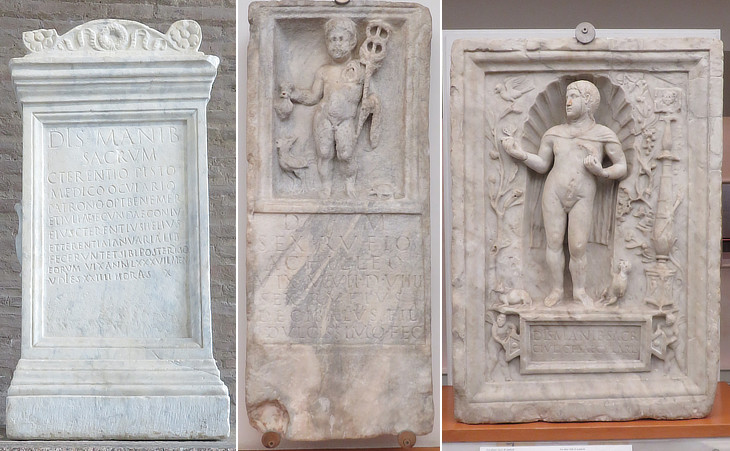
Museo Nazionale Romano alle Terme di Diocleziano: (left) ossuary altar of an oculist (medico oculario) who lived 87 years, 5 months, 24 days and 10 hours (Ist century AD - from Porta Maggiore); (centre) tombstone of Sextus Rufius Achilleus who died 7 months and 9 days old. He was depicted as Mercury the god who accompanied the dead to Hades. Also the rooster and the turtle at his feet are symbols of Mercury (IInd century AD from the Kircherian Museum - see other reliefs depicting the god); (right) altar with hollows to contain the ashes of Caius Iulius Saecularis. The inscription is held by two Cupids and it does not say more but the fine relief shows the dead in a sort of Garden of Eden, with animals and trees (Ist century AD from Tusculum)
The more artistic parts of the collections were moved to nearby Palazzo Massimo or to Palazzo Altemps. The rooms at Terme di Diocleziano were converted into a museum for Rome's prehistory and epigraphy. The latter collection, of which only a part is actually on display, offers an interesting insight into the social life of Ancient Rome which is not limited to its upper class, similar to what occurs at the Epigraphic Gallery of Musei Capitolini.

Museo Nazionale Romano alle Terme di Diocleziano: sarcophagi decorated with the Labours of Hercules (above) and with the Sun and the Moon (below)
Some exhibits on display at the baths are shown in pages dealing with the locations where they were found, e.g. a relief from Castra Equitum near Villa Giustiniani, statues of Venus and Mars from Ostia and a small statue of Isis.

Coats of arms and inscriptions of Pope Gregory XIII (left) and Pope Paul V (right)
It is estimated that after the 1527 Sack of Rome the city had only about 30,000 inhabitants. During the second half of the century the population grew significantly and by the year 1600 Rome had nearly 100,000 inhabitants.
The growth was in part due to the many charitable institutions which were founded as part of the Catholic Reformation effort to reshape Roman society. According to President de Brosses who visited Rome in 1739, beggars were a quarter of the population (and statues another quarter).
The responsibility for ensuring a constant supply of basic commodities fell on the Papal government.
There is a general consensus that the papal decision to directly buy (also abroad) a large part of the commodities needed for the functioning of charitable institutions, was a key factor in the abandonment of the Roman countryside.
An effect of this policy was the need to store wheat and oil in very large quantities, to strengthen the bargaining position of the Papal State.
Prefettura dell'Annona, a special department of the administration, was founded in 1560 to purchase
and store basic commodities. Praefectus Annonae was the officer of ancient Rome who was in charge of the grain-supply chain and
Fortuna Annonaria was the goddess who protected this activity.
In 1575 three halls of the baths which stood to the left of S. Maria degli Angeli were turned into a granary by
Pope Gregory XIII; the choice of this location was also due to the fact that there was no risk that the Tiber could flood it.
In 1609-1612 Pope Paul V enlarged the granary by adding new halls.

(left) Coat of arms and inscription of Pope Clement XI; (right) hall of the baths which was
meant to be used as a granary; the inscription above the entrance celebrates the decision not to modify an ancient monument
At the beginning of the XVIIIth century Pope Clement XI came to the conclusion that the granaries were not up to the needs of the city. It was decided to turn a circular hall at the south-eastern corner of the baths into another granary. Carlo Fontana, the architect in charge of the project, eventually preferred to build a new granary and the ancient circular hall was not modified.

Coats of arms and inscriptions of Pope Benedict XIV (left) and
Pope Clement XIII (right)
In 1754 Pope Benedict XIV visited the granaries (of Pope Paul V)
and promoted their restoration and the construction of a small church dedicated to St. Isidore the Farmer, an XIth century Spanish day labourer, who is the patron saint of farmers. He is particularly venerated in time of drought as he is said to have caused a fountain of fresh water to burst from the dry earth.
In 1764 Pope Clement XIII added a depot for storing olive oil and celebrated the event with a large coat of arms. Because
most of the inhabitants of Rome were not able to read the inscriptions, sheaves of wheat and branches of olive-trees provided
an alternative means of making known the purpose of the buildings.

(left) S. Isidoro in Thermis; (right) Octagonal Hall and column supporting a small ship, the symbol of the City of Paris which since 1961 is twinned with Rome
Today the ancient halls which housed the granaries have been brought back to their original shape and are part of Museo Nazionale Romano; S. Isidoro in Thermis is deconsecrated and it is used for conferences or small exhibitions.

Fontana delle Naiadi (see it in a 1909 painting by Yoshio Markino)
After the annexation of Rome to the Kingdom of Italy in 1870, the new government opened Via Nazionale, a straight street between Villa Aldobrandini and Piazza di Termini. It was meant to be the symbol of Rome as capital of a large European country.

Fontana delle Naiadi and behind it Palazzi dell'Esedra
In 1885 a large fountain
was designed at the centre of Piazza di Termini. In 1888-1889 two large buildings were erected on the foundation of the ancient exedra. They were designed
by Gaetano Koch in a neo-Renaissance style (see also Palazzo Margherita) and they provided Via Nazionale with a monumental entrance. In 1901 sculptor Mario Rutelli decorated
the fountain with four Naiads (water-nymphs) in the act of taming: the sea nymph a horse, the lake nymph a swan,
the river nymph another horse and finally the nymph of underground waters a reptile.
Rutelli prepared a group of statues for the centre of the fountain: tritons, a dolphin and an octopus; the proposed addition was labelled
as fritto misto (mixed fried fish) and it was relocated to the gardens of Piazza Vittorio Emanuele.

Fontana delle Naiadi: details and "Le Grand Hotel" which was built in 1894 by Giulio Podesti for César Ritz, a famous Swiss hotelier,
between the fountain and Mostra dell'Acqua Felice (see them also in another image)
In 1911 Rutelli added the statue of Glaucus, a sea-god holding a dolphin which is more consistent with other Roman statues (in particular Fontana del Moro and Fontana del Tritone by Gian Lorenzo Bernini). Usually the many streams of spouting water do not allow a clear view of the statues. During the maintenance of the fountain it is possible to understand why Rutelli's Naiads were so criticized and charged with being (in today's words) soft-porn.

Fontana delle Naiadi during maintenance
Next plate in Book 2: Piazza delle Quattro Fontane.
Next step in Day 2 itinerary: Porta Pia.
Next step in your tour of Rione Monti: Villa Peretti.
Excerpts from Giuseppe Vasi 1761 Itinerary related to this page:
Piazza di Termini
Dalle mentovate Terme prese il corrotto nome di Termini questa gran piazza, o prato, se vogliamo dire il vero.
Sonovi d'intorno molti granai della R.C.A. e da una parte il gran casino della villa Negroni, già Peretti, dall'altra il
detto orto de' monaci di S. Bernardo, e dall'altra parte le maravigliose Rovine delle Terme Diocleziane. |


