All images © by Roberto Piperno, owner of the domain. Write to romapip@quipo.it.


Notes:
Page revised in January 2025.
All images © by Roberto Piperno, owner of the domain. Write to romapip@quipo.it.
Notes:
Page revised in January 2025.
 Piazza di Spagna
Links to this page can be found in Book 2, Map B2, Day 2 and Day 3, View C6, Rione Campo Marzio and Rione Colonna.
The page covers:
The plate by Giuseppe Vasi
Today's view
SS. Trinità dei Monti
Obelisco Sallustiano
Scalinata di Trinità dei Monti (Spanish Steps)
Fontana della Barcaccia
Palazzo di Propaganda Fide
Palazzo di Spagna
Colonna dell'Immacolata
Vasi's Second Plate for Piazza di Spagna
A second page covers:
Interior of SS. Trinità dei Monti
Convento della Trinità dei Monti
A third page covers:
The Strangers' Quarter
Caffè Greco and Babington's Tea Rooms
S. Atanasio dei Greci, Via del Babuino and Teatro d'Alibert
Palazzo Boncompagni Cerasi
Via Margutta
Calcogafia di Mariano Vasi

Piazza di Spagna is located near Porta del Popolo which in the XVIIIth century was
the main entrance to Rome; many inns were positioned near the square to cater for foreign travellers,
who were glad to quickly find a conveniently placed accommodation after a long and tiring journey; for this reason the area
became known as the Strangers' Quarter.
The square has an unusual shape which is similar to two opposite triangles having their vertices at the
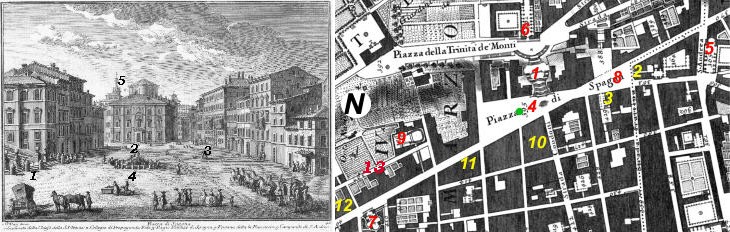
fountain. This 1752 etching by Giuseppe Vasi shows the eastern part of the square which was called Piazza di Spagna because in 1647 the
Spanish Embassy was moved to a palace shown in the right side of the plate; the western section of the square, which included the steps leading to the French church of
SS. Trinità dei Monti, was called Piazza di Francia; in this way the historical struggle for supremacy in Italy between these two
European nations was reflected in the topography of Rome.
This foreword may explain why Vasi did not show the famous steps leading to the church;
over time Piazza di Spagna became the name of the whole square and English travellers attributed to Spain also the
steps which were built with French money.
The view is taken from the green dot in the 1748 small map below.
In the description below the plate Vasi made reference to: 1) Steps leading to SS. Trinità dei Monti;
2) Palazzo di Propaganda Fide; 3) Palazzo di Spagna; 4) Fontana della Barcaccia;
5) Campanile di S. Andrea delle Fratte.
5) is covered in another page.
The small map shows also 6) SS. Trinità dei Monti; 7) S. Atanasio dei Greci (along Via del Babuino);
8) Colonna dell'Immacolata; 9) Teatro d'Alibert; 10) Caffè Greco (in Via Condotti); 11) Calcografia di Mariano Vasi; 12) Palazzo Boncompagni Cerasi; 13) Via Margutta.
The dotted line delineates the border between Rione Campo Marzio (left) and Rione Colonna (right).
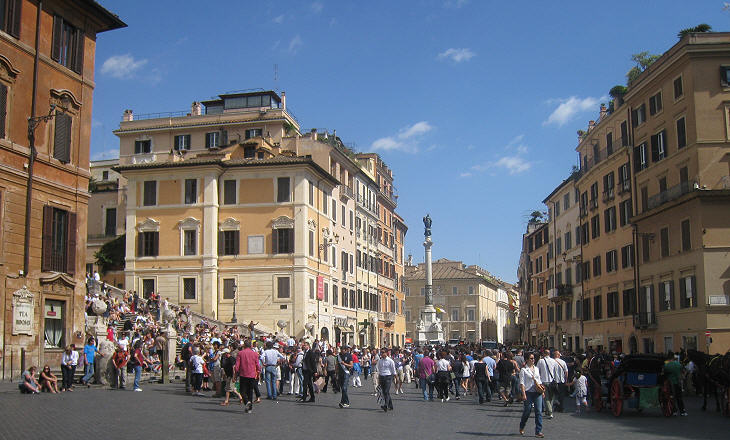
The view in June 2010
The old inns have been replaced by primary chain stores so Piazza di Spagna continues to attract foreign travellers; the main change relates to the erection of Colonna dell'Immacolata in 1857. Some houses are higher than they were in the XVIII century; their terraces are much sought after (you may wish to visit the House of Isa and Giorgio de Chirico at the top floor of one of them).

SS. Trinità dei Monti and the monastery of the Minims (see it from a different point)
SS. Trinità dei Monti preceded in time the other monuments of Piazza di Spagna and because of its commanding position it influenced the design of the
square; in 1483 King Louis XI of France fell gravely ill; he asked Pope Sixtus IV to send him Francis of Paola, a Franciscan monk who was renowned for his miracles.
Francis was unable to heal the king, but he gained his admiration and that of his son, the future King Charles VIII; the latter
in 1494 bought a piece of land on the Pincio hill to build a monastery and a church for the Minims,
a branch of the Franciscan Order which was founded by Francis of Paola.
The monastery was reserved to French members of the order.
Today SS. Trinità dei Monti is part of the French religious institutions in Rome (Pieux Etablissements de la France) which include also S. Luigi dei Francesi, S. Ivo dei Brittoni, SS. Andrea e Claudio dei Borgognoni and S. Nicola dei Lorenesi.
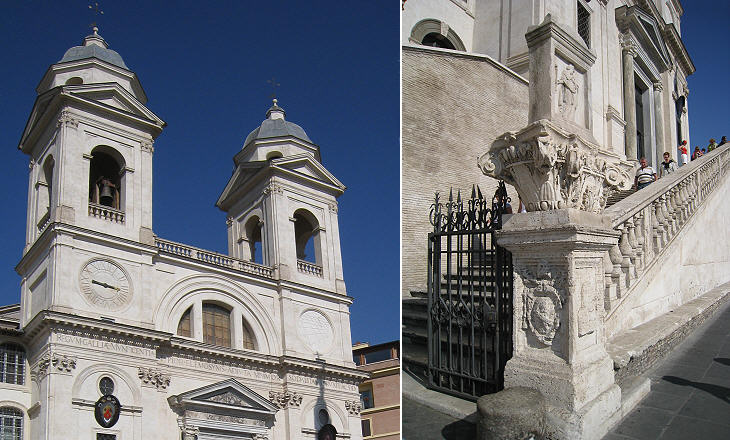
(left) Detail of the façade with the two bell towers; (right) steps bearing the coat of arms of Pope Sixtus V
The church was built in 1519, but the façade was finished towards the end of the century,
most likely by Giacomo Della Porta (the steps are similar to those of Palazzo Senatorio, which Della Porta was completing in that period).
The two bell towers are evocative of those of many French cathedrals, although their final appearance is only
vaguely Gothic; two clocks were placed on them: one indicated the French (international) hour and the other the Italian hour. The latter was replaced by a sundial after 1847 when the Italian system was abandoned.
You may wish to see the church as it appeared
in a 1588 Guide to Rome. Move to page two and visit the interior of the church and the adjoining convent.
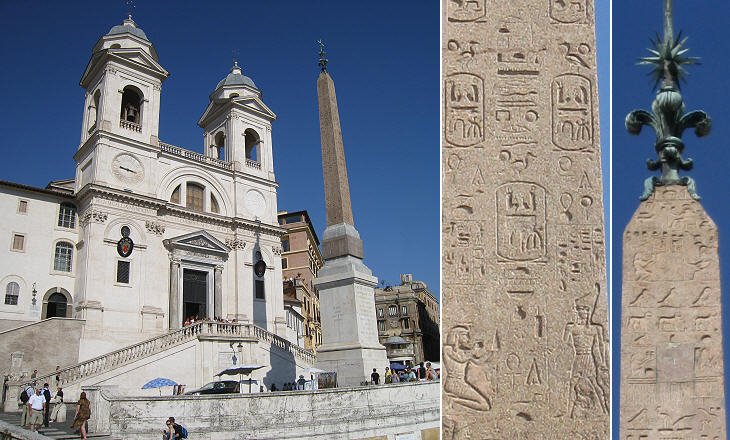
(left) Obelisco Sallustiano; (centre) detail of its hieroglyphics; (right) bronze heraldic symbols of Pope Pius VI
In 1789 Pope Pius VI erected an obelisk in front of the church; it is a small scale copy of the obelisk to Pharaoh Rameses II, now in Piazza del Popolo and it was found at Horti Sallustiani for the decoration of which it had been made. The obelisk can be seen from a great distance from the obelisk in front of Tribuna di S. Maria Maggiore and from Palazzo Borghese. You may wish to see all the obelisks of Rome in one page.

The winding design of the steps makes them less steep; in late April/early May they are decorated with azaleas
In one of the Galleries of the Vatican Palace they shew'd us Models for an Ascent to the Church of Trinita del Monte, which indeed is very much wanted: when we were there, the Ascent was not only rude and wild, but troublesome and difficult from the Piazza di Spagna to it.
Edward Wright - Some Observations made in Travelling through France, Italy &c. in the years 1720, 1721 and 1722, [1730].
December 13. The day arose as beautiful, as brilliant, as cloudless, as I could have desired for the first day in Rome. About seven o'clock, and before any one was ready for breakfast, I walked out of Albergo di Parigi in Via Santa Croce and directing my steps by mere chance to the left, found myself in the Piazza di Spagna and opposite to a gigantic flight of marble stairs leading to the top of a hill. I was at the summit in a moment; and breathless and agitated by a thousand feelings, I leaned against the obelisk, and looked over the whole city. I knew not where I was: nor among the crowded mass of buildings, the innumerable domes and towers, and vanes and pinnacles, brightened by the ascending sun, could I for a while distinguish a single known object; for my eyes and my heart were both too full: but in a few minutes my powers of perception returned; and in the huge round bulk of the castle of St. Angelo, and the immense facade and soaring cupola of St. Peter's, I knew I could not be mistaken. I gazed and gazed as if I would have drunk it all in at my eyes: and then descending the superb flight of steps rather more leisurely than I had ascended, I was in a moment at the door of our hotel.
Anna Jameson - Diary of an Ennuyée - 1826
The kings of France and the popes debated for more than a century on how to appropriately give access to
SS. Trinità dei Monti from the centre of Rome; at one point Monsignor Elpidio Benedetti, an envoy of
Cardinal Jules Mazarin and the owner of Villa del Vascello, showed Pope Alexander VII
a project which the French were prepared to finance; it had only one drawback for the Pope, i.e. it provided for a large equestrian
statue of King Louis XIV. Only after the death of this king relations with France improved and in 1717 a contest was called for a suitable project.

Piazza di Spagna and Via Condotti early in the morning. You may wish to see it at Ferragosto
Eventually a second contest in 1723 led to the endorsement of a project designed by Francesco de Sanctis; the curved lines of the steps recall those of
Porto di Ripetta by Alessandro Specchi.
Costs were born by France (a donation had been made in 1655 by Etienne Gueffier, a French nobleman)
and the
small columns and the globes at the beginning of the steps were decorated with the fleurs-de-lis of the French kings together with the chequered eagle of Pope Innocent XIII, the reigning pope.
An aspect which contributes to the beauty of the steps is that their axis is not perpendicular
to the façade of the church; this lack of total symmetry gives them a lightness which a more traditional approach would not have yielded.
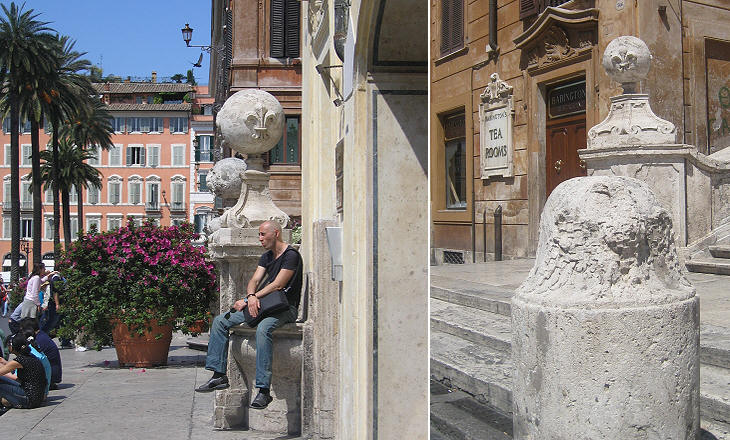
(left) You need to jump to have a good seat; (right) small columns and globes
The original plan provided for several statues of French saints on the balustrades; in addition two large
statues portraying King Louis XI and St. Francis of Paola were to be placed at the top of the steps; the project was never completed and probably
this lack of religious symbols made the steps so popular among the foreigners who lived in Piazza di Spagna, many of whom were not
Catholics; those who were, very often were rather skeptical.
Read Hans Christian Andersen's account of a beggar who was surnamed the King of the Spanish Steps.
Read Charles Dickens's account of the Roman models who used to spend their days on the Spanish Steps.
Read William Dean Howells' 1908 account of this neighbourhood.
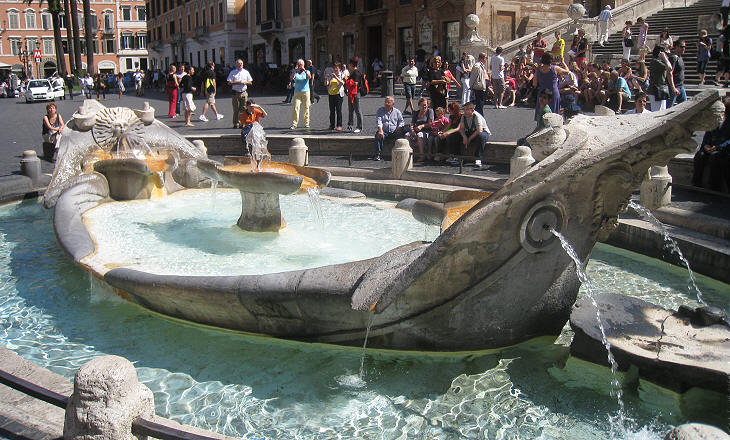
La Barcaccia, the ugly boat, but "barcaccia" was the name given to the shallow boats which carried wine to Porto di Ripetta; you can see it also in the image used as background for this page
According to Vasi the fountain was designed by Gian Lorenzo Bernini, but today the prevailing opinion attributes it to Pietro Bernini, his father,
who was in charge of a project for the distribution of the water of
Acqua Vergine, an ancient aqueduct restored by Pope Sixtus IV. Low water pressure influenced the design of the
fountain, the shape and meaning of which has been extensively debated by art historians; most likely
Pietro Bernini, who worked at the decoration of many villas (including Villa Borghese), designed a fountain meant to amuse, rather than to impress.
La Barcaccia was built in 1627-1629 and it was decorated
with two reliefs showing a shining
sun, one of the heraldic symbols of Pope Urban VIII.
You may wish to see
Filippo Juvarra's plate
of the coat of arms of the Pope which he attributed to Gian Lorenzo Bernini or a page with links to the historical fountains of Rome.

(left) Façade by Gian Lorenzo Bernini (to the right that by Francesco Borromini);
(right) flag of the Vatican City State and coat of arms of Pope Urban VIII
The decision to build an elegant fountain was linked to the fact that in 1626 Pope Urban VIII was bequeathed a nearby building where he decided
to locate the headquarters of Collegio di Propaganda Fide,
a new congregation aimed at promoting and coordinating missionary activities (see a page on some of these activities). The façade in Piazza di Spagna was designed by Gian Lorenzo Bernini in 1644;
he placed at its centre a coat of arms of the Pope which
Filippo Juvarra included in his selection of papal coats of arms.
The palace is an extraterritorial property of the Holy See (hence the papal flag), although most of the activities of the congregation are now housed
in Nuovo Collegio Urbano De Propaganda Fide.
The façade by Borromini and the other sides of the palace are shown in a separate page.
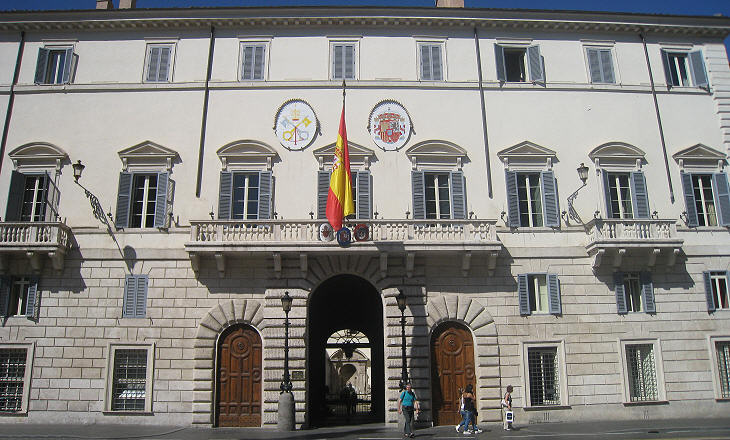
Façade
In 1622 a Spanish ambassador rented a small palace belonging to the Monaldeschi in Piazza della Trinità, the old name of Piazza di Spagna. In 1647, in consideration of the development which had occurred in the area, King Philip IV of Spain bought the building to use it as the permanent location of the Spanish Embassy. Today it houses the Spanish Embassy to the Holy See, while that to the Italian Republic is at Palazzo Borghese (you may wish to see the Spanish Ambassador to the Holy See in high uniform).
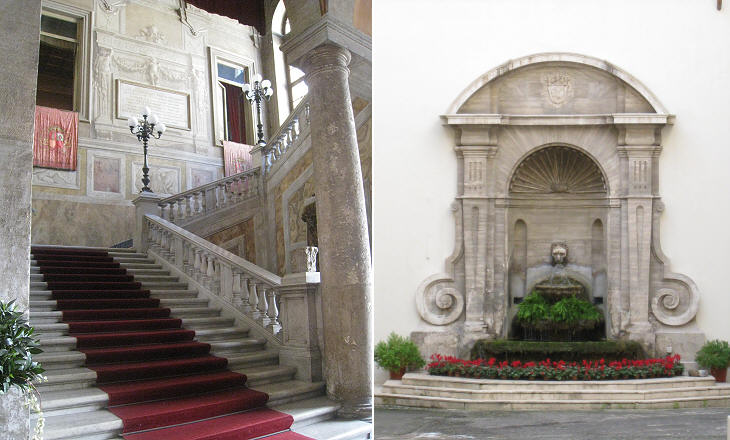
(left) Staircase designed by Antonio Del Grande; (right) fountain in the courtyard. You may wish to see more fountains in the courtyards of Rome
The palace was modified by Antonio Del Grande in the 1650s; art historians believe that Del Grande received advice from Francesco Borromini, who however was not directly involved in the redesign of the building. Spanish ambassadors used to organize great celebrations in front of their palace on the occasion of births, weddings and deaths of royal family members. The façade was given its current rather unassuming aspect in 1838 by Antonio Celles, a Spanish architect.

(left) Colonna dell'Immacolata; (centre) statue by Giuseppe Obici; (right) King David by Adamo Tadolini
In 1777 a tall cipollino column was unearthed near
L'Immacolata Concezione in Campo Marzio; Pope Pius VI, the reigning pope, considered placing it in
Piazza di Montecitorio,
but he eventually preferred to erect an ancient obelisk there; in 1856 Pope Pius IX
decided to use it for a monument to the Virgin Mary, in order to celebrate the
Immaculate Conception of the Virgin Mary, a dogma he promulgated on December 8, 1854. The monument was inaugurated in September 1857. Rome had already a similar column at S. Maria Maggiore.
You may wish to see the ceremony which takes place every year on December 8 at the foot of the column.

"Second" view by Giuseppe Vasi
The official target of the 10 books of etchings published by Vasi between 1746 and 1761 was not the admirer of the Roman monuments, but rather the faithful pilgrim. Mariano Vasi sold his father's books and etchings in a shop near Piazza di Spagna; he realized that his customers were mainly foreign travellers and that they would have gladly bought a view of the Spanish Steps. The original plate of Piazza di Spagna was replaced by Scalinata in Piazza di Spagna, an etching falsely attributed to Giuseppe Vasi (he passed away in 1782 when the obelisk was not yet placed at the top of the steps).
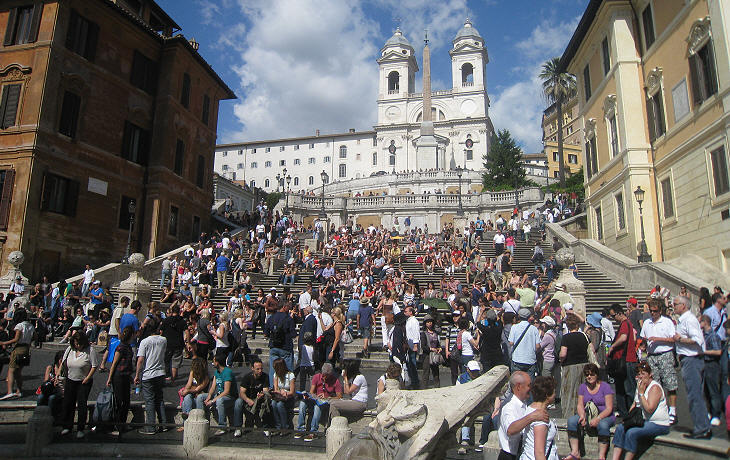
The view in June 2010
Those who do not like to be in a crowd, can reach SS. Trinità dei Monti via Rampa di S. Sebastianello or Rampa Mignanelli, two of the silent streets of Rome.
Move to page two.
Excerpts from Giuseppe Vasi 1761 Itinerary related to this page:
Piazza di SpagnaDopo la divisata strada si slarga la magnifica piazza, che dicesi di Spagna non solo per il palazzo dell'Imbasciatore di quel Monarca; ma ancora perchè è di giurisdizione del medesimo, e perciò è la più frequentata e abitata da' forestieri, e illustri viaggiatori; onde vi sono de' nobili alloggiamenti, e degli antiquarj condottieri in abbondanza.Scalinata e Fontana della BarcacciaSulla medesima piazza corrisponde la grande scalinata fattavi dal Re Cristianissimo Luigi XIV. col disegno di Franc. de Santi per rendere agevole e maestoso l'accesso alla chiesa della ss. Trinità de' Frati Minimi Francesi, che sta sul monte Pincio. E da piede si vede il fonte fattovi dal Bernino per ordine di Urbano VIII. che per essere in forma di nave, dicesi la barcaccia.Chiesa della SS. Trinità sul Monte PincioNel sito più bello del monte Pincio fu eretta questa chiesa l'anno 1494. dal
Re Christianissimo Carlo VIII. ad istanza di s. Francesco di Paola, per stabilirci li Frati
Minimi Francesi, e nel 1595. fu consagrata , e poi ornata di marmi, e di pitture inoltre;
fra le quali la decollazione di s. Gio. Batista, e i laterali a fresco nella prima cappella a
destra sono del Naldini; il s. Francesco di Sales nella seconda è di Fabbrizio Chiari;
le pitture nella terza sono di Daniele da Volterra; il s. Michele Arcangelo però è di
Giuseppe Corvi; e quelle nella cappella dell'Assunta sono di Gio. Paolo Rosetti,
fuorchè li due figuroni negli angoli, che sono del Volterra, e le istorie nella volta,
di Marco da Siena, e di Pellegrino Bologna; la natività della ss. Vergine è di Bizzarra
Spagnolo; e gli Innocenti di Michele Alberti. Il Cristo morto nella cappella, che siegue,
ed altre pitture sono di Paris Nogari; la natività del Signore con altre pitture sono di
persona incognita. Il ciborio nell'altare maggiore è disegno di Monsù Gio. Sciampagna, il
quale vi fece in stucco il mistero della ss. Trinità, e ne' laterale la statua di s. Luigi,
e quella di s. Francesco di Paola; il quadro della Coronazione della santissima Vergine nella
cappelletta è di Federigo Zuccheri. Le pitture nella crociata sono di Pierin del Vaga;
l'Assunzione però, e gli Apostoli, e Profeti furono principiati da Taddeo Zuccheri, e poi
terminati da Federigo suo fratello. La cappella di santa Maria Maddalena con le pitture a
freso nelle lunette, e volta sono di Giulio Romano, ajutato da Francesco suo cognato, e i
laterali colla piscina, e resurrezione di Lazzaro di Pierin del Vaga; la deposizione della
Croce con tutto il resto sono di Daniello da Volterra; la ss. Nunziata colla creazione di
Adamo, ed Eva, di Cesare del Piemonte, e la natività del Signore, che le sta incontro, con
l'altre della ss. Vergine, sono di Paolo Cedaspe Spagnolo. Il ss. Crocifisso nell'ultima
cappella è di Cesare Nebbia, e la sepoltura del Perini con due putti è opera del Lorenzetto. |