
All images © by Roberto Piperno, owner of the domain. Write to romapip@quipo.it.


Notes:
Page revised in June 2020.
All images © by Roberto Piperno, owner of the domain. Write to romapip@quipo.it.
Notes:
Page revised in June 2020.
 Palazzo Borghese
Links to this page can be found in Book 4, Map C2, Day 4, View C5 and Rione Campo Marzio.
The page covers:
The plate by Giuseppe Vasi
Today's view
Palazzo Borghese
- Ancillary buildings
- Eagles and Dragons
Piazza di Monte d'Oro (Ospizio di Liegi)
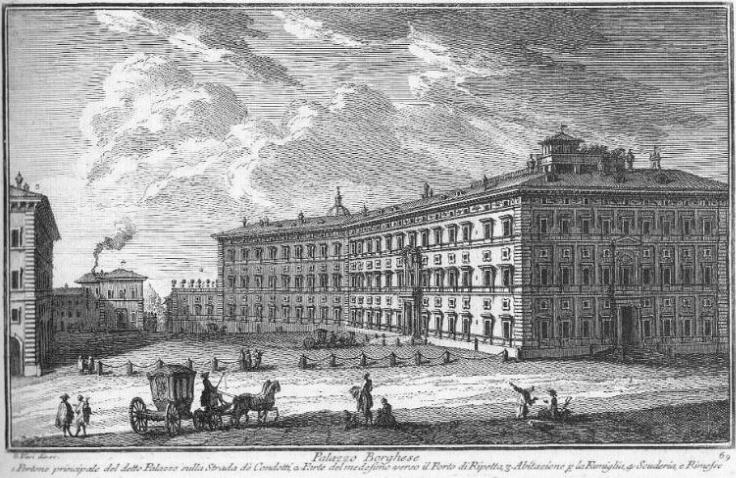
Palazzo Borghese was built in a relatively short period of time (1560-1614),
but it is the result of a series of additions, rather than the conclusion of a comprehensive initial project;
in this 1754 etching Giuseppe Vasi tried to show the three sections of the palace: a) the southern façade which was completed before 1600 (far right);
b) the angled and very long western façade (1605-1612); c) the northern terrace facing Porto
di Ripetta (1612-1614). Other illustrators of the palace chose to show only two of its sections, e.g. Alessandro Specchi in 1699 (it opens in another window). Palazzo Borghese was called il Cembalo (Harpsichord) to describe its unusual shape.
The view is taken from the green dot in the small 1748 map here below.
In the description below the plate Vasi made reference to: 1) Main entrance to the palace along Strada dei Condotti;
2) Prospect of the palace over Porto di Ripetta;
3) Building for the "family" (people working for the Borghese either as servants or in the administration of their properties);
4) Stables and coach house. 2) is shown in another page.
The small map shows also 5) Piazza di Monte d'Oro.


The view in June 2010: (left) western side; (right) southern side
The exterior of Palazzo Borghese is unchanged from the time of the etching exception made for the loss of the coat of arms of Pope Paul V on the western façade, which Filippo Juvarra sketched in his book on the finest papal coats of arms. The stables and the coach house have been replaced by a modern building; today the square houses stalls selling old books and prints. The palace was repainted in 2010. You may wish to see the colour it had before (it opens in another window) and a page on the colours of Rome in the 1990s.

(left) Section facing the river; (right) southern side on Via della Fontanella Borghese with a view towards Via Condotti and SS. Trinità dei Monti

(left) Western entrance; (right) small columns of granite and cipollino
I went to see the Pallace of Burghesi. This is one of the noblest Pallaces in Rome. It gives you a fair Broadside of Windows, three Stories one over another;
and its Length is Prodigious.
Richard Lassels' The Voyage of Italy, or a Compleat Journey through Italy in ca 1668
The construction of Palazzo Borghese was started by Monsignor Tommaso Del Giglio and it was continued by Cardinal Pedro de Deza;
in 1600 the southern façade was completed; many art historians attribute the design of this section to
Martino Longhi. In 1604 Cardinal Camillo Borghese bought the building, which he bequeathed to members of his family after he was elected
Pope Paul V in May 1605.
The Borghese commissioned Flaminio Ponzio the enlargement of the palace;
a façade almost identical to the existing one was built on the western side of the block; in 1607 an adjoining building was bought by the Borghese and this side was lengthened (with an angle); in 1612-1614 a sort of hanging garden was built opposite Porto di Ripetta.
Piazza Borghese, the square in front of the western façade, was also known as Piazza delle Catene, because of the chains placed on the small columns protecting the entrance.

Courtyard and loggia with ancient granite columns
Mounting up to
the Chambers I found a fair open Gallery built
upon Arches and Pillars round about the Court. Lassels
March 1788. I was one morning in the Borghese Gallery, which I
had not seen for a year, and to my joy I found that I now
contemplated it with much more understanding eyes than
formerly. There are unspeakable treasures in the Prince's
possession.
J. W. Goethe - Italian Journey - Translation by Charles Nisbet
The picture-rooms open from one into another, and have many points of magnificence, being large and lofty, with vaulted ceilings and beautiful frescoes, generally of mythological subjects, in the flat central parts of the vault. The cornices are gilded; the deep embrasures of the windows are panelled with wood-work; the doorways are of polished and variegated marble, or covered with a composition as hard, and seemingly as durable. The whole has a kind of splendid shabbiness thrown over it, like a slight coating of rust; the furniture, at least the damask chairs, being a good deal worn; though there are marble and mosaic tables which may serve to adorn another palace, when this has crumbled away with age.
Nathaniel Hawthorne - Passages from the Italian Note-book - 1859
The Borghese and in particular Cardinal Scipione Borghese, nephew of the Pope, were avid collectors of paintings which they used for the decoration of their town palace; today these paintings constitute the bulk of those shown at Galleria Borghese.

Large statues: 1) a woman with an added head not consistent with the size of the body; 2) statue of Apollo with the head of a woman; 3) Ceres, a Roman goddess, with the head of a woman of the time of Emperor Septimius Severus; 4) Mars
The Borghese were collectors also of antiquities. Statues and reliefs were mainly utilized for the decoration of their suburban villa, but a limited number of them were placed in the courtyard of the town palace and in the adjoining garden. In line with the usage of the time the missing parts of ancient statues were replaced by modern additions or by fragments of other ancient statues.
In the centre of the palace four lofty whitewashed colonnades, filled with statues and busts, inclosed a little garden; tall aloes and cactuses grew up the pillars; citron-trees stood there with grass-green fruit which was not yet yellowed by the sun. Two dancing Bacchantes held a water-bowl aloft, but so obliquely that the water streamed upon their shoulders; tall water-plants drooped over them their juicy, green leaves.
Hans Christian Andersen - The Improvisatore - 1845
In 1658 Giovanni Battista Borghese married Eleonora Boncompagni, from the family of Pope Gregory XIII. She had her study room in the ground floor of the western wing of the palace. In 1671 her husband decided to renovate the rear part of the palace to provide his wife with a pleasant small garden she could access from her study room.

Ancient statues in the garden: 1) Hercules; 2) Dionysus; 3) a male figure with a head from another statue; 4) a female figure with a head which might belong to another statue (but it fits well)
In the Garden. A Bas-Relief of five Figures, One sits upon a Rock playing on a Fistula. Two Antique Statues, extremely Fine, of
the Hercules of Farnese: Less than that, but big as the Life. Venus of Medicis. Antique.
Jonathan and Jonathan Richardson - Account of Some of the Statues, etc. in Italy - 1722
Carlo Rainaldi superintended the design of the garden. He decorated it with some ancient statues, because this was a must for a noble Roman residence, but he chose statues which were nicer to see and less imposing than those in the courtyard. Some of them are still there.
Three fountains were the key feature of the new set up of the garden. They were decorated by
Leonardo Retti, Filippo Carcani and Francesco Cavallini, three sculptors who began their career either working for Gian Lorenzo Bernini or for a sculptor of the master's inner circle (e.g. Retti worked with Antonio Raggi at the ceiling of il Gesù). Retti made also the 29 vases on the top of the back wall, one of which can be seen in the image used as background for this page.
The gaiety of the decoration of the garden however is not indicative of Eleonora Boncompagni Borghese's personality and mood. She was interested in religious matters and she supported the views of Miguel de Molinos, a Spanish theologian who supported mystical prayer and a state of contemplation. These views were condemned as heretical in 1687 and eventually Molinos was sentenced to life imprisonment. Relations between Eleonora and her husband were very tense and only on her deathbed she expressed the desire to reconcile herself with him, but she expressly wanted to be buried at S. Lucia dei Ginnasi, rather than in the family chapel at S. Maria Maggiore.
Cardinal Scipione Borghese had a personal court of more than 200 people; because he shared Palazzo Borghese with
other members of the family, he built a completely independent palace for his assistants and servants; during his lifetime it was called
Palazzo della famiglia del Cardinale; the design of the building is rather simple, but not without grace.
Eagles
and dragons are the heraldic symbols of the Borghese; those shown above are just some of the many ones which decorate their properties. The Borghese still live in a section of their family palace.

Bath of Diana by Leonardo Retti and a detail of its elaborate stucco decoration

(left) The Three Graces by Francesco Cavallini; (right) Spring by Filippo Carcani

Relief from a sarcophagus depicting an Amazonomachy and a "strigilato" Christian sarcophagus used as the basin for a fountain (as in other Roman palaces)
Ancillary buildings

Palazzo della Famiglia Borghese

(left) Modern building on the site of the stables; (right) main entrance to Palazzo della Famiglia Borghese
Eagles and Dragons

Heraldic symbols in Piazza Borghese

Heraldic symbols of Monsignor Tommaso del Giglio (left) and of Cardinal Pedro de Deza (centre/right) in the courtyard of Palazzo Borghese
Piazza di Monte d'Oro

(left) Piazza di Monte d'Oro (Golden Mountain, the name of a lost inn); (centre) madonnella at the corner with Via dell'Arancio
Today the area behind Palazzo Borghese is void of interest because of the many changes made at the end of the XIXth century; the size of Piazza di Monte d'Oro, a square shown in Vasi's 1781 Map of Rome (No. 14), was reduced.
A street along the northern side of Palazzo Borghese is called Via dell'Arancio, a reference to the orange trees which grew on the terrace of the palace.
One of the buildings of the square housed a hostel for pilgrims from Liège, the main town of the French-speaking part of Belgium (the Flemish-speaking one had a church and a hostel at S. Giuliano dei Fiamminghi). It was founded in 1699 and it was restored in 1854 at the initiative of Xavier de Mérode, a Belgian prelate who was for many years Pope Pius IX's Minister of War.
Next plate in Book 4: Palazzo Madama.
Next step in Day 4 itinerary: Collegio Clementino.
Next step in your tour of Rione Campo Marzio: Collegio Clementino.
Excerpts from Giuseppe Vasi 1761 Itinerary related to this page:
Palazzo BorgheseA sinistra della detta chiesa si vede il magnifico palazzo, che per la sua forma dicesi il cembalo di Borghese. Fu questo principiato dal Card. Deza Spagnolo, ma poi fu terminato da Paolo V. per dare comoda abitazione ai suoi nipoti. Quella parte, che corrisponde sul porto di Ripetta è disegno di Flaminio Ponzio, il resto però verso la piazza è di Martin Lunghi il vecchio. È notabile il gran cortile ornato con portici doppi sostenuti da cento colonne tutte di granito egizio: gli appartamenti sono ricchi di quadri insigni, e di arredi preziosi: fra tutti è distinta la cappella domestica per le molte reliquie giojellate, e l'appartamento di D. Giacomo fratello del Principe, ornato, di cose rare e pellegrine; perciò sarà più gradito al lettore il vederle, che il sentirne la narrazione, tanto più, che dal custode viene tutto mostrato. |


