All images © by Roberto Piperno, owner of the domain. Write to romapip@quipo.it.


Notes:
Page added in December 2025.
All images © by Roberto Piperno, owner of the domain. Write to romapip@quipo.it.
Notes:
Page added in December 2025.
 Piazza dei Miracoli & The Leaning Tower
You may wish to see a page on Ancient Pisa first.
The appellation dei Miracoli was first used in 1910 by Gabriele d'Annunzio, a famous Italian poet, with reference to the beauty of the four monuments which stand in the piazza which until then was known as Piazza del Duomo.

The "Four Fabrics", illustration from "Dean Howells - Italian Journeys - 1867"
The brook Arno runs from the East to the west through Pisa, seated in a Plaine, and towards the North-West by North is a Gate, and a most faire Cathedral Church. (..) The steeple is neere the Church but severed from it, which seemes to threaten the falling from the top to the bottome, but that is done by the great Art of the workemen, deceiving the eye; for it is as strongly built as the Church. Not farre thence is a yard used for common buriall, called the holy field, vulgarly Campo Santo.
Fynes Moryson - An Itinerary: Containing His Ten Years Travel Through .. Italy (in 1594)
October 1644. The Campanile or Settezonio, consists of several orders of pillars, thirty in a row, designed to be much higher. It stands alone on the right side of the cathedral, strangely remarkable for this, that the beholder would expect it to fall, being built exceedingly declining, by a rare address of the architect; and how it is supported from falling I think would puzzle a good geometrician. The Duomo, or Cathedral, standing near it, is a superb structure, beautified with six columns of great antiquity; the gates are of brass, of admirable workmanship. The cemetery called Campo Santo, is made of divers galley ladings of earth formerly brought from Jerusalem. (..) Near this, and in the same field, is the Baptistery of San Giovanni. (..) The place where these buildings stand they call the Area.
John Evelyn - Diary and Correspondence related to his stay in Italy in 1644
We actually
have a bona fide septizonium in the Campanile of Pisa, the tiers
of which were only seven in the original design of Wilhelm and
Bonanno. The eighth was added about a century later.
Rodolfo Lanciani - The ruins and excavations of ancient Rome

Piazza dei Miracoli, from "Descrizione Storica e Artistica di Pisa e de suoi Contorni
by Ranieri Grassi - 1836"
The most remarkable things we took notice of in this City were: 3. The Domo or Cathedral Church, a sumptuous building of Marble, having all the doors of brass curiously engraven, a double isle on each side the Nave, and two rows of Marble pillars. (..) 4. The Baptisterium, having in the middle a large marble Font like the Cistern of a Fountain, with water continually running into it. 5. The burying place called the Campo Santo, because made of earth brought out of the holy Land. 6. The Campanile or Steeple, a large round tower of a considerable highth, so very much enclining or seeming to encline or lean to one side, that one would think it could not long stand upright, but must needs fall that way. I suppose it was on purpose built so at first, one side being made perpendicular and the other enclining, to deceive the sight, though some say it sank after it was built, and doth really incline.
John Ray - Observations topographical, moral, and physiological: published in 1673.

Piazza dei Miracoli, illustration from "Florence & some Tuscan cities painted by Colonel R. C. Goff - 1905"
I resolved to stay here one day onely, in which time I saw
1. The Domo whose Canons officiate in Scarlet like Cardinals.(..)
2. Near to the Domo stands if leaning may be called standing the bending Tower, so artificially made, that it seems to be falling and yet it stands firm.
3. On the other side of the Duomo, is the Campo Santo a great square place cloistered about with a low Cloister curiously painted.
Richard Lassels - The Voyage of Italy, or a Compleat Journey through Italy in ca 1668
From Leghorn I went to Pisa, where there is still the shell of a great city, though not half furnished with inhabitants. The great church, baptistery, and leaning tower, are very well worth seeing, and are built after the same fancy with the cathedral of Sienna.
Joseph Addison - Remarks on several parts of Italy, in the years 1701, 1702, 1703
The principal things they take Travellers to see, are the Dome, the Baptistery, the Campo Santo, and the Leaning Tower, all built of white Marble, and standing near together under one view in a large open pleasant place.
Edward Wright's Observations made in France, Italy &c. in the years 1720, 1721 and 1722.

View in July 2025: (left to right) Camposanto, Cathedral and Leaning Tower
They have several handsome squares, and a great many magnificent buildings. The chief of these is the cathedral, dedicated to S. Mary, very advantageously situated in the middle of a large piazza. (..) In the same square with the dome, stands the baptistery a round fabric supported by stately pillars, and remarkable for a very extraordinary eccho. Near it is the burying place, called Campo Santo, being covered with earth brought from the Holy-Land. Near the church there is a steeple in the form of a cylinder, to which they ascend by 153 steps; it inclines fifteen feet on one side, which some ascribe to art, but others to the sinking of the foundation.
Thomas Nugent - The Grand Tour - 1749
Pisa appears to great advantage at some distance, presenting the swelling dome of its cathedral, attended by its baptistery on one side, and the singular form of the leaning tower on the other, with various lesser domes and towers around or in perspective. (..)
On the evening of our arrival, this immense fabric (the Cathedral) was illuminated, in compliment to the king of Etruria, who was expected to offer up his devotions there on his arrival from Florence. As the tapers were almost innumerable, and their arrangement extremely beautiful, the effect was to us at least novel and astonishing. Illuminations indeed, whether in churches or in theatres, are no where so well managed as in Italy; no expense is spared; tapers are squandered with prodigality; all the architectural varieties of the hall or edifice are marked by lights; and the curves of the arches, the lines of the cornices, and the flourishes of the capitals, are converted into so many waving flames; so that we no where meet with such magnificent shews and surprising combinations of lights as at Rome, Naples, Venice, and the other great cities of Italy.
John Chetwood Eustace - Classical Tour of Italy in 1802 (publ. 1813)
Pisa. Its gravity pervades every street, but its magnificence is now confined to one sacred corner. There stand the Cathedral, the Baptistery, the Leaning Tower, and the Campo Santo; all built of the same marble, all varieties of the same architecture, all venerable with years, and fortunate both in their society and their solitude.
Joseph Forsyth - Remarks on Antiquities, Arts, and Letters in Italy in 1802-1803

View in July 2025: (left to right) Baptistery, Cathedral and Leaning Tower
But the finest group of buildings of this description perhaps in the world, is that which Pisa presents to the contemplation of the traveller in her Cathedral, and its attendant edifices, the baptistery, the belfry, and the cemetery. These fabrics are totally detached, occupy a very considerable space, and derive from their insulated site, an additional magnificence. They are all of the same materials, that is, of marble, all nearly of the same era, and excepting the cloister of the cemetery, in the same style of architecture. Eustace
I might have known better; but, somehow, I had expected to see the Tower, casting its long shadow on a public street where people came and went all day. It was a surprise to me to find it in a grave retired place, apart from the general resort, and carpeted with smooth green turf. The group of buildings, clustered on and about this verdant carpet comprising the Tower, the Baptistery, the Cathedral, and the Church of the Campo Santo is perhaps the most remarkable and beautiful in the whole world; and from being clustered there, together, away from the ordinary transactions and details of the town, they have a singularly venerable and impressive character. It is the architectural essence of a rich old city, with all its common life and common habitations pressed out, and filtered away.
Charles Dickens - Pictures from Italy - 1846
Among memorable custodians in Italy was one whom we saw at Pisa, where we stopped on our way from Leghorn and spent an hour in viewing the Quattro Fabbriche. The beautiful old town, which every one knows from the report of travelers, one yet finds possessed of the incommunicable charm which keeps it forever novel to the visitor. (..) You may drive on, to the great Piazza where stands the most famous group of architecture in the world, after that of St. Mark's Place in Venice. There is the wonderful Leaning Tower, there is the old and beautiful Duomo, there is the noble Baptistery, there is the lovely Campo Santo, and there - some where lurking in portal or behind pillar, and keeping out an eagle-eye for the marveling stranger - is the much-experienced cicerone who shows you through the edifices. Howells

Cathedral: dome and apse (more on it in a separate page)
In speaking of the style of this group of edifices, I have, in conformity with other travellers, used the epithet Gothic, though, even in its usual acceptation in architectural language, not quite appropriate on this occasion. In fact, it is a composite style formed of Roman orders, corrupted and intermingled with Saracenic decorations. Thus, the open galleries of the Campanile, and the first and third stories of the cathedral, with the first and second of the baptistery, and all the exterior of the cemetery, are formed of semicircular arches resting upon pillars; a mode introduced about the time of Diocletian, very generally adopted in the era of Constantine, and almost universally prevalent both in the east and west, for a thousand, perhaps twelve hundred years afterwards, and not entirely laid aside even in our times. In the Campanile therefore, as in the stories abovementioned, there is little, if any thing, that can strictly be called Gothic. The arches of the gallery that surrounds the dome of the cathedral externally, are neither pointed nor round, but of the form of a fig-leaf; above each rises a pediment very narrow and very high. These ornaments are perhaps Gothic; the same may be said of the pediments or gables, for they resemble the latter much more than the former, as well as of the many pinnacles that adorn its parapet. (..) The cathedral exhibits in the gallery described above, some striking features of the style afterwards called Gothic. Eustace
The peculiar features of the monuments of Piazza dei Miracoli have led art historians to define their style as Pisan Romanesque. It is not limited to buildings in Pisa, but it applies to churches in other Tuscan towns, e.g. at Volterra and Massa Marittima, and in Sardinia.
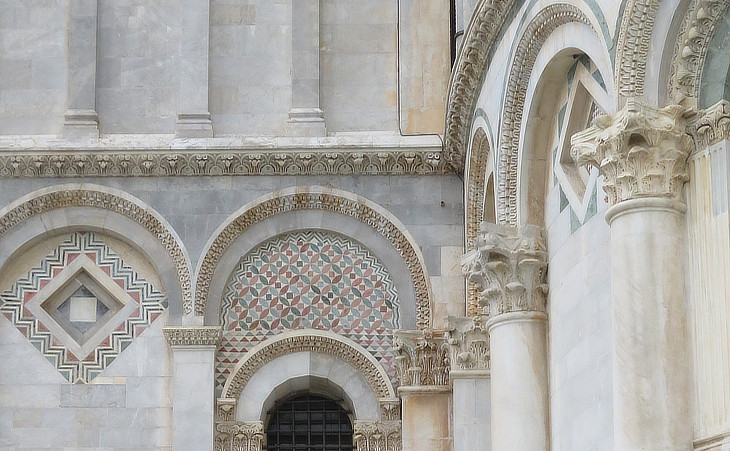
Cathedral: detail of its marble decoration
The Cathedral is built out of a great heap of wrought marble, such as pillars, pedestals, capitals, cornishes, and architraves, part of the spoils, which the Pisans took in their eastern expeditions, when the republic was in a flourishing condition. Nugent
The quantity of marble contained in these four immense edifices, and the number of pillars employed in their decoration are truly astonishing. The latter, some suppose to have been taken from ancient edifices, and as a proof of the magnificence of Pisa in the time of the Romans they cite an expression of Strabo, which however applies not to edifices, but to quarries. The great variety ot marble of which these columns are formed, and the rarity and value of some, give them an apparent claim to antiquity; though it does not appear that they belonged to any edifices either in this city or in its vicinity. They may have been imported by the Pisan gallies in their triumphant returns from Majorca, Sardinia, Corsica, Carthage, Sicily, and Naples; and may perhaps be considered rather as monuments of the victories of this once powerful republic, than as remains of its municipal magnificence under the Romans. Eustace
The cathedral of Pisa, begun in 1063, and consecrated
in 1118 by Pope Gelasius II., is mostly built of marbles
taken from Rome and Ostia. The workshop in which
the classic remains were transformed into new shapes
by Busketus and Ronald, the architects of the duomo,
has lately been found on the banks of the Arno. Some
of the marbles actually bear the mark of their origin;
one near the southwest corner of the transept is inscribed "To the Genius
of Ostia." They also imported sarcophagi, as that discovered in 1742 at the foot of the high altar, and now
preserved in the Camposanto, inscribed with the name
of Marcus Annius Proculus, a magistrate and leading
citizen of Ostia.
Rodolfo Lanciani - The Destruction of Ancient Rome - 1897

The Baptistery (more on it in a separate page)
The Baptistery, which, as in all the ancient Italian churches, is separated from the cathedral, stands about fifty paces from it full in front. It is raised on three steps, is circular, and surmounted with a graceful dome. Eustace
The cathedral at Pisa, with its baptistery, campanile, and the Campo Santo, are as interesting a group of buildings as any four edifices in the world. (..) They group well together and are seen to advantage. Visitors to these buildings are much pestered by persons offering their services as guides, but they are quite useless. A small fee is paid to the door-keepers of the Baptistery, Campanile, and Campo Santo: a paul to each of these is sufficient, except in the case of a large party.
John Murray - Handbook for travellers in Central Italy - 1861

The Camposanto (more on it in a separate page)
The three edifices which I have described, stand in a line, and appear together in full view; but the cemetery lies on the north side of the cathedral and baptistery, and seems rather a grand boundary than a detached edifice. (..) The four grand fabrics above described surpass any group of buildings I have beheld out of Rome, and confer upon Pisa a distinction worthy of its ancient fame and long duration. A duration which, if we may credit a poet, dates its commencement before the Trojan war! Eustace

Porta del Leone in the walls surrounding the western side of Piazza dei Miracoli (see a page on the walls and gates of Pisa with a map of the town)
The moon was shining when we approached Pisa, and for a long time we could see, behind the wall, the leaning Tower, all awry in the uncertain light; the shadowy original of the old pictures in school-books, setting forth "The Wonders of the World." Like most things connected in their first associations with schoolbooks and school-times, it was too small. I felt it keenly. It was nothing like so high above the wall as I had hoped. It was another of the many deceptions practised by Mr. Harris, Bookseller, at the corner of St. Pauls Churchyard, London. His Tower was a fiction, but this was reality - and, by comparison, a short reality. Still, it looked very well, and very strange, and was quite as much out of the perpendicular as Harris had represented it to be. The quiet air of Pisa too; the big guardhouse at the gate, with only two little soldiers in it; the streets, with scarcely any show of people in them and the Arno, flowing quaintly through the centre of the town; were excellent. So, I bore no malice in my heart against Mr. Harris (remembering his good intentions) but forgave him before dinner, and went out, full of confidence, to see the Tower next morning. Dickens
(1873) And these monuments for the most part, are off on the large grassy carpet spread for them, and with the elbow of the old city-wall, not elsewhere erect, respectfully but protectingly crooked about. (..) I need scarcely add, the centre of my daily revolution - quite thereby on the circumference - was the great Company of Four in their sequestered corner; objects of regularly recurrent pious pilgrimage, if for no other purpose than to see whether each would each time again so inimitably carry itself as one of a group of wonderfully-worked old ivories. Their charm of relation to each other and to everything else that concerns them, that of the quartette of monuments, is more or less inexpressible all round.
Henry James - Italian Hours - 1909

Former Spedale di S. Chiara, today Museo delle Sinopie, at the southern side of Piazza dei Miracoli
Pisa and its monuments have been industriously vulgarised, but it is astonishing how well they have survived the process. The charm of the place is in fact of a high order and but partially foreshadowed by the famous crookedness of its campanile. The Cathedral and its companions are fortunate indeed in everything - fortunate in the spacious angle of the grey old city-wall which folds about them in their sculptured elegance like a strong protecting arm; fortunate in the broad greensward which stretches from the marble base of Cathedral and cemetery to the rugged foot of the rampart; fortunate in the little vagabonds who dot the grass, plucking daisies and exchanging Italian cries; fortunate in the pale-gold tone to which time and the soft sea-damp have mellowed and darkened their marble plates; fortunate, above all, in an indescribable grace of grouping, half hazard, half design, which insures them, in one's memory of things admired, very much the same isolated corner that they occupy in the charming city. James

Leaning Tower: (left) from "Descrizione Storica e Artistica di Pisa e de suoi Contorni" by Ranieri Grassi - 1836; (right) from "Corrado Ricci - Romanesque Architecture in Italy - 1925"
It is perhaps not impossible that the first plan of the
Pisa campanile originated in Ravenna, where there were
already some towers crowned with a double arcade, each
of which had five three-light openings, and which form
two nearly continuous galleries. Corrado Ricci
We now proceed to the Campanile or belfry, which is the celebrated leaning tower of Pisa. It stands at the end of the cathedral opposite to the baptistery, at about the same distance. It consists of eight stories, formed of arches supported by pillars, and divided by cornices. The undermost is closed up, the six others are open galleries, and the uppermost is of less diameter, because it is a continuation of the inward wall, and surrounded not by a gallery but by an iron balustrade only. The elevation of the whole is about one hundred and eighty feet. The staircase winds through the inward wall.
The form and proportion of this tower are graceful, and its materials which are marble, add to its beauty; but its grand distinction, which alone gives it so much celebrity, is a defect which disparages the work, though it may enhance the skill of the architect, and by its novelty arrest the attention. I allude to its inclination, which exceeds fourteen feet from the perpendicular. The cause of this architectural phenomenon has occasioned some debate, while many ascribe it to accident, and many to design; the former is now the generally received opinion. The ground at Pisa and all around it, is rather wet and swampy, and may easily have yielded under edifices of such elevation and weight; and indeed, if I am not mistaken, the cathedral and baptistery themselves have a slight and almost imperceptible inclination southward; a circumstance which if ascertained, as it easily might be, would leave no doubt, if any could be supposed to remain, as to the cause of the deviation from perpendicularity observable in the Campanile. However, though the unequal sinking of the foundation may have been the cause of this singularity, it yet appears that it took place before the termination of the edifice; and that the architect had the courage to continue the work, notwithstanding so alarming a symptom, and the skill to counteract its consequences. This is inferred from the observation, that the uppermost story diverges much less from the perpendicular line than the others, and seems to have been constructed as a sort of counterpoise. A French traveller carries this idea still farther, and supposing that the foundation gave way when the edifice had been raised to the fourth story, pretends that the architect to restore the equilibrium, gave the pillars on the leaning side a greater elevation. This representation, as far as it regards the fifth and sixth stories, is inaccurate. At all events, whatever cause produced the effect, the result equally evinces the solidity of the edifice and the judgment of the architect, as it has now stood more than six hundred years without the least appearance of fissure or decay.
"Ruituraque semper Stat (mirum) moles." Luca. lib. iv.
(Although tottering,
and on the brink of destruction, it stands secure, to the admiration
of all men).
Eustace

Leaning Tower: (left) from an observation point which minimizes its leaning; (right) from an observation point inside Museo dell'Opera del Duomo which maximizes it
The Leaning, Tower (of which we have many Prints
in England) is a Piece of fine Architecture, tho its not standing upright as a very disagreeable Effect. The People of the Place say that its leaning on one side was contrived on purpose by the Architect: If that be true, he seems to have excelled in an error and shewn rather what might, than what ought to be done. (..) The Stairs within, by which we went up to the Top, are all inclining too. Tho it appear so tottering, it stands very firm, the Whole being of Marble, and the parts very well cramp'd and cemented together, so that it may be consider'd only as one Stone, and the Center falling considerably within the Base. Wright
The Leaning Tower. Here are eight circles of columns supporting arches, which are smaller and more numerous in proportion as you ascend. Such a profusion only betrays that poverty of effect, which must ever result from small columns and a multitude of orders.
As to the obliquity of this tower, I am surprized that two opinions should still exist on its cause. The Observatory in the next street has so far declined from the plumb line as to affect the astronomical calculations of the place. A neighbouring belfry declines to the same side, and both these evidently from a lapse in the soft soil, in which water springs every where at the depth of six feet. This great tower, therefore, leans only from the same cause, and leans more than they, because it wants the support of contiguous buildings. Many Pisans, however, are of the old opinion. Forsyth
Nothing can exceed the grace and lightness of the structure; nothing can be more remarkable than its general appearance. In the course of the ascent to the top (which is by an easy staircase), the inclination is not very apparent; but, at the summit, it becomes so, and gives one the sensation of being in a ship that has heeled over, through the action of an ebb-tide. The effect upon the low side, so to speak - looking over from the gallery, and seemg the shaft recede to its base - is very startling; and I saw a nervous traveller hold on to the Tower involuntarily, after glancing down, as if he had some idea of propping it up. The view within, from the ground - looking up, as through a slanted tube - is also very curious. It certainly inclines as much as the most sanguine tourist could desire. The natural impulse of ninety-nine people out of a hundred, who were about to recline upon the grass below it, to rest, and contemplate the adjacent buildings, would probably be, not to take up their position under the leaning side; it is so very much aslant. Dickens
The great Campanile of the Cathedral of Pisa is unlike any other. Here the Pisans have indulged to the full their passion for arcading, with a magnificent result. At the same time, strange as it may seem, I think the effect owes something to the accident of the tower leaning out of the perpendicular. Had it been upright I am not sure that all those arcades in contiguity to the multitudinous arcading of the Duomo would have pleased so well; there would have been too much of them; whereas the inclination gives them a fresh aspect.
Thomas Graham Jackson - Byzantine and Romanesque architecture in France, England, and Italy - 1913
You may wish to see the bell tower of S. Nicola which perhaps was built prior to the Leaning Tower.

Leaning Tower: (left) entrance; (right) detail of the portal
The extraordinary Campanile, or bell-tower, more usually called the "Leaning Tower" was begun in Aug. 1174. The architects were Bonanno of Pisa, and John of Innsbruck. It is celebrated from the circumstance of its overhanging the perpendicular upwards of 13 ft., a peculiarity observable in the Asinelli and Garisenda towers at Bologna, and many others in Italy, but in none to so great an extent as in this. There can be no doubt that the defect has arisen from an imperfect foundation, and that the failure exhibited itself before the tower had been carried to one - half of its height; because, on one side at a certain elevation the columns are higher than on the other; thus showing an endeavour on the part of the builders to bring back the upper part to as vertical a direction as was practicable. The walls too are strengthened with iron bars. In consequence, the materials adhere firmly together; and, as the courses of stone cannot slide one on another, the tower does not fall, because the centre of gravity still remains within its base. The tower is cylindrical, 53 ft. in diameter at the base, and 179 ft. high. It consists of eight tiers or stories of columns, each of which supports semicircular arches, the whole forming as many open galleries round the tower. The eighth story was added by Tomaso Pisano about 1350. There are some ornaments in the basement, in which the arches are solid; mosaics, and a few sculptures of the 14th centy. An inscription also has been added, commemorating experiments of Galileo made here on the fall of bodies, the origin of the Newtonian theory of gravitation. Murray

Leaning Tower: (left) view showing it is bent; (centre/right) detail of its stories
The ascent of the campanile is by 294 steps, and is very easy. On the summit are seven bells, so arranged that the heavier metal is on the side where its weight counteracts the leaning of the building . These bells, of which the largest weighs upwards of 12,000 lbs., are remarkably sonorous and harmonious. The best toned is called the Pasquareccia; it was this bell which was tolled when criminals were taken to execution. It was cast in 1262, and is ornamented with a figure of the Virgin, and the devices of Pisa. The bell - founders of this city enjoyed great reputation. The panorama from the summit of the campanile is interesting. The city and the surrounding plain are seen in their full extent.
Murray
At Pisa we climbed up to the top of the strangest structure the world has any knowledge of, the Leaning Tower. As every one knows, it is in the neighborhood of one hundred and eighty feet high - and I beg to observe that one hundred and eighty feet reach to about the hight of four ordinary threestory buildings piled one on top of the other, and is a very considerable altitude for a tower of uniform thickness to aspire to, even when it stands upright - yet this one leans more than thirteen feet out of the perpendicular. It is seven hundred years old, but neither history or tradition say whether it was built as it is, purposely, or whether one of its sides has settled. There is no record that it ever stood straight up. It is built of marble. It is an airy and a beautiful structure, and each of its eight stories is encircled by fluted columns, some of marble and some of granite, with Corinthian capitals that were handsome when they were new. It is a bell tower, and in its top hangs a chime of ancient bells. The winding staircase within is dark, but one always knows which side of the tower he is on because of his naturally gravitating from one side to the other of the staircase with the rise or dip of the tower. Some of the stone steps are foot-worn only on one end; others only on the other end; others only in the middle. To look down into the tower from the top is like looking down into a tilted well. A rope that hangs from the centre
of the top touches the wall before it reaches the bottom. Standing on the summit, one does not feel altogether comfortable when he looks down from the high side; but to crawl on your breast to the verge on the lower side and try to stretch your neck out far enough to see the base of the tower, makes your flesh creep, and convinces you for a single moment in spite of all your philosophy, that the building is falling. You handle yourself very carefully, all the time, under the silly impression that if it is not falling, your trifling weight will start it unless you are particular not to "bear down" on it.
Mark Twain - The Innocents Abroad - 1869
Then we ascended the Leaning Tower, skillfully preserving its equilibrium as we went by an inclination of our persons in a direction opposed to the tower's inclination, but perhaps not receiving a full justification of the Campanile's appearance in pictures, till we stood at its base, and saw its vast bulk and height as it seemed to sway and threaten in the blue sky above our heads. There the sensation was too terrible for endurance, - even the architectural beauty of the tower could not save it from being monstrous to us, - and we were glad to hurry away from it to the serenity and solemn loveliness of the Campo Santo. Howells

Former Spedale di S. Chiara: (left) one of the two portals with the Medici coat of arms and a clock; (right) weather vane with dial on the other portal
The hospital which closes the southern side of the piazza was built in the XIIIth century and it was modernized and modified several times. It included a very large rectangular hall which, similar to what occurred at Spedale di S. Maria della Scala in Siena, was called il Pellegrinaio because it was used to provide assistance to pilgrims, in addition to the sick and the poor. It was used as a hospital until the 1970s. Today it houses a permanent exhibition of the sinopie (preparatory drawings) of the frescoes of the Camposanto and temporary exhibitions.

Other monuments in the piazza near the Leaning Tower: (left) Fontana dei Putti by Giuseppe Vaccà and Giovanni Antonio Cybei which was completed in 1765; (centre) pedestal bearing the coat of arms of Pisa; (right) XIXth century copy of a vase upon a granite column near the back of the Cathedral; it depicts a "thiasos", a procession of followers of Bacchus (in the past it was kept in the Camposanto and it is said to have been studied by Nicola Pisano when he designed the pulpit in the Baptistery - see some Roman sarcophagi depicting these processions)
The image used as background for this page shows a medieval relief on the façade of the Cathedral.
Move to
The Ancient Town
The Baptistery
The Camposanto
The Cathedral
The Knights of St. Stephen
The Walls and the Lungarni
A Walk along the northern Terzieri
A Walk along the southern Terziere
Churches of Terziere S. Maria
Churches of Terziere S. Francesco
S. Maria della Spina
S. Matteo and its Museum
S. Piero a Grado
An Excursion to Vicopisano