All images © by Roberto Piperno, owner of the domain. Write to romapip@quipo.it.


Notes:
Page added in September 2026.
All images © by Roberto Piperno, owner of the domain. Write to romapip@quipo.it.
Notes:
Page added in September 2026.
 The Ancient Town
Italy was called Janicula of Janus or Noha, whom they affirme to have come thither after the deluge, and to have taught them the art to plant vines and sow corne, and to have built the Citie Janua, now called Genoa. (..)
No doubt the City is of great antiquity, which some say was built by Gianus King of Italie, and of him had the greatname; and that the Promontory Calignano, was of old called the vineyard of Gianus. (..) Others will have the City named of a Latin word, as the gate of Italy.
Fynes Moryson - An Itinerary: Containing His Ten Years Travel Through .. Italy (in 1594)
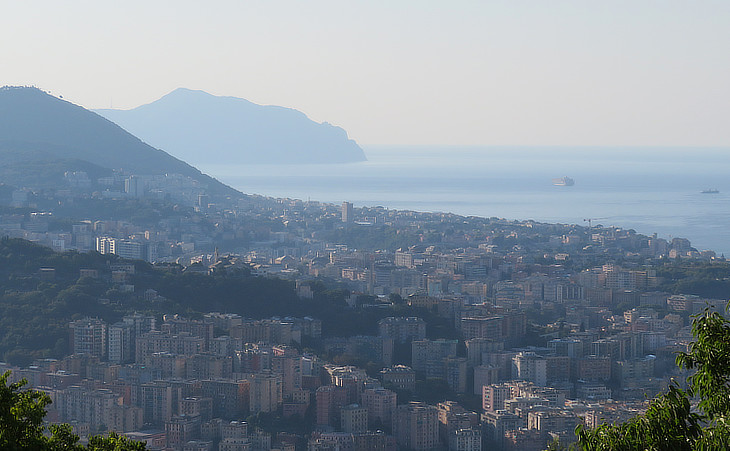
The Ligurian coast east of Genoa seen from the Righi district on the heights of the city
The Coast of Liguria lieth between the Rivers Varus and Macra, 211 Miles. Extending behind all the Ligurian places are the Apennines, the most considerable of all the mountains of Italy, the chain of which extends unbroken from the Alps to the Sicilian sea.
Pliny the Elder, The Natural History - (Note: Italy was divided by Emperor Augustus into eleven regions; the ninth of which nearly corresponded to today's Liguria).
This City lies under the mountains exposed to the South, so that it must needs be very hot in Summer, as witness the Orange and Olive trees which grow so plentifully heer, that they can afford those fruits at easie rates, and drive therewith a great trade, furnishing with Oranges Florence and a good part of Tuscany, and sometimes sending them into England.
John Ray's Observations (..) made in a journey through part of (..) Italy in 1663.
The Genoese are esteemed extremely cunning, industrious, and inured to hardship above the rest of the Italians; which was likewise the character of the old Ligurians. And indeed it is no wonder, while the barrenness of their country continues, that the manners of the inhabitants do not change: Since there is nothing makes men sharper, and lets their hands and wits more at work, than want.
The character the Latin Poets have given of them is not much different:
"Fallaces Ligures." Auson. Eid. 12. (The deceitful Ligurians).
"Assuetumque malo Ligurem." Virg. George ii. v. 168 (The hard Ligurians, a laborious kind).
"Apenninicolae bellator filius Auni Haud Ligurum extremus dum fallere fata finebant." Virg. En. xi. v. (Yet, like a true Ligurian, born to cheat, At least whilst fortune favoured his deceit) Dryden.
Joseph Addison's Remarks on several parts of Italy, in the years 1701, 1702, 1703
This country, which was the ancient Liguria, is now called the Riviera, or coast of Genoa, extending along the Mediterranean sea, from the river Var to the Magra, 150 miles in length, and not above 20 in breadth, and in some places scarce 10. It is bounded on the land side by the Alps and Apennine hills and by the Mediterranean on the south. This country lying open to the south sun, and Soil, being sheltered by the rocks and mountains from the northern winds, is favoured with a much warmer air than the neighbouring country of Piedmont.
Genoa is a city of great antiquity , being mentioned by Strabo as the chief emporium of Liguria in his time.
Thomas Nugent - The Grand Tour - 1749
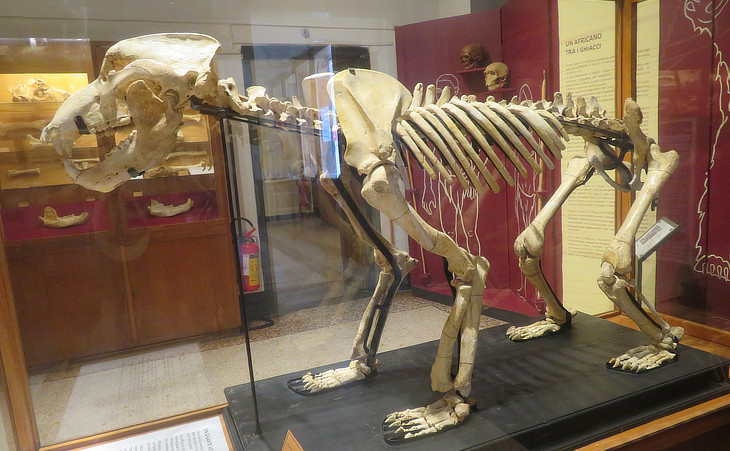
Museo Archeologico Ligure (Palazzo Durazzo Pallavicini at Pegli, a western suburb of Genoa): Reconstructed skeleton of a cave bear (Ursus Spelaeus) from a karst cave system at Toirano, near Savona, west of Genoa
Larger than today's grizzly bears and mainly herbivorous, cave bears were widespread in Europe during the Upper Pleistocene.
This bear could reach a height of up to 3.5 metres on its hind legs and had long teeth and sharp claws.
These animals took refuge in caves during the winter, and some individuals could die or be hunted by Neanderthals: cave bears would provide a
large amount of meat, but also fur, tendons and fat. At Toirano cave bears lived between 50,000 and 24,000 years ago, and an excavation inside
the cave has revealed a layer where traces of fossilised fur have been found. A large specimen of cave bear has been completely reconstructed
from the bones of different individuals.
The mild climate of Liguria attracted the first human beings.
The wild oleasters and fig trees provided them with edible fruit. Caves at Ventimiglia at the western end of Liguria show evidence of having
been inhabited by both Neanderthals and Homo Sapiens. This can be noticed also in other locations of the Italian peninsula with especially
sunny and sheltered features, e.g. Quarto Caldo, the southern side of Mount Circeo. You may wish to see a Pleistocene site in the environs of Rome.
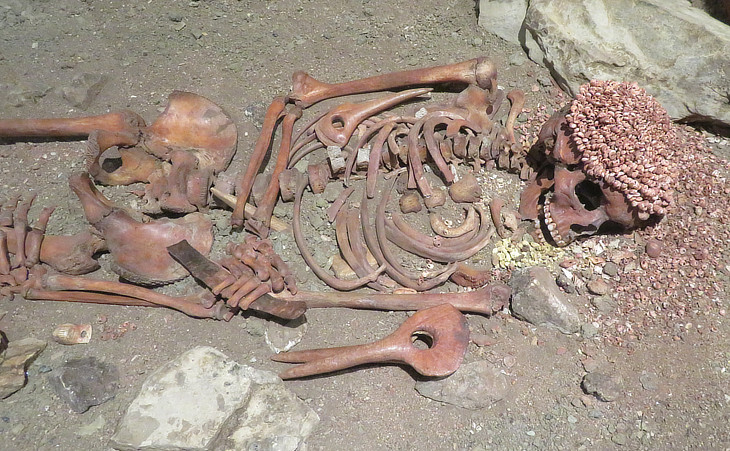
MAL - Burial of the "Young Prince" of Arene Candide (White Sands), a site at Finale Ligure, west of Genoa
This prehistoric site was already known in the XIX century and was systematically excavated in 1940-1950. The stratigraphy is formed of several historic, protohistoric, and Neolithic layers, followed by a Late Pleistocene sequence. The Gravettian layer (ca 30-20,000 BC) is well-known for the
rich burial of the so-called "Young Prince". It is one of the most spectacular Upper Palaeolithic burial artefacts, and due to the
richness and variety of its grave goods, its excellent state of preservation and its precise stratigraphic location, it has been an
important source of data since the time of its discovery.
The community to which the deceased belonged felt the need to emphasize signs and
gestures in order to elaborate and ritualize his violent death which was caused by a devastating wound to the left shoulder,
perhaps due to a very strong blow inflicted on the jaw and left shoulder by an animal.
The burial shows the complexity of the funerary rites that the Gravettian culture was able to express.
The "Prince" was buried supine with a few stones over his hands and feet according to a ritual repeated in various other burials of the period.
The modern name of "Prince" was determined by the hundreds of perforated shells around the head, which led the archaeologist Luigi Cardini to
suggest they formed a kind of headdress or crown. The study of the stable isotopes of the "Prince"'s skeleton has revealed that around 1/4 of the protein in
his last year of life was of marine origin.
with
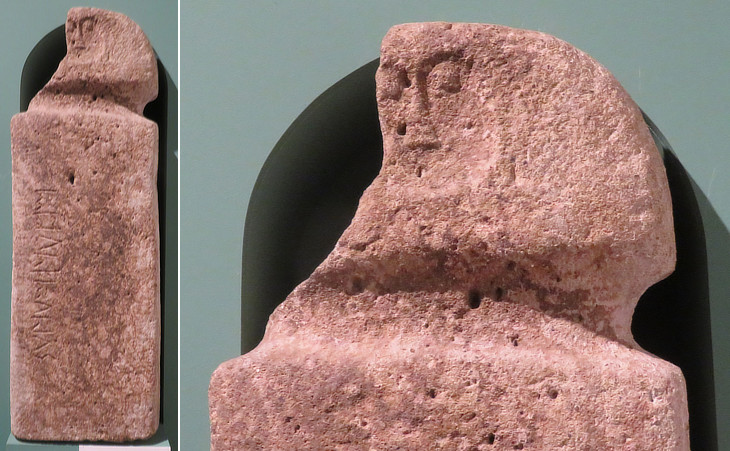
MAL - Stela of Zignago, a hamlet at the border between Liguria and Tuscany
The most nortlherly city of Etruria was Luna. It stood on the very frontier, on the left bank of the Macra, which formed the
north-western boundary of that land. And though at one time in the possession of the Ligurians, together with a wide tract to the south,
even down to Pisa and the Arno, yet Luna was originally Etruscan, and as such it was recognised in Imperial times.
George Dennis - The Cities and Cemeteries of Etruria - 1848 Ed.
(*) Luna or Luni, a town in Tuscany, near today's Carrara.
The Romans called Lunense its white marble.
The stela was found in 1827 at a rural mountain location, most likely to mark pastures at a time of intensive sheep farming (Copper Age - IIIrd millennium BC).
It is likely to depict an ancestral god or hero. These stelae are linked to the development of high-altitude pastoralism and the spread of human
groups for whom it may have been important to mark certain elements of the territory that were of significant value within the society of the time.
The inscription belongs to a later period (Iron Age: 1200-500 BC); it was generally thought to be an Etruscan onomastic formula, but today the
use of a Ligurian alphabet has been suggested. The stelae evolved into Greek and Roman herms.
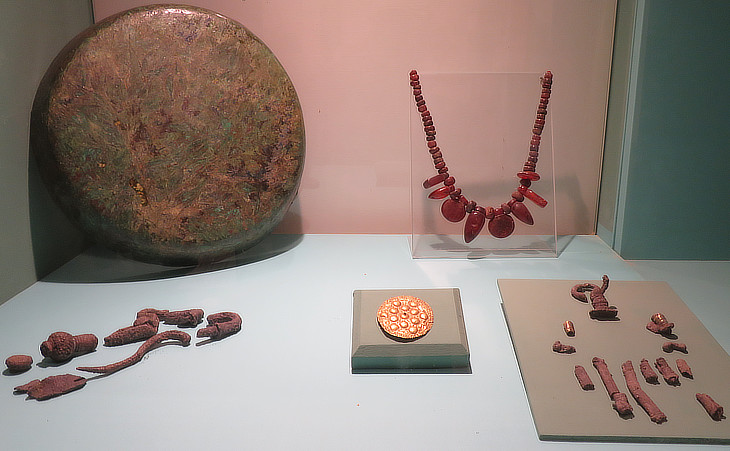
MAL - Jewels and other objects from a pre-Roman female tomb in the centre of Genoa
A short promontory sheltering a gravel beach at almost the very centre of the Ligurian coast is the location where ancient Genoa was founded. Ancient harbours usually developed at the mouth of rivers which facilitated the trade with inland regions (e.g. Ostia, Pisa and Aquileia), but the site chosen by the Ligurians was good enough for a small settlement squeezed between the shore and Castello (Castle), the hill of the promontory. Its northern end reached the site of S. Lorenzo, the medieval Cathedral. Tombs of a necropolis were found scattered without apparent order beyond S. Lorenzo in today's Via XX Settembre. The tombs consisted of circular shafts, closed by a roughly hewn stone slab. In the lower space, the cinerary vessel and other grave goods were deposited. In the case of a female tomb they testify to the breadth of contacts of Genoa with the populations of the Po Valley. Overall, the grave goods seem datable to the Vth century BC. The deceased, a woman of high social rank, was buried with a rich set of jewellery which was damaged by exposure to the fire of the funeral pyre.
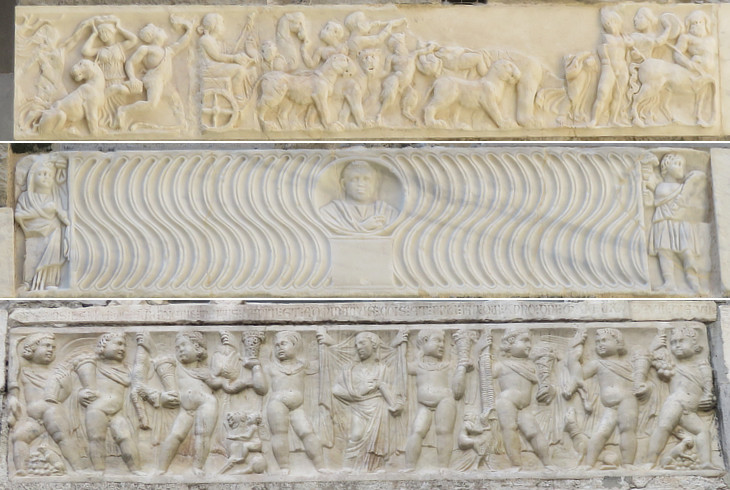
Fronts of Roman sarcophagi: (above) Cathedral - Triumph of Dionysus/Bacchus; (middle) Cathedral - clipeus and strigiles; (below) S. Matteo - Genii
A man would expect, in so very ancient a town of Italy, to find some considerable antiquities; but all they have to show of this nature is an old rostrum of a Roman ship, that stands over the door of their arsenal. Addison
Over the Door of the Arsenal, I saw the Rostrum of an old Roman Ship, 'tis of Iron, with the Representation of a Boar's Head at the End; the Neck of it is hollow; the Sides of that are cut through with Rust in some places: 'twas found in cleaning their Port, as the Inscription under it sets forth. 'Tis plac'd as looking through a sort of Window, and, I believe, the whole length of it is not seen: about half a Yard of it appears; it may probably be no more than a further Continuation of the same Iron which is in view; within which ('tis likely) went the Beam of Timber 'twas fix'd upon. If this be, (as the Inscription says it is) the only original one hitherto existing, it must certainly be esteeme'd a truly valuable Rarity.
Edward Wright Some observations made in travelling through France, Italy, &c. in 1720, 1721, and 1722
Genoa presents no vestige of antiquity; if ever she possessed magnificent edifices or trophies of glory they have long since mouldered into dust, or been swept away
by the waves. Her name alone remains, and that name she has ennobled since the fall of the empire by a series of great achievements abroad, and
at home by an almost uninterrupted display of industrious exertions, bold speculations, and wise councils. (..) If in my observations on Genoa
I have passed over some objects of curiosity noticed by most other travellers, such as the catino or celebrated plate of emerald, the beak of a
Roman galley, &c. the reader will remember that the French had been for several years masters of the city, and that the articles alluded to were
either seized by them, or removed previous to their first arrival, and still kept, and indeed likely long to remain, in a state of concealment.
John Chetwood Eustace's Classical Tour of Italy in 1802 (publ. 1813)
In 1814 the Great European Powers met at Vienna and they assigned Genoa and its former dominions to the
Kingdom of Sardinia (Piedmont) and the rostrum ended up at the Royal Armoury of Turin.
Travellers did not mention as Roman antiquities a number of reliefs, mainly fronts of sarcophagi, which decorate some of the churches of Genoa. This because they are likely to come from other locations which were part of the dominions the Republic (Sardinia, Corsica, possessions in Africa and Asia) or were taken from Pisa when Genoa sacked its port.
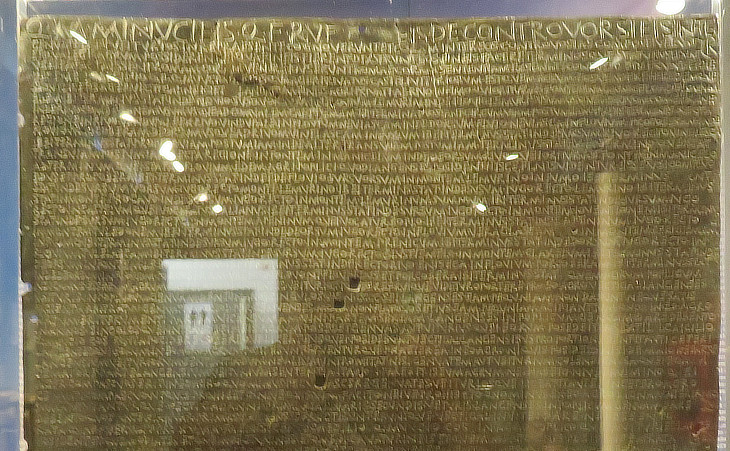
MAL - Polcevera Table or "Sententia Minuciorum", a lengthy bronze Roman inscription dated 117 BC
Not farre from the Harbour is the most faire Cathedrall Church, in which is an ancient monument of mettall, digged out of the
adjoyning valley, which hath an old inscription, shewing the antiquity of the City. (..) The monument in the Cathedrall Church witnesseth that
this City florished among the old Cities of Italy, about 300. yeeres before Christs incarnation. Moryson
The inscription was found in 1506
in the upper Polcevera Valley, Polcevera being a stream which empties west of Genoa. Its valley has a north-south direction and it led to a pass
(Monte Giovi) which gave access to the Po Valley. The importance of the inscription from a historic viewpoint was immediately understood and the
panel was initially affixed in the Cathedral where it was noticed by Moryson.
The inscription sheds light on how the Romans expanded their
influence in Italy. At the time Genoa had already signed a foedus, a treaty of alliance with Rome. The Viturii Langanenses, a tribe living in
the mountains north of Genoa (today's Langhe), were not yet subject to Rome, but they asked the Romans to decide on a series of controversies
they had with Genoa. The inscription says that Quintus and Marcus Minucius Rufus, regarding the disputes between Genuati and Viturii,
made a reconnaissance of the land and in the presence of the two parts they settled the disputes and established according to which rules they
should own the territory and where the border should pass. The border is carefully described and the payment of a sum is established in
favour of Genoa. By acting as impartial judges the Romans acquired a moral standard which facilitated their hegemony over Northern Italy which led to the creation of the Province of Gallia Cisalpina in the early Ist century BC.
Other lengthy bronze inscriptions have been found at Lyon, Amiterno, east of Rome, Antequera in Spain and elsewhere. It is likely that many of them were melted down and reused for other purposes.
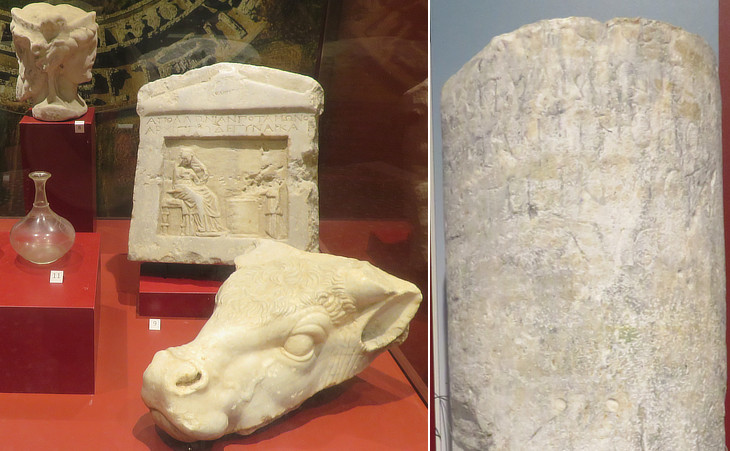
MAL - (left) Roman artefacts; (right) miliary column with an inscription celebrating Emperor Constantine; the image used as background for this page shows a small funerary relief depicting Minerva
The funerary stela depicting two women at the side of an altar was found during the restoration of Porta Soprana, a medieval gate. It was made at Constantinople or Smyrna in the IIIrd century AD and it probably reached Genoa as a consequence of the first embassy sent by Genoa to the court of the Byzantine emperor in 1142. The head of a bull was part of a funerary monument in the environs of Genoa. The miliary column was placed along Via Postumia, a Roman road which linked Genoa with Aquileia across Verona, which was renovated by Constantine.
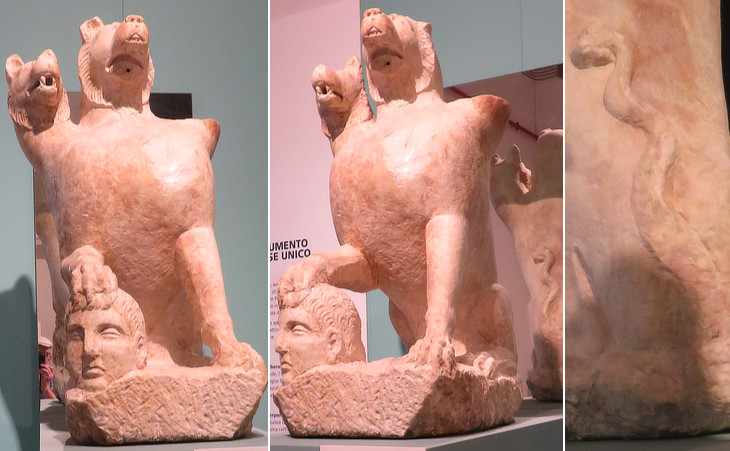
MAL - Statue of Cerberus showing also its tail of a dragon (according to Apollodorus) which was found at Via Fieschi near Porta Soprana and was placed in the museum in 1936. It is dated Ist century BC - Ist century AD
The twelfth labour imposed on Hercules was to bring Cerberus, the Guardian of the Underworld from Hades to Earth. The monster was often depicted on sarcophagi portraying the Labours of Hercules, less so in statues, apart those where it stood next to Hades (e.g. at Gortyn). A statue of Cerberus similar to that found at Genoa can be seen at Chieti. The human head, a portrait of a young man with closed eyes and a face stiffened in the swell of death, is carefully worked and it refers to the man to whom the funerary monument was dedicated.
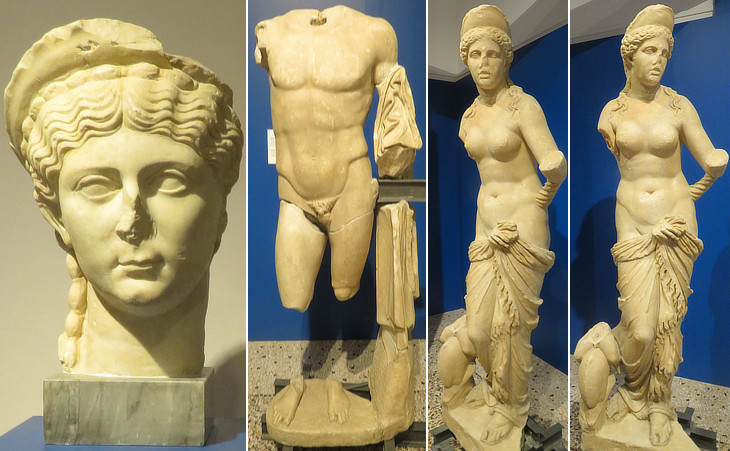
MAL - (left) Head of an Empress of the Julio-Claudian Dynasty, (maybe Livia or Antonia the Elder) from Luni; (centre/right) Ludovisi-type Hermes and Aphrodite from Villa Giustiniani Cambiaso
The portrait may correspond to Antonia the Elder, niece of Augustus, in terms of hairstyle; the portrait may date from the period 37-39 AD
when Antonia received special honours from her nephew Caligula; the stylistic rendering of the surfaces and the
workmanship of the hair also date to these years. The head was found in the XIXth century in the excavations of the city of Luni and it was
purchased in 1888.
In the XVIth century the Giustiniani were among the most important families of Genoa, especially for their role in
the administration of the island of Scio (Chios). In the 1550s they embellished a villa they had at Albaro, east of the
city walls, with ancient statues, similar to what was done in Rome. The Giustiniani were eventually forced out of Scio in 1566 and some of them
settled in Rome where their palace housed one of the finest collection of antiquities.
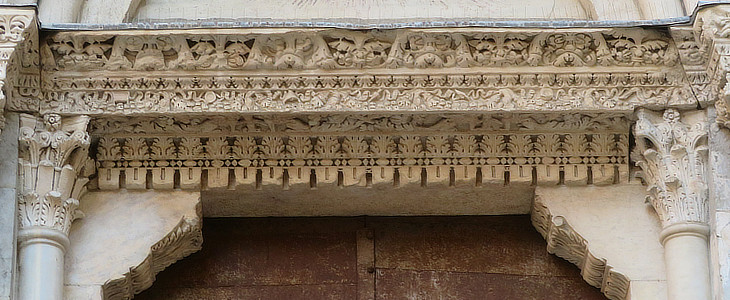
IIIrd century AD Roman cornice at S. Maria di Castello
Santa Maria di Castello is said to be built on the site of a temple of Diana, some of the columns of which still remain.
John Murray - Handbook for travellers in Northern Italy - 1843
Fragments of architectural elements and ancient columns can be seen in many medieval churches of Genoa but, similar to what said about the
sarcophagi, their origin is generally uncertain.
Tentative plan of this section:
The Ancient Town
The Cathedral
The Doria's Palaces and Church (S. Matteo)
Palazzo del Principe
The Harbour
The Piazza Nuova
The Strada Nuova
Via Balbi
Two Grand Churches
A Walk to Castello
In the Heart of the Old Town
Old and New Portoria
Museums: Exhibits from Churches
Museums/Palaces: Tursi and Bianco
Museums/Palaces: Rosso and Spinola
Some Environs of Genoa
Anthony van Dyck's 2026 Exhibition