
All images © by Roberto Piperno, owner of the domain. Write to romapip@quipo.it.


Notes:
Page revised in July 2026.
All images © by Roberto Piperno, owner of the domain. Write to romapip@quipo.it.
Notes:
Page revised in July 2026.
 Fonte dell'Acqua Acetosa
Links to this page can be found in Book 5.
The page covers:
The plate by Giuseppe Vasi
Today's view
Fontana dell'Acqua Acetosa
S. Chiara a Vigna Clara

In this small 1754 etching Giuseppe Vasi shows people going to a mineral spring which was known for its beneficial effects; aceto means vinegar and acetosa is the derived adjective. The spring was located near a beach of the Tiber and it was surrounded by trees, so the site attracted many picnickers.
In the description below the plate Vasi made reference to: 1) Beach on the Tiber; 2) Street leading to Rome.
The small 1883 map shows: 1) Fontana dell'Acqua Acetosa; 2) Ponte Milvio or Molle (which is covered in another page); 3) approximate location of S. Chiara a Vigna Clara.


The view in May 2010
In the XVIIIth century Acqua Acetosa was a countryside location whereas today it is close to very busy roads. After years of neglect the fountain was recently cleaned and a small fenced garden protects it from being vandalized with graffiti.

(left) Interior of the fountain; (right) inscriptions by Pope Paul V (above) and Pope Clement XI (below)
The oldest inscription of the fountain is by Pope Paul V and it says that the spring, in addition to being beneficial for loins and stomach, "Mille (a thousand) Malis (diseases) Prodest (is useful for) Ista (this)
Salubris (saluber) Aqua (water)".
The current fountain was built in 1661 during the pontificate of Pope Alexander VII and for a long time it was attributed to Gian Lorenzo Bernini, but more likely it was designed by Andrea Sacchi, who is best known for his paintings.
Pope Alexander VII wanted to be remembered for having promoted the construction of the fountain, which therefore was decorated
with his heraldic symbols: six mountains and a star (you can see them also in the image used as background for this page).

Inscription and coat of arms of Pope Alexander VII
Drinking Acqua Acetosa was very popular, however in the text of Book V which provides information on the plates Giuseppe Vasi wrote that the mineral water violenta è nell'operare (has a too forceful effect) and that in general doctors were against its use.
J. W. Goethe was happy with the effects of Acqua Acetosa; in summer 1787 he wrote: The heat is terrific. I get up at dawn and walk to the Acqua Acetosa, a mineral spring about half an hour's walk from the Porta del Popolo, where I live. There I drink the water, which tastes like a weak "Schwalbacher" (*), but is very effective. (...) The variety, misty transparency and colouring of this landscape drives me wild with joy.
Italian Journey - Translation by W. H. Auden and Elizabeth Mayer - Collins.
(*) Schwalbacher is a mineral spring at Schwalbach am Taunus near Frankfurt am Main in Germany.
Due to pollution of the aquifer layer, the water of the fountain is no longer that of the mineral spring, but ordinary drinkable water.

Museo Nazionale Romano: IInd century AD floor mosaic from a Roman villa between Ponte Milvio and Acqua Acetosa. It depicts a sea "thiasos", i.e. a Dionysiac procession of tritons and other sea creatures
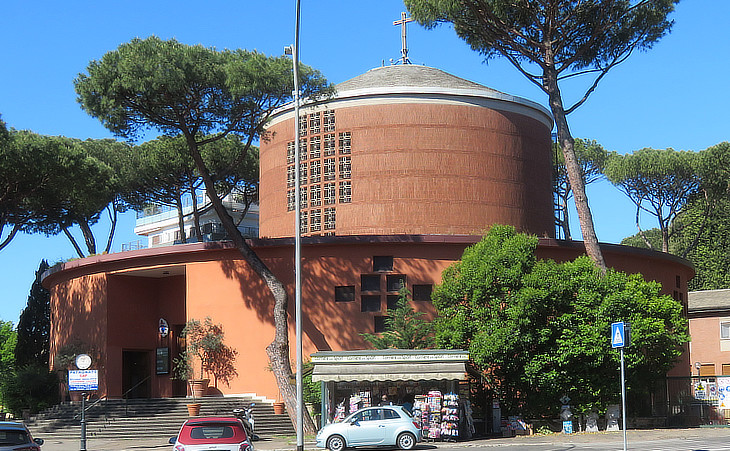
S. Chiara a Vigna Clara (design by Alberto Ressa)
Rome experienced a major sprawling of its urban area in the 1950s and 1960s. Very often it was very poorly regulated, especially in the eastern part of the City. The neighbourhood of Vigna Clara was developed by Società Generale Immobiliare (largely owned by the Holy See) at the beginning of the 1950's for higher-income buyers who were looking for apartments with balconies and modern facilities. Living at Vigna Clara became a status symbol, similar to what had occurred at Parioli after WWI.
Vigna Clara did not have an identity until its parish church was built (1959-1963). Its dimensions and design are based on those of S. Stefano Rotondo, a very old church, which make it very different from the many churches which have been built in the suburbs of Rome.
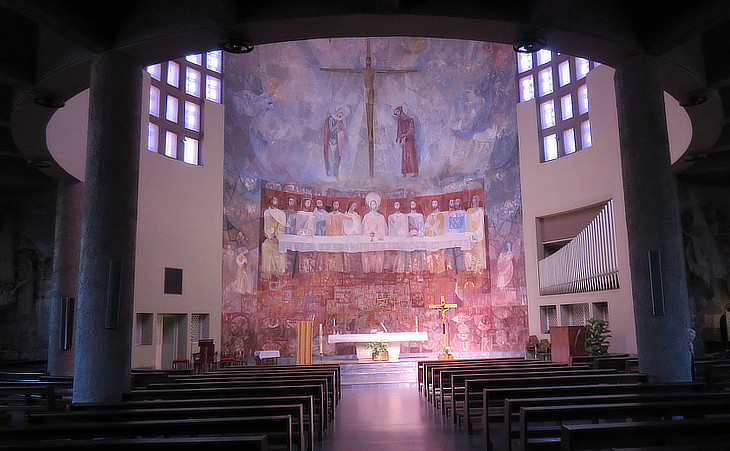
Interior
The interior is made up by a circular high hall almost entirely surrounded by an ambulatory aisle. Four large concrete columns support the structure. The decoration is based on large paintings by Mariano Villalta Lapayes (Madrid 1928 - Roma 1984) which portray the Last Supper and a Crucifixion between St. Clare and St. Francis of Assisi.
Next plate in Book 5: Ponte Milvio.


