
All images © by Roberto Piperno, owner of the domain. Write to romapip@quipo.it.


Notes:
Page revised in July 2021.
All images © by Roberto Piperno, owner of the domain. Write to romapip@quipo.it.
Notes:
Page revised in July 2021.
 Grand View of the Aventine Hill
The Grand View of Rome published by Giuseppe Vasi in 1765 was accompanied by two large
etchings having the same height as the Grand View so that they could be placed next to it to complete the decoration of a wall. These two etchings were followed in 1771
by two others having the same dimensions.
These four large etchings showed:
Campo Vaccino (1765)
La Città Leonina (Vatican City) che si vede colla Basilica Vaticana, Ponte e Castel S. Angelo (1765)
La veduta della Basilica di S. Maria Maggiore dalla parte verso le Quattro Fontane (1771)
La veduta della Basilica di S. Paolo fuori delle Mura dal Monte Aventino e dal Fiume Tevere (1771)
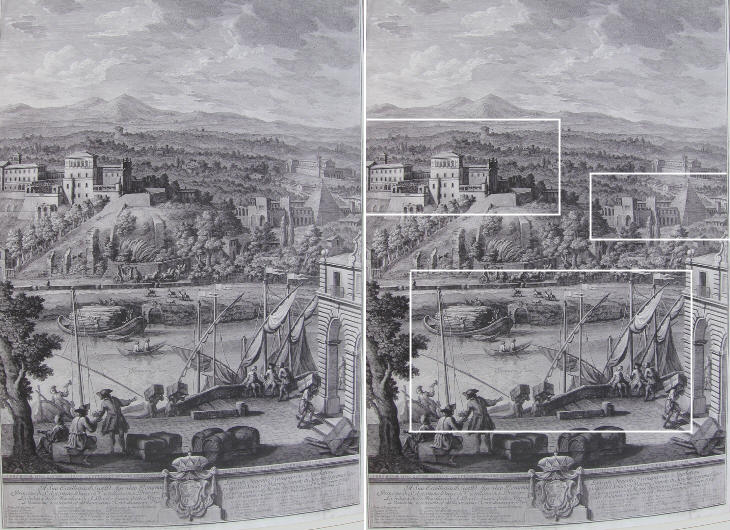
Overall view of the etching and location of the enlarged sections
The choice of Campo Vaccino and of the Vatican as the subjects of the two 1765 etchings was consistent with the approach followed by Vasi in his ten books of etchings aimed at showing the magnificence of both ancient (Campo Vaccino) and modern (the Vatican) Rome. For the 1771 etchings Vasi chose areas of Rome which were not visible in detail in the Grand View of Rome. The lower part of the etching shown above contains a long dedication to Agesilao Bonanno, a Sicilian baron, who was very powerful in that part of the island where Vasi was born (Corleone, near Palermo).
A Sua Eccellenza il Sig. D. Agesilao Bonanni Grisafi Ioppolo Gianquercio e Spadafora
Principe di S. Antonino Duca di Castellana & Pretore e Capo del Senato di Palermo, Grande di Spagna di prima Classe
La veduta della Basilica di S. Paolo fuori delle Mura ed adiacenze dal Monte Aventino e dal Fiume Tevere
L'umilissimo divotissimo ed obbligatissimo Servo Giuseppe Vasi Conte Palatino e Cavaliere dell'Aula Lateranense l'anno 1771.
Agesilao Bonanno is mainly remembered for having levied a tax on doors and windows; Bonanno (Italian for Goodyear) is a common surname in Sicily and a "Joe" Bonanno (1905-2002) was a Sicilian-born American Mafioso
who became the boss of one of the New York City crime families.
It is worth noting the long list of surnames of
Vasi's patron, an effect of the long Spanish rule on the island.
Vasi placed between the etching and the dedication a long sentence by the historian Plutarch (46-127).
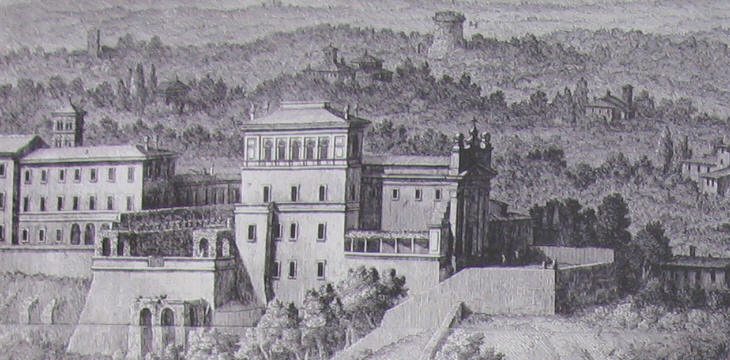
Vasi showed S. Maria del Priorato, the church of the Knights of Malta, both in a section of the Grand View and in one of the plates of Book V, but in both etchings the details of the church were not clearly visible: this 1771 view is of great interest because it shows the church after the 1765 changes made by Giovan Battista Piranesi and before the damage caused to the upper part of the church in 1849 when it was hit by a French cannon during Garibaldi's Defence of Rome.

View of the Aventine from Villa Sciarra
The comparison with an actual view of S. Maria del Priorato and of the Aventine Hill
suggests that Vasi designed the
etching based on sketches made in late afternoon towards the end of June:
the shadows in the print indicate a position of the
sun which occurs only during the weeks close to the summer solstice.
The flag (white cross on a red background) on the building next to the church (Villa Magistrale) indicates that the location is under the jurisdiction
of the Sovereign Military Order of Malta.
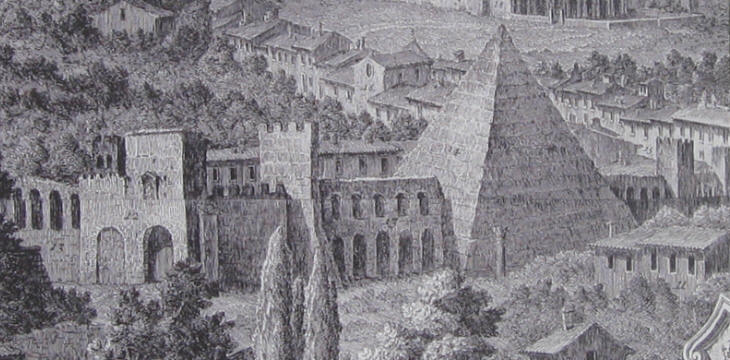
The walls near Porta S. Paolo and Piramide di Caio Cestio: behind them the street leading to Basilica di S. Paolo fuor delle mura
This section of the etching shows a nice view of the walls between Porta S. Paolo and
Monte Testaccio: there is no evidence of the
Protestant Cemetery which already existed next to the walls.
In the corresponding
section of the Grand View of Rome Vasi showed just a few buildings along the street leading to Basilica di S. Paolo; in this etching the area seems
much more populated and Cappella dei SS. Pietro e Paolo is more clearly detailed; it was
a small church on the assumed site
where the two apostles parted company before their martyrdom.
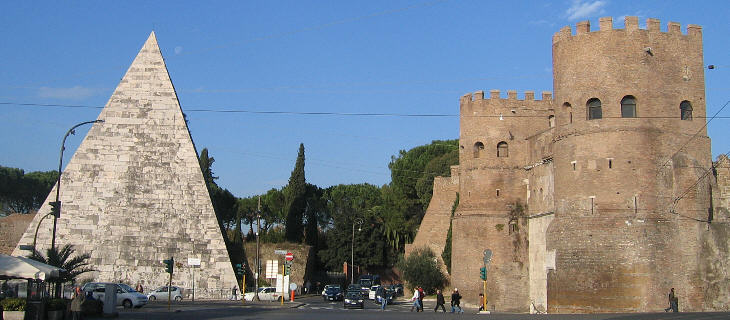
The opening in the walls between Piramide di Caio Cestio and Porta S. Paolo
In 1888 the expansion of Rome led to the pulling down of a section of the ancient walls to the east of Porta S. Paolo (far right in the photo): this allowed tramways to link the city with a new industrial development and the neighbouring quarter called Garbatella. In the XXth century the development of private motorization caused the pulling down of the section of the walls between the gate and the pyramid.
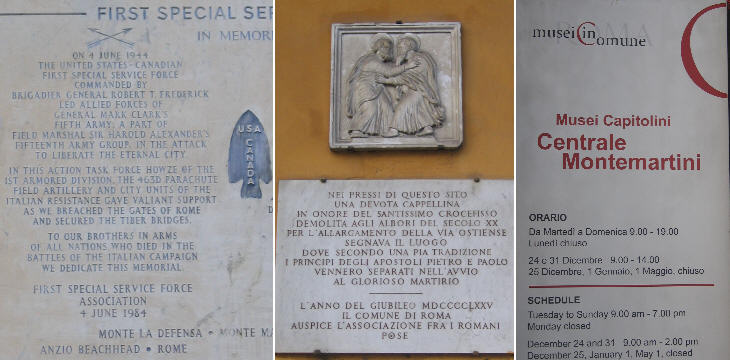
(left to right)
Inscription on the walls near Piramide di Caio Cestio celebrating the 1944 liberation of Rome; inscription near the site of the small chapel located midway
between Basilica di S. Paolo and Porta S. Paolo; (Centrale Montemartini) the power plant built on that area is now a museum
The anonymous modern road linking the gate with the basilica is one of the least interesting parts of Rome with the remarkable exception of Centrale Montemartini, a former power plant where some ancient statues belonging to the City of Rome have been relocated: it is a very interesting blending of industrial and traditional archaeology.
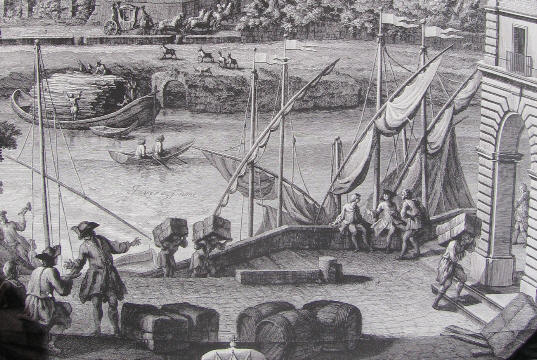
View of Porto di Ripa Grande
At last, at the extremity of the city, we reached a large range of warehouses and a small quay, where lay half a dozen little vessels and a miniature steam-boat, which plies between this and Civita Vecchia, the real port of Rome, at thirty or forty miles distance on the sea.
Rembrandt Peale - Notes on Italy, written during a tour in the years 1829 and 1830.
Vasi had a grand vision of Rome: his etchings were aimed at illustrating
the monuments of ancient and modern Rome: he paid little attention to showing the everyday life of the Romans.
The tastes of his customers however were changing slightly: foreign travellers came to Rome (and Italy) not only
to ponder on the ruins of its ancient buildings or to pray on the tombs of the martyrs: they were also looking for what can be
called Italian colour, a theatrical, outdoor lifestyle. It is interesting to remark that while Vasi and Piranesi in the XVIIIth century acquired worldwide
fame with their views of the monuments of Rome, Bartolomeo Pinelli (1771-1835), a Roman engraver of the early XIXth century became famous for his illustrations of the costumes of the
Romans, their games, their serenades; his prints portraying the Roman brigands were particularly praised.
This may explain why in this late etching Vasi gave so much room to the activity at Porto di Ripa Grande, the main river harbour of the city; however the scene he portrayed was conventional and the workers were too neatly dressed to meet the expectations of travellers in search of Roman colour.
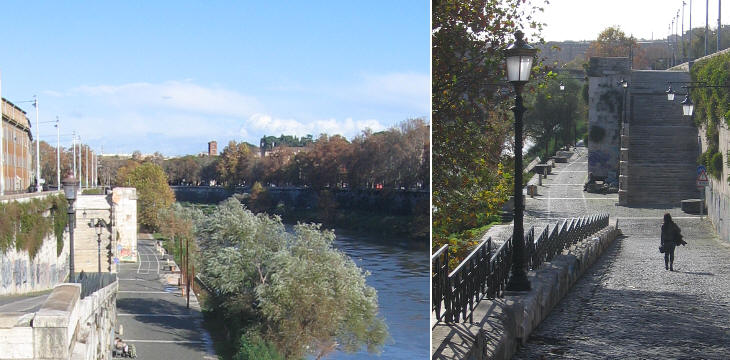
Ripa Grande today
A major flood of the Tiber occurred in December 1870, right after the annexation of Rome by the Italian State. The government decided to protect the city by building high walls along the river and by enlarging its bed. In the same historical period the development of a modern railway system made the traditional use of the river to supply Rome look obsolete. For these reasons the river harbours of Ripetta and of Ripa Grande were demolished.
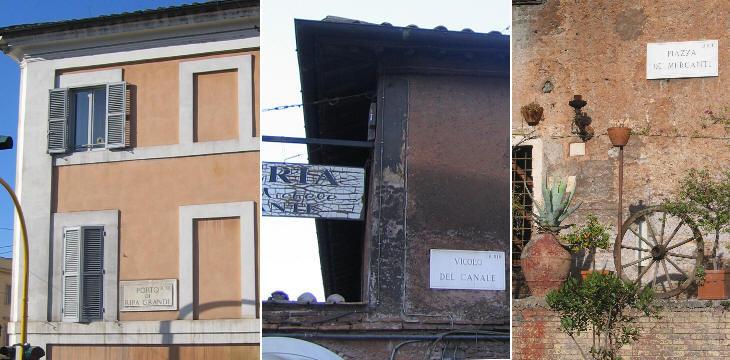
The names of the streets (Porto di Ripa Grande/Vicolo del Canale/Piazza de' Mercanti) are reminders of the old harbour


