
All images © by Roberto Piperno, owner of the domain. Write to romapip@quipo.it.


Notes:
Page revised in May 2024.
All images © by Roberto Piperno, owner of the domain. Write to romapip@quipo.it.
Notes:
Page revised in May 2024.
 Porto di Ripa Grande
Links to this page can be found in Book 5, Map C3, Day 6, View C11 and Rione Trastevere.
The page covers:
The plate by Giuseppe Vasi
Today's view
Ospizio di S. Michele
S. Maria del Buon Viaggio (and S. Maria della Torre)
Carcere Minorile e Femminile
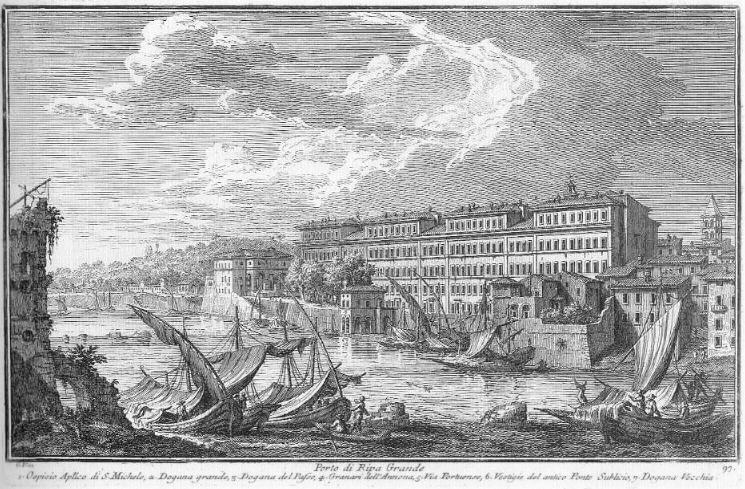
The decision by Romulus to found Rome near the Tiber was to a great extent due to the trade opportunities the river provided: boats of a relatively large size were able to reach the new town from the sea; at the peak of its development the population of Ancient Rome was in the region of 1,000,000; the supply chain was mainly based on goods from the provinces of the empire which reached the harbours of Ostia and Porto at the mouth of the Tiber and eventually the horrea (warehouses) of Rome which were located on the left bank of the river.
In 1754 when Giuseppe Vasi published this etching Rome continued to rely on this trade route, but goods were unloaded on the right bank of the river; the importance of this harbour is testified to by its name Porto di Ripa Grande (great bank)
compared to Porto di Ripetta (small bank), the name given to the harbour which received goods from the inland regions of Sabina and Umbria.
Vasi showed Ripa Grande also in plate
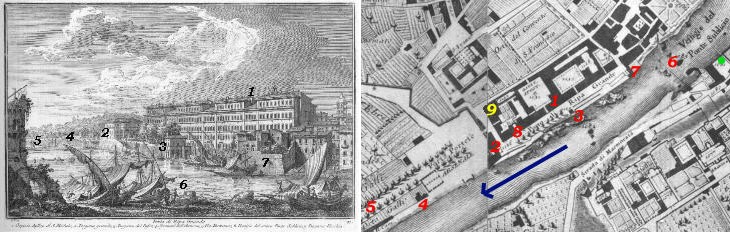
98 and in a 1771 large view of the Aventine Hill. The view is taken from the green dot in the small 1748 map here below.
In the description below the plate Vasi made reference to: 1) Ospizio di S. Michele;
2) Main custom house; 3) Dogana del Passo, another custom house; 4) Granaries; 5) Via Portuense; 6) Ruins of Ponte Sublicio; 7) Old custom house.
5) and 6) are shown in detail in other pages. The small map shows also 8) S. Maria del Buon Viaggio; 9) Carcere Minorile.
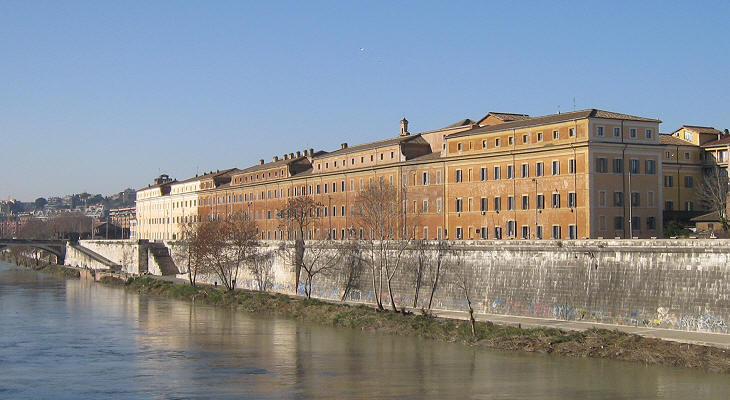
The view in January 2010
I took the Ripa Grande in my way, and saw there the Boats of Merchandise which come to Rome from Ligorn, Civita Vecchia, Naples, and other places, and disembark their goods here.
Richard Lassels' The Voyage of Italy, or a Compleat Journey through Italy in ca 1668
In the late XIXth century the river lost its importance as a trade route because of the
high walls built to prevent floods and of the development of railroads. The custom houses were all demolished to make room for the lungotevere, the new street along the river: in 1914 a modern bridge was named Ponte Sublicio. The ruins of the ancient bridge by the same name were blown up to facilitate the flow of the water. The granaries were pulled down or converted into workshops.
Ospizio di S. Michele was enlarged towards the end of the XVIIIth century with the construction of a fifth block to the right of the existing ones; it hides the view of the bell tower of S. Grisogono which Vasi showed to the far right of the plate.

Façade along the river
According to President de Brosses, a French traveller who visited Rome in 1739, beggars amounted to a quarter of the population; maybe his assessment was not based on accurate research, but certainly pauperism, the state of being poor and relying on charitable assistance for living, was a normal condition for a significant part of the population of Rome. The city attracted poor people from the countryside and the many institutions founded by the popes to tackle pauperism in a way caused its growth.
In 1686 Carlo Tommaso Odescalchi, a relative of Pope Innocent XI, felt that a partial solution could be found in teaching a job to the abandoned male children of the poor; he bought a piece of land near Porto di Ripa Grande and by 1689 a building was completed (probably designed by Mattia de' Rossi); it was located in the second from the left of the five identical blocks which make up today's Ospizio di S. Michele.
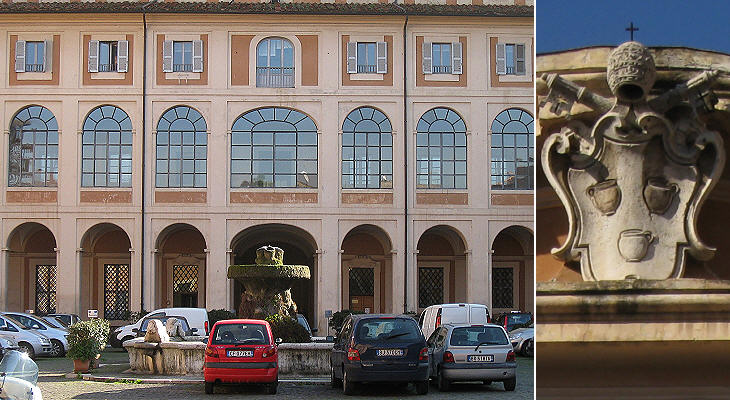
(left) Cortile dei Ragazzi (courtyard of the boys); (right) coat of arms of Pope Innocent XII
January 20th 1825. Went at an early hour & in the midst of heavy Rain to the Hospital San Michele, wh. is intended for near inferm old Men & for the Education of poor
Boys & Girls, the former of whom are instructed in Painting, Sculpture,
Architecture, Engraving, & Paper Drawing - in Printing, Engraving, Shoemaking, &c. They enter here at 8 years old, & being supported by the establishment & taught their Trade leave it at 20. People who have already
subscribed, obtain by the payment of 4 crowns admission & Education for one
child; others having shares send what number the amount of their subscription
may enable them, without paying any thing more. Book Binding is another trade cultivated here. Spoke to the Principal, the making of Helmets for the Police
occupies exclusively a particular set of workmen, to whom is allowed an exclusive
right of manufacturing them (The price was 2 or 3 scudi, the man said of each
Chacol). We went to the infirmaries, Dormitories, Refectories, Kitchens.
In the Engraving Room, a boy had carved a Head in Brass very well; I cd. not
help complimenting him. The Painters seemed a desperate Hope. The
Melancholy Effects of Failure in these Professions is Starvation to the
unfortunate Parties, as of course when they are 20 it is late to change their Trade
- tho' Provision can be made for such chances. There is in this Establishment no
mathematical Master, & while there are betwn. 30 & 40 scholars in the various
Arts of Design, there is only one Master for Design. Good jolly Priests alternately
went round with us. We went from this & the Rooms where the Girls who are
taken particularly Good care of, & their apartments kept clean, & well aired.
Sir Charles Fergusson - Travel Journal in Italy 1824-1825
In 1693 Pope Innocent XII bought the charitable institution and commissioned Carlo Fontana to enlarge the existing building; Fontana added another storey to it and built two identical blocks at its sides; a fourth block was completed by 1714. The new complex housed in separate sections also old people and unmarried women. The boys worked in a wool factory, but also a printing press was installed in the premises reserved to them. Fontana built also a large church inside one of the blocks; its bells can be seen from the outside (and are shown in the image used as background for this page).
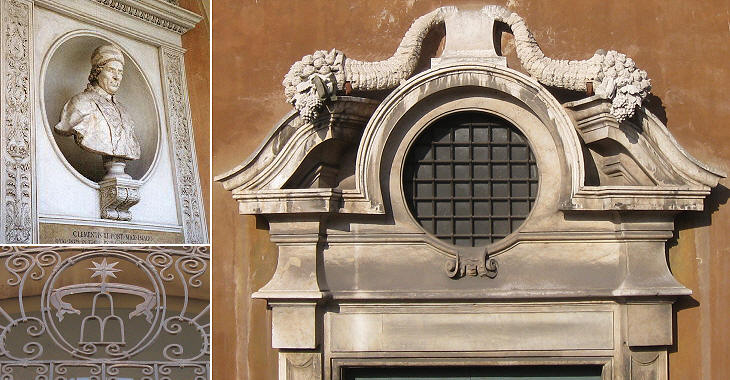
(left-above) Bust of Pope Clement XI; (left-below) heraldic symbols of the Pope; (right) one of the two main entrances
S. Michele is the great poor-house of Rome, unequalled
perhaps in any other country in extent, endowment and usefulness.
It comprises eight courts, and consists of four grand divisions composed of old men, old women, boys
and girls. (..) The children of both sexes
are admitted about the age of ten: the young men, having learnt some art, are dismissed about the age of
twenty with a complete suit of clothes and a sum of
money sufficient to purchase the implements of their
trade or profession: the young women are kept until
provided for by getting married or entering a convent,
and are entitled to a dowry of 100 crowns, or to 200
crowns if they enter religion.
Rev. Jeremiah Donovan - Rome Ancient and Modern - 1843
Ospizio di S. Michele was the largest charitable institution of Rome until the second half of the XIXth century, when it was no longer thought to be a suitable location for an orphanage. It fell into abandonment in particular after WWII, during which it had been occupied by German and Allied troops. A thorough renovation of the internal setup of Ospizio di S. Michele started in 1973 and at its end, a very large section of it was assigned to Istituto Superiore per la Conservazione ed il Restauro, the Italian body in charge of the preservation and restoration of works of art. The wool factory had very large halls for drying the thread; they are used for handling the restoration of large detached frescoes.
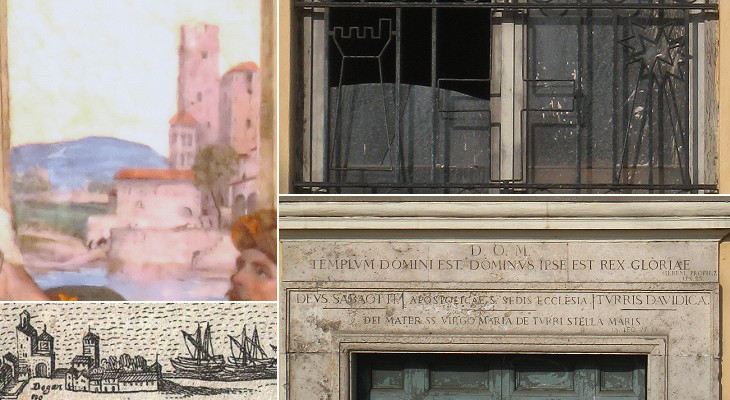
(left-above) detail of a 1488 fresco by Filippino Lippi in Cappella Carafa inside S. Maria sopra Minerva showing Ripa Grande and S. Maria della Torre: (left-below) S. Maria della Torre in a 1593 Map of Rome by Antonio Tempesta; (right-above) detail of the window; (right-below) inscription above the entrance
In medieval time a tower of the ancient walls of Rome along the river was turned into the bell tower of S. Maria della Torre, a small church which was used by the seamen who worked at Ripa Grande. It was pulled down by Carlo Fontana when he enlarged Ospizio di S. Michele; a new church for the seamen was built inside the hospice, but with a separate entrance. S. Maria del Buon Viaggio means St. Mary of the Safe Journey; Fontana preferred not to disrupt the design of the new building and for this reason the existence of the church is hardly noticeable; the church has been closed for very many years.
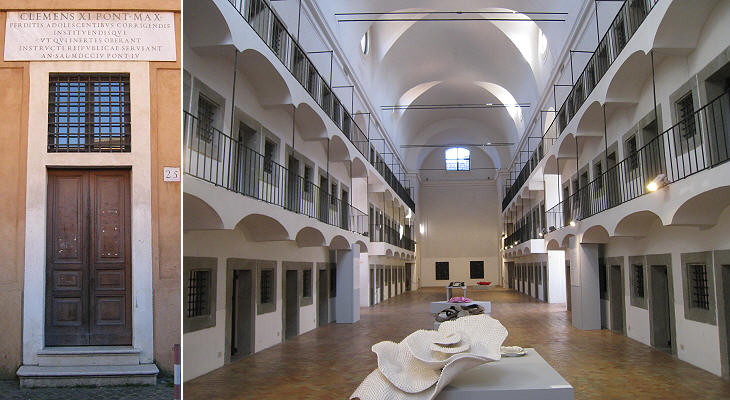
Juvenile prison: (left) entrance; (right) interior
We
went to the house of Correction adding - this is for Children, who are not to be
restrained by Parental Authority, or whose offences are of a grave Stamp. A
particular Cardinal is at the Head of it, the same who rules the other house, with
the power howv. in the Governor of the city to send any children not having any
claim on the Establishment, by paying a certain sum. We saw some of the young
Culprits at work, & regular Raffs they appeared. One of them apart from the
rest was confined for killing his brother in law, he having severely beaten & nearly
killed his father, & the young one 24 hours after stabbed the aggressor. He had
been condemned here for 5 years, but was to leave the day after the following,
having been only confined 26 months - the Govnr. had respited him from the
remainder, his father & friends having interceded for him. He was 16 years old,
and when we doubted him being so young, as in fact he looked like 21, & we said
so - he replied in a gay tone, I shd. be "vecchio" then. There are places apart for
the Private & Domestic Offences. The Estabt. is in some respects a very good
one, but is susceptible of much improvement. Fergusson
In 1701 Pope Clement XI commissioned Carlo Fontana to build a juvenile prison; the inmates were not necessarily offenders, they could just be boys having shown a rebellious character; the purpose of the institution was to promote their re-education; they worked in the large central hall. The building designed by Fontana is located on the rear of Ospizio di S. Michele and it was seen for a long period as a very advanced example of prison.
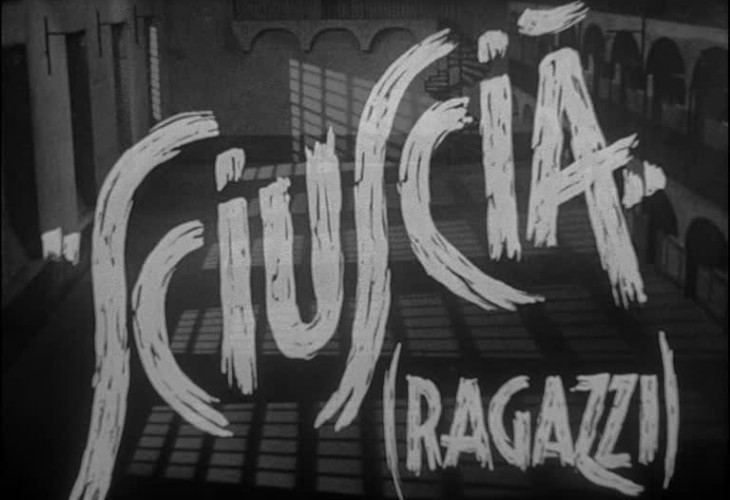
First screenshot of "Shoeshine" a 1946 movie directed by Vittorio De Sica which was shot in the reconstructed juvenile prison of S. Michele. Plot: Two shoeshine boys in post-war Rome, save up to buy a horse, but their involvement as dupes in a burglary lands them in juvenile prison where the experience takes a devastating toll on their friendship
The prison was closed in 1972. Today it is occasionally used for exhibitions. The photo of its interior was taken during a collective exhibition of contemporary artists in January 2010.
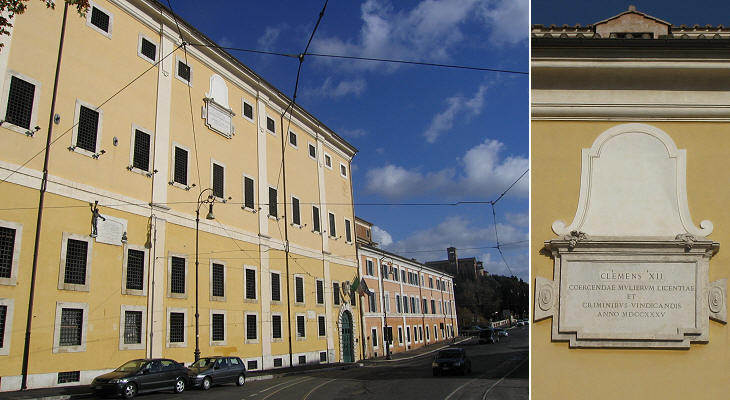
Prison for women: (left) façade and in the background S. Anselmo on the Aventine hill; (right) inscription indicating the two categories of women committed to this prison: "mulierum licentiae" (women of ill repute) and "criminibus vindicandis" (law offenders)
Next plate in Book 5: Altra Veduta di Ripa Grande.
Next step in Day 6 itinerary: Porta Portese.
Excerpts from Giuseppe Vasi 1761 Itinerary related to this page:
Ospizio di s. Michele
Sotto Innocenzo XI. ebbe principio questo grande ospizio l'anno 1686. affine di dare ricovero ai poveri
fanciulli mendicanti per la Città, e di levarli dall'ozio. Perciò vi sono delle botteghe, e maestri per tutte
le arti specialmente de' lavori di lana, e di arazzi; evvi ancora lo studio delle lettere, della musica, e del
disegno colla stamperia di caratteri, e di rami; e per quelli, che non hanno volontà di far bene, vi è la
casa di correzione, con tutte le sorte di gastighi. Clemente XI. accrebbe molto la fabbrica col disegno
di Mattia de' Rossi, e di Francesco Fontana, aggiungendovi l'ospizio de' vecchi, ed invalidi dell'uno, e
dell'altro sesso, eretto, come diremo, nella giornata seguente, da Sisto V. presso ponte Sisto.
E finalmente Clemente XII. vi fece le carceri per le donne insolenti, che meritano la galera, o altra
pena per i loro misfatti. Presedono a questo grande ospizio due Cardinali con alcuni nobili Deputati,
e una famiglia di religiosi delle scuole Pie vi abita per insegnare a quei fanciulli, non solo le lettere, ma
ancora i buoni costumi, ed il santo timor di Dio.
|


