
All images © by Roberto Piperno, owner of the domain. Write to romapip@quipo.it.


Notes:
Page added in September 2025.
All images © by Roberto Piperno, owner of the domain. Write to romapip@quipo.it.
Notes:
Page added in September 2025.
 about Rome: Rembrandt Peale
Rembrandt Peale (1778-1860) was an American painter who specialized in portraits. His father Charles Willson Peale was a painter too and this explains the first name of his son. He visited Italy in 1829-1830 and he published a book (Notes on Italy written during a tour in the years 1829 and 1830) on his experience there:
For a number of years the duties required by a large family forbade a separation from them. These, at length, permitted my wish to be gratified, especially as several gentlemen of New York and Boston liberally patronised my plan, and, as my only son evinced a disposition to study the profession of his father and grandfather. I may, therefore, well be pardoned for seeking this enjoyment at the age of fifty-one, particularly as I made it an essential point to select, for the employment of my pencil, some of the most excellent pictures of the great masters, which are preserved in Rome and Florence. (..) Instead of a heated and visionary series of exaggerations or quotations on affairs of church and state, in which I might have indulged as many preceding travellers have done, or affecting to be wise at the expense of other men's thoughts, I have preferred the simple task of describing only those things which I saw, as they may be seen by other persons in my situation, and have pretended to no opinions or judgments but such as forced themselves upon me. (..) The churches of Rome are so numerous, that, in Vasi's guide-book, out of three hundred and sixty, one hundred and twenty-nine are selected as worthy of notice; yet, from the similarity of their structure, the repetition of splendid objects of ornament, and the sameness of materials, the eye soon becomes sated with the gorgeous entertainment, and finds a permanent pleasure only in such as are distinguished by the possession of the finest works of the painter's and the sculptor's art: travellers, therefore, generally agree in saying, that it is necessary to visit only about thirty of the whole number.
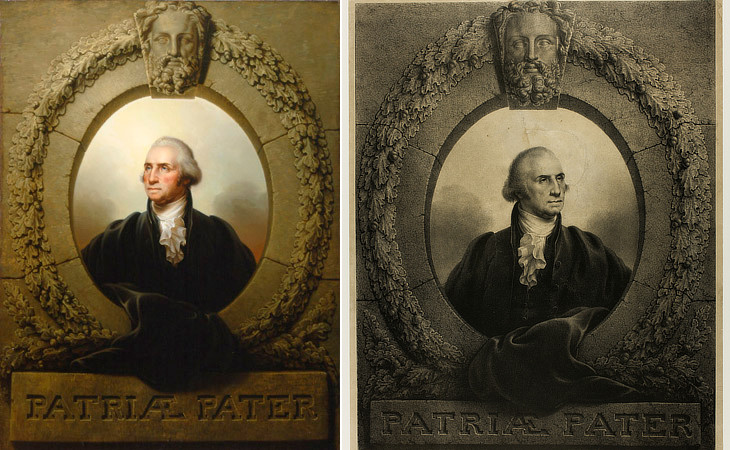
Portrait of George Washington inside a stone work
I had taken with me to Italy my portrait of Washington, which represents him as seen through a perforated screen of ornamented stone work, beneath the Phidian head of Jupiter. I cannot withhold this anecdote of a portrait which is so well known to my countrymen. Washington himself, although he was very desirous of visiting Europe, had denied himself that gratification, governed by motives of the purest patriotism. Born on Washington's birth day, I had in a measure chosen him for my tutelar saint, and in my pilgrimage to Rome, I could not deny myself the pleasure of taking with me this memorial of that great and good man. Peale
When he was eighteen, Rembrandt Peale painted a portrait of Washington from life in the presence of his father. During the remainder of his career, he replicated this famous portrait seventy-nine times.
Excerpts from Rembrandt Peale's Notes on Italy, written during a tour in the years 1829 and 1830.
Pincio promenadeA delightful walk, on the brow of the hill, overlooking the tops of the houses and gardens, extends from SS. Trinità dei Monti, under rows of trees, to the palace of the French academy of the fine arts, and so on to the terraces, groves, walks, and carriage-ways at the termination of the Pincian hill, which overlooks one extremity of Rome. There the eye is cast directly down upon the noble circular place, just within the Gate of the people, with its mighty Egyptian obelisk and fountains in the centre, and fountains, statues, churches, and palaces on its circumference. To these a descent is afforded by a road constructed in the style of a double stair-case - a beautiful work, commenced when the French ruler governed Rome, and now finishing, by the well advised policy of the popes, to embellish a city which owes so much to the visitation of strangers. These walks and rides are greatly resorted to, especially by the English; and the prospect at sunset is indeed beautiful, commanding a distant view of the dome of St. Peter's and the neighbouring hills on the borders of the Tiber. |
Streets of the Shopping DistrictFrom the Piazza di Spagna, to go to St. Peter's, it is necessary to pass down one or two streets filled with little shops, outside and inside of which are displayed, for the especial temptation of strangers, (forestieri) a vast variety of real and fictitious antiques, gems, cameos, mosaics, bronzes, paintings, and prints. These lead into the Corso, the fashionable course of carriages, the only long straight street in Rome. |
Colonnade of Piazza S. PietroFor the pleasure of this sumptuous array, we are indebted to the architectural taste of the sculptor Bernini, whose statues, with those of his pupils, ornament this and many other places in Rome; and to the genius which enabled him to fascinate those who held the public purse-strings, into such schemes of costly magnificence. |
S. PietroThe attention is powerfully invited to the great mosaic pictures which decorate almost every altar, - pictures which neither damp, nor smoke, nor time can injure - so wonderfully executed, with semi-vitreous porcelain, that every line and tint of the original pictures are indelibly expressed; and possessing lustre by polish, which is given to the surface when the work is finished. The best known are the Transfiguration by Raphael, and the Communion of St. Jerome by Domenichino; but the most excellent is the St. Petronilla, which is more beautiful than the original picture by Guercino, preserved in the museum of the Capitol. (..) The guide conducted us to the opening at the top of the inner dome, through which we looked down upon the diminished baldichino and the atoms of men and women who were moving on the pavement below - and then, descending to the base of the dome, entered a gallery within, and saw, with surprise, those rude gigantic mosaic incrustations, which from below resemble well painted cherubs and apostles. |
Arco di Settimio SeveroThe first object that presents itself is the triumphal arch of Severus, cleared out to its foundation, and looking as if it were built in a cellar. Its fractured and dark-stained arches, shattered columns and mutilated bassi relievi, carry the mind back more than sixteen hundred years, when the people and senate of Rome commemorated the victories obtained over the Arabians and other barbarous people, by erecting this arch, which was surmounted by the victor in a triumphal car with six horses - now gone, no one knows where. |
Arco di TitoOn leaving the avenue you come to the arch of Titus, the sculpture on which still commemorates the plunder of Jerusalem. This little arch is renovated with modern additions which restore its entire form, and will preserve the old portions, much to the displeasure of the lovers of ruins, who preferred it in its crumbling state, covered with ivy, and overwhelmed with an ancient massive wall. At this spot a number of labourers, lazily occupied in the schemes of excavation, have cleared a considerable distance down, exposing to view, at the depth of fifteen feet, the pavement of the ancient Via Sacra, which leads towards the Colosseum and the arch of Constantine. Fragments of enormous granite columns are discovered, lying in all directions, to increase the wonder which is excited by the surprising quantity of earth and rubbish which has accumulated over the ancient surface, not only here, but in almost every other part of Rome |
ColosseoThe broken arches, upon which the seats rested, are supported by new timber and brickwork, and every passage cleared out, among which you may pass and see with astonishment the huge stones which were employed by consummate skill to give strength to the foundation arches of this enormous structure. Some spots, however, are left neglected and covered with plants and shrubs, as a sample of its former guise. My old friend, as an artist, is among those who regret the change; for he remembers seeing the Colosseum a beautiful wilderness of ruins, vines and shrubbery. But though the total amount is reduced, the variety, in its exposed points, and warafnooks and corners, is not less than it was; for Sebastiani, a Roman botanist, in his Flora Colossea, describes two hundred and sixty plants which grow there; and the number has since been found to reach three hundred. A consecrated cross stands in the middle of the arena, which is kissed in remembrance of the Christian martyrs who suffered here; around the circumference is a series of holy stations at which prayers are said; and at one side are a desk and benches where the eloquence of a bald-headed Dominican occasionally excites the sympathies of a casual audience. (..) In a warm moonlight evening I took occasion, according to custom, to visit the Colosseum. Besides various parties of pedestrians we found eight carriage loads of company, some of whom were curiously exploring the corridors and arches with torches. The dim light of the moon, which only exhibits the great architectural masses without the minute details that during broad daylight disturb the attention, produces its effect, by merely permitting the spectator to be fully impressed with the simple perceptions of bulk and proportion. |
Domus AureaThe custode carried with him a little fixture of waxtapers attached to a very long reed, which he held at arm's length, to show us the arabesque paintings on the vaults of several rooms, executed with fresco colours and gold, and still in excellent preservation. These are said to be the only documents which remain, to show the style in which the houses of the ancient Romans were adorned. Some of the walls of the inner courts, which had never been plastered, were of the most exact workmanship - the bricks of equal size, neatly made and well burnt - and apparently of recent erection. |
Terme di CaracallaFew vestiges of the covered ceilings remain, but spacious walls, arches and niches astonish the eye and bewilder the imagination. Room after room, hall after hall, of such extent and height produce a singular impression of the power and magnificence of ancient Rome (..) Piles of rubbish and rank weeds give a wild aspect to the whole interior; and the ivy grows unmolested on the walls. We picked up amongst the rubbish some beautiful little specimens of serpentine porphyry and marbles. Remains of great granite columns, and fragments of pure white Corinthian capitals were lying about. |
Piazza di PietraWe pass the immense portico of the temple of Antoninus Pius, before mentioned as the site of the central custom-house or dogana. The eleven Corinthian columns which compose its single front, each forty feet in height, though all their flutings are fractured, and scarcely a vestige remains of the mouldings of their bases, occasioned, doubtlessly some contiguous conflagration, yet spread out so broad and high, and support so elegant an entablature, that they must be often seen to be sufficiently admired; although much of their beauty is injured by walls and windows which fill up the intercolumniations. |
MadonnelleA striking feature in the appearance of Rome is found at the corners of many streets, where there are devotional decorations of emblematic stucco, and sometimes of good marble sculpture, surrounding a picture or statue of the Virgin Mary; calculated in a peculiar manner to impress the stranger with the conviction of ecclesiastical influence, which so profusely displays the emblems of its power. |
Flea Market at Piazza NavonaThe most singular market in Rome is one that occurs every Wednesday morning in the great oblong square called Piazza Navona. There, spread out on the ground, or arrayed on benches, you may find every kind of old or second-hand articles of cloth, wood, iron, or brass; old pictures, books, coins and antiquities, as well as cheap articles of earthen ware, tools, &c. - and at one extremity of the piazza, all sorts of vegetables. The shops around the place partake of the miscellaneous and second-hand style of the market, although it is the largest place in the city, and decorated with no less than three costly fountains, of which the centre one by Bernini, is a singular assemblage of great rock work and colossal sculpture, surmounted with an Egyptian obelisk. |
S. Eligio dei FabbriIn searching for the arch of Janus, I passed through some of the dirtiest and busiest streets of Rome, beyond the Capitol, thronged with a population of sturdy mechanics, exercising their trades with a vigour and activity, totally unlike the indolence which prevails in other parts of the city frequented by strangers. In this quarter are many blacksmith shops, where I saw, around a central fire place, nine or ten men, with naked bodies, vigorously but gaily clinking their hammers. |
Fireworks at Piazza NavonaI did not remain in Rome late enough to witness the sport of walking and driving around these fountains, in the month of August, when the whole place is flooded with water every Saturday and Sunday afternoon; but, for the purpose of showing the Grand Duchess of Russia the ingenuity of Roman artificers of fire-works, there was an extraordinary display which I did witness in this place, consisting of every species of rockets, wheels, snakes, bees, wreaths, garlands, crowns, ciphers, inscriptions, temples, fountains, and irruptions, that could be effected by gunpowder and the chemical agents of light and colour. Besides the spectators in all the neighbouring windows, and standing in every vacant space, there were probably not less than twenty thousand rush-bottomed chairs, in regulated rows, hired out for the evening all around the piazza. This brilliant spectacle. which lasted half an hour, concluded by the most singular effects of fiery fountains around the obelisk, the cavernous rocks at the same time being illuminated with a glowing red light, as if the infernal Pluto had suddenly taken mysterious possession of the premises. |
S. IgnazioThe spacious ceiling is painted to represent the architectural continuation of the edifice, arch over arch, column beyond column, till they are lost in the distant heavens, into which St. Ignatius is ascending, accompanied by groups of other saints and angels, and a great variety of figures filling the immense expanse. The two side altars of the cross are decorated with magnificent columns of verd antique, and one of the altar-pieces is a great composition by Le Gros, sculptured in marble in high relief, and of great beauty, representing St. Luigi Gonzaga on a cloud, ascending to heaven. The strong relief of this figure, the graceful attitude, and heavenly character of the head and hands, gave me more pleasure than I ever received from this species of art, and made it difficult to avert my eyes, even as I retired from a long admiration of it. |
S. Andrea della ValleIn my early rambles through Rome, without book or guide, among many churches which I entered at hazard, there was one whose delightful fresco paintings drew me into repeated visits. Afterwards when, at the recommendation of several artists, I eagerly inquired for the church of St. Andrea della Valle, I was surprised to find it an old acquaintance and Domenichino the unknown cause of my admiration. His splendid fresco paintings occupy the angles between the arches that support the dome. (..) The attitude, drapery, and countenance are sublime, and the colouring fresh and beautiful, and worthy the rival of Guido. |
Certosa di S. Maria degli AngeliThe Chartreuse Monastery occupies its centre, in connexion with the Church of St. Maria degli Angeli. As it was not an hour for the church to be open, we sought admittance at the gate of the monastery, and were conducted through the silent cloisters; the confraternity being reduced to eight members. We passed through many rooms and passages, contrived for the convenience of the monks. |
Guido Reni at Chiesa dei CappucciniIn the Church of the Capuchins is the celebrated picture by Guido, representing St. Michael subduing Satan, which was uncovered for my inspection by an obliging monk of the barefoot fraternity, who spoke on the beauties of the painting with much knowledge and taste. The colouring of the head and shadowy neck, and the celestial tranquillity of the face, simply regarded as beautiful objects, are worthy of much praise; but I cannot agree with those enthusiastic admirers who commend it for wanting an expression suitable to the action, and applaud that action, because it is deficient in the energy of a mortal form, since the painter chose to represent nothing but a mortal form. Neither is it an excellence in the Demon that he makes no signs of resistance. Energy of expression was not the talent of Guido. Still, however, we must return to the head and neck, and admire the softness of its colouring and the mild but steady look of the angel. |
Villa AlbaniA long walk out of the Salarian Gate took us to the Villa Albani, where two hours were scarcely sufficient to examine this highly decorated little palace of the Cardinal Albani. The gardens and grounds, in the Italian style, with fences of cut evergreens, terraces, balustrades, fountains, and canals, are of great extent, variety, and beauty. This Casina was the splendid and costly toy of an enthusiastic and extravagant lover of ancient statuary. It is constructed of the richest marbles and columns, with niches, recesses, and pedestals for the display of a most extensive and choice collection of statues, busts, and vases. Bassi relievi are inserted in the walls; fresco, and every kind of decorative painting, are in studious accord with those objects. Ranges of small rooms in the style of the ancients, are profusely decorated with busts and other sculpture. |
Angels of Ponte S. AngeloIt is true the marble angels on the bridge are mottled and dirty, but they by no means offended me with their varied actions of somewhat mannered grace which Bernini delighted to give, or knew not how to avoid. And when new and clean, and before such quantities of fine Greek statues were found, they must have been considered very beautiful objects. |
Ripa GrandeAt last, at the extremity of the city, we reached a large range of warehouses and a small quay, where lay half a dozen little vessels and a miniature steam-boat, which plies between this and Civita Vecchia the real port of Rome, at thirty or forty miles distance on the sea. |
Mausoleo di AugustoFor the purpose of seeing the interior of the vast circular wall which remains of the proud tomb of Augustus, now converted into a theatre for the exhibition of bull fights and equestrian performances, I went to an exhibition of the latter. I found the seats, fashioned like those in the ancient amphitheatre, covering a large portion of the diameter; a row of sixty-one boxes around its sides, and the terrace on the top of them, all filled with spectators of every rank, to the amount, it is said, of thirty-five thousand persons. The circle for the horses, temporarily erected in the centre of the arena for the bull fights, was not large, and the performances not better than are usually given in America. The costumes, however, were more correct, and the imitations of the contests of gladiators marked by more vigorous muscular efforts, and by stronger picturesque expression; the spectators testifying their approbation by loud applause and the waving of handkerchiefs. The building is so high that the arena, two hundred and twenty feet in diameter, is two or three stories above the ground, with rooms below, which are used for various purposes. Except the boxes, which are covered, all other parts are exposed to the weather and the rays of the sun, and the occasional drenching of a shower; as the performances are in the day time. Yet the Roman multitude waited patiently for hours, many of them in the broiling sun, and many hundreds without seats, for the commencement of an entertainment that with us could have enticed spectators only during the leisure of the night. |
PulchinelloPulchinello, as exhibited in the streets by a man who stands in a narrow upright box, where he talks and squeaks to the action of little puppets on his elevated hands, appears to be a favourite amusement with the people. I have seen some of these, however, where the coarse monotonous voice of the operator, and his vain efforts to be droll, failed to detain the smallest audience from the passing throng - but at other times, around a happier genius, of more flexible voice, producing witty repartees with rapid and animated incidents, a thickening crowd have united in bursts of laughter and some remuneration to the compendious manager, as soon as he issued, in copious perspiration, from his closet. |
Caffè GrecoAfter dinner, a neighbouring coffee-house, called the Cafe Greco, is thronged with the mixed multitude of the sons of paint. In the cloud of tobacco smoke, it was difficult to distinguish the whiskers, mustachios, and chin tufts of your acquaintance from those of strangers; and the din of voices, that had been reserved all day, made it necessary to bellow into the ear of him who would listen to you. As I found that neither the smoke nor noise were pleasant to my senses, and the increasing din could not be mistaken for conversation, I was always glad to escape after a few minutes' observation of the scene. |
Protestant CemeteryA sad occasion for the assemblage of the few Americans who were in Rome, occurred to cloud the cheerfulness of spring by the death of Mr. Hone, of New York. It is not easy to express the loss thus sustained by his relations and friends, nor to say how much the fine arts have suffered by the early death of one whose taste, zeal, and liberality were so favourable to their cultivation in America. He was interred in the ground allotted for strangers, close to the Pyramid or tomb of Caius Cestus. A number of curious Italians followed the unusual procession of carriages, to witness the solemn ceremony as performed by an English episcopal clergyman; during which they respectfully remained uncovered. I could not repress a most melancholy feeling on finding myself in the midst of so many tombs, bearing inscriptions in all the languages of Europe, over the remains of many amiable and distinguished persons, who had died so far from their homes. |
Battistero di S. Giovanni in LateranoAlthough a number of Jews and Turks are occasionally converted to the Catholic faith, as lately a whole family of the former, yet it is customary to select two for the ceremonies of the Saturday before Easter. Having obtained admittance into the baptistery of St. John, where the soldiers who guard the doors permitted very few but strangers to enter, I found it difficult to see much of the ceremonies by reason of the crowd that surrounded the Octagonal balustrade, within which stands the great baptismal font, an antique Urn of Basalt. As I waited the arrival of the converts and dignitaries of the church, I contemplated the venerable antique columns which support a fantastic roof; and viewed the faded frescos of Andrea Sacchi and Carlo Maratti, and the indifferent battle-pieces which have been irreverently painted here. The ceiling is rich with golden ornaments. The font and balustrade around it, as well as the variegated marble floor, were covered with flowers. A cardinal bishop officiated at the baptism, assisted by a number of other ecclesiastics. The converts were dressed in white silk gowns, and bore the tedious ceremony with great patience. From the baptistery they proceeded to the basilica of St. John, where countless ceremonies were performed, in the changes of dresses, prostrations, and chanting, which became so tiresome that I was glad to escape out of the crowd, and still better pleased to get into the Corsini chapel, there to gaze upon its lovely children of unspotted marble. |
Illumination of S. Pietro and Girandola of Castel Sant'AngeloScarcely was it dark when I found the whole dome, and the principal features of the cathedral most beautifully illuminated, even to the top of the cross. We took our stations at the bottom of the piazza, so as to command the perspective of the colonnade, and the front. An immense concourse of people from all parts of the city filled the place and neighbouring houses. I had been prepared to expect a sudden and additional illumination; and, in fact, had just time to glance over and admire the tasteful arrangement of the lights, when the whole edifice appeared to burst out into flowers of flame. In one quarter of a minute a new set of lights, blazing in metal pans each a foot in diameter, by their superior brightness, rendered the former lights nearly invisible. It was the most brilliant and extraordinary illumination perhaps ever seen, accomplished by means of four thousand four hundred of the lesser, and eight hundred of the greater lights ; and, yet, but a few minutes were sufficient to see it, and the multitude moved off, to view it at a greater distance. Even at midnight the magic dome was still in full splendour, visible to all the country around. The fire-works at the castle of St. Angelo, which commonly are shown on Easter Sunday, were deferred till Monday evening; and, in honour of the arch duchess of Russia, were more costly than usual: the price of the materials amounting, I am told, to fifteen hundred dollars, and being made by the soldiery in the castle. I was fortunate in procuring a seat on a small building close to the bridge and river, in front of the castle, where an hour's waiting was rendered amusing by looking down upon the great but orderly crowd that was still pressing from all parts, and occasionally compelled to open a passage for coaches that were carrying company to the neighbouring houses, of which every window was rented out. Directly opposite us was a rich suite of rooms, and balcony decked with crimson velvet and gold, prepared for the grand duchess. A band of military music was stationed in front of the house, of whose performance we shared the benefit. At nine o'clock, cannon announced the commencement. Immediately an irruption of rockets drew the attention of all, and in an instant the whole front of the building was illuminated by white lights in the most tasteful forms, crowned with the cross-keys and papal tiara. Rockets, that burst into numberless white falling stars, were continually rising from different places. A variety of revolving wheels, and floods of hissing snakes, and streams of white ball rockets, succeeded; occasionally a large one rose, and, as it burst, its noise was augmented by the well-timed discharge of a cannon from the ramparts. Mock musketry, from various parts of the battlements, resembled an actual engagement, intermingled with the deep roar of the real cannon. Cones or fountains of fiery sparks spread on all sides, and produced volumes of smoke, which became variously illuminated, covering and hiding the whole castle, whilst the most beautiful effect was produced that could be imagined. Those bright rockets, or rather slow moving globes of light, now were seen bursting through the clouds; being directed from the back of the castle, and, breaking into innumerable stars of the purest brightness, fell in front. The whole concluded by a tremendous and surpassing irruption of rockets from the centre, front, and sides of the castle, with the sound of cannon from every rampart. It lasted about half an hour, and certainly by its variety, extent, and skilful arrangement, together with the advantage of situation, the splendour and grandeur of the spectacle were beyond what even the imagination could have conceived, and perhaps have never surpassed by any similar attempt. |
Death of Pope Leo XII and Coronation of Pope Pius VIIIPreparations for celebrating the merry carnival were commenced shortly after my arrival, and the city was filled with strangers, who had come chiefly to enjoy it, when the sad news circulated that the pope was not expected to live, and in fact he died after a few days. His corpse was exposed in state in the Sistine chapel, where multitudes flocked to see it; and afterwards in a chapel at St. Peter's. I went among the crowd and witnessed how the soles of his slippers were stained with the kisses of the devout multitude who could approach them, by protruding their mouths through the bars of the grate. During several days the cardinals performed mass at St. Peter's, on account of the late pope; and crowds of people flocked to see the great temporary cenotaph, erected at an expense of fifteen thousand dollars, in the body of the cathedral. It was composed of timber work, covered with frames of painted canvass, in imitation of granite, forming an immense pyramidal obelisk resting on a square base, and elevated on a flight of steps, which went all round - the whole ornamented with statues, bas reliefs, and inscriptions. At the corners rose immense candelabra, or pyramids of candles. When mass was over, it was amusing to see the manner of extinguishing the lights on these towering candelabra; it was effected by a man seated on a block, through which a rope passed up to the cornice of the church on each side, where men were stationed to raise or lower him to every part of the candelabra, and ropes, on each side, were held by men on the pavement to prevent his swinging. At first sight he appeared to be flying in the air. Eight days after the death of the pope, a great crowd of people surrounded the Quirinal palace to witness the cardinals enter what is now called their prison, where they must remain, until they shall agree, by a majority of two thirds, in the election of one of their own number, who must be an Italian. They walked from a neighbouring church, amidst a throng of people, who were kept off by long lines of soldiers, and accompanied by a military band. As soon as they had passed in, the multitude quietly dispersed. Here they remained thirty-four days, voting ineffectually twice a day. Their provisions were sent to them daily in their own coaches, and introduced by means of a revolving closet; as no one was permitted to see them, except through a small hole, or to hold any private intercourse with them, the military occupying and surrounding the premises. A singular state of things during the interregnum of pontifical despotism. At length the looked-for signal was given, by the cardinals breaking open a window leading to the balcony, which was walled up. Here the news was proclaimed that Pius VIII. was duly elected, and confirmed by the discharge of cannon. Although it rained in copious showers, there was soon a countless multitude on the square in front of the palace, exhibiting the most compact array, amid a perfect sea of swelling umbrellas. Next day the pope proceeded to St. Peter's, was borne through the church in his chair of state, supported on men's shoulders, and deposited at the grand altar, where he received the humble devotions of the cardinals, recently his equals, who first knelt at his feet, then rose and were embraced in tiresome succession. After this he passed out by a back door to his carriage of state, rich with massive gilt ornaments, and drawn by six long-tailed black horses in gold harnesses, caparisons, and trappings. We hastened out of the church, and took a station to look down upon the procession of the officers of church and state, with their ban-ners and staves, followed by the pope; who, as he passes among the people, is continually making on them the sign of the cross, a benefaction which he bestows in return for all the worldly power he receives from them. An immense succession of cardinals, in rich coaches, each with two, three, or four footmen in livery, was followed by a company of horse-guards. The coronation was to take place on the following Sunday morning, and at an early hour I hastened to St Peter's. A close double line of soldiers guarded a wide passage from the grand door of entrance to the altar; but they suffered us, as strangers, to pass beneath the dome, where distinguished princes and ambassadors were provided with temporary galleries. All the gold lace, ribands and stars which they possessed, were called into requisition. The most magnificent in the number of their attendants were the Grand Duchess of Russia, and the French ambassador, Chateaubriand. A band of music indicated the approach of the Pope; who, entering the church, seated in a crimson chair, and borne on the shoulders of men, was preceded by the clergy. After attending a mass in one of the side chapels, his escort was increased, candles were carried before him, a silk canopy was held over his head, and a showy fan of feathers waved on each side, till he reached the grand altar under the dome, where he was lowered and permitted to walk to his throne. The procession of cardinals was in all the splendour of cloths, of gold and silver, velvet, ermine and lace; but the most interesting, was the appearance of two Greek bishops, in their peculiar and magnificent drapery. At the elevation of the host, the vast multitude, whose shuffling feet and buzzing voices pervaded the edifice, were in a moment hushed, and all bent or rested on their knees. Four trumpeters, from a balcony over the front door, blew a soft and animated strain, which, through the extensive vaults, and at such a distance, sounded as soft as flutes in an ordinary room. At the close of the mass, I hastened out to the front of the church, where a countless multitude were waiting the ceremony of coronation, in the front balcony. As soon as the tiara was placed on the head of the new pope, and he had given his benediction, all the bells of the church began to ring at once, so loud, that we could scarcely hear the thunder of the neighbouring cannons of St. Angelo. The crowd immediately dispersed with a quietness and order which seems peculiar to Rome. In the evening, the city was illuminated, which was repeated the two following evenings, much to the enjoyment of the young part of the population, who frolicked around bonfires in every street, procured at the expense of many wine casks, old baskets and chairs, and bright blazing reeds and grape vines. |
Read What Dante Saw.
Read What Goethe Saw.
Read What Lord Byron Saw.
Read What Charles Dickens Saw.
Read What Henry James Saw.
Read What Mark Twain Saw.
Read What William Dean Howells Saw.
Read Dan Brown's Spaghetti Bolognaise (excerpts from Angels and Demons)


