All images © by Roberto Piperno, owner of the domain. Write to romapip@quipo.it.


Notes:
Page revised in June 2020.
All images © by Roberto Piperno, owner of the domain. Write to romapip@quipo.it.
Notes:
Page revised in June 2020.
 S. Giorgio al Velabro
Links to this page can be found in Book 3, Map C3, Day 5, View C9, Rione Ripa and Rione Campitelli.
The page covers:
The plate by Giuseppe Vasi
Today's view
S. Giorgio al Velabro
Arco degli Argentieri
Arco di Giano Quadrifronte
S. Eligio dei Fabbri
S. Giovanni Decollato
S. Anastasia
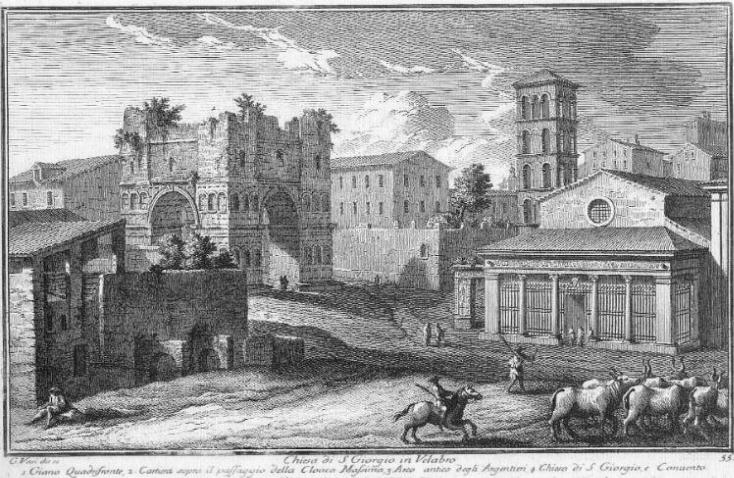
Velabro, the area along the river at the foot of the south-western spur of the Palatine Hill
was marshy until the ancient Romans developed a system of drains which
carried off rainwater to the Tiber via Cloaca Massima, a large sewer. After the fall of the Roman Empire the drains were no longer maintained and eventually a small stream which crossed Circus Maximus was channelled through Cloaca Massima. In 1753 when Giuseppe Vasi published this etching its flow was used by
a paper mill which is shown in the left side of the plate. The cows and oxen in the lower right corner of the plate came from nearby Campo
Vaccino, the weekly cattle market on the site of the ancient Roman Forum.
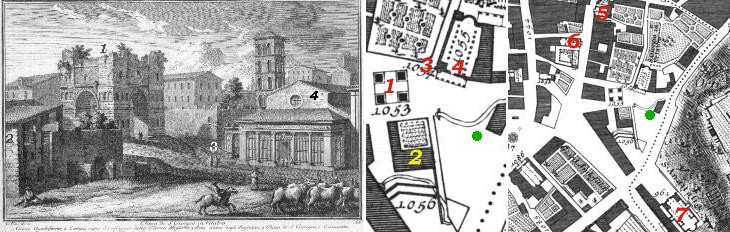
The view is taken from the green dot in the small 1748 map below.
In the description below the plate Vasi made reference to: 1) Arco di Giano Quadrifronte;
2) Paper mill above Cloaca Massima; 3) Arco degli Argentieri; 4) S. Giorgio al Velabro. The small 1748 map shows also:
5) S. Eligio dei Fabbri; 6) S. Giovanni Decollato; 7) S. Anastasia.
The dotted line in the small map delineates the border between Rione Ripa (left) and Rione Campitelli (right).
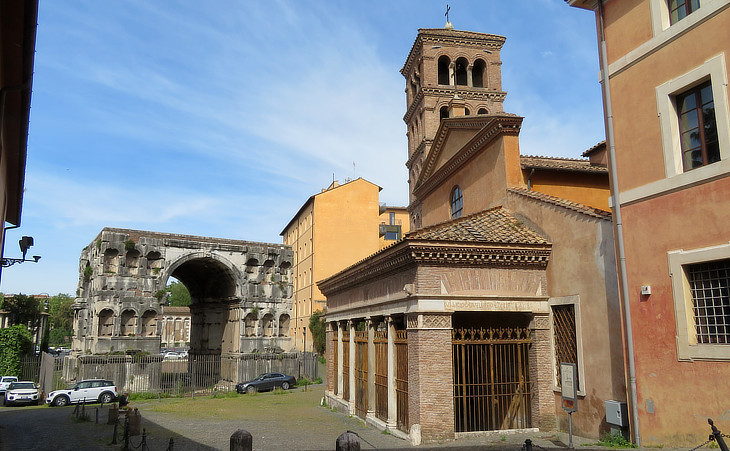
The view in May 2020 (you may wish to see a 1909 watercolour by Yoshio Markino depicting this site)
In 1830 the upper part of Arco di Giano Quadrifronte was pulled down because it was assumed to be a medieval tower added by the Frangipane to the Roman arch as part of their fortifications around the Palatine. It was instead the attic of the monument which had entirely lost its marble facing. Arco degli Argentieri is hidden by the church.
A man sallied forth from the neighbouring shades with an enormous key and whispered the soul-stirring name of the "Cloaca Maxima". I joyfully assented and he led me apart under a series of half-buried arches into a deeper hollow, where the great mouth of a tunnel seemed to brood over the scene and thence introduced me into a little covered enclosure, whence we might survey a small section of the ancient sewer. It gave me the deepest and grimmest impression of antiquity I have ever received. He lit a long torch and plunged it down into the blackness. It threw a red glare on a mass of dead black travertine and I was assured that I was gazing upon the masonry of Tarquinius Priscus. If it wasn't I'm sure it ought to have been.
Henry James in an 1869 letter to his mother. Read other Roman comments by Henry James.
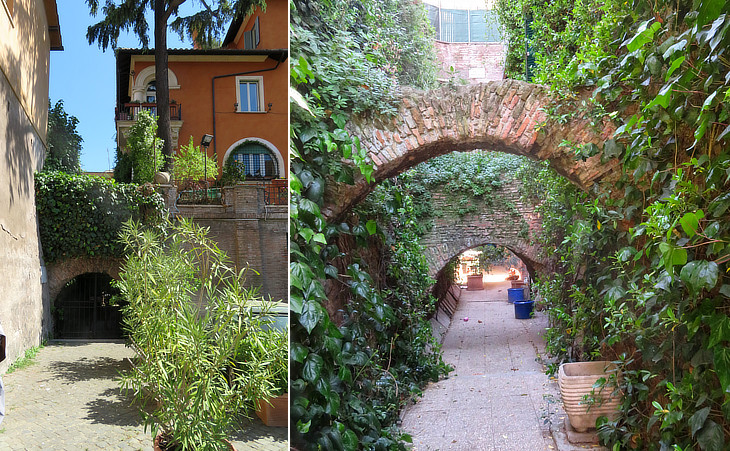
The paper mill has been replaced by two modern buildings, between which some ancient arches above Cloaca Massima can be seen. The path leads to a point of access to the last section of the sewer.
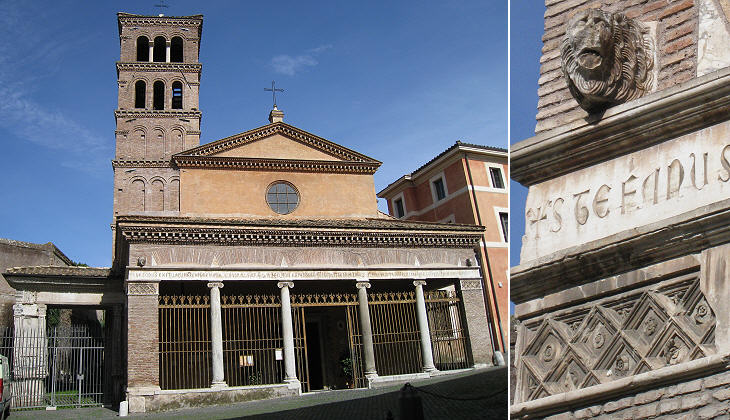
(left) S. Giorgio al Velabro and Arco degli Argentieri; (right) detail of the portico
The church was built in the late VIIth century, during the Byzantine administration of Rome, similar to many other churches in the area, including S.
Maria in Cosmedin. The dedication to St. George replaced a previous one to St. Sebastian; both were soldier saints, but the former was the patron of the small Byzantine garrison of Rome.
The portico was built in the IXth century and it was redesigned in the XIIIth century in a way which greatly resembles that of SS. Giovanni e Paolo (also in the inscription). In 1993 it was almost wiped out by a car bomb (it opens in another window), a terrorist act by a Sicilian mafia ring, but it has been rebuilt as it was.
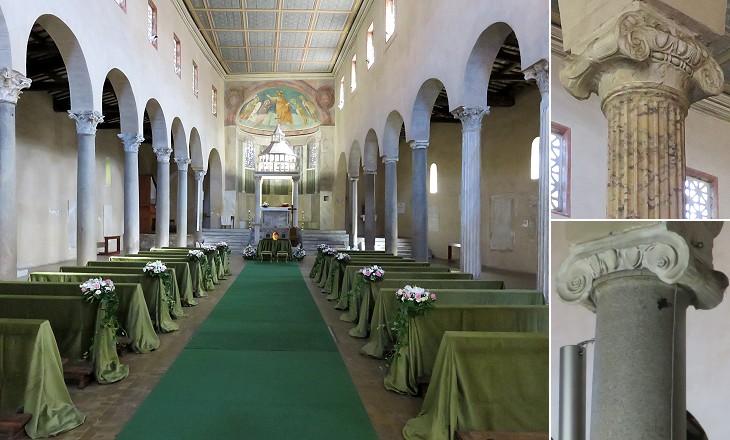
(left) Interior; (right) two ancient columns
In the 1920s all the side altars and other mainly XIXth century additions were removed in order to reveal the original design of the church which was based on fine columns taken from ancient monuments. Their shafts are of yellowish pavonazzetto and grey granite. These stones, unlike white marbles, could not be burned to make mortar.
You may wish to see the church as it appeared in a 1588 Guide to Rome.
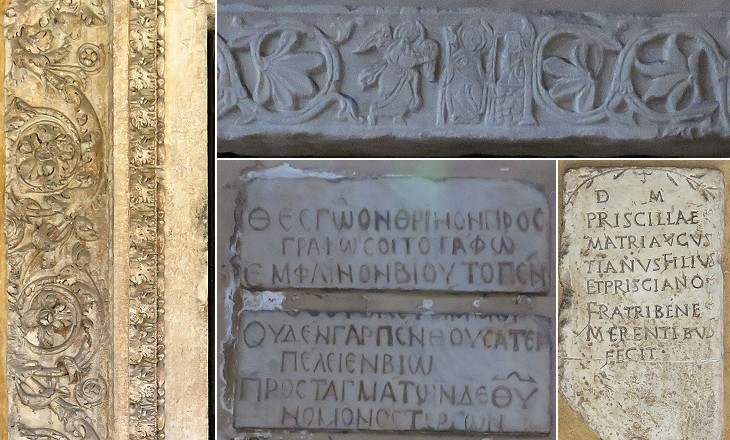
(left) Fragment of ancient Roman lintel; (right-above) a relief with a scene depicting the Annunciation to Zacharias; (right-below) Greek and Latin inscriptions on the wall of the portico
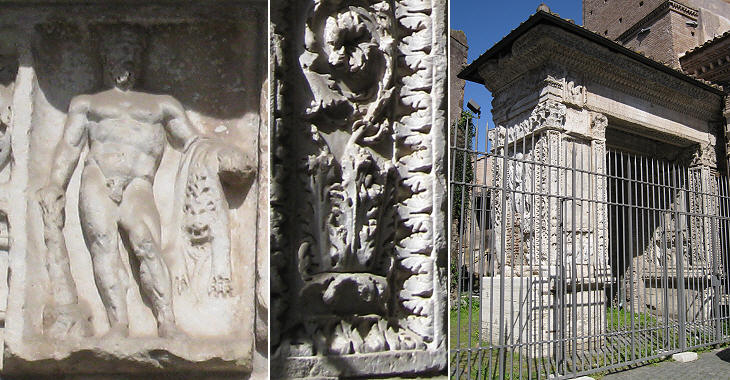
(left) Hercules; (centre) detail of the decoration; (right) overall view
This small arch was erected in 204 by argentarii (money-changers) and cattle dealers in honour of Emperor Septimius Severus: the decoration and the inscriptions made reference to that emperor and his two sons: Caracalla and Geta. After Caracalla murdered Geta all references to the latter were deleted (see how). The relief portraying Hercules is due to the traditional account which sets one of his labours in this part of Rome, where a temple to him still exists (it was turned into a church).
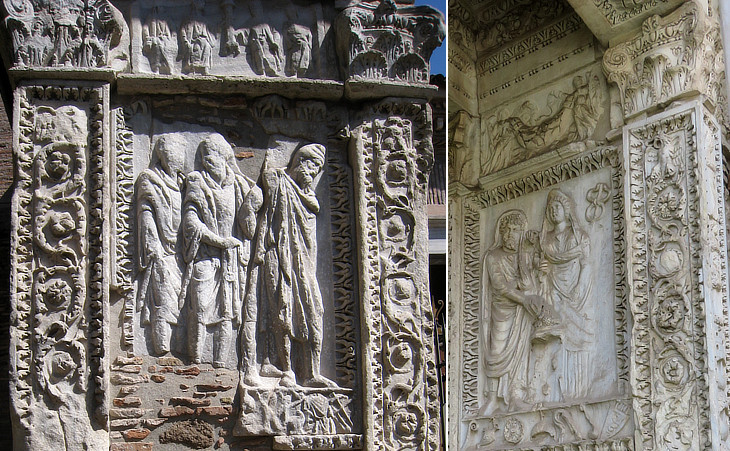
Reliefs depicting: (left) a prisoner in Dacian attire; (right) the Emperor and Iulia Domna his wife performing a religious ceremony
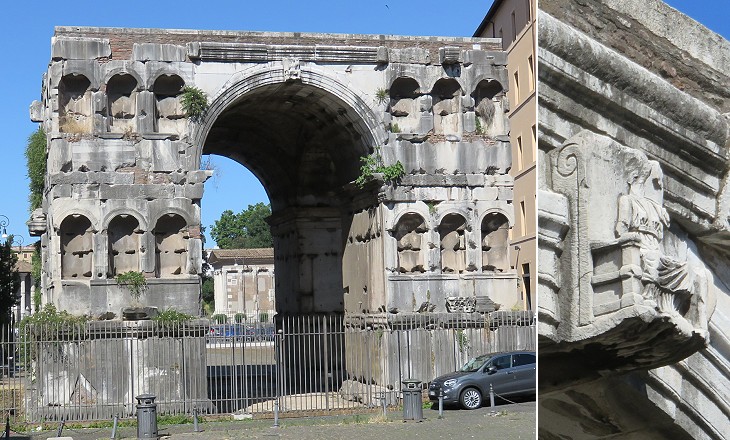
(left) Arco di Giano (eastern side) and behind it Tempio di Portuno; (right) small statue of seated Rome or Juno on the arch keystone
The arch has different names and it was likely built at the time of Emperor Constantine or of Maxentius, Constantine's rival. Giano (Lat. Janus) was the god of the passages (Lat. ianua means door and January marks the passage to the new year): the arch dedicated to him had four fronts (It. quadrifronte) instead of two. The main purpose of the arch was to shelter the dealers who used to meet in this commercial part of the city. Its design is similar to arches at Malborghetto, at Carnuntum in Austria and at Tripoli in Libya.
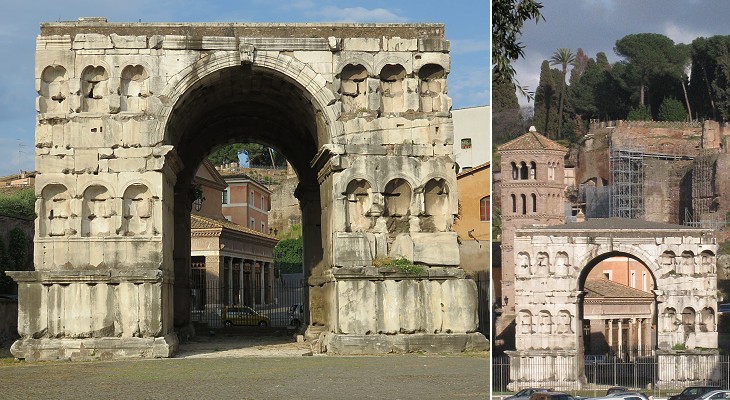
(left) Arco di Giano (western side); (right) the arch with the Palatine in the background
The marble niches (one of them can be seen in the image used as background for this page)
housed statues of gods. They were short-lived, because in 392 Emperor Theodosius declared the Christian faith the sole religion of the Roman Empire.
You may wish to see the arch in the moonlight.
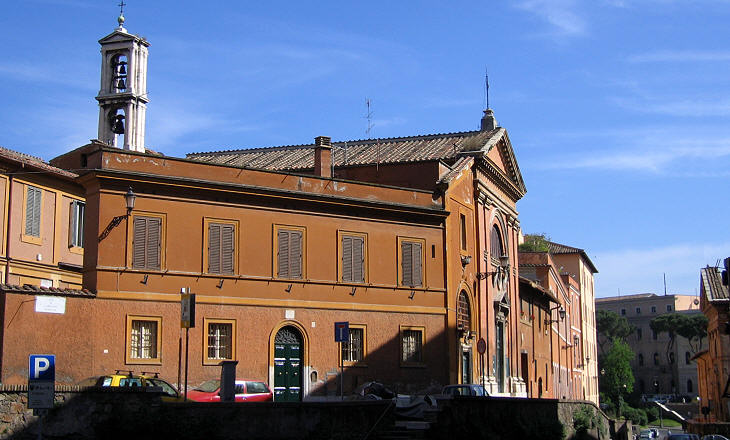
The complex of S. Eligio dei Fabbri opposite S. Giovanni Decollato (far right in the photo)
St. Eligius was a talented goldsmith and therefore he is the patron saint of goldsmiths. Because he cut a horse's leg, shod its hoof and subsequently re-attached it, he is the patron saint also of those who work with horses and iron. For this reason three Roman guilds (goldsmiths, farriers and blacksmiths) dedicated a church to him: S. Eligio degli Orefici (goldsmiths) near Via Giulia, S. Eligio dei Sellai (farriers) in Trastevere (the church was pulled down at the beginning of the XXth century) and S. Eligio dei Fabbri (blacksmiths) which is covered in this page.
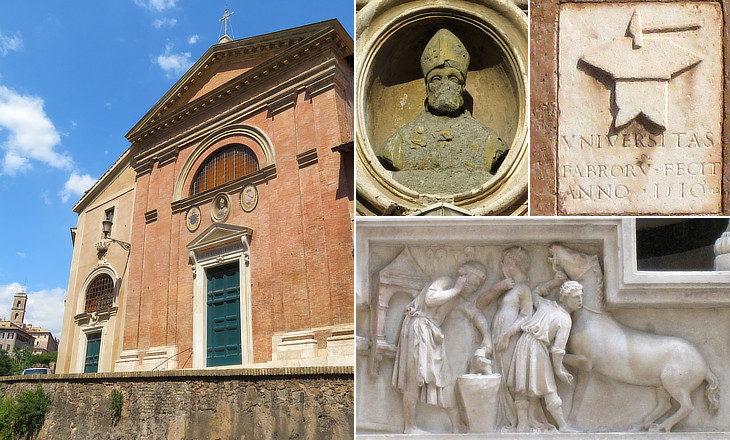
(left) S. Eligio dei Fabbri and to the very left the tower of Palazzo Senatorio on the Capitoline Hill; (right-above) bust of St. Eligius and 1510 plaque with the symbol of the guild; (right-below) detail of the relief depicting the legendary account of the horseshoe below the statue of St. Eligius by Nanni di Banco at Orsanmichele in Florence (it opens in another window)
In searching for the arch of Janus, I passed through some of the dirtiest and busiest streets of Rome, beyond the Capitol, thronged with a population of sturdy mechanics, exercising their trades with a vigour and activity, totally unlike the indolence which prevails in other parts of the city frequented by strangers. In this quarter are many blacksmith shops, where I saw, around a central fire place, nine or ten men, with naked bodies, vigorously but gaily clinking their hammers.
Rembrandt Peale - Notes on Italy, written during a tour in the years 1829 and 1830.
The church is in the valley between the Palatine and the Capitoline hills. It was built in 1562 and it still belongs to the brotherhood of the guild.

(left) Interior; (right) 1604 wooden ceiling
The churches of the Roman guilds were usually rather small in size, but they were lavishly decorated. This occurred over a long period of time because the guilds could not rely on wealthy patrons, e.g. cardinals or noble families, to take care of the cost of embellishments. The interior of S. Eligio dei Fabbri was decorated over a period of nearly two centuries. The guild included also grinders, tinkers, locksmiths, gunsmiths and other trades. Each of the trades represented by the guild had to decorate a chapel. Even the garzoni, the wage earners, were asked to donate a painting or a statue.
You may wish to see a directory of churches belonging to a guild.

(left) 1725 decoration of Cappella di S. Ampelio. Ampelius, a IVth century hermit who chased the Devil by brandishing a hot iron, was chosen as patron saint by the Chiavari (locksmiths), because he protected them from burns; (right) altarpiece (mid XVIIth century) in Cappella di S. Francesco which belonged to the Ferracocchi, the makers of the metal parts of carriages
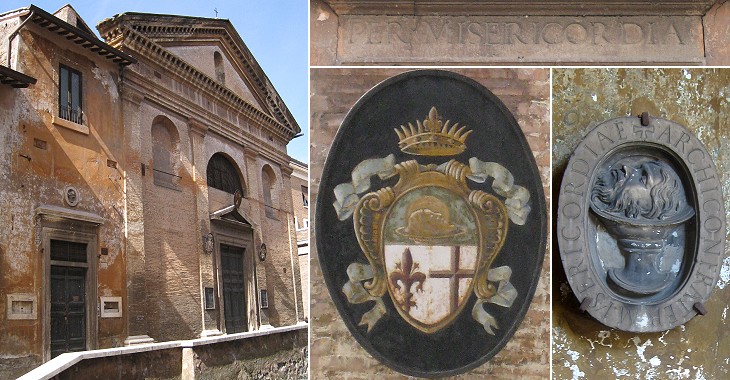
(left) Façade; (upper right corner) inscription on the side of the church;
(centre) coat of arms of the brotherhood; (right) relief with the head of St. John the Baptist surrounded by the inscription "Misericordiae Archiconfrater(nitas)"
In Florence when you need an ambulance, you do not call the Red Cross, you call "La Misericordia" (from Lat. miserere, pity and cor, cordis, heart), a brotherhood for helping the sick. It was founded in the XIIIth century and its members wore the traditional hooded uniform until 2006. In 1490 the
Florentines of Rome created their own local Misericordia and named it after St. John the Baptist, the patron saint of Florence.
Pope Innocent VIII gave the brotherhood a piece of land where a church and an oratory were built during the first half of the XVIth century (you may wish to see the building as it appeared in a 1588 Guide to Rome).
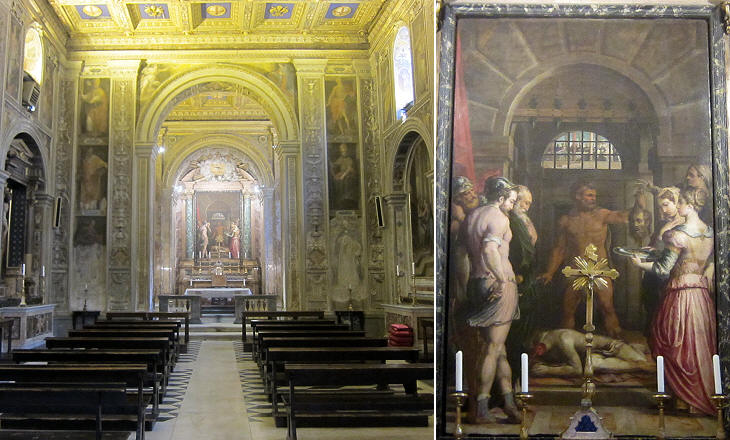
(left) Interior; (right) Decollation of St. John the Baptist by Giorgio Vasari; see images of beheadings at Oratorio dei Bianchi, a brotherhood similar to Misericordia in Palermo and the stucco relief of another similar brotherhood at Avignon
The interior of the church has a rich decoration and paintings by Giorgio Vasari and other Florentine mannerist artists.
The members of the brotherhood comforted those who were sentenced to death during their last hours and in 1540 Pope Paul III granted the brotherhood the yearly right to free one of them.
After a short delay, some monks were seen approaching to the scaffold from this church; and above their heads, coming on slowly and gloomily, the effigy of Christ upon the cross, canopied with black. This was carried round the foot of the scaffold, to the front, and turned towards the criminal, that he might see it to the last.
Read more of Charles Dickens's account of an execution near this church in 1845.
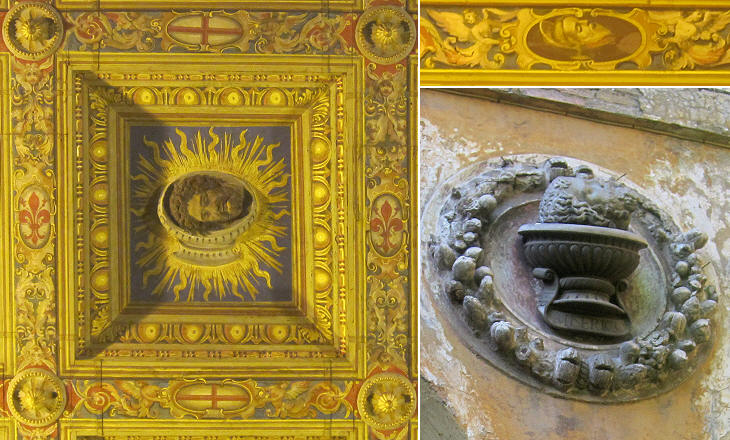
(left) Central panel of the ceiling of the church; (right above) another detail of the ceiling; (right below) relief in the cloister
St. John's head on a platter was the symbol of the brotherhood and it is a recurring theme of the decoration of the church and of buildings belonging to it; the emphasis placed on this gruesome reference to the saint was in line with the guidelines developed by the Roman Catholic Church at the Council of Trento which promoted the portrayal of the martyrs and in particular of the tortures they endured and the ways they were put to death.
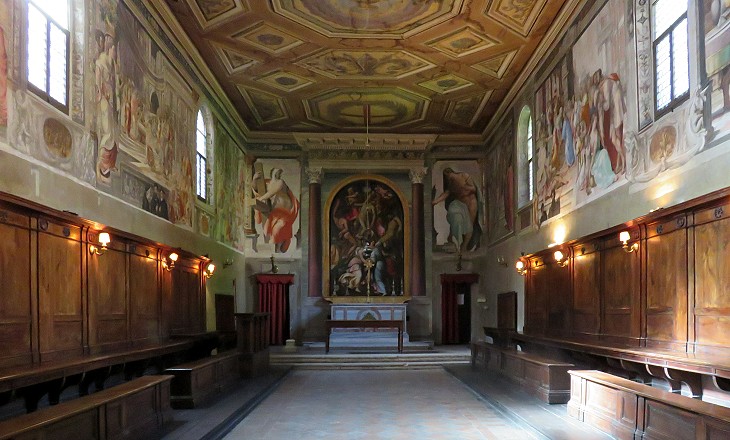
The oratory
The complex includes an oratory where the members of the brotherhood held their meetings. It is decorated with frescoes by Florentine painters who joined the brotherhood. The church and the oratory can be visited only on June 24, feast of St. John the Baptist.
You may wish to see a directory of national churches in Rome.
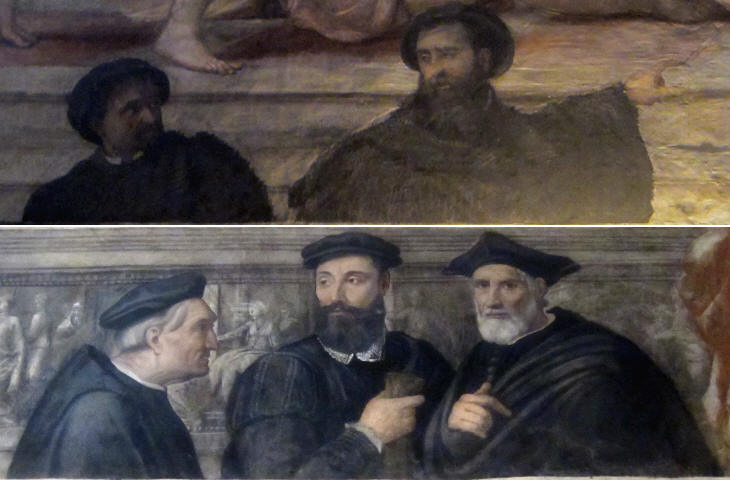
Details of 1551 frescoes by Francesco Salviati in the oratory showing members of the brotherhood including Michelangelo (the man with the long beard in the upper image); see other paintings by Salviati showing the influence of Michelangelo at S. Maria dell'Anima and at Galleria Nazionale di Palazzo Barberini
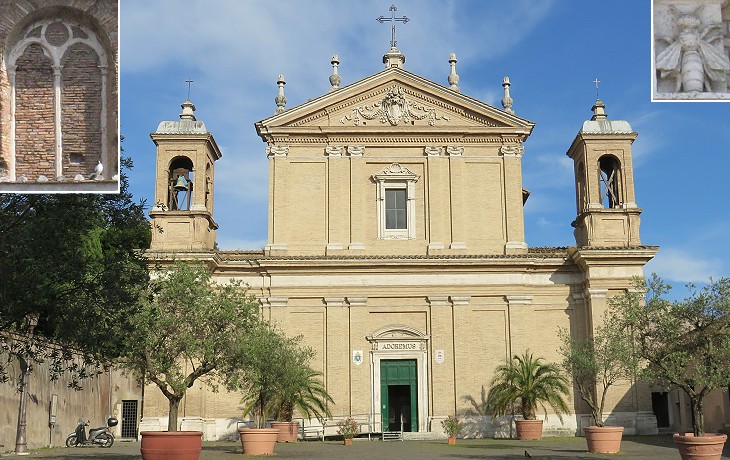
S. Anastasia: (left upper corner) window of the late XVth century building; (right upper corner) a bee, heraldic symbol of Pope Urban VIII above the entrance
S. Anastasia is one of the oldest churches of Rome; it is dated IVth century, although its current appearance is the result of several reconstructions; during the Byzantine administration it was the church of the governors of the City. Major modifications were made by Pope Sixtus IV for the 1475 Jubilee. In 1636 the façade was thoroughly redesigned by Gian Lorenzo Bernini (or Luigi Arrigucci) for Pope Urban VIII, whose heraldic bees decorate the façade (you may wish to see the building as it appeared in a 1588 Guide to Rome, when it had a tall Romanesque bell tower).

Interior of the church with columns of "pavonazzetto" and "cipollino" (left) and granite (right)
The interior of the church was redesigned in 1721-1722 by Carlo Gimach, a Maltese architect who worked extensively in Portugal, for Cardinal Nuno da Cunha e Ataide from Lisbon; the ancient columns which once supported the building were used to decorate the new large nave.

Statue of St. Anastasia by Francesco Aprile and Ercole Ferrata under the main altar
The statue of St. Anastasia was clearly inspired by Bernini's works. Her ecstatic face is similar to that of St. Teresa and her posture to that of Blessed Ludovica Albertoni. The church was probably named after Anastasia, a sister of Emperor Constantine, but it was later on dedicated to St. Anastasia of Sirmium in today's Serbia, a martyr of the late IIIrd century.
Next plate in Book 3: Chiesa di S. Maria in Cosmedin.
Next step in Day 5 itinerary: Chiesa di S. Teodoro.
Next step in your tour of Rione Campitelli: Chiesa di S. Maria Liberatrice.
Next step in your tour of Rione Ripa: Circus Maximus.
Excerpts from Giuseppe Vasi 1761 Itinerary related to this page:
Chiesa di s. EligioEra questa anticamente delicata a ss. Giacomo, e Martino, e vi era unito un conservatorio di povere donne: ma poi ottenuta dalla Confraternita de' Ferrari nell'an. 1563. riedificarono la chiesa da' fondamenti, ed ora l'hanno ornata con nobilissime cappelle di marmi e pitture. Poco più oltre si vede a destra laChiesa di s. Giovanni DecollatoPrima dicevasi questa chiesa s. Maria della Fossa, perchè in essa si dava sepoltura a' giustiziati, che allora si facevano morire sul vicino monte Caprino Ma essendo nell'an. 1487. da Innoc. VIII. approvata la Confraternita della Misericordia eretta, e composta di nazionali Fiorentini, fu di nuovo edificata la chiesa, e dedicata a s. Gio. Batista col titolo di Decollato, e comecchè il loro istituto è di assistere a ben morire i condannati a morte, e dar loro sepoltura, vi eressero il cimiterio cinto di portici. Sonovi nella chiesa, e sagrestia delle pitture del Vasari, del Salviati, del Pomarancio del Naldini, ed altri. Quindi camminando a destra si vedono le rovine delGiano QuadrifonteSi ravvisa questo antichissimo edifizio tutto formato di marmo con quattro archi aperti ne' quattro prospetti, ed in ogni prospetto dodici nicchie, e viene creduto essere il tempio di Giano Quadrifronte, ma è più verisimile esser uno delli due fornici adorni di statue di oro, che fece Stertinio nel foro Boario, che quivi si stabilisce dall'iscrizione, che ancor si legge nell'arco fatto dagli Argentarj, e negozianti del medesimo foro Boario, quale ancora si vede appoggiato allaChiesa di s. Giorgio in Velabro
Si dice in velabro questa chiesa a vehendo, poichè fu quivi una palude o stagno del vicino Tevere, in
cui furono spinti i due fanciulli Romolo, e Remo dalle onde in quel tempo fluttuanti, e però si tragittava
colla barchetta; seccata poi la palude da Tarquinio Superbo, vi fu eretto il foro Boario, in cui fu alzato un
vitello di bronzo dorato, in memoria di aver ivi Romolo coll'aratro tirato da un bue, ed una vacca
principiato il solco per segnare le mura di Roma. |