
All images © by Roberto Piperno, owner of the domain. Write to romapip@quipo.it.


Notes:
Page revised in July 2026.
All images © by Roberto Piperno, owner of the domain. Write to romapip@quipo.it.
Notes:
Page revised in July 2026.
 along Via Flaminia

(left) Late XIXth century map: the green line indicates the section of Via Flaminia which is covered in this page; the red dot (the ruins of Veii) and the blue dot (Sepolcro di Nerone, an ancient sarcophagus) are covered in other pages; (right) "Augustus of Prima Porta", a statue found at Villa di Livia, now at Braccio Nuovo (see a detail of the armour)
This walk along Via Flaminia starts from Ponte Milvio (aka Ponte Molle) and it ends at Malborghetto, respectively the ending and the starting points of the Battle of Ponte Milvio between Constantine and Maxentius which was fought in 312 AD.

(left) Gran Madre di Dio; (right) nearby Casa del Fascio built at approximately the same time
In the Roman Catholic Church Mary is usually referred to as St. Mary, rather than as Mother of God, whereas in the Greek Orthodox Church Theotokos is the usual title and
Agia Maria is rarely used.
In 431 a council was held at Ephesus to establish whether Mary should be referred to as Theotokos or Christotokos (Mother of Christ). The latter opinion was supported by Nestorius, Patriarch of Constantinople, who feared that the use of Theotokos could lead to worshipping Mary as a goddess. The Council rejected his views and Nestorius retired to a monastery.
As part of the celebrations held in Rome for the 1500th anniversary of that council, Pope Pius XI promoted the construction of a church to the Mother of God in the square opposite Ponte Milvio, where the Christian Faith/Constantine defeated Paganism/Maxentius.
The monumental church was designed by Cesare Bazzani, an architect best known for Galleria d'Arte Moderna, and Clemente Busiri Vici in a mixture of styles. At a few hundred yards from the church another building shows that in the same period some young Italian architects were developing new "rationalist" patterns (see a page on E.U.R., a new development designed according to these new patterns).

(left) The series of buildings making up Villa Brasini; (right) the tower at the main entrance
Armando Brasini (1879-1965) was an architect who was very highly regarded by the Fascist government (1922-1943) for his
monumental buildings where he mixed various styles with results which are considered rather poor by today's art historians.
He built
a large villa for himself on a hill next to Ponte Milvio and to a bridge he had designed. The villa is adjoined by apartment blocks which give the complex the overall shape of a castle, to the point that the locals call it il Castellaccio (the Ugly Castle).

(left/centre) Details of the main courtyard; (right-above) an ancient relief on a sarcophagus; (right-below) a
coat of arms of Pope Alexander VI
The internal courtyards of the villa show that Brasini had an unexpected penchant for XVIIth century architecture which was despised by Fascism as a sign of Italy's decline after the Renaissance.
Brasini supervised the pulling down of old buildings which were promoted in the 1930s to enhance spectacular views of the Colosseo, Mausoleo di Augusto, Teatro di Marcello, etc. He was allowed to collect
some reliefs and fragments of statues which were found during these clearances and he decorated his villa with them.

Views of the landscape along Via Flaminia
Via Flaminia heads north towards Civita Castellana, initially following the Tiber. From time to time the buildings of modern Rome give way to sites retaining a rural aspect. The first volcanic rocks, typical of northern Latium, appear on the left, while on the right one sees meadows at the sides of the river (you may wish to see other views of this area).

Large mausoleum at la Celsa, near Grottarossa (Ist century AD) which was turned into a small medieval fortress,
similar to Tomba di Cecilia Metella
Via Flaminia, although to a much lesser extent than Via Appia, was flanked by funerary monuments. The ruins of a few of them can still be seen among the trees near the river or on the hills overlooking the road, often covered with that picturesque vegetation which made the ruins of Rome so appealing to the travellers of the past.
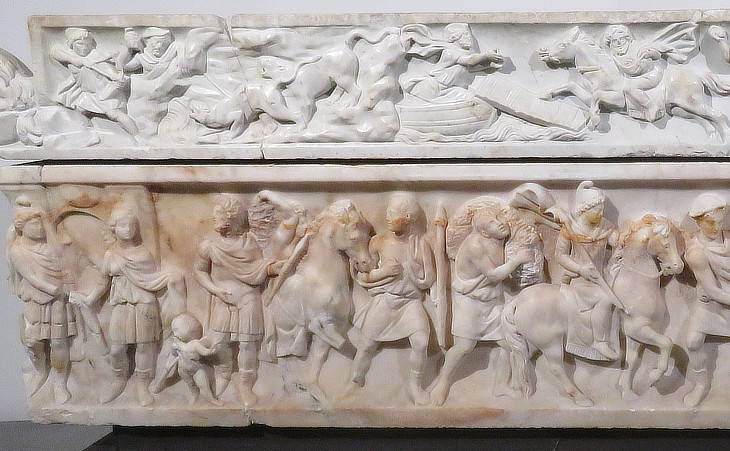
Museo Nazionale Romano: detail of a sarcophagus which was found in a tomb at Grottarossa (IInd century AD): Box: Aeneas and Dido taking part in a stag-hunt and Ascanius riding a horse (see a mosaic at the Museum of Taunton, Somerset to learn more about this scene); Lid: hunters chasing lionesses and a cavalryman carrying a lion cub to a ferryman (Charon?), perhaps a reference to the young age of the dead

Tombs cut into the rock at la Celsa (above) and at Prima Porta near Villa di Livia (below)

Main peristyle
The White House is the residence of the President of the United States of America; the White Hens (ad Gallinas Albas) was one of the
suburban residences of Emperor Augustus, or to be more precise of Livia, his beloved third wife. The reference to white hens is due to a legend telling that Livia dreamt that an eagle had dropped in her arms a white
hen holding a laurel branch in its beak: the dream was interpreted as a favourable indication of glory and wealth and white hens
were bred at the villa.
1863 excavations led to the discovery of a statue of the emperor, which in addition to its high artistic value, is very interesting as it tells us exactly
how Augustus wanted to be portrayed for both political and religious reasons.

Details of black and white mosaics
The Romans had a liking for black and white mosaics, rather than for coloured ones. The former can be compared to a drawing, the latter to a painting. Black and white mosaics were suited for creating optical effects (you may wish to see those at Villa Adriana and at Villa dei Volusii).

Frescoes
Most of the frescoes at Villa di Livia had a merely decorative purpose; they did not cover the entire wall and they had large empty spaces between each subject. You may wish to see those of the Houses of Augustus and Livia on the Palatine Hill.

Museo Nazionale Romano di Palazzo Massimo: reconstructed underground room with a fresco decoration
The villa was made up of terraces overlooking the river and supported by walls. It had several underground rooms providing a refreshing haven during the hottest days. One of them was found in excellent condition with a fresco decoration depicting plants and birds. You may wish to see similar frescoes at Villa di Poppea at Oplontis and at the House of the Orchard at Pompeii.

Detail

(left) SS. Urbano e Lorenzo; (right) a detail of the modern church by the same name with a poster celebrating the 1700th anniversary of Constantine's Vision before the Battle of Ponte Milvio which is shown in the image used as background for this page
The statue is called Augustus of Prima Porta (First Gate), after the name acquired by the section of Via Flaminia near Villa di Livia in the following centuries. The aqueduct bringing water to the villa formed a sort of gate over Via Flaminia which travellers saw as the first indication of having reached Rome. Only one pillar of the aqueduct is left next to a small church rebuilt by Pope Urban VIII in the XVIIth century.

The small castle/farmhouse built making use of the Roman arch and the 1567 inscription celebrating a
restoration by Pope Pius V
Malborghetto means evil small hamlet: it does not sound very reassuring: the name given to this building is most likely due to the fact that travellers, who stopped here on the last leg of their journey to Rome, were often robbed. The lower part of the building shows the neat design of Roman masonry, while the upper one is a medieval addition made up of small stones. The building which was used as a small castle, a farmhouse and a coach station was originally built as a triumphal arch dedicated to Emperor Constantine.

(left) Interior of the lower storey showing a section of Via Flaminia beneath the medieval floor; (centre/right) fragments of tombs,
lintels and statues in the garden surrounding Malborghetto
The structure of the arch was similar to Arco di Giano in Rome with four openings. The two monuments were built at approximately the same time. Malborghetto and the surrounding garden house findings of excavations carried out along Via Flaminia.

You may wish to move ahead along Via Flaminia or visit nearby Sacrofano


