All images © by Roberto Piperno, owner of the domain. Write to romapip@quipo.it.


Notes:
Page revised in April 2026.
All images © by Roberto Piperno, owner of the domain. Write to romapip@quipo.it.
Notes:
Page revised in April 2026.
 Piazza del Colosseo - page one
Links to this page can be found in Book 2, Map B3, Day 1, View C9, Rione Campitelli and Rione Monti.
This page covers:
The plate by Giuseppe Vasi
Today's view
Colosseo
- The Building
- Gladiatorial Games and Venationes
- Decadence and Ruin
New Underground Station of Colosseo-Fori Imperiali
In the second page:
Arco di Costantino
Meta Sudante
Tempio di Venere e Roma
Compitum Acilii
Domus Aurea
Terme di Tito
Terme di Traiano (including Sette Sale)

We know that Giuseppe Vasi sold his plates also separately from the books which they illustrated. This 1752 view of Piazza del Colosseo was most likely the etching which he sold most. The amphitheatre was the symbol of Ancient Rome and no visitors would leave Rome without a "postcard" of it. Vasi depicted the monument from the best possible point i.e. from the hill to its north in order to show the side of the amphitheatre which retained the outer ring. The result however was not as impressive and dramatic as that achieved by Giovanni Battista Piranesi in a 1761 etching (it opens in another window).
The view was taken from the green dot in the map below. In the description below the plate Vasi made reference to: 1) Anfiteatro Flavio; 2) Arco di Costantino; 3) Ruins near S. Maria Nuova (Tempio di Venere e Roma); 4) S. Bonaventura. 4) is shown in another page. The small 1748 map shows also 5) Domus Aurea; 6) Terme di Tito; 7) Terme di Traiano; 8) Sette Sale. The dotted line in the small map delineates the border between Rione Monti (upper part) and Rione Campitelli (lower part).


The view in June 2009 (7:00 a.m.)
Vasi forced perspective laws to show the whole building and at the same time the apse of Tempio di Venere e Roma. Today the area between Colosseo and Arco di Costantino is reserved for pedestrians, but until 1980 the amphitheatre was a sort of gigantic roundabout. This was an effect of the 1932 opening of Via dei Fori Imperiali which channelled a large number of cars towards Piazza del Colosseo.

North-western view in the evening in June 2009
Lord Byron translated this saying as (Childe Harold's Pilgrimage -CXLV):
The saying is attributed to the Venerable Bede, the first English historian (672-735), who learned it from Anglo-Saxons pilgrims. It probably made reference to a nearby colossal statue of Emperor Nero, rather than to the amphitheatre, but all British travellers had it in mind when they visited Rome.

North-western view in June 2015 after a major cleaning effort
November 11, 1786. In the evening we came upon the Coliseum,
when it was already twilight. When one looks at it, all else
seems little; the edifice is so vast, that one cannot hold the
image of it in one's soul - in memory we think it smaller,
and then return to it again to find it every time greater
than before.
J. W. Goethe - Italian Journey - Translation by Charles Nisbet
Let the spectator first place himself to the north, and contemplate that side which depredation, barbarism, and ages have spared, he will behold with admiration its wonderful extent, well proportioned stories and flying lines, that retire and vanish without break or interruption. Next let him turn to the south, and examine those stupendous arches, which, stripped as they are of their external decorations, still astonish us by their solidity and duration.
John Chetwode Eustace - A Classical Tour through Italy in 1802
The exterior of the amphitheatre with semi-columns of the three orders (Doric, Ionic and Corinthian) and its attic with low Corinthian pilasters became a reference pattern for many architects during the Renaissance and afterwards (e.g. for Gian Lorenzo Bernini in the design of the façade of Palazzo Barberini).

Museo della Civiltà Romana (temporary exhibition at Mercati di Traiano): model of Colosseo
Colosseo was named after a nearby colossal statue of Nero as Helios, God of the Sun. Some archaeologists believe it was made of bronze and that it was re-used by other emperors. According to this opinion parts of it are now on display at Musei Capitolini. Anfiteatro Flavio is a more appropriate name for the amphitheatre, because it was built by the emperors of the Flavian dynasty. Construction started in 72 AD at the initiative of Vespasian; it was inaugurated in 80 by Titus and it was completed by Domitian.

Attic: (left) exterior; (right) interior
On August 23, a. d. 217, Macrinus being Emperor, the amphitheatre was repeatedly struck by lightning. The tabulationes of the fourth story caught fire and the falling embers set the floor of the arena ablaze. In fact, there must have been more wood and timber in the structure than we generally believe. (..) Heliogabalus began and Severus Alexander finished in 223 the work of reconstruction. (..) The repairs can be examined to the best advantage from the upper platform; they consist of a patch- work of stones of every description, trunks of columns, pieces of entablatures, lintels, and architraves recovered from the portions damaged by fire or taken away from other buildings. The construction of this upper story is altogether hasty and negligent: the joints of the stones are irregular and the composite pilasters are not all straight nor placed on the same perpendicular as the columns below.
Rodolfo Lanciani - The ruins and excavations of ancient Rome - 1897

Interior
The design of Colosseo shows the skill of its architects in providing effective solutions to the many issues they faced because of its large audience (perhaps up to 70,000). Each of the eighty entrances was numbered so spectators knew where to access the building in order to reach their seat. A series of vomitoria, large internal staircases, allowed easy access to the three tiers into which the amphitheatre was divided: ima cavea and media cavea, the two lower tiers had numbered marble seats; summa cavea, the upper tier, was reserved for those who bought the cheapest tickets; they sat on wooden benches or they stood on their feet.
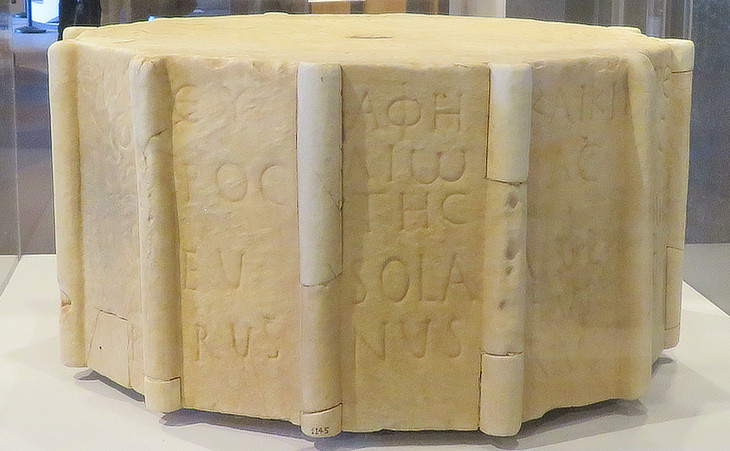
Musei Vaticani (at a temporary exhibition): anemoscope, a device designed to show the direction of the wind
A sort of awning (velarium) sheltered the audience from the sun. It was manoeuvred by sailors of the Roman fleet. A device which indicated the direction of the wind was discovered in 1779 on the hill behind the amphitheatre. The winds are written in Greek and Latin (with some spelling mistakes) in twelve sections of the stone pedestal of the device which was completed by a rod carrying a windvane. See the Tower of the Winds at Athens which was based on eight winds and another anemoscope at Parco Archeologico del Celio.

(above) A series of marble seats with signs and inscriptions; (below) inscription: "(QU)IB. IN THEATR . LEGE . PL(ebis) . VE(SCITO SEDERE) / (L)ICET . P(edes) . X I I" which in accordance with the law assigned to the members of a guild or a religious body a seat of twelve feet
No trace is left of the Imperial suggestum (tribune). (..) The balcony reserved for the magistrate who exhibited the games has also disappeared. We have, on the other hand, many epigraphic records of the places pertaining to senators, knights, high priests, ambassadors, guests of the S. P. Q. R., etc., according to the distribution made in a. d. 80 by the Imperial commissioner, Manius Laberius Maximus, assisted by an officer named Thyrsus. The places were not assigned to individuals, but collectively to the body or college or corporation to which they belonged; for instance, "to the ex- consuls, one hundred and ten feet," or, "to the school-teachers, . . . feet." Towards the middle of the fourth century this division by classes was given up, and spaces for one or more seats were permanently occupied by the same individual, or by the same family, whose name was accordingly engraved on the marble pavement or on the parapet of the podium; and as families were extinguished in the course of years, and individuals died away, the names were erased, and those of the newcomers engraved. (..) I have published in 1880 one hundred and ninety-three inscriptions of seats, and a few more have been discovered since. The "Corpus inscriptionum" of the Flavian amphitheatre numbers over two hundred and sixty specimens, which, if properly arranged and exhibited on the spot, would revive its history and make us conversant with details which it is difficult to make out from books and manual. Lanciani

(left) Corinthian capital with a head of Gorgon from the upper loggia; (right) "tabula lusoria" gaming board (see similar ones on the Palatine and at Thamugadi in Algeria)
The amphitheatre, in fact, is not so poor in architectural or ornamental marbles as we make it appear to be. It would be an easy and also a most useful and noble undertaking to put back these marbles into their proper places, and fully restore one of the "cunei" (sectors) of this wonderful structure. There are about forty shafts of columns belonging to the upper loggia, and as many capitals of the Corinthian order, some of the time of the Flavians, others of the fourth century. Lanciani
(In the Forum) diagrams of games (tabulae lusoriae) have been scratched: most of these diagrams are in the form of a circle and were employed in a game where two players, each provided with three pebbles, placed them at various points on the diagram and then made alternate moves until one of them won by getting his three pebbles in a row.
Christian Hülsen - The Roman Forum, its history and its monuments - 1909
Roman spectators are known to have played board-games in Roman amphitheatres and circuses, presumably in the intervals between events.

Separations between sectors of the seats (see those at the Amphitheatre of Capua) and inscription at entrance XLVI (46) (see a similar inscription at the Amphitheatre of Verona)
There are hundreds of marble steps and seats, and many exquisite screens or parapets once placed on the side or above the vomitoria. Lanciani
Today the interior of Colosseo is entirely bereft of its decoration,
but we know that every element of the building was carefully thought of also from an aesthetic viewpoint; each tier was divided into sectors and to facilitate their identification they were separated by low marble screens which also served as handrails. These were all decorated with a variety of reliefs.

Inscription around the arena and details of it: (left) AD MAIOREM; (right) DD. NN. (dominorum nostrorum)
There are inscriptions making the round of the edifice; and yet all these valuable materials are allowed to lie useless and scattered in great confusion, and some pieces have actually been taken away and removed I know not whither. (..) The earthquake of 422, described by Paul the Deacon, must have done the building serious injury. An inscription discovered by Fea in 1813, speaks of restorations made by Theodosius II. and Valentinian III. between 425 and 450. There are also copious fragments of three inscriptions, each 70 or 80 metres long, commemorating other work done under the latter Emperor, by Flavius Paulus, prefect of the city in 438. Lanciani
The inscription was written twice around the arena and it celebrated a restoration of the building after an earthquake (terrae motu): Pro felicitate dd. nn. Theodosii et Placidi Valentiniani,
perpetuorum invictissimorum principum, Flavius [---?] Paulus, vir clarissimus, urbi praefectus,
vice sacra iudicans, ad maiorem gratiam voluptatemque populi Romani arenam, podium et ianuas,
gradus ex columnis ad imam caveam terrae motu dilapsos instauravit ac decennio post, feris
dimissis, dedicavit.

Museo e Galleria Borghese: detail of a IVth century AD mosaic found in 1834 at Torrenova, along Via Casilina in the outskirts of Rome. It is one of the most dramatic depictions of gladiatorial fights; another detail is shown in the image used as background for this page
There is nothing so ruinous to good character as to idle away one's time at some spectacle. (..) The other day, I chanced to drop in at the midday games, expecting sport and wit and some relaxation to rest men's eyes from the sight of human blood. Just the opposite was the case. Any fighting before that was as nothing; all trifles were now put aside - it was plain butchery. The men had nothing with which to protect themselves, for their whole bodies were open to the thrust, and every thrust told. The common people prefer this to matches on level terms or request performances. Of course they do. The blade is not parried by helmet or shield, and what use is skill or defense? All these merely postpone death.
In the morning men are thrown to bears or lions, at midday to those who were previously watching them. The crowd cries for the killers to be paired with those who will kill them, and reserves the victor for yet another death. This is the only release the gladiators have. The whole business needs fire and steel to urge men on to fight. There was no escape for them. The slayer was kept fighting until he could be slain. 'Kill him! Flog him! Burn him alive!' (the spectators roared) 'Why is he such a coward? Why won't he rush on the steel? Why does he fall so meekly? Why won't he die willingly? ". Do not, my Lucilius, attend the games, I pray you. Either you will be corrupted by the multitude, or, if you show disgust, be hated by them. So stay away.
Seneca - Moral letters to Lucilius - Epistle 7 - Translation by Richard Mott Gummere
The audience gathered in Colosseo to watch gladiatorial fights and venationes, wild beast hunts. The gladiators were so named after gladius, a short sword which was part of the equipment of a Roman legionary. Those who fought in the amphitheatre usually did not have the same weapons: the retiarii fought with a net and a trident and they did not have body protection apart from a heavy bandage on their left arm. Those fighting with a sword fell into different categories based on the other equipment (shield, helmet and armour) they wore.

Archaeological Museum of Madrid: mosaics depicting gladiatorial fights which were found in the proximity of Colosseo and were acquired by Cardinal Camillo Massimo (see other mosaics of his collection)
In the Palazzo Massimi are two curious Pieces of antique Mosaic, representing Combats of the Retiarii and Secutores.
In one of them are written the Names of the Combatants, Calendio and Astianax; the former being the Retiarius, and the later the Secutor: And 'twas he that got the Victory, as the Inscription tells us Astianax vicit tho' the other is represented
there to have so much the Advantage, as to have thrown his Net quite over his Adversary.
Edward Wright - Some Observations made in France, Italy etc. in the years 1720, 1721 and 1722 [1730].
The combats of Gladiators were at first used in Rome at
funerals only, where prisoners were obliged to assume that profession, and fight before
the tombs of deceased Generals or Magistrates, in imitation of the barbarous custom
of the Greeks, of Sacrificing captives at the
tombs of their heroes. (..) As the people's
fondness for these combats increased every
day, they were no longer confined to funeral Solemnities, but became customary on
days of public rejoicing, and were exhibited, at amazing expence, by Some Generals
after victories. In the progress of riches,
luxury, and vice, it became a profession in
Rome to deal in gladiators. Men called
Lanistae made it their business to purchase
prisoners and slaves, to have them instructed in the use of the various weapons; and
when any Roman chose to amuse the people with their favourite show, or to entertain a select company of his own
friends upon any particular occasion, he applied to the Lanistae; who, for a fixed price,
furnished him with as many pairs of those
unhappy combatants as he required.
John Moore - A View of Society and Manners in Italy - 1781
You may wish to read the Colosseo playbill Mark Twain found in 1867, most likely on April Fools' Day.

Ashmolean Museum of Oxford: marbles from Smyrna: (left) relief depicting collared slaves being conducted to fight against beasts (IInd century AD); (right) gravestone of a "retiarius" (Ist century AD)
(Rome) op'd the gloomy caverns, whence out-rushed
Before th' innumerable shouting crowd
The fiery, madded, tyrants of the wilds,
Lions and tigers, wolves and elephants,
And desperate men, more fell.
John Dyer - The Ruins of Rome - 1740
Gladiatorial fights were popular throughout the whole Roman Empire and all towns of some size had an amphitheatre. Initially these fights were part of funerary ceremonies and they did not take place in amphitheatres, as shown in the reliefs of a Ist century BC monument in the environs of Rome.

Museo Pio-Clementino - Cortile Ottagono: fragments of a late IIIrd century AD sarcophagus depicting lions attacking horses and a "magister", attendant in charge of the lion, behind the two animals; see a similar sarcophagus which was found in Teatro di Marcello
The Oryx - Not the meanest quarry among the beasts of
morning shows, the savage oryx costs me the
death of how many dogs!
Martial - Epigrams - Book XIII:XCV - Loeb edition
The gladiatorial fights were preceded by fights with animals or among animals, which took place at noon. They became very popular when the expansion of the Empire came to a halt and the number of prisoners/slaves who were trained as gladiators declined.

Underground structure
The arena or central open space, where the shows took place, derived its name from the sand with which it was covered for the purpose of absorbing the blood. (..) It was composed of a boarded floor supported by beams which rested on a series of walls, some parallel with the main axis, some following the curve of the ellipse. A great piece of wooden floor was discovered in the excavations of 1874, but we are not sure whether it did really belong to the arena or to the floor below it. (..) Every trace of the woodwork has been allowed to disappear since 1874. Lanciani

(left) Main axis of the underground structure; (right) detail of equipment for raising cages
In the same excavations of 1874-75 the sockets were discovered to which windlasses, capstans, or lifts (peymata) were fixed, by which the cages of wild animals were raised to the level of the trapdoors of the arena. We must not suppose that the animals could be kept for any length of time in the dark and stuffy dens below the arena or the podium. They were kept in readiness in the west porticoes of the Claudium and brought up in rolling cages as they were wanted. From this point of view, that is, from the point of view of exhibition of gladiatorial or hunting shows, the Coliseum appears to us as the capital of a kingdom of its own, as the centre of a vast administration, with branch offices in Syria, in Africa, on the Red Sea, and head offices in Rome itself, occupying large tracts of the second, third, fifth, and sixth regions. Lanciani
The wild animals were captured in the mountains of Northern Africa and Asia and then shipped to Rome, as shown in mosaics at Hippo Regius and in Sicily. Statues, mosaics, reliefs, inscriptions and even lamps, etc. have provided archaeologists and historians with a large documentation on these fights.
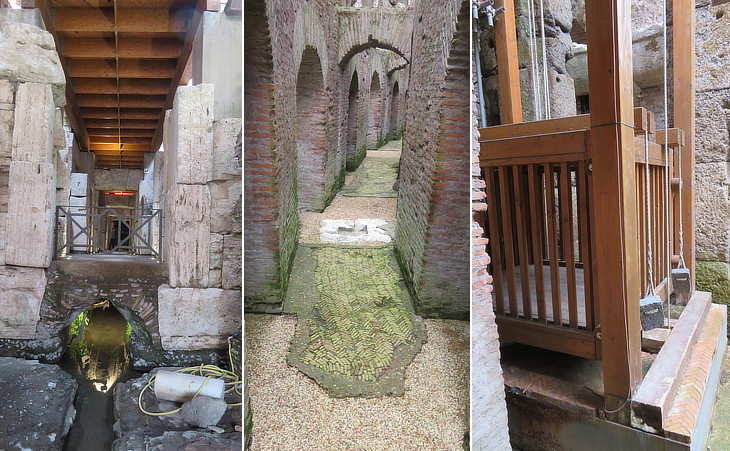
(left) Sewer underneath the underground structures; (centre) evidence of "opus spicatum" floor; (right) modern reconstruction of the raising cage equipment
I believe that when the substructures of the amphitheatre became damp and wet on account of the neglect in keeping the drains in repair, the old floor of opus spicatum must have been covered with a floor of wood resting on supports of stone. Lanciani
Built in wood for the inauguration, the underground levels were transformed into solid masonry under Domitian. At risk of collapses and fires due to their structural characteristics and the abundance of wood and rope, they were destroyed in the fire of 217 which seriously damaged the entire monument. The underground levels were rebuilt for the reopening of the amphitheatre and underwent various transformations in its last two centuries of activity, until they were completely filled in.
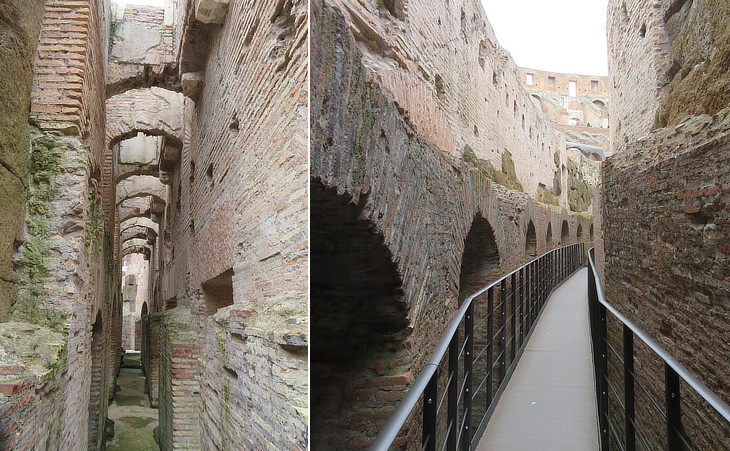
Straight and elliptical underground passages (see those of the Amphitheatre of Capua)
A great display of venationes took place in a.d. 281, on the occasion of the triumph of Probus. One hundred of the finest breed of lions (iubati) (having a large mane) were let loose in the arena at the same time. Their thundering roars shook the great amphitheatre to its foundations. They were followed by 100 lionesses, 100 leopards from Nubia, 100 leopards from Syria, and 300 bears. The slaughter of these noble animals without offering them fair play and letting them fight for their lives revolted the assembly. (..) The venationes of Anicius Maximus in 523 (during the Ostrogothic rule) are the last recorded in the history of the place. Here I must observe that, while repairing the drains and underground passages of the arena in 1878, we discovered a considerable quantity of bones, which were identified as pertaining to domestic animals, like bulls, horses, and stags. The discovery shows how insignificant the last shows must have been in comparison with those of the golden age. Lanciani

Ludus Magnus and the archaeological park of Colle Oppio
Smaller buildings housed stables, barracks
and training grounds and were linked to Colosseo by underground passages; the large barracks called Ludus Magnus (Great Game) are now partly visible in an area excavated in the 1960s; archaeologists were guided in their work by a fragment of Forma Urbis, a marble plan of Ancient Rome. The gladiators practised in a small scale replica of Colosseo.
In 438 Emperor Valentinian III closed the gladiators' schools and performances were limited to venationes.

Holes between travertine blocks
We may grant that natural agencies have contributed their share to the demolition of ancient buildings, fires, floods, earthquakes, and the slow but resistless processes of disintegration due to rain, frost, and variations of temperature; but such prodigious changes, such wholesale destruction, could have been accomplished only by the hand of man.
Rodolfo Lanciani - The destruction of ancient Rome - 1899
The travertine blocks were fastened together with iron clamps. The expansion of the iron through rust, which caused the stone to split, has frequently been a great source of injury to Roman walls, as well as the practice, common in the Middle Ages, of breaking into the stones in order to extract the metal. Thousands of holes caused by this practice are visible throughout the building.

(left) Tablets with the symbol of Compagnia del Salvatore above two external arches; (right) northern upper corridor: 1540 coat of arms of B. P., a member of the Paparoni family, who most likely held a position in Compagnia del Salvatore; the brotherhood run a female hospital with a small church (S. Giacomo al Colosseo) inside their part of the building
The Frangipani and other turbulent barons occupied the ruins of temples and arches, crowning and surrounding them with battlemented towers. (..) The collapse of the side towards the Caelian hill, must be attributed to the earthquake of Petrarch, which ruined so many monuments of ancient and mediaeval Rome, September, 1349. (..) In 1362 the Romans, the legate of Pope Urban V and the Frangipani were already quarreling over the spoils of the fallen giant, "de faciendo tiburtinam" (to make lime) with the stones of the Coliseum. A few years later, in 1386, the S. P. Q. R. made a present of one third of the Coliseum to the "Compagnia del Salvatore ad sancta Sanctorum." The event is chronicled to the present day on the walls of the amphitheatre - above the sixty-third arch, towards the Meta Sudans by a marble bas-relief with the bust of the Saviour between two burning tapers. Lanciani
During the Middle Ages Colosseo was fortified by the Frangipane, who erected
a wall around it using Arco di Tito and Arco di Costantino as gates. Also other Roman amphitheatres or theatres were turned into medieval fortresses, e.g. at Arles and Bosra.

(left) Eastern view; (right) inscription celebrating restorations made by Pope Benedict XIV
The mountain of stone caused by the fall of the western belt ranks first among the stone quarries within the walls. It has taken four centuries and fifteen generations of stone-cutters and lime-burners to exhaust it. (..) Towards the end of the seventeenth century the supply seemed to be exhausted, when another accident, the earthquake of February 3, 1703, filled the quarry with new material. Lanciani
In the XIVth century
the building was placed under the protection of the Senatore di Roma and the Conservatori, his four assistants, but this did not prevent
the usage of its fallen parts for calcination (for lime-making) or for decorating the façades of churches (e.g. S. Agostino) and palaces (e.g. Palazzo della Cancelleria). In 1704 Pope Clement XI did not hesitate to use the travertine blocks which had fallen because of an earthquake to pave the stairways of Porto di Ripetta.

(left) Plan of the church designed by Carlo Fontana; (right) detail of an 1870 lithograph by Philippe Benoist
At the beginning of the XVIIIth century Carlo Fontana developed a project for building a church inside Colosseo. The project was eventually shelved, but the drawing supporting it shows the condition of the monument at that time; it was practically open on its southern side (right side of the plan). This side, but not its outer ring, was rebuilt in 1845 by Pope Gregory XVI.
In 1750 Pope Benedict XIV, in order to preserve Colosseo from further damage,
prevented access to it by closing the arches on the ground floor; he dedicated the ancient monument
to the Passion of Jesus Christ in memory of the many
martyrs who (according to tradition) died there. The Pope built fourteen Stations of the Cross and placed a large cross at the centre of the arena (now it has been relocated to its northern side).
A hermit has a little apartment inside. We passed through his hermitage to climb to where the seats and corridors of the theatre once were. (..) It was shocking to discover several portions of this theatre full
of dung. It is rented to people who use it in this fashion.
From James Boswell's letters on the Grand Tour related to his visit to Rome in 1765.
A consecrated cross stands in the middle of the arena, which is kissed in remembrance of the Christian martyrs who suffered here; around the circumference is a series of holy stations at which prayers are said; and at one side are a desk and benches where the eloquence of a bald-headed Dominican occasionally excites the sympathies of a casual audience.
Rembrandt Peale - Notes on Italy, written during a tour in the years 1829 and 1830.

Fresco depicting the City of Jerusalem and the Crucifixion (late XVIIth century)
The arena was transformed at the beginning of the sixteenth century and Passion plays were performed among the ivy-clad ruins for a number of years. The perspective plan of Jerusalem, painted above the main entrance on the side of the Sacra Via, is a recollection of these Passion plays. Lanciani
I drove to the Coliseum, where I found a long procession of penitents, their figures and faces totally concealed by their masks and peculiar dress, chaunting the Via Crucis.
Anna Jameson - Diary of an Ennuyée - 1826
Colosseo became the scene of
many processions and religious ceremonies, in particular during the Holy Week. Popes led a torchlight procession inside the amphitheatre on Good Friday until 1870. The procession was reintroduced in 1965, but it takes place on the terrace of Tempio di Venere e Roma.

Views of the wall built by Pope Pius VII in 1807
Happily for the Coliseum, the shape necessary to an amphitheatre has given it a stability of construction sufficient to resist fires, and earthquakes, and lightning, and sieges. Its elliptical form was the hoop which bound and held it entire till barbarians rent that consolidating ring, Popes widened the breach, and time, not unassisted, continues the work of dilapidation. At this moment the hermitage is threatened with a dreadful crash, and a generation not very remote must be content, I apprehend, with the picture of this stupendous monument.
Joseph Forsyth - Remarks on Antiquities, Arts, and Letters in Italy in 1802-1803
One of the most effective actions aimed at preventing the further fall of the outer ring was taken by Pope Pius VII. The wall shows some of the arches which were about to collapse. A similar, but less imposing wall was built at the other end of the outer ring.
The Coliseum, or Amphitheatre of Titus, the noblest ruin in Rome, is circular, built of red stone and brick, with arched windows,
and the gillyflower and fennel growing on its walls to the
very top! one side is nearly perfect. As you pass
under it, it seems to raise itself above you, and mingle
with the sky in its majestic simplicity, as if earth were
a thing too gross for it; it stands almost unconscious of
decay, and may still stand for ages - though Mr. Hobhouse has written Annotations upon it!
William Hazlitt - Notes of a Journey Through France and Italy in 1824-1825
The broken arches, upon which the seats rested, are supported by new timber and brickwork, and every passage cleared out, among which you may pass and see with astonishment the huge stones which were employed by consummate skill to give strength to the foundation arches of this enormous structure. Some spots, however, are left neglected and covered with plants and shrubs, as a sample of its former guise. My old friend, as an artist, is among those who regret the change; for he remembers seeing the Colosseum a beautiful wilderness of ruins, vines and shrubbery. Peale
The flora of the Coliseum was once famous. Sebastiani enumerates 260 species in his "Flora Colisea," and their number was subsequently increased to 420 by Richard Deakin in 1855. These materials for a hortus siccus (herbarium), so dear to the visitors of our ruins, were destroyed by Rosa in 1871, and the ruins scraped and shaven clean, it being feared by him that the action of roots would accelerate the disintegration of the great structure. Lanciani

Painted cupboard in the Vatican Library showing Colosseo from Vigna Sinibaldi (Terme di Traiano) in ca 1860. See two views of the amphitheatre from the Palatine Hill: (1) and (2)
A moonlight visit to Colosseo became a must for Grand Tour travellers.
My farewell to Rome was heralded in a particularly solemn manner: for three consecutive nights a full moon stood in a cloudless sky, diffusing its magic over the immense city, and more than ever before, I felt myself transported into another simpler and greater world. At the end of each day, spent in distractions mingled with sadness, I took a walk with a few friends, and on one evening I went out quite alone (..) when I approached the grand ruins of the Colosseum and looked through the gate into the interior, I must frankly confess that a shudder ran through me, and I quickly returned home.
J. W. Goethe - Italian Journey - April 1788 - translation by W. H. Auden and E. Mayer - Collins 1962
In a warm moonlight evening I took occasion, according to custom, to visit the Colosseum. Besides various parties of pedestrians we found eight carriage loads of company, some of whom were curiously exploring the corridors and arches with torches. The dim light of the moon, which only exhibits the great architectural masses without the minute details that during broad daylight disturb the attention, produces its effect, by merely permitting the spectator to be fully impressed with the simple perceptions of bulk and proportion. Peale
You may wish to read Henry James's 1873 and William Dean Howells' 1908 accounts of their visits.

(left) Inscription celebrating a restoration after an earthquake (terrae motus) in 484 by the "Praefectus Urbis", the governor of Rome, without references to any emperor; (centre) cross granting one year and twelve days of indulgence to those who kiss it (you may wish to read Charles Dickens's comments on these crosses); (right) re-enactment of scenes from the history of Ancient Rome for the joy of tourists
Today the Christian aspects of Colosseo with its crosses and processions are overlooked and the amphitheatre is seen only as the most impressive symbol of the Roman Empire.

Cats at Colosseo (left) and at Basilica Julia (right); see those at the Protestant Cemetery

Modern fountain in Piazza del Colosseo made up of an ancient sarcophagus and of a head of a lion, most likely from another sarcophagus
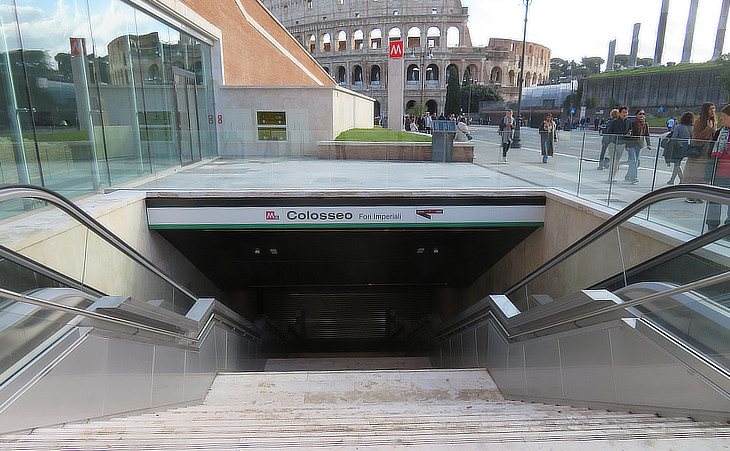
The station was built by the Metro C Consortium (led by Webuild and Vianini Lavori) and inaugurated on 16 December 2025, marking the arrival of Line C in the heart of Rome and providing an interchange with Line B, the first underground line which was inaugurated in 1955 and links Stazione Termini with EUR, a modern development south of Rome. Line C links the easternmost suburbs of Rome (near Monte Compatri) with the city centre. A new Underground Station at S. Giovanni houses a permanent exhibition of the archaeological materials which were found when digging for the new line.
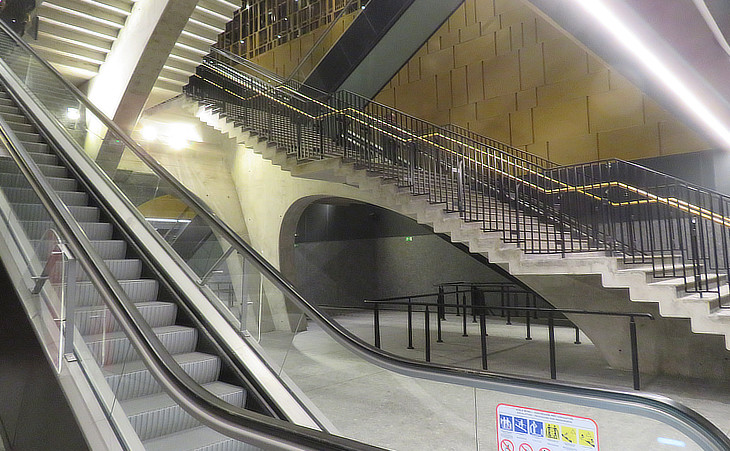
From an engineering standpoint, this public infrastructure is monumental: the station extends for around 150 metres and plunges almost 40 metres underground. The design of the station was agreed with the Colosseum Archaeological Park authorities and was developed with the assistance of the La Sapienza University of Rome. Passengers go through five sections where they see exhibits found when digging the Porta S. Giovanni - Colosseo section of line C and the underground station itself, plus other ancient materials which are related in general to the Roman monuments near the station.
In 1939 an open trench technique was used for digging the B line. It led to damaging some buildings near Colosseo, in particular Antiquarium Comunale, an archaeological museum of the City of Rome. Tunnel Boring Machines were used for the tunnels of the C line which are located at a considerable depth in order not to find foundations of ancient Roman buildings and minimize the impact of vibrations. This notwithstanding, archaeologists monitoring the excavations came across 28 wells going back to the IInd century BC when Rome was not yet supplied water by aqueducts. Their operation is explained by three partial reconstructions.
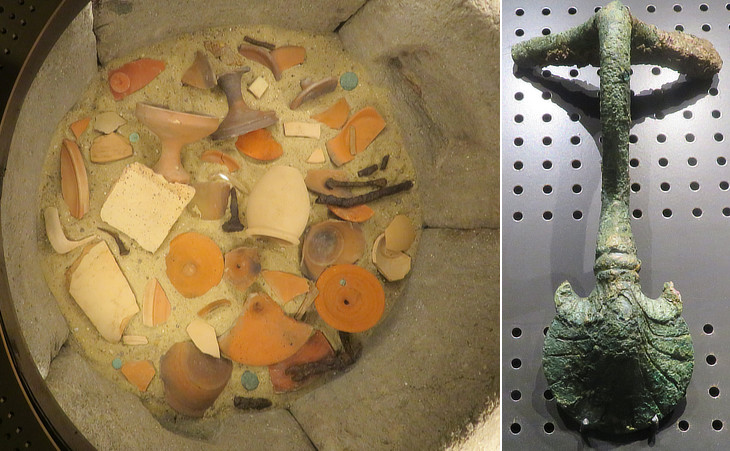
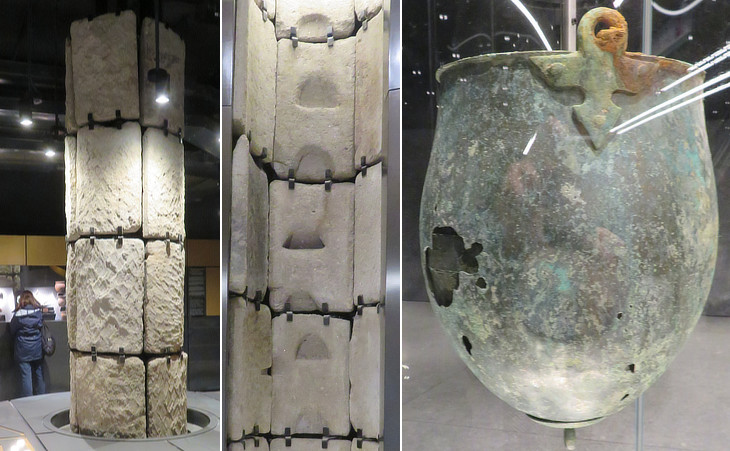
The wells contained hundreds of everyday artefacts, including hairpins, oil lamps, irrigation pipes, knives and small statues, many of which are on display.
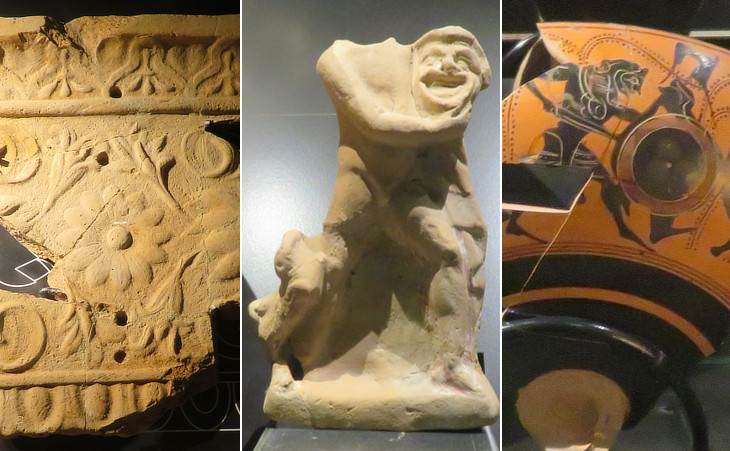
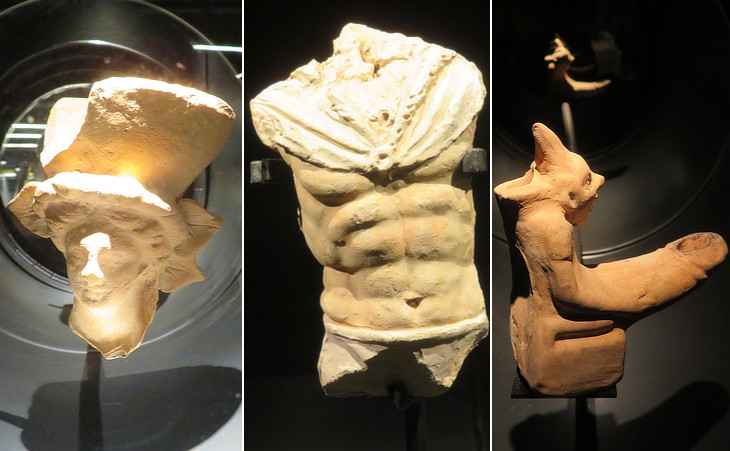
For the ancient Romans the depiction of a phallus had an apotropaic purpose, i.e. it turned away evil influences. See examples at Pompeii, Antioch and in Tunisia.
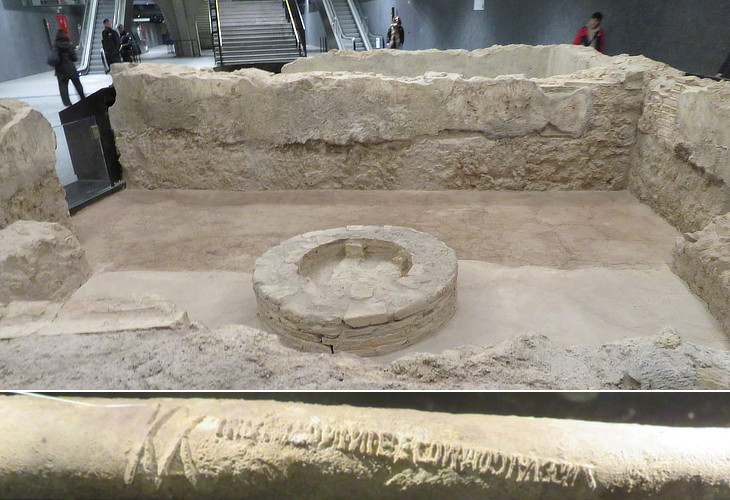
Among the most interesting findings is a balneum belonging to a private house which is dated between the IInd century BC and the fire during the reign of Emperor Nero. The structure was excavated, documented, removed, restored and relocated inside the station.
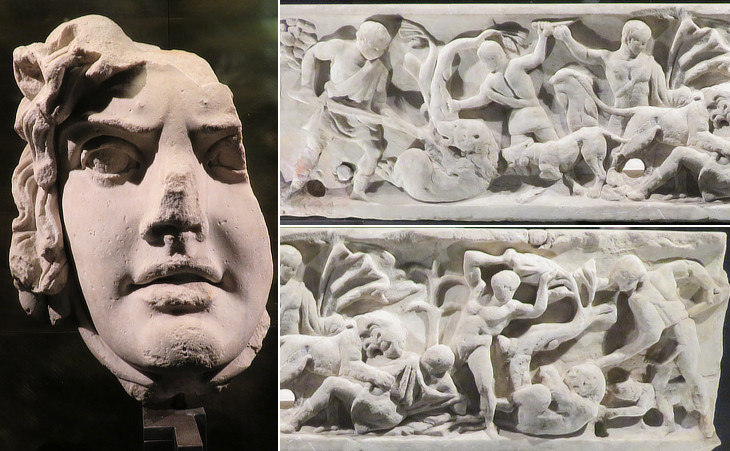
A section displays some exhibits which are not directly related to the construction of the station or of the line, but come from the huge deposits of archaeological material of the State and of the Comune di Roma. They have been selected to give an idea of the type and quality of works of art which decorated Rome.
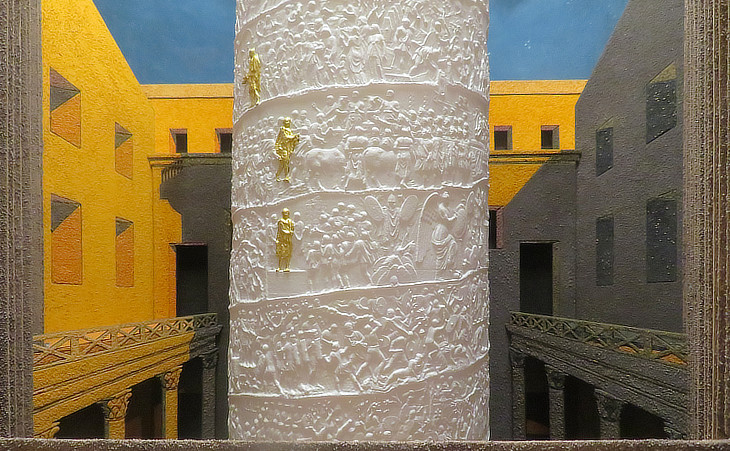
With reference to Via dei Fori Imperiali, the second name of the underground station, a series of optical devices show reconstructions of five great monuments along the road as small illuminated theatres.
Move to page two.
Next plate in Book 2: Piazza di S. Giovanni in Laterano.
Next step in Day 1 itinerary: Chiesa di S. Clemente.
Next step in your tour of Rione Monti: Villa Altieri.
Next step in your tour of Rione Campitelli: Casino Fini.
Excerpts from Giuseppe Vasi 1761 Itinerary related to this page:
Anfiteatro FlavioDa Flavio Vespasiano fu principiato questo meraviglioso edifizio per solennizzarvi spettacoli, e feste pubbliche, e poi da Tito suo figliuolo fu terminato, e dedicato in onore di suo Padre. Era capace di settecentosette migliaja di spettatori, senza che uno impedisse l'altro, e però vi furono fatte delle feste maravigliose e splendide, e delli spettacoli molto crudeli, e tal volta a danno de' Cristiani, non pochi de' quali vi soffrirono il martiri. Si disse Colosseo da un colosso, che vi era alto 120. piedi rappresentante Nerone. In oggi svanire tutte le superstizioni, e crudeltà de' gentili, rimbombar si sentono spesso in in mezzo a quelle maravigliose rovine le lodi del Signore, e della santissima sua Croce, e Passione, poichè per fare onore a' santi Martiri, vi fu eretta una piccola chiesa, e 13. cappellette, nelle quali li rappresentano i misterj della passione del nostro Salvatore, ultimamente rinnovate dal Pontefice Benedetto XIV. ed arricchite delle indulgenze della Via Crucis. |