
All images © by Roberto Piperno, owner of the domain. Write to romapip@quipo.it.


Notes:
Page revised in January 2024.
All images © by Roberto Piperno, owner of the domain. Write to romapip@quipo.it.
Notes:
Page revised in January 2024.
 - Ancient Rome
In this page:
Commodus
Septimius Severus
Caracalla
Heliogabalus (Mithraeum and Temple to the Sun)
Alexander Severus
Military Anarchy
Iconography
Marcus Aurelius' son Commodus became emperor at the age of 19; he had accompanied his father on his
last campaigns against the Marcomanni beyond the River Danube, but he had not his father's sense of duty and he preferred to reach a peace
agreement with the enemy and return to Rome.
He was a strongly built man and he identified himself with Hercules; he soon became popular among the
lower classes as he enjoyed taking part personally in the fights between gladiators.
Antoninus Pius and Marcus Aurelius had both at least formally
respected the role of the Senate and had ruled the empire with the support of the
Roman aristocracy. Commodus gradually lost this support and over the years
became more and more isolated, even in his own family; in 183 he put to death the Quintili brothers, two senators who had a large villa along Via Appia which he confiscated for his personal use; his hard reaction to unrest in various provinces of the Empire
and to grievances in Rome and his claim of being a god increased the number of those who plotted against him.
In 192 praetorians, members of the emperor's inner circle and of the Roman aristocracy,
commanders of legions all took part in a conspiracy to kill Commodus.
His mistress Marcia poisoned him and then he was strangled by Narcissus, his wrestling partner.
The Senate decreed his damnatio memoriae and
this may explain why the memory of Commodus is so bleak.
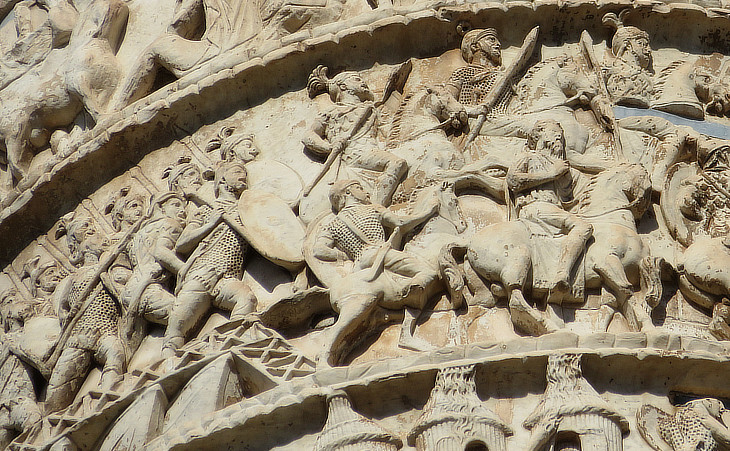
Colonna Antonina: Marcus Aurelius leads the Roman army across a river
Commodus celebrated his father by erecting in Campo Marzio a column similar to that of Trajan: its reliefs portray the two campaigns conducted by Marcus Aurelius against the Marcomanni. The column was located on a high base next
to Via Flaminia (today's Via del Corso): the street level was some 20 feet lower
than it is today; the reliefs were therefore very high, with the sculptures almost fully
projecting out of the background, so that they could be seen from a great distance.
An interesting
comparison between the two columns shows that while Trajan was portrayed in situations where he was not directly involved in battles, Marcus Aurelius was often depicted at the head of his army. Commodus erected also an arch to celebrate his father: the arch is lost, but some of its reliefs were used to decorate Arco di Costantino; other reliefs were found in 1515 near SS. Luca e Martina.
Although his name was deleted from all inscriptions we know that Commodus restored the Theatre of Ostia and that he enlarged the warehouses of the town for the supply of which he created Classis Africana Commodiana Herculea, a mercantile fleet based in Carthage. His name is still associated with an aqueduct at Thugga, a town (Colonia Julia Aurelia Commoda, i.e. Thuburbo Majus) and an arch at Lambaesis. Other monuments he built were renamed by his successors.
The death of Commodus was followed in the next six months by that of his two successors
(Pertinax and Didius Julianus): the legions then elected their own emperors: Clodius Albinus in Britain and Gaul, Pescennius Niger in Syria and Septimius Severus in Pannonia who by 197 managed to get rid of his rivals. He was born at Leptis Magna, a major trading post of Roman Africa which he embellished with many large monuments. He married Julia Domna, the daughter of a Syrian high priest, because her horoscope predicted that she would wed a king. He gave her the title of Augusta and a major role in state affairs.
The Emperor strongly relied on the army to retain his power and in 194-195 he led his legionaries in campaigns meant to punish the supporters of Pescennius Niger in the eastern provinces of the Empire (e.g. Arabia) and in the neighbouring small independent kingdoms of Osroene (around Edessa) and Adiabene (east of Mardin). In 197-198 he directly attacked the Parthians, he sacked their capital Ctesiphon and he created the Roman province of Mesopotamia, similar to what Trajan had done. For this victory he was given the title of Parthicus Maximus. It was one of the last Roman campaigns which yielded a
large number of slaves.
He limited the power of the praetorians by stationing a legion of trusted soldiers at Albano.
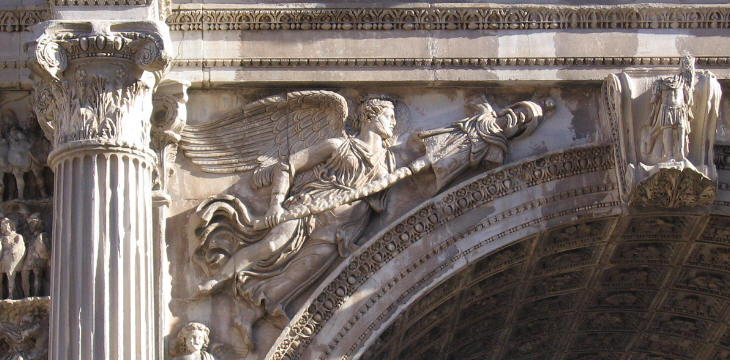
Arco di Settimio Severo: detail of the western side portraying a Victory holding a military trophy. The inscription celebrates the Emperor as Parthico Arabico and Parthico Adiabenico
A large arch was erected in the Forum to celebrate his campaigns: the quality of the decoration shows that, notwithstanding the economic crisis and the decrease in population which had hit the empire in the last decades of the IInd century, the quality of the works of art in Rome was still high. Septimius Severus spent most of his time in power outside Rome, but he nevertheless promoted an enlargement of the imperial palace; he also placed at its entrance from Via Appia the Septizodium, a sort of gigantic façade, part of which still stood until 1586 when Pope Sixtus V pulled it down to use its columns and marbles for the decoration of the many monuments he built in Rome.
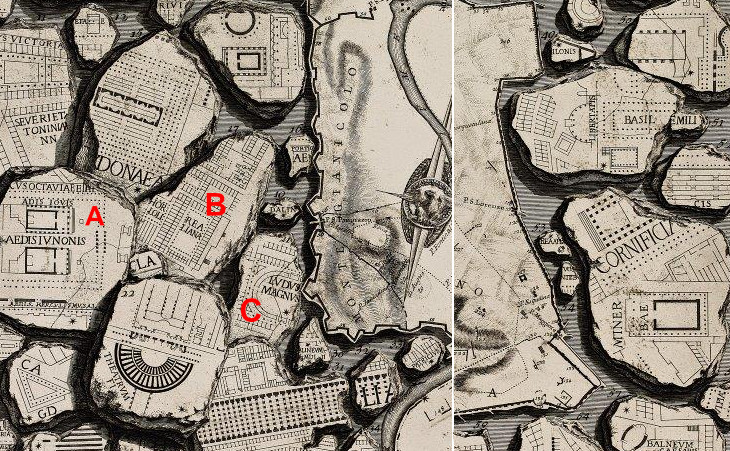
Giovanni Battista Piranesi: details of the frontispice of "Le Antichità Romane"(1756) showing fragments of "Forma Urbis Severiana", a marble plan of Rome at the time of Emperor Septimius Severus which was affixed at Tempio della Pace: A) Temples to Jupiter and Juno; B) warehouses at Testaccio; C) Ludus Magnus
Septimius Severus restored or rebuilt several monuments of Rome which had been damaged by fires or poor maintenance, e.g. Casa delle Vestali, Tempio della Pace, the Pantheon, Portico di Ottavia and many others. An accurate marble plan fixed the aspect of the City of Rome as it was in 203. Fragments of the plan began to be discovered in the XVIth century and they greatly helped archaeologists in their efforts to identify the ruins of Rome.
The list of monuments associated with his name
in provincial towns is endless, especially in Africa (see pages on Cuicul, Thamugadi and Thugga).
Septimius Severus associated his two young sons Marcus Aurelius Antoninus
(known as Caracalla, after caracallus, a short Gaul tunic he used to wear)
and Publius Septimius Geta with the throne.
In 208, accompanied by them, he started a campaign in Britain to quell the rebellion of some local
tribes and to protect that province from Caledonian raids. In 209 or 210 he was given the title of Britannicus Maximus (he shared the triumph with Caracalla). He died at Eboracum (York) in 211, possibly poisoned by his own son Caracalla.
Septimius Severus endeavoured to publicize his family as a happy one where all members (including his wife) shared the responsibilities of rule. This image soon proved to be false as Caracalla hastened to arrange the assassination of his brother Geta, accusing him of having made an attempt on his life. He decreed his brother's damnatio memoriae and had his name erased from all inscriptions (not only in Rome, as one can see at Cendere Koprusu, a bridge in eastern Turkey and at Cuicul and Thamugadi in Algeria). He also arranged the killing of his own wife. Eventually his conscience could not bear the weight of his crimes and he sought the help of Galen at Pergamum to treat his nightmares.
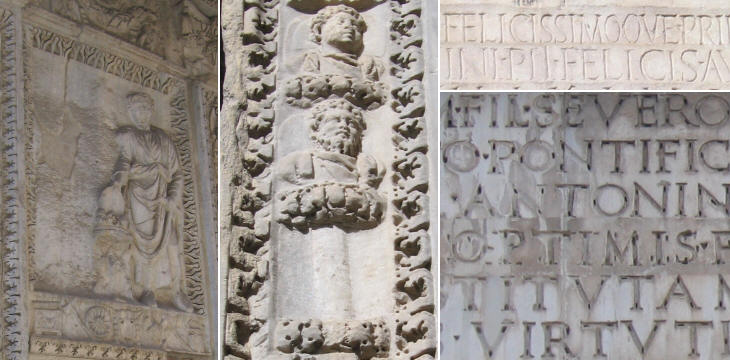
Arco degli Argentari: (left/centre) reliefs from which Geta was
removed; (right) inscriptions on the same arch (first line) and in Arco di Settimio Severo (fourth line)
where the name of Geta was replaced by other words
In 204 the guild of the Argentari (money-changers) erected a small arch in honour of Septimius
Severus; knowing that his two sons would have been the next emperors and that
Septimius Severus had already given them official responsibilities, these shrewd
tradesmen thought it wise to decorate the arch
with portraits of both Caracalla and Geta.
In 212 they had to quickly erase all references to Geta, even though this meant
damaging the symmetry of the decoration and rewording (using narrower letters) the inscription.
The Senate
took care
of doing the same on the Arch dedicated to Septimius Severus:
the holes of the erased bronze letters which do not match the inscription are evidence of the change required by Caracalla.
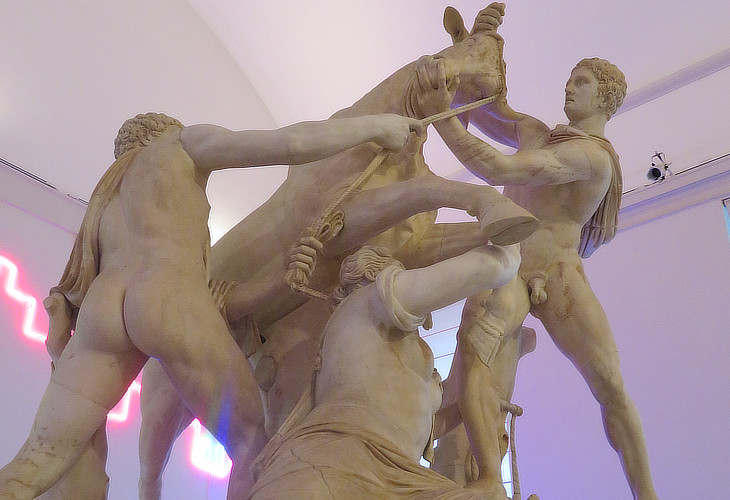
Archaeological Museum of Naples: detail of The Punishment of Dirce aka the Farnese Bull, a colossal statue which was expressly made to decorate the eastern palaestra of Caracalla's Baths in Rome
Caracalla understood that by killing his brother he had undermined his own power and
to restore his popularity he issued Constitutio Antoniniana, a law which granted Roman citizenship to freemen throughout the Roman Empire; there were also economic
motives behind this decree as it enlarged the number of taxpayers. He completed many monuments and public facilities which his father had begun e.g. at Baalbek and Sagalassos and he built new ones. In Rome, in addition to the baths bearing his name, he erected a gigantic Temple to Serapis on the Quirinal Hill. Many provincial towns e.g. Volubilis and Thassos, erected triumphal arches to him.
Caracalla, following his father's policy, tried to maintain the support of the army by increasing
the legionary pay and by providing the soldiers with benefits and facilities, including
baths for the legion at Albano.
In an attempt to gain his father's military reputation, he waged war against the Parthians, but his campaign was inconclusive. In April 217 Marcus Opellius Macrinus, a native of Caesarea Mauretaniae (Cherchell) and the head of the praetorian guard, relying on the growing
dissatisfaction with Caracalla's leadership, managed to have him killed at Carrhae and to be proclaimed the new
emperor by the troops.
Macrinus styled himself as M. Opellius Severus (see a rare inscription with his name at Cavaillon). He continued without success the campaign against the Parthians; in the meantime the financial situation of the Roman Treasury had so worsened that he had to reduce the benefits granted to the army by Caracalla. By doing this Macrinus signed his death sentence: in 218 at the instigation of Julia Maesia, Caracalla's aunt, and Julia Soemia, her daughter, the troops rebelled and killed him. Sextus Varius Antoninus, the fourteen-year-old son of Julia Soemia, became the new emperor.
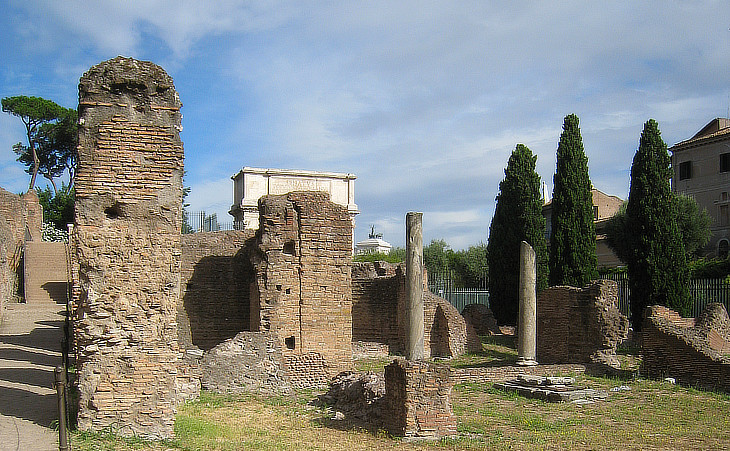
Baths built by Heliogabalus and Arco di Tito in the background
The young emperor was a high priest of the cult of Elegabal, a sacred stone (most likely a meteorite) worshipped in Syria and in Phoenicia: Varius tried to impose this god (Latinized as Heliogabalus - Sun God) in Rome claiming that he was superior to the traditional ones. Roman historians ended up by referring to him by the name of the god. He built a temple dedicated to the Sun on the Palatine on the site of today's S. Sebastiano al Palatino; it was adjoined by baths which could be accessed from Via Sacra. He himself preferred to live in a family villa near today's S. Croce in Gerusalemme.
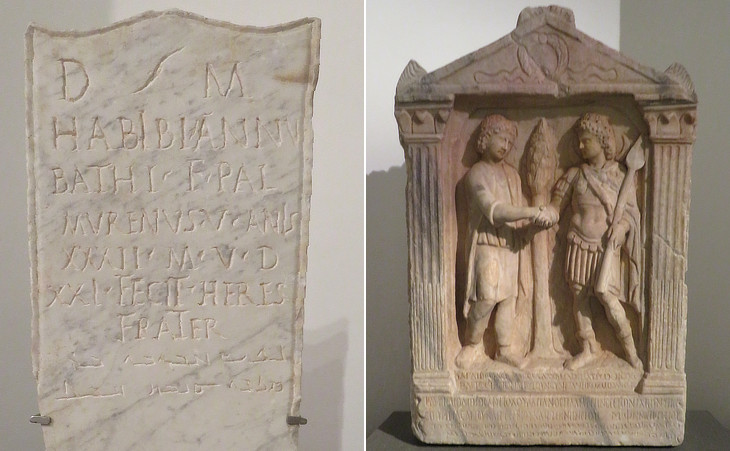
Musei Capitolini: inscriptions related to citizens from Palmyra in Syria who lived in Rome, both with small Palmyrene inscriptions: (left) gravestone of Habib (IInd century AD): (right) altar to the gods Malakbel (Sun) and Aglibol (Moon) (235 AD) (from Villa Giustiniani); see other eastern reliefs showing gods shaking hands
The cult of Heliogabalus was based on orgiastic ceremonies,
which, although not uncommon in the Ancient World (see Villa of the Mysteries at Pompeii), had aspects which alienated the Emperor the support of both the Senate and the army, because of the effeminacy of his behaviour.
He was forced by his grandmother to adopt as co-emperor his younger cousin
Alexander Severus.
In March 222 the voice spread that Heliogabalus had tried to assassinate his cousin and the praetorians found him at his villa where he was about to start a chariot race. He was slain together with his mother and his body was thrown into the Tiber.
His memory was for centuries that of a dissolute madman; towards the end
of the XIXth century his extravagances attracted the
attention of the painter Sir Lawrence Alma-Tadema (see some of his paintings in the Iconography section).
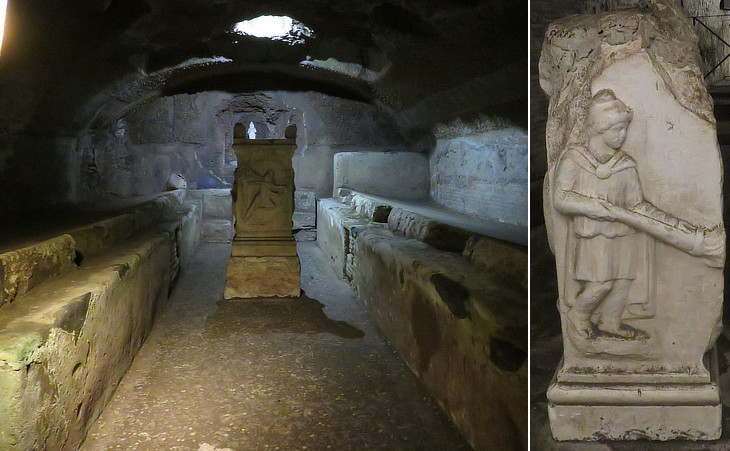
Mithraeum of S. Clemente: altar to the god and relief on one of its sides portraying Cautopates, a torch bearer holding his torch down; together with Cautes, another torch bearer, he indicated the rise and fall of the sun and more in general the cycle of life
Mithraism, the cult of the Persian god Mithra, is one of the oriental religions which became popular in the Roman Empire, h especially in the military. Its earliest presence in Rome is dated ca 100 AD but it reached its apogee in the last quarter of the IInd century. Its Roman version had points in common with Freemasonry: it was a fraternal organization which required its members to abide by some basic moral standards and to keep secrecy about the ceremonies; there were seven grades of initiation associated with the planets. The members regularly met in small rooms having the aspect of a cave and long benches on both sides; there they had a common meal and attended their rites: a significant difference from what occurred in the temples where the ceremonies took place outside the god's cell.
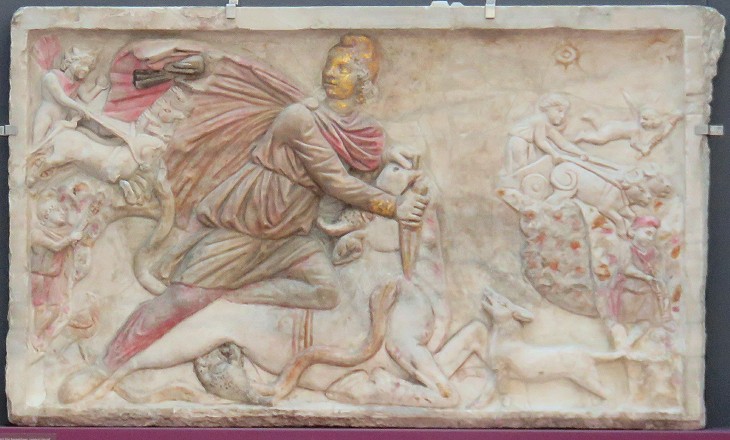
Relief portraying Mithra killing the Bull which was found in a mithraeum underneath S. Stefano Rotondo
The altar usually had a relief portraying Mithra in the act of killing a bull and surrounded by other animals. It is generally thought that the bull indicates the constellation of Taurus, and the other animals constellations which were all aligned with the celestial equator during the spring equinox in that period. In the upper part of the relief the Sun and the Moon watch the scene. These elements suggest that astronomy played a major part in this cult.
Other aspects of Mithraism had points in common with the Christian faith: a
concept of resurrection, distribution of bread and water (or wine),
fast as a mean of purification and a sort of baptism.
For their meetings the followers of this belief built mithraea, some of which
have been discovered under churches or other Roman buildings.
The most interesting of these halls are under S. Clemente, S. Prisca,
Palazzo Barberini and at Ostia (you may wish to see also mithraea at Capua and at Marino). The worship of Mithra was very popular among the legionaries in Gaul, Britain, and along the Rhine and Danube borders.
Alexander Severus was just thirteen when he became emperor. A body of sixteen senators was created to help him in gradually
restoring an effective administration and the authority of the central government, but his mother Julia Mamea had a major role in state affairs; she was given the titles of mater castrorum, mother of the barracks, and of Augusta and she accompanied Alexander in his military campaigns.
At the age of 22 Alexander thought the time had come to show his ability
to lead the Roman legions. In 231 he waged war against the Sassanids who in 224
had defeated the Parthians and by 226 had definitely replaced them as the new eastern
neighbour of the Roman Empire. The campaign was inconclusive; the Sassanids preferred to
retreat and eventually the cost of the expedition was such that Alexander had to levy
new taxes.
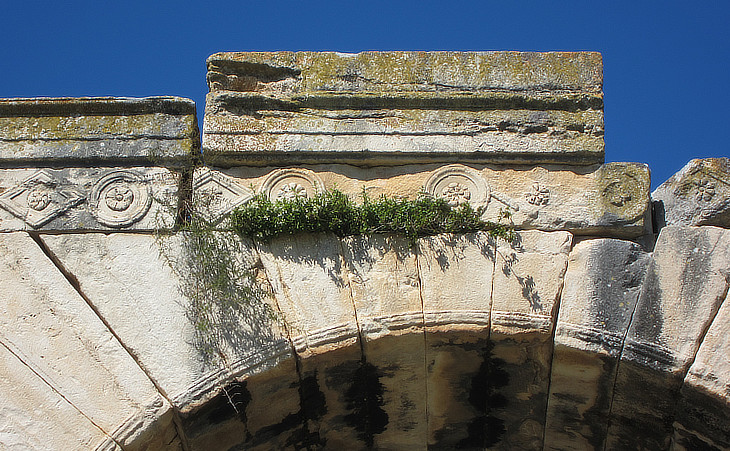
Detail of the Arch of Alexander Severus at Thugga (Tunisia)
In 233 the Alemanni, a confederation of German tribes, raided some Roman towns near the Danube/Rhine border and the Emperor organized a campaign to repel this threat by recruiting auxiliary troops in the eastern provinces of the Empire. He then moved to Germany, accompanied by his mother, and he won some battles. He established his headquarters at Mogontiacum (Mainz) and he tried to achieve a durable peace by making some concessions to the Alemanni. He was accused of betraying the loyalty of the troops and in March 235 he was killed together with his mother by a group of his own soldiers. His name was erased from inscriptions which celebrated him, e.g. at Cuicul in Algeria and at Amasya in Pontus. According to Flaminio Vacca, who wrote in 1594 an account of his discoveries of antiquities, the Emperor and his mother were portrayed in statues lying on a couch in the lid of a gigantic sarcophagus in the environs of Rome.
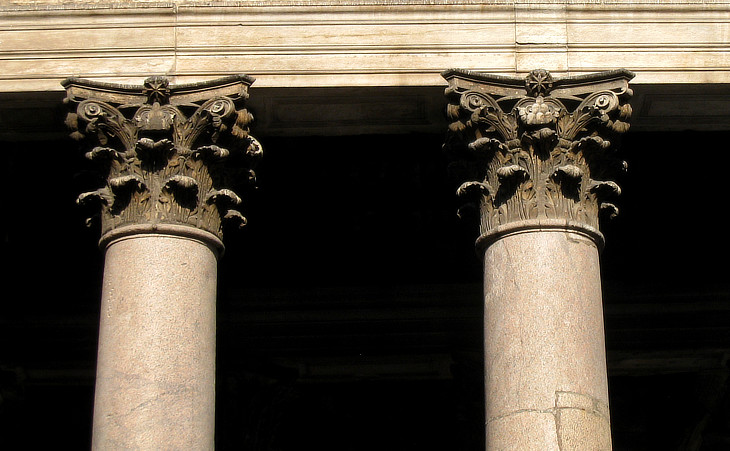
Two columns of the portico of the Pantheon which were added by Gian Lorenzo Bernini in 1660 and which came from "Thermae Alexandrinae"; they bear one of the heraldic symbols of Pope Alexander VII
Alexander Severus built the last Roman aqueduct, named after him Aqua Alexandriana. It supplied water to baths built by Emperor Nero on the site of today's Palazzo Madama and which were restored by Alexander Severus and renamed after him Thermae Alexandrinae. Of these baths very little is left: two columns now in Piazza de' Crescenzi and two columns which were used by Bernini to replace missing ones in the portico of the Pantheon. Alexander Severus is also credited with having erected a monumental fountain on the Esquiline which is best known as Trofei di Mario.
Alexander Severus did not adopt or associate to the throne his successor, probably because his mother wanted to retain her power. This created an interruption in the line of succession by adoption which could be traced back to Emperor Nerva. The fifty years which followed the Emperor's assassination are called by
historians the period of the military
anarchy because during it 22 emperors were acclaimed by the troops. They often ruled for just a few months and / or on a limited part of the empire and in many cases they did not even visit Rome or seek the approval of the Senate.
The legions on the Rhine border acclaimed as emperor • Maximinus Thrax (235-238), their commander and a veteran from Thracia. He continued the campaign against the Alemanni and other German tribes and to finance it he levied new taxes. In 238 the province of Africa rebelled with the backing of the Senate. Maximinus on his way to Rome to punish the senators laid siege to Aquileia, where he was killed by his own troops.
The year 238 is known as The Year of the Six Emperors at the end of which • Gordian III (238-244), a boy of thirteen, was acclaimed emperor. In 240 Shapur, the Sassanid Emperor, conquered some Roman fortresses in Mesopotamia and made his way into Syria. In 242 Gordian with the advice of Timesithus, his father-in-law and the head of the praetorian guard, prepared a powerful expeditionary force to respond to the Sassanid threat. Gordian conquered back Syria and in 244 he planned to lay siege to Ctesiphon, but Timesithus died in obscure circumstances and Marcus Julius Philippus, the new head of the praetorian guard began to plot against his master. What actually happened is unclear. Shapur claimed to have killed Gordian, but Roman sources say that Gordian was murdered at the instigation of Philippus who became the new emperor.
He is best known as • Philip the Arab (244-249) after his town of origin in Arabia Petraea which he greatly embellished. He immediately signed a humiliating peace treaty with Shapur and rushed to Rome to get the endorsement of the Senate.
In 248 he had the honour to preside over the celebrations of the one-thousandth anniversary of the foundation of Rome; the festivities were magnificent consisting of both gladiatorial spectacles and races in the Circus, but their cost together with the payments made to the Sassanids, forced Philip into levying more taxes, thus weakening his popularity.
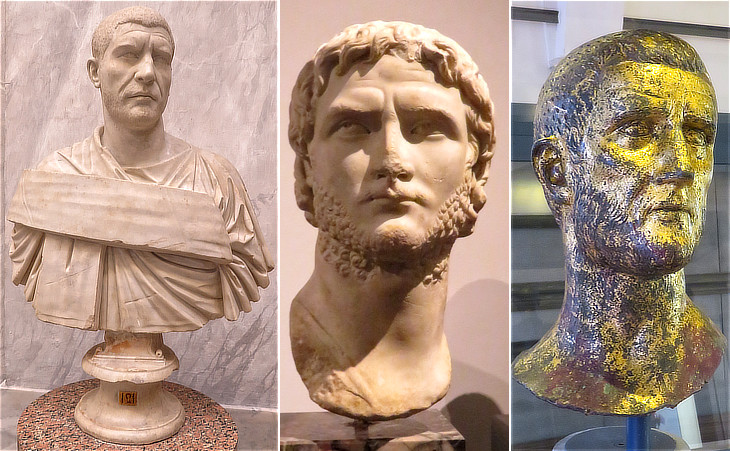
(left) Musei Vaticani: Philip the Arab; (centre) Antiquarium Palatino: Gallienus (253-268); (right) Museum of the City of Brescia at Santa Giulia: Claudius Gothicus (268-270) or Aurelian (270-275)
In late 248 invasions by Germanic tribes and rebellions by usurper generals forced Philip to entrust Trajanus Decius, a senator, with a special command to expel the invaders and quell the rebellions. Decius accomplished his tasks but then he turned against his master whom he defeated and killed at Verona.
• Decius (249-251) ordered one of the most severe persecutions of the Christians,
whom he charged with spreading a pestilence. He built on the Aventine new baths, which most likely
made use of existing buildings (their only remaining evidence is underground). In 250 he defeated the Goths in Dacia, but in 251 he fought them in Moesia (Bulgaria) and he was killed together with his son Herennius Etruscus at Abritus near the Danube border. The latter is thought to be portrayed in Sarcofago Grande Ludovisi, one of the most impressive Roman sarcophagi while a portrait of Decius can be seen in Romania.
In September 253 after a period of turmoil the Senate acknowledged as emperor • Valerian (253-260) who appointed co-emperor his son • Gallienus (253-268). This decision had the objective of achieving greater political stability and of having an emperor in command on each of the two fronts where the Empire was threatened. Eventually this approach was codified in 293 in a formal manner by Diocletian in the tetrarchy system. Gallienus took care of controlling the Rhine/ Danube border while his father regained control of some Syrian towns which had fallen into the hands of Shapur.
In 260 Valerian was taken prisoner at Edessa; the Roman sources say that this occurred when he was attending a meeting to reach a peace agreement. The Sassanid ones claim that he was defeated in battle. Shapur celebrated his victories against Gordian III, Philip the Arab and Valerian in two gigantic rock-cut reliefs near Persepolis and at Bishapur, the new capital of his empire which was built by Roman prisoners.
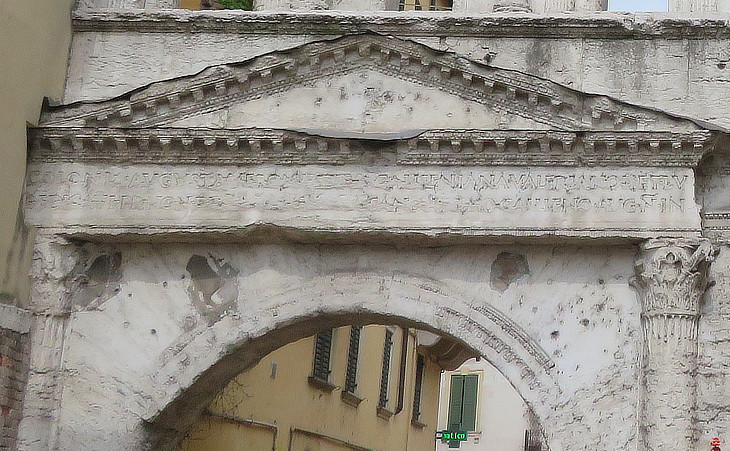
Detail of the inscription at Porta Borsari at Verona in which the town is referred to as "Colonia Augusta Verona nova Gallieniana"
Gallienus was unable to ransom his father because he had to deal with a series of rebellions by his generals. Shapur however could not retain his conquests because he was defeated by Odaenathus, King of Palmyra, an important town in the Syrian desert. Gallienus named him totus Orientis imperator, a sort of imperial representative for the eastern part of the Empire. In that same year an independent Gallic Empire was proclaimed by Postumus, commander of the legions along the Rhine. It deprived Gallienus of the control over Britain, Germany, Gaul and Hispania. The defences along the Danube did not manage to contain the pressure of the Gothic tribes; in 267
the Heruli, a small tribe living along the Lower Danube crossed the river,
raided Greece and sacked Athens. Other tribes crossed the Alps and raided towns in Northern Italy (e.g. Verona). In that same year Zenobia, the widow of Odaenathus, founded an independent Empire which controlled Syria and Egypt. Gallienus was not even able to control Italy and in 268 he was murdered while sieging Milan. He is remembered by a small arch dedicated to him (but the arch was already in place) and
by the ruins of a funerary monument along Via Appia.
• Claudius II (268-270), an experienced commander, was proclaimed Emperor by his troops and the decision was backed by the Senate. He managed to stop the raids south of the Danube and was therefore given the appellation of Gothicus; he then recovered some provinces of the Gallic Empire. He promoted the strengthening of the fortifications of some towns which could be raided, e.g. Nicaea. He died of smallpox in 270 and he was immediately deified. Constantius Chlorus claimed to descend from him. A column celebrating his victories over the Goths was erected in Constantinople.
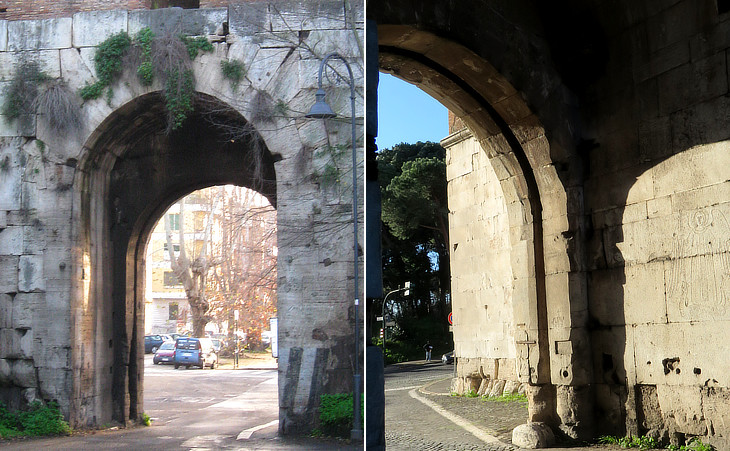
(left) Porta Latina seen from Rome; (right) Porta S. Sebastiano: opening
for lifting the sliding door; a stretch of the walls is shown in the image used as background for this page
• Aurelian (270-275), the commander of the cavalry under Claudius, managed to defeat Alemanni and Goths and to quell internal rebellions. He realized that the province of Dacia beyond the Danube was too difficult and expensive to protect and he withdrew the two legions who were stationed there. In 272 he conquered Palmyra and brought Zenobia in golden chains to Rome and in 273 he put an end to the Gallic Empire. He promoted the worship of Sol Invictus by erecting a temple in Campus Martius, of which only two columns remain. A triumphal arch to him was erected near the temple.
The worst of the crisis of the IIIrd century was over, but Aurelian felt that, after nearly 500 years during which no enemy
had threatened Rome, the city needed the protection of defensive walls.
It was a decision difficult to accept and maybe for this reason many gates (20) reduced its
negative impact: often the gates were larger than they are now; their size was reduced in the early Vth century by Emperor Honorius; in addition to the usual doors the gates were closed (in case of threat) by a
vertical sliding door.
• Probus (276-282), another emperor with a military background, made a major effort to pacify the Rhine / Danube border. In 281 he celebrated with extraordinary venationes his accomplishments there for which he received the title of Germanicus Maximus. He actually allowed the Alemanni to settle in the Agri Decumates, the same decision for which Alexander Severus was killed in 235.
When eventually this troubled period came to an end, the nature of the
Roman Empire and the role of Rome had dramatically changed: the Senate and the Roman aristocracy
lost their political influence; they had no say in financial matters as the Senate had
been deprived of the right of issuing new coins: the emperor was no longer the
highest institution of the Republic, but a monarch: while Augustus and
the other great emperors were portrayed on coins wearing a wreath of laurel,
the emperors of this period wore a gold crown with sun rays (see some silver coins at Tongeren in Belgium).
The following links show works of art portraying characters and events
mentioned in this page; they open in another window:
Bust of Commodus as Hercules between two tritons at Musei Capitolini - Rome.
Busts of Pertinax and Alexander Severus at Galleria degli Uffizi in Florence.
Bust of Septimius Severus in Musei Capitolini.
Colossal heads of Septimius Severus and his wife Julia Domna in Algeria.
Septimius Severus reproaches Caracalla of having plotted to kill him by Jean-Baptiste Greuze (1725-1805).
Caracalla and Geta by Sir Lawrence Alma-Tadema (1907).
The Baths of Caracalla by Sir Lawrence Alma-Tadema (1899).
The Roses of Heliogabalus by Sir Lawrence Alma-Tadema (1888).
Next page:
XI - From Diocletian to Constantine
Previous pages:
I - The Foundation and the Early Days of Rome
II - The Early Republican Period
III - The Romans Meet the Elephants
IV - Expansion in the Eastern Mediterranean Sea
V - Pompey and Caesar
VI - Augustus
VII - From Tiberius to Nero
VIII - The Flavian Dynasty
IX - From Nerva to Marcus Aurelius


