
All images © by Roberto Piperno, owner of the domain. Write to romapip@quipo.it.


Notes:
Page revised in November 2023.
All images © by Roberto Piperno, owner of the domain. Write to romapip@quipo.it.
Notes:
Page revised in November 2023.
 - Ancient Rome
In this page:
A Difficult Transition and the First Roman Heroes
Expansion of the City
Old Republican Sites
Crisis and New Foundation
War at Sea (Rostra)
Relocation of the Harbour
A New Player in the Mediterranean Game
Iconography
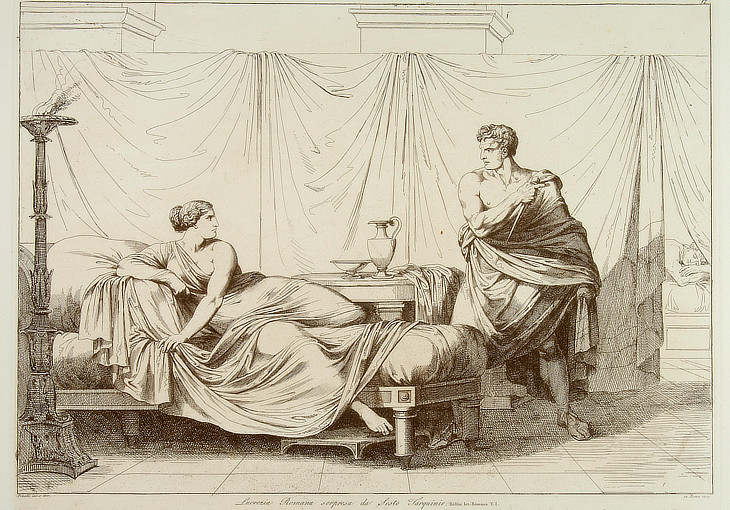
Bartolomeo Pinelli: The Rape of Lucrezia - 1817
From the besieged Ardea all in post,
Borne by the trustless wings of false desire,
Lust-breathed Tarquin leaves the Roman host,
And to Collatium bears the lightless fire
Which, in pale embers hid, lurks to aspire
And girdle with embracing flames the waist
Of Collatine's fair love, Lucrece the chaste.
The Rape of Lucrece by William Shakespeare
Cherchez la femme (look for the woman) is a well known French saying meaning that behind many events there is a love affair. According to the traditional account also behind the expulsion of Tarquin the Proud, the seventh and last king of Rome, there was a love affair. Sextus Tarquinius, son of the king, took a fancy to Lucretia, wife of Tarquinius Collatinus: one day he abandoned the Roman camp near Ardea, a town his father was besieging, and returned to Rome. He managed to get into the home of Lucretia and, once alone with her, he forced her to have sex with him. He threatened her with his sword: either she would consent or he would kill her together with one of her slaves and then claim he found them having an affair. This is what a few hours later Lucretia told her father and her husband before killing herself with a dagger.
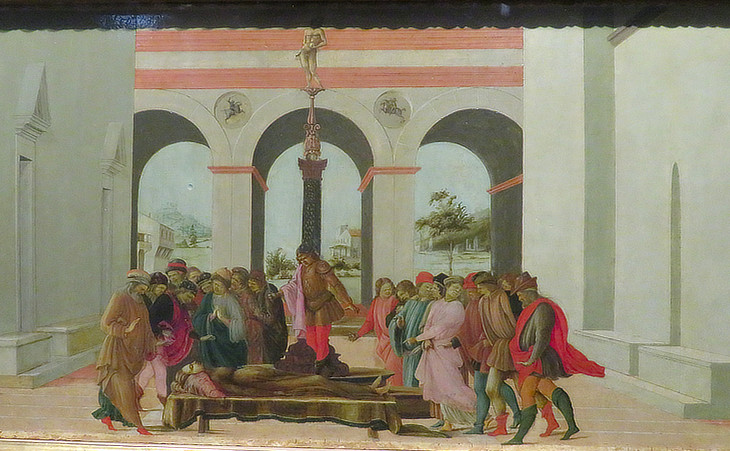
Galleria degli Uffizi - Florence (2024 exhibition at Musei Capitolini): Filippino Lippi - Death of Lucretia (1478-1480); the painting is perhaps a depiction of the Florentines mourning the death of Giuliano de' Medici
Her family brought
her body to the Forum and there a family friend, Lucius Iunius Brutus, incited the Romans to revolt against the king and his
wicked son. When Tarquin the Proud learnt what was happening in Rome, he precipitously returned, but only to discover
that the gates of Rome were closed and the Romans were on the walls, ready to defend their city.
According to the traditional account, Tarquin the Proud sought help from Porsenna, the
Etruscan king of Chiusi (a town in southern Tuscany) who moved with a large
army towards Rome and placed his camp on the Janiculum;
he then tried to cross the river at Ponte Sublicio,
but a Roman soldier, Horatius Coclites, stopped the Etruscans on the bridge while
his companions tore it down. He eventually dove into the Tiber and safely reached Rome.
He was not the only Roman hero of that war: Porsenna had not been able to seize Rome,
but by controlling the right bank of the Tiber he blocked the
supplies which the city received from Ostia; the Romans wondered for how long they could
resist: a young member of a noble Roman family, Gaius Mutius Scaevola, decided to sacrifice his
life to save Rome. Disguised as an Etruscan soldier, he managed to
enter the enemy camp; he then looked for the royal tent as his mission was to kill Porsenna with his dagger.
He found a large and decorated tent and inside it the man he was looking for. In a fraction
of a second he plunged the dagger into the king's heart. The last scream of the victim and the fall of his
dead body alarmed the sentinels, but Mutius Scaevola did not even try to escape, as he thought
that by showing to the Etruscans he did not care about his own life, they would have understood
that the Romans could not be won.
He expected to be immediately put to death, but to his great surprise he was
brought before Porsenna; he had mistaken a high dignitary for the king. Once he realized he had failed, he told
the king that there were 300 other Romans ready to make the attempt again. A furious Porsenna
threatened to send him to the stake; Mutius calmly placed his right hand on a brazier, as to punish it for its failure, and, without
showing a sign of pain, he kept it there until it was totally burnt. Porsenna got the message
and sought a peace agreement with the Romans.
Mutius Scaevola
is remembered by a very common Italian sentence mettere la mano sul fuoco
(to put one's hand on the fire), meaning that someone is totally sure that what he says is true.
According to many historians Scaevola means left-handed and it was added to the
name of the hero after he lost his right hand.

(left) Columns of Tempio di Castore e Polluce;
(right) their statues in Piazza del Campidoglio
The transition from monarchy to republic is associated also with a pair of twins, the second set after Romulus and Remus. Tarquin the Proud, in addition to the help of Porsenna sought that of other Latin towns. The Latins and the Romans clashed at Lago Regillo, a now dried lake, not far from Ponte di Nona: the Roman cavalry attacked the enemy and at that point the Romans saw Castor and Pollux, the Dioscuri (sons of Zeus), galloping at their side. The divine appearance strengthened their resolution and they defeated the Latins. The Romans worshipped Castor and Pollux in a temple in the Forum (which was rebuilt several times); the Dioscuri were also portrayed in two sets of gigantic statues, now in Piazza del Campidoglio and in Piazza del Quirinale. Their inclusion among the Roman deities is a sign of the first contacts with the Greek colonies in southern Italy and in particular with Tarentum where the two demigods were worshipped.

(left) Ruins of Tempio di Bellona; (right) a remaining column of a temple near Portico di Ottavia
At the end of the monarchy Rome consisted of the Palatino and Campidoglio hills and of the two flat areas next to them,
one (the Forum) to the north of them, the other Velabro, between the hills and the river. In the first centuries of the republic the city expanded
along the river towards the vast flat land, almost encircled by a bend of the Tiber, which later on became known as Campus Martius (the field of Mars), because the Roman army used it as a
training ground.
This part of Rome, broadly corresponding to Rione Sant'Angelo, has been inhabited
without interruptions for more than 2,500 years; in the 1930s excavations near Teatro di Marcello
brought to light some Roman temples which lay under medieval buildings, but many are still hidden, although they have been identified.
They constitute part of the so-called Roma sotterranea (external link - it opens in another window), the underground legacy of Rome.
Ipogea (tombs below the ground) and other underground monuments, in addition to
their archaeological interest, offer the visitor a bit of speleological zest.
Occasionally a hidden piece of ancient Rome requires you to go up the stairs and not down. In Via Sant'Angelo in Pescheria, behind
Portico di Ottavia, a still standing column of Tempio di Giunone Regina is
embedded in a small house, but its decorated capital comes out of the roof.
To see it you need to enter the house at No 28, go up the staircase and look from the window at the upper floor towards No 11.

(left) Fonte di Giuturna near Tempio di Castore e Polluce: (right) detail of the
Republican temples "D" (left) and "C" (right) at Largo di Torre Argentina
Res publica (public matter) is the name the Romans gave to their political
system after the expulsion of the last king. The new system was an oligarchic one, with all
the power in the hands of a small group of families, the patricians (patricius = having noble father).
The Senate, the members of which were patricians, was the most important institution, but the ongoing affairs were managed by annually
appointed magistrates, the praetors (maybe the word means those who go first, because they led
religious or civil processions). During wars or other emergencies, the Senate had the
option to entrust what we call today the executive power to a single praetor, who was called
dictator. Eventually the number of praetors having jurisdiction in political and
military matters was fixed at two: the consuls. Definitely the history of Rome had a liking
for pairs.
Archaeologists have found in the Roman Forum at least eight pavement layers. Those related to the early republican
period are covered by travertine pavements dating from later periods.
The Dioscuri, not only had
helped the Romans at Lago Regillo, but they also had immediately reported the good news
to Rome. They were seen with their horses at a spring at the foot of the Palatino, very near the site where their temple stands:
archaeologists have found evidence that a fountain was built to control the spring in the early
republican period, but its travertine border belongs to a later period.

(left) Map of the so-called Servian walls; (right) a section of the Servian walls found in the XIXth century near
Chiesa dei SS. Vito e Modesto
Marcus Furius Camillus is regarded by many historians as the second founder of Rome. In
396 he led the Roman army against the rich Etruscan town of Veii,
located just 10 miles north of Rome. The seizure of Veii marked the end of the Etruscan
threat to the development of Rome. In the next few years the Romans seized Falerium, a town
north of Veii and the security of Rome from Etruscan attacks was further ensured
by the conquest in 389 of Sutri, located in a key position on the road leading to Rome.
The success of Camillus at Veii attracted the envy of other patrician families and he was accused
of having royal ambitions: he chose to go into voluntary exile at Ardea.
But Rome had not yet completely enjoyed the benefit of its victories, when a new unexpected
threat came from the north. In 390 (or in 387) a tribe of Gauls, the Senones, invaded the Etruscan territories and moved
southwards under the leadership of Brennus. The Romans placed their legions along the Allia, a
small stream near Monterotondo, to prevent them from reaching Rome; the Gauls simply routed the Roman army. The
soldiers who had managed to escape from the battlefield, fled back to the city in disarray.
The Romans barricaded themselves
in the Campidoglio, where one night they were alerted to a Gallic attack by the sacred geese of Juno. The rest of the city
was plundered by the Gauls, in what can be seen as an anticipation of the barbarian invasions which occurred 800 years later.
The event is associated with a couple of famous sentences: Brennus had agreed to leave Rome if the Romans had paid a certain amount of gold. At the
weighing of the gold, the Romans discovered that the weights were heavier than standard ones. When
they complained he shouted Vae victis (woe to the vanquished): at this point Marcus
Furius Camillus made his unexpected appearance followed by a Roman army and threw his sword into the scale proclaiming: Not auro, sed ferro, recuperanda est patria.
(not gold, but steel redeems the nation). He then attacked the Gauls and forced them out of Rome (see the event in an XVIIIth century painting at Casino Borghese).
Notwithstanding the happy, albeit miraculous, end of these events, it is said that the
Romans wondered whether they should rebuild their city on the same site or move to a more easily
defensible location; eventually this option was discarded, but the awareness of the
weakness of the old fortifications led to the decision to build a new set of walls to protect the whole city and not just
the two original hills. These walls are called Servian, after Servius Tullius, the sixth
king of Rome, but they belong to the early republican period, although they were
to a great extent rebuilt several times in the following centuries. The main remaining
sections are located near Termini railway station (Aggere Serviano)
and near Chiesa di S. Saba,
but smaller parts of the walls can be found elsewhere
in Rome.

(left) Rostra in Foro Romano (see the steps which led to the platform and a relief depicting the monument in Arco di Costantino); (right) Column in Piazza del Popolo
While the Etruscans blocked the expansion of the Romans towards the north,
that southwards was also rather difficult due to the hostility of the Volsci, an Italic people
occupying the coastal plain south of Rome: their main towns were Velitrae (Velletri),
Antium (Anzio) and Anxur (Terracina). The wars the Romans waged against them
led to many land battles, but in 338 there was what is recorded as the first Roman naval
battle in the sea near Anzio. In those days the ships travelled along the coastline, so the Roman ones,
en route towards the harbour of Ostia from the south, were at risk of being captured by the Volsci.
The excitement for this first naval victory was such that the captured ships' bronze beaks (rostra)
were placed in the Forum in an open square (Comitium - go together), where all the
Romans could see them.
In 260 the Romans defeated the Carthaginians at sea near Milazzo in Sicily: the rostra
captured in that battle were placed on a column in the Comitium.

Temporary exhibition at Musei Capitolini: XVIth century marble rostra and a 1593 engraving by Antoine Lafréry depicting an imaginary reconstruction of the column; the inscription celebrating the victory over the Carthaginians was discovered in 1565 near Arco di Settimio Severo
In 29 BC Augustus, after having defeated the Egyptian fleet at Actium in Greece, in the frame of a general restructuring of the Forum, moved the rostra to a sort of large altar which ended by being used to speak to the Roman people assembled in the Forum. 2,000 years after its erection the column with the Carthaginian rostra inspired the Neoclassic decoration of Piazza del Popolo.

(left) Temple to Fortune now included in S. Niccolò in Carcere; (right)
nearby Tempio di Portuno
Many believe that behind the expansion of Rome lay a militaristic and expansionistic drive: this is probably due to the fact
that wars, battles, heroes and the likes appeared more interesting to both the writers
and readers of books on the history of Rome: however it is more consistent with the actual
development of the events to make a parallel between the growth of Rome with that of
the British Empire, which was clearly
driven by trade interests.
Rome was a large emporium (trade centre) well before having an imperium (command and later on empire). The republican
walls protected an area which by far exceeded that of Athens, at a time when Rome
did not even rule over the whole of Latium. The decision to found the city on a low hill shows
that military considerations were not high in the mind of Romulus and that he was mainly
interested in the commercial benefits Rome would gain from being placed on the Tiber.
At the beginning ships moored near the Velabro, but in the republican period the area was too congested and gradually
a river harbour was developed in what is today called Testaccio.
The area of Velabro was embellished by the merchants who continued to meet there: they
built many small temples dedicated to the gods who were patrons of their trade (this tradition in a way
was continued many centuries later by the churches built by the medieval
and Renaissance guilds).
This explains why the temples are so many and so small. Three temples were lined up one next to the other (you see them in the image used as a
background for this page); today they are almost entirely incorporated in a small church.
The temples of Velabro were rebuilt or repaired several
times, but they retain something of their original design. A characteristic of the early
Roman architecture is the high basement upon which temples were built, because in the very early days of their city the Romans
just placed an altar on high ground to allow maximum visibility to the performance of
religious ceremonies (chiefly sacrifices).

A section of Via Appia in the Roman countryside
With the victory over the Volsci Rome had no longer rivals
in southern Latium: it controlled an area relatively small, but larger than the territory
of each of the many rich Greek colonies in southern Italy. These did not constitute a united
front, they were divided as much as their parent towns in Greece. Some of them saw Rome as
a potential ally in their quarrels with their neighbours. Rome made with them alliances
called foedus (after which we have today federal/federation) and in some cases granted
citizenship rights to their patricians.
In order to speed communication with these towns, towards the end of the IVth century BC, the Consul Appius Claudius (the Blind) promoted
the construction of the first Roman road, named after him Via Appia.
It initially reached only Terracina, but with the growth of the Roman influence in southern Italy it was
prolonged several times until it reached Brundisium (Brindisi), the gateway to Greece.
The characters and events mentioned in this page have inspired many artists: in particular
Lucretia was portrayed by many Renaissance painters: the following links which open in separate windows
show paintings by Cranach,
Titian, Veronese and
Rembrandt.
Horatius Coclites, Mutius Scaevola and the Dioscuri at the battle of Lago Regillo were all portrayed in the frescoes of
Palazzo dei Conservatori.
Previous page: I - The Foundation and the Early Days of Rome
Next page: The Romans Meet the Elephants


