
All images © by Roberto Piperno, owner of the domain. Write to romapip@quipo.it.


Notes:
Page revised in June 2026.
All images © by Roberto Piperno, owner of the domain. Write to romapip@quipo.it.
Notes:
Page revised in June 2026.
 - Anzio
This page is based on Idyllen vom Lateinischen Ufer, a
description of the shores of Latium near the town of Anzio by Ferdinand Gregorovius, a German historian who lived in Rome for 22 years.
The road to Antium runs through a forest bordering the sea coast for many miles. It contains some very fine trees, though the far greater part were cut down and sold to the French some time before the revolution. The fall of so much wood, though at the distance of thirty miles from Rome, is said to have affected the air of that city, by exposing it to the winds that blow from the marshes on the shore, and thus rendered some of the hills formerly remarkably salubrious, now subject to agues and fevers. The wood consists of young oak, ilex, myrtle, and box, and is peculiarly refreshing, not by its shade only but by the perfumes that exhale on all sides from its odoriferous shrubs. This pleasure however is considerably diminished by the apprehension of robbers; an apprehension not altogether ill-grounded, as all the criminals who escape from Rome and its neighborhood betake themselves to this forest, and lurk for years in its recesses.
J. C. Eustace - Classical Tour of Italy in 1802 (publ. 1813)
On June 24, 1854 Gregorovius left Rome from Porta S. Giovanni; the
journey to Anzio took five hours: the last two hours were spent crossing
a thick wood which at the time was a brigands' favourite retreat.
Gregorovius had already seen the shores of Naples and Sicily, so at first he found the low coast around Anzio rather disappointing,
although it reminded him of the dunes of the Baltic Sea in his country; day after day his feelings changed and he fell in love
with this corner of Italy and with the memories of the past it retained.

(left) Modern bronze statue of Emperor Nero by Claudio Valenti; (inset) Musei Capitolini:
bust of Emperor Hadrian found at Anzio; (centre/right) ancient columns in the former site of Villa di Nerone
Here Nero, who was born in Antium and planted a colony there, held his Bacchanalia; here he made his triumphal entry
with white horses after his return from his debut in Greece. Gregorovius
Nero is still the popular hero, and the subject of many legends in the folklore of Antium. Nowhere does one feel more disposed to forgive his misdeeds and to admit extenuating circumstances than in this city, which he beautified and cherished above all other imperial residences. Nowhere can one better appreciate his worth as an artist and as an engineer.
Rodolfo Lanciani - Wanderings in the Roman Campagna - 1907
In 68 AD the Roman Senate declared Nero hostis (enemy) of the Republic and after his death all references to him, such as statues and inscriptions were removed (damnatio memoriae). Yet in recent years historians
have made a less negative assessment of the policies pursued by the Emperor and in 2010 the authorities of Anzio
built a monument to their most famous fellow citizen; the dedicatory inscription highlights that during the reign of Nero the Roman Empire experienced a long period of peace and growth.
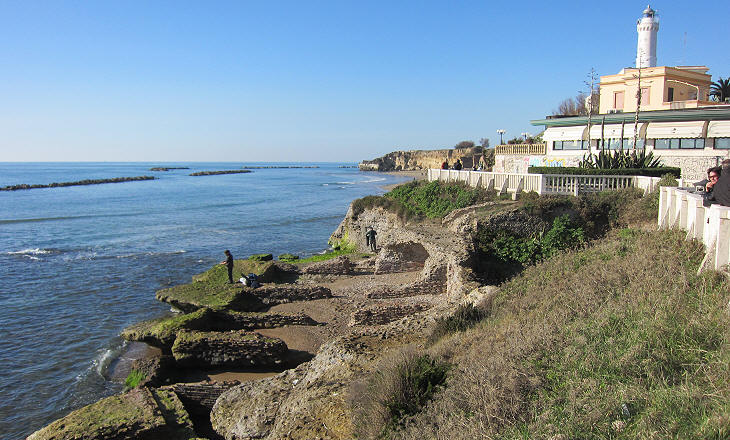
One can pick up Verde Antico, Giallo
Antico, the gorgeous oriental Alabaster, Porphyry, Pavonazzetto, Serpentino, and blue Smalt. Wherever these rare stones exist, a glance into the
waves tells us where they come from. For out of the sea rise the foundations of ancient Roman water-palaces, and at a quarter of an hour's distance from Antium, the shore is nothing less than a ruin of continuous
masonry. They look like masses of rock and the over-throwings of a
cliff, and if one examines one finds that they are simply Roman walls of
Peperino stone, and the imperishable Pozzolano, and delicate Roman
reticulated work. Gregorovius
The archaeological site which today is referred to as Villa di Nerone is actually an imperial villa which was inhabited almost continuously from the time of Emperor Augustus to that of Emperor Septimius Severus; it faced south-west in order to enjoy sunlight and the sea breeze; it was preceded by a large harbour, the wharfs of which are today under sea level.
It was not the only villa in the area, as also Cicero had a villa not far away (probably at Torre Astura).

Villa di Nerone: (left) library; (right) baths
Now the whole weird coast yawns with grottoes and halls of old baths and villas, and the foundations of temples and palaces crop up along the line of the shore. Here stood once the beautiful marble villas of the Emperors. Here Caligula besported himself, who particularly liked Antium, and had even formed a plan of making it his residence, here he celebrated his nuptials with the beautiful Lollia Paulina. (..) Also in earlier days Antium was the beloved holiday resort of the Romans; Atticus, Lucullus, Cicero, Maecenas, and Augustus, had here their villas; and where, on what charming hill, on what lovely Italian shore, had not these lucky fellows their villas! How this shore must once have shone with all the stones, the historic fragments, which the waves have constantly been tossing to and fro for centuries. These ruins bring a singular elegiac-historical character into the delightful Idyll of Antium, and the voice full of memories which here everywhere accompanies the wanderer, heightens not a little the attractions of the shore. Gregorovius

Villa di Nerone: "grottoni" (artificial caves). You may wish to see Grotta di Tiberio at Sperlonga
The celebrated temple of Equestrian Fortune was here, and divination ("Sortes in Fortunarum Templo") was in great repute. A temple of Aesculapius was also famous at Antium, as the serpent god coming from Epidaurus seemed inclined to remain here instead of proceeding to Rome. In imperial times a temple of Apollo, a circus, where the Circensian games were exhibited, a temple of Venus and Thermae, contributed to the magnificence of Antium.
Sir William Gell - The Topography of Rome and its vicinity - 1834
In Italy one cannot give oneself up to the quiet influence of
Nature, without a grave spirit of the classical past taking possession
of the soul, and leading one to meditate upon the recollections of its
great men. So that one can sit upon the ruined palaces of the Romans,
and, the waves murmuring round, may exclaim with Horace*:-
" O diva, gratum quae regis Antium,
Praesens vel imo tollere de gradu
Mortale corpus, vel superbos
Vertere funeribus triumphos! "
And again the sight of the beautiful Cape of Circe leads to the song of
Homer, while the ever-conspicuous but distant Astura draws one to
other associations and poems; so that three periods of the world's
poetry and the world's culture surround one, Homer, Horace, and the
Hohenstaufen poet Wolfram von Eschenbach (an early XIIIth century German knight and poet). Gregorovius
* O Goddess, who presidest over beautiful Antium; thou, that art ready to exalt mortal man from the most abject state, or to convert superb triumphs into funerals! Transl. C. Smart
Near the entrance of the town, on the right hand, we have a fine ruin of imperial construction, supposed to be the villa of Nero. It consists of several rooms and baths, which still retain their mosaic pavement and their painted walls. The villa appears to have been of great extent, but its chief interest is derived from the large number of works of art which have been found among its ruins. The Apollo Belvedere was found here in the time of Julius II.; the Borghese Gladiator was discovered about a century later; and our account of the Vatican Museum shows how many valuable sculptures have been subsequently disinterred. There are no remains of the temples of Apollo and Aesculapius, celebrated in the history of the voyage of the Sacred Serpent from Epidaurus to Rome; nor of the more famous shrine of Equestrian Fortune, which Horace has commemorated.
John Murray - Handbook for travellers in Italy - 1843
Antium (ancient Anzio) was famous for a sanctuary to Fortuna (the personification of luck), which rivalled that of
Praeneste (Palestrina). Archaeologists have not been able to identify its site, which was probably located to the east
of Antium towards Nettuno.

(left) Small castle which protected the harbour; (right) entrance to the castle with coat of arms and inscription celebrating a restoration
by Pope Pius VII
Antium, once a flourishing city of the Volsci, and afterwards of the Romans, their conquerors, is at present reduced to a small number of inhabitants. They consist chiefly of those who occupy the magazines erected by the Papal government for merchandize, in the hopes of re-establishing the lost importance of the place. (..) The eastern mole was applied by Pope Innocent XII. about the year 1700, towards the construction of a new port, to the east of the old one. He added a short new mole, of right angles to the former, which affords a tolerable shelter to very small vessels, but which is now fast filling up with depositions of sand. Gell
The harbor of Antium, built for the use of the Imperial galleys during the stay of the court at that seaside resort, is still practically in use, although much damaged and disfigured in the time of Pope Innocent XII (1691-1700). The piers with which he sheltered the harbor are still extant, as fine examples of hydraulic architecture as can be found on the shores of the Mediterranean. They are still encased in their original frames or cradles of stout oak beams, which have hardened to the consistency of iron. The piers are 4300 feet long and thirty wide, and reach a depth of forty. Lanciani
After the fall of the Roman Empire the villas were abandoned and the harbour was no longer maintained; marshes developed along the coast and the area became unhealthy because of malaria.
In 1698 Pope Innocent XII built a new small harbour to the east of the ancient one
and set up a penal colony to provide the workforce for dredging the sea floor. Gregorovius wrote that many of the inmates used to remain at Anzio after they had served their sentence, so that the population, similar to Australia, mainly originated from the presence of the penal colony. Fishing was the main economic resource of Anzio, but the locals were not fishermen, who instead came from Naples and Ischia.
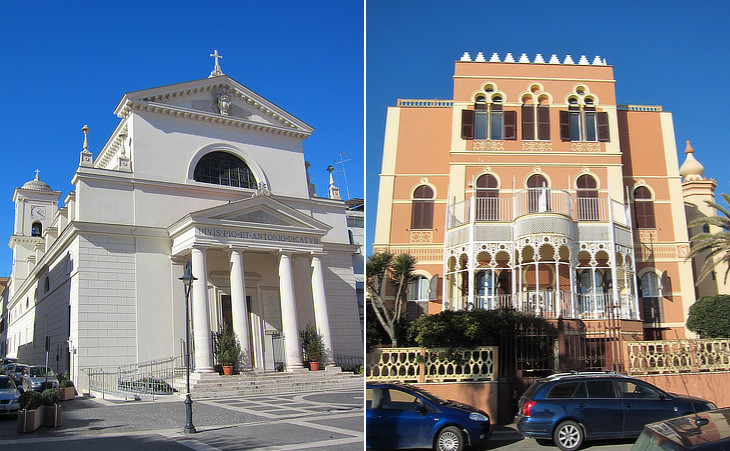
(left) S. Antonio; (right) Villino Moresco, a hotel (1911)
As Albano is not above ten miles distant from the coast, we took an opportunity of making an excursion thither and visiting Antium, the capital of the Volsci, often mentioned in Roman annals. (..) Antium was once a considerable port, improved, augmented, and embellished by Nero, and much resorted to by the higher classes of the Romans who adorned it with many magnificent villas. (..) The port has been repaired and fortified by some of the late pontiffs, but though capable of admitting large vessels it is totally nil frequented. A few straggling houses alone remain of the town, though some handsome villas shew that the beauty and coolness of the situation deserve more attention and a better fate. Eustace
The town is very small, merely a knot of modern houses
grouped around a square (in which stands the new church of
S. Antonio), with a few more ancient fishermen's cottages.
Augustus J. C. Hare - Days near Rome - 1873
Pope Pius IX promoted the development of Anzio as a fishing port by attracting fishermen from the Kingdom of the Two Sicilies and in 1851 the first stone of a new parish church was laid down. After the annexation of Latium to the Italian Kingdom in 1870, Antium became a favourite seaside resort for the greatly enlarged population of Rome and it still is.
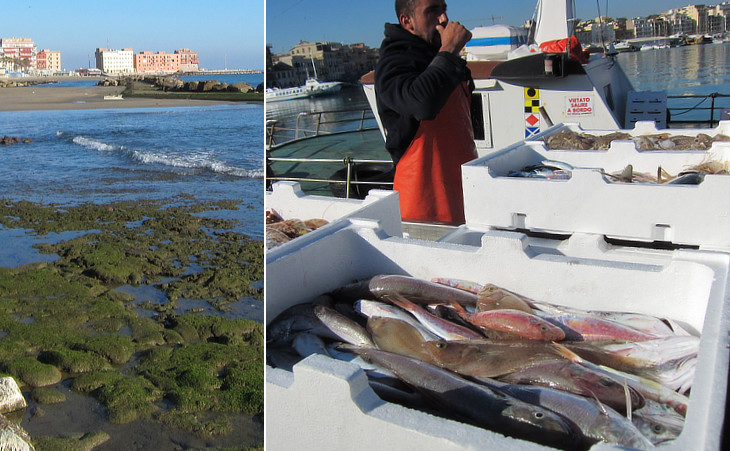
(left) Evidence of the structures of the ancient harbour; (right) sale of the remaining fish after the main catch has been shipped to Rome
It is the custom of the fishermen to go out towards Ave Maria, and
to fish through the night. That which is caught will be brought with
the morning into the straw-roofed sheds, but in the evening it will be
registered and packed up, and by night it will be carried in carts to
Rome. Evening brings with it an exciting scene. The clerks sit at a
table with a lantern and register the fish; all around fishermen are occupied in bringing in fish in baskets, while others pound pieces of ice,
and lay the fish upon this frozen surface. The variety and wonderful
forms of these creatures of the sea is astonishing. There is the long
Grongo, the great and handsome Palombo, the beautiful spotted Murena,
the flounder-like prickly Ray, the great multitude of glittering Triglie
and Sardines, and the well-tasting Merluzzo. Sometimes a Dolphin
is brought up, and once I saw in a fish-basket two Pesce-cane (sharks), which
had been found here. They were from eight to ten feet long, their
black-steel blue colour had something uncanny about it. Gregorovius
The fishing boats and the fishing operations are a great
amusement to those who stay long at Porto d'Anzio. Hare

Plaques on the same house celebrating Pope Pius IX (left) and Giuseppe Garibaldi (right)
During Pope Pius IX's sojourn at Anzio, some celebrations (usually ending with fireworks) were held in the harbour. In 1858 he watched these celebrations for the sixth time from a small house, where the owner put an inscription to record the event. The temporal power of the popes came to its end in 1870 and in 1875 Giuseppe Garibaldi (a bandit in 1858 and a national hero in 1875) spent a night in the house and a second inscription celebrated the event.

(above) View towards Nettuno (the fortress and the medieval burg are on the left part of the image); in the background the snowy mountains behind
Cori (right part of the image); (below) view towards Torre Astura
When you sit in the window of your chamber, before which the Neapolitan fishermen are seated on the white sands mending their nets, the whole of the glorious gulf stretches before you, and you see the lovely shore as far as the Circean promontory. On the coast near Anzio rises the noble villa of Prince Borghese in a wild park of ilexes and olive-trees, further off are the castle and town of Nettuno, brown and picturesque, built into the sea, and celebrated through all the world for the beauty of its women, and their splendid costume. Gregorovius

View of Anzio and Nettuno in 1686 by Pandolfo Reschi, now at Palazzo Chigi of Ariccia
Antium, situated on the point of a little promontory, sheltered by woods behind and washed by the sea before, and commanding an extensive view of the Roman coast to Ostia and the mouth of the Tiber on one side, and to Astura and Circe's promontory on the other, might attract the eye of a man of taste and opulence. Eustace
The modern village and harbour of Porto d'Anzio belong to Prince Borghese, whose villa, formerly the property of the Costaguti family, stands upon the acropolis of the Volscian city. The climate is considered good, and during the winter and spring nothing can be more delightful as a residence. The beautiful scenery of the neighbourhood affords abundant occupation to the artist, and the lofty and well-wooded banks which bound the coast effectually protect it from the north winds. Murray
The view was painted before the construction of Porto Innocenziano and it shows some ruins of Villa di Nerone. The building on a commanding position is Villa Costaguti and to the far right the fortress of Nettuno is visible. Pandolfo Reschi mainly worked in Florence for the Medici family. In this painting he most likely portrayed Cardinal Francesco Maria de' Medici and a group of his courtiers during a journey they made in the Roman countryside.

Villa Costaguti Borghese seen from the harbour of Anzio (left) and from the coastal road (right)
The road from Nettuno to Porto d'Anzo lies on the coast. The sea is close on the left, and a high woody bank on the right, on which stands the Villa Torlonia, a palace once possessed by the family of Costaguti. From the summit of this building is an extended view over the sea, and of the ancient and modern moles of Antium. Gell
In 1648 Anzio was again chosen as the site of a summer residence by Cardinal Vincenzo Costaguti, of a wealthy Genoese family (see their palace in Rione Sant'Angelo) who built a villa at the centre of a large wood to the east of the abandoned port;
in 1698 Cardinal Giambattista Costaguti hosted Pope Innocent XII when he came to Anzio to follow the construction of the new harbour. The main building, due to the risk of corsair raids, is more similar to a fortress than to the elegant casinos which decorated the papal villas near Frascati, although the Costaguti called it Villa di Bell'Aspetto. In 1818 the Costaguti sold the villa to Giovanni Torlonia.

Watch tower of Villa Borghese
The view from the tower of the Villa Borghese is extremely fine: on the left it commands the line of coast towards Nettuno and the Circaean promontory. Murray
On the pleasantly wooded shore, half-way between
the two villages, stands the handsome villa of Prince Borghese, who is
the feudal lord of all the land in the district. Gregorovius
In 1831 Prince Camillo Borghese acquired the estate, which still belongs to the family; a section of the park which includes a much renovated watch tower today houses wedding parties and other events. The Borghese had already a castle at Pratica di Mare, north of Anzio.
The image in the background of this page shows the heraldic symbols of the Borghese.

(left) Façade of Villa Albani; (right) detail showing the heraldic symbols of Pope Clement XI
(a star on the railing) and of Pope Pius IX (a rampant lion on the lintel)
After the completion of the new harbour Anzio reverted to being a holiday resort for the richest Roman families; their villas were built at a distance from the
coastline and on high ground in order to reduce the risk of malaria and they were used just for a short period in spring and early summer before
the heat spread the disease.
In the 1720s Cardinal Alessandro Albani, nephew of Pope Clement XI, who was a keen collector of ancient statues, bought a large property near Villa di Nerone; the casino was perhaps designed by Alessandro Specchi; twenty years later he started to build a large
suburban villa off Porta Salaria in order to arrange his collection there. In 1852 the villa was bought by Pope Pius IX who renovated the casino.

(left) Villa Corsini Sarsina (today the Town Hall of Anzio); (right-above) a small watch tower; (right-below) coat of arms
of Pope Clement XII
There are other villas at Porto d'Anzo, (among which is the Corsini,) built for the benefit of the marine air and bathing. No place could afford a more delightful winter marine residence than Antium. Gell
Besides the Villa Borghese the town contains a villa belonging to the Mencacci family, who purchased it in 1820 from the Corsini for 20,000 scudi. Don Miguel* frequently resides here, and makes Porto d'Anzo his head-quarters in his sporting expeditions. Murray
The example of Cardinal Albani was followed a few years later by Cardinal Neri Maria Corsini, nephew of Pope Clement XII,
who built his villa above the foundations of an ancient temple; in 1878 an ancient statue was found in the premises of Villa Corsini;
it portrays a young woman, but archaeologists have been unable to identify her as a goddess or person of historical importance; it is
therefore known as La Fanciulla di Anzio (The Girl from Anzio).
* Don Miguel was King of Portugal from 1828 to 1834 when he was forced out from the throne. He lived the last 32 years of his life in exile first in Italy, then in England, and finally in Germany. He lived for a time in Rome, in apartments provided by Pope Gregory XVI, who also gave him a small monthly allowance.
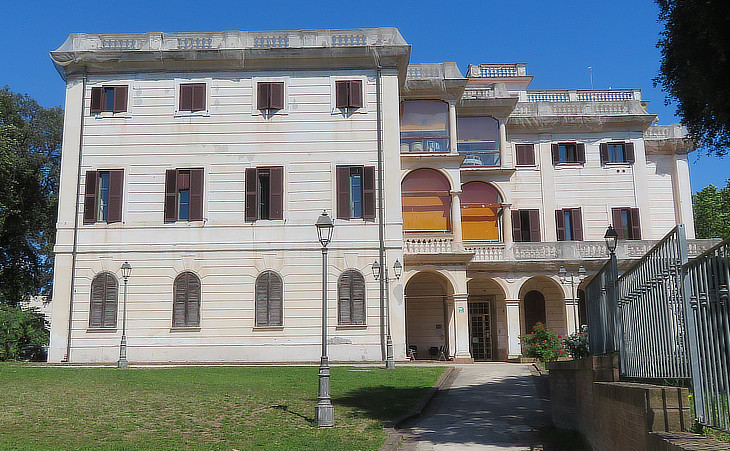
Villa Adèle (a XIXth century name) aka Cesi Pamphilj Borghese
This villa was built in 1600 by Mons. Bartolomeo Cesi and it was subsequently inherited by Federico II, Duke of Acquasparta. The property was sold to Camillo Pamphilj, nephew of Pope Innocent X. In 1834 it was inherited by Prince Francesco Borghese Aldobrandini who renamed the villa after his French wife Adèle.
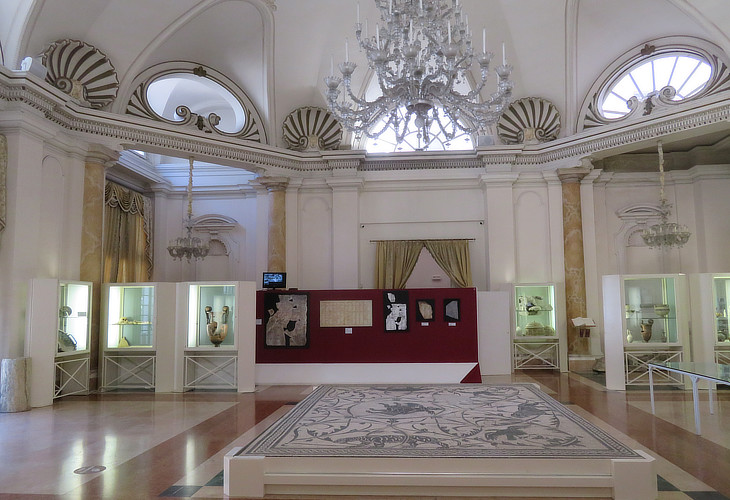
Villa Adèle - 1927 Entrance Hall (Sala delle Conchiglie - Hall of the Shells; you can see some details of the Roman floor mosaic in the second page)
In the 1920s the villa was entirely redesigned and for a time it was a luxury hotel. In 1964 it was bought by the City of Anzio and it currently houses the Town Library, the Archaeological Museum and a Museum on the 1944 Anzio Landing.

(left) Map of the 1944 landings in the harbour; (right) inscription celebrating the 50th anniversary; ceremonies were attended by President Bill Clinton
Operation Shingle, the landings of Allied troops at Anzio and Nettuno in January 1944, had the objective of hastening the liberation of Rome; the landings were successful, but the overall operation ended in stalemate and only in May the forces in the bridgehead were able to make a common front with those arriving from the south where they had been stuck for months before managing to conquer Montecassino. The Allies made their entrance into Rome on June 5. Large war cemeteries at Anzio and Nettuno are evidence of the fierce fights which took place in the area and which caused more than 12,000 deaths.
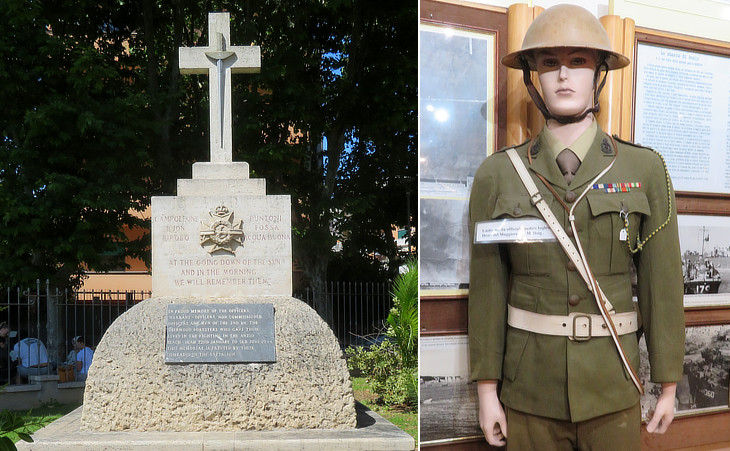
Villa Adèle: (left) Monument to the Fallen of the Sherwood Foresters; (right) uniform of Major M. Doig, a British Medical Officer
The Allies, including the 2nd Battalion of the Sherwood Foresters landed on the 22nd of January 1944. Whilst there was little resistance to begin with, there were too few to do a major drive. The bitter fighting that had begun would continue for months.
The 14th Battalion landed and joined on the 24th of February. They particularly suffered heavy casualties mid-March in a period of two weeks. In total 262 Sherwood Foresters were killed at Anzio. They are remembered on a memorial which initially was erected near the Commonwealth War Cemetery of Cassino. It was moved to the garden of Villa Adèle on the 50th anniversary of the landing. The inscription says: "At the going down of the sun/And in the morning/we will remember them". The memorial was raised by the members of the 2nd Battalion.
The museum of Anzio retains many uniforms, weapons, photos and other mementos of Operation Shingle.
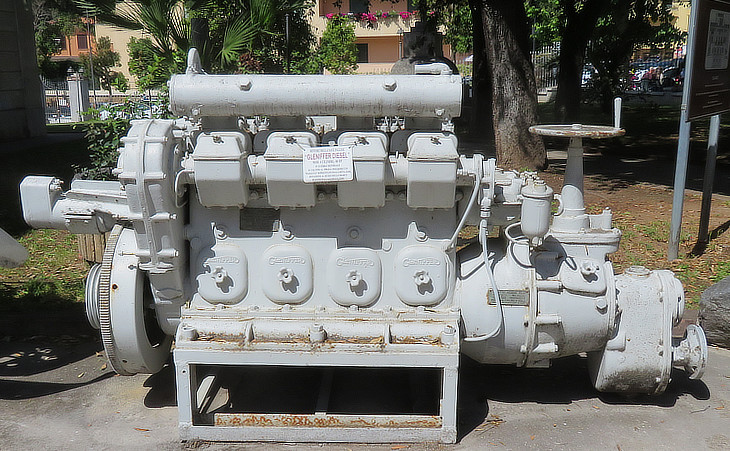
Villa Adèle: Gleniferr Diesel four cylinder 80 HP engine of a British small ship; after the war it was used by a local fishing vessel until 1998
The Churchill Archives provide detailed information about the first phases of Operation Shield:
- 28 Jan 1944 Telegram from WSC to General Harold Alexander [Commander in Chief of the Allied Armies in Italy] stating that he is pleased that General Mark Clark [Commander of the United States Fifth Army] is going in to the Bridgehead and commenting that it will be unpleasant if they become sealed off and cannot advance from the south.
- 31 Jan 1944 Telegram from General Harold Alexander to WSC stating that the 6 Corps have failed to capture Cisterna and that the First British Division have captured Campoleone but commenting that he is not satisfied with the situation and informing him that he intends to go to Anzio tonight.
- 9 Feb 1944 Telegram from General Harold Alexander to WSC informing him that the British Division have been forced to give up some ground and reporting on the changes he is making to the divisions in the beachhead and adding that General Bernard Freyberg [Commander of the New Zealand Division] hopes to launch his attack on the night of February 11th.
- 9 Feb 1944 Telegram from Field Marshal Sir John Dill Representative of the British Chiefs of Staff in Washington to WSC informing him that General George Marshall [United States Chief of Staff] has sent a message to General Jacob Devers [Commander in Chief North African Theatre of Operations] to ask General Henry Wilson [Supreme Commander in Chief Mediterranean Theatre] if in his opinion any of the United States Commanders involved in Shingle have failed and adding that if the answer is yes, appropriate action will be taken.
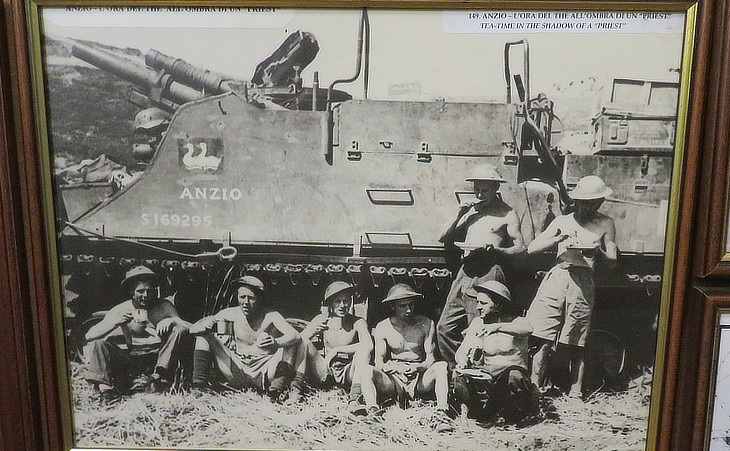
Villa Adèle: A moment of rest under a "Priest": the 105 mm Howitzer motor carriage M7 was an American self-propelled artillery vehicle produced during World War II. It was given the service name "Priest" by the British Army, due to the pulpit-like machine gun ring
All those concerned with the Anzio [Italy] landings have agreed for operations to proceed as planned; and that the plans work towards an X date [May 1944] for Overlord [invasion of Normandy, France] and Anvil [invasion of the South of France]. Churchill Archives
The effort to breach the German lines lost impetus because of the preparations for the landings in France.
- 2 May 1944 Letter from WSC to General Dwight Eisenhower [Supreme Commander Allied Expeditionary Force in Western Europe, United States Army] asking him to provide the Leclerc division with some transport and reminding him of the disaster of Anzio due to a lack of transport. Churchill Archives
Thus the position in Italy was changed greatly to our disadvantage. The Germans were strongly reinforced and ordered to
resist instead of to withdraw. The Allies, on the contrary, were
sending eight of their best divisions from Italy and the Mediterranean back to England for the cross-Channel attack in 1944.
The four extra divisions I was gathering or had sent did not
repair the loss. A deadlock supervened, and was not relieved
during eight months of severe fighting. (..) There could be no hope now of a break-out from the Anzio
beach-head and no prospect of an early link-up between our two
separated forces until the Cassino front was broken. The prime
need therefore was to make the beach-head really firm, to relieve
and reinforce the troops, and to pack in stores to withstand a
virtual siege and nourish a subsequent sortie. (..) Prime Minister to Premier Stalin 5 June 44:
You will have been pleased to learn of the Allied entry into Rome. (..) Although the amphibious landing
at Anzio and Nettuno did not immediately fructify as I had hoped
when it was planned, it was a correct strategic move, and brought its
reward in the end.
Sir Winston Churchill - The Second World War - Vol 5 - 1952

Rome, Via del Corso, June 1944
Move to page two and see the works of art which were found at Anzio in the local and other museums or move on to Nettuno and Torre Astura or make an excursion to Pratica di Mare (Lavinium) or to Ardea.
Introductory page on Ferdinand Gregorovius
Other walks:
Roman Campagna: Colonna and Zagarolo. Palestrina, Cave, Genazzano, Olevano, Paliano and Anagni.
The Ernici Mountains: Ferentino, Frosinone, Alatri, Fiuggi (Anticoli di Campagna), Piglio and Acuto
The Volsci Mountains: Valmontone and Montefortino, Segni and Gavignano, Carpineto, Norma and Cori
Circe's Cape: Terracina and San Felice
The Orsini Castle in Bracciano
Subiaco, the oldest Benedictine monastery
Small towns near Subiaco: Cervara, Rocca Canterano, Trevi and Filettino.
Excerpts from Giuseppe Vasi 1761 Itinerary related to this page:
Giuseppe Vasi
|


