All images © by Roberto Piperno, owner of the domain. Write to romapip@quipo.it.


Notes:
Page revised in February 2024.
All images © by Roberto Piperno, owner of the domain. Write to romapip@quipo.it.
Notes:
Page revised in February 2024.
 Ariccia
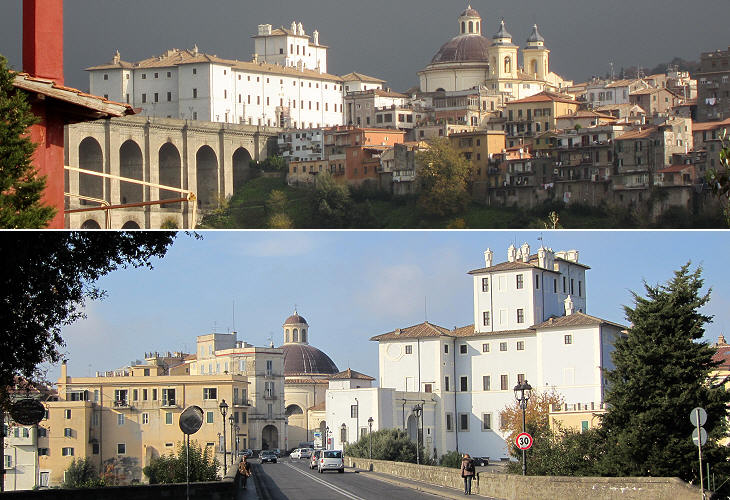
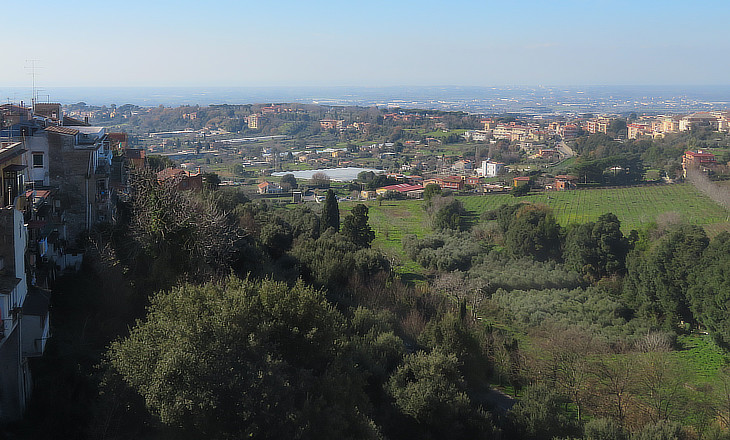
Ariccia seen from S. Maria della Stella (Albano) (above) and from the road to Genzano (below)
The road from Albano to Laricia, following the direction of the Appian way, is peculiarly beautiful: it divides a park belonging to Prince Chigi, whose late father never suffered the trees to be cut down, that artists might enjoy the advantage of studying them in their natural state, and in every stage of their vegetation and decay. The inequality of the ground, and the frequent caves in the rocks, add much to the beauty of the scenery; rustic gates and fountains contribute also to favour the landscape, and they occur at very trifling distances.
Laricia is only a short mile from Albano; yet the prospect continually varies, and a considerable series of views may be taken on this road; one of the most interesting of which is, that where the palace of the Prince with the cupola, and turrets of the opposite church, appear above the trees, and produce so fine an effect, that innumerable paintings and drawings of it are every where to be seen.
Ellis Cornelia Knight - Description of Latium: or, La Campagna di Roma - publ. 1805, based on notes made before the first French occupation of Rome in 1798.
The lofty dome of the church of Ariccia I imagined to be that of S. Peter, which the angels had hung up in the blue air among the dark olive-trees.
Hans Christian Andersen - The Improvisatore - 1834
Vallericia, a corruption of "Valle di Laricia," is an extensive vale surrounded by hills, on which stands the town of Laricia. It is the crater of an extinct volcano, which from a lake became marshy ground, and produces a great quantity of flax, in the cultivation of which the women of Albano and the neighbourhood find employment. The pleasantest way to this valley is through Prince Chigi's park. Amongst the old trees are several green arbours, opposite to which are posts with nets affixed to them, for the purpose of catching the birds who come to drink at the fountains; an ancient road passes through the valley, and there are many vestiges of tombs and other antiquities, particularly a circular temple like those of Faunus, which is still in tolerable preservation, and the whole scene is very beautiful. After sunset when the dew begins to fall, the air of this valley is moist and oppressive, and often occasions pains in the head and teeth. Knight
Ariccia stands over a bowl-shaped valley, the crater of an extinct volcano.
The Latins, the ancient inhabitants of southern Latium, believed that the area was a sacred one because of its volcanic
landscape and of its thick woods (see a page on the relationship between woods and the earliest shrines).
The son of fam'd Hippolytus was there,
Fam'd as his sire, and, as his mother, fair;
Whom in Egerian groves Aricia bore,
And nurs'd his youth along the marshy shore,
Where great Diana's peaceful altars flame.
Virgil - The Aeneid - Book VII. Translation by John Dryden.
At the time of Emperor Augustus Virgil, similar to other Roman writers, linked the origin of Rome to Greece and Troy; he assumed
that the name of Aricia derived from a nymph who bore a child to Hippolytus,
son of Theseus, the founder of Athens. According to the Greek myth Hippolytus was unjustly charged with having raped Phaedra, his stepmother.
Theseus cursed him and asked Poseidon, god of the horses, for help and on that same day Hippolytus was crushed to death during a stampede of his own horses.
According to a Roman addition to this tale Diana asked Asclepius, the god of medicine, to revive the young man who concealed himself for the rest
of his life in a grove sacred to the goddess at Ariccia.
What renders this place more particularly interesting, is our attachment to the ancient poets, who have made it a theatre of so many delightful fictions, that it is difficult to trace how far real history is intermixed with fable, in the events related as having taken place here.
They tell us, that Hippolitus found a refuge in this valley, under the name of Virbius (born twice), after being restored to life by his protectress Diana; and that in remembrance of the fatal accident which occasioned his death, all horses were excluded from the place. They also inform us, that Egeria retired hither to indulge her grief for the loss of Numa, and was at length changed into a fountain, by the compassionate goddess of the woods. One of her nymphs, who became the wife of Hippolitus, is supposed to have given her name to the town of Aricia, as is asserted by some authors. Knight
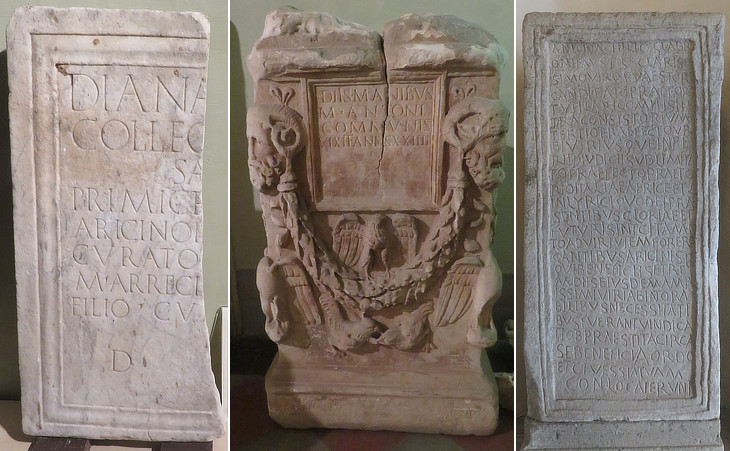
Saturday, 3lst October, 1789. From Albano the ancient road descends into the valley of Aricia, where the magnificent substructions of it are still visible; from thence it ascended to the Collis Virbii still known by the name of Colle di Virbio and then to Genzano and Civita Lavinia. From the Virbian hill a branch of the way descended to the celebrated temple of Diana, situate on the banks of the Lake of Nemi. (..) I find another inscription which refers to the goddess Diana Aricina. It is as follows: DIANAE AVG(USTAE): COLLEGIUM LOTORUM SACRUM PRIMIGENIVS . R . P . ARICINORVM . SERVUS ARCus CVRATOR . II . CVM . M . ARRECINO . GELLIANO . FILIO CVRATORE . T. D(icat) D(edicat). This inscription records a dedication made to Diana Aricina, and to Virbius, by the college of Lotores, at the sacellum, or chapel of the bona Dea, which was situate sub clivum Aricinum, where now stands the modern chapel of S. Maria Stella and it mentions also the precise period of this dedication, namely, in the year of Rome 873, and of Christ 122 under the consulate of M. Annius Verus (grandfather of Emperor Marcus Aurelius), and Aurelius Augurinus.
Richard Colt Hoare - A Classical Tour Through Italy and Sicily - 1819
Diana, goddess of pregnant women to whom she granted a delivery free from pain, was the Roman equivalent of Greek Artemis.
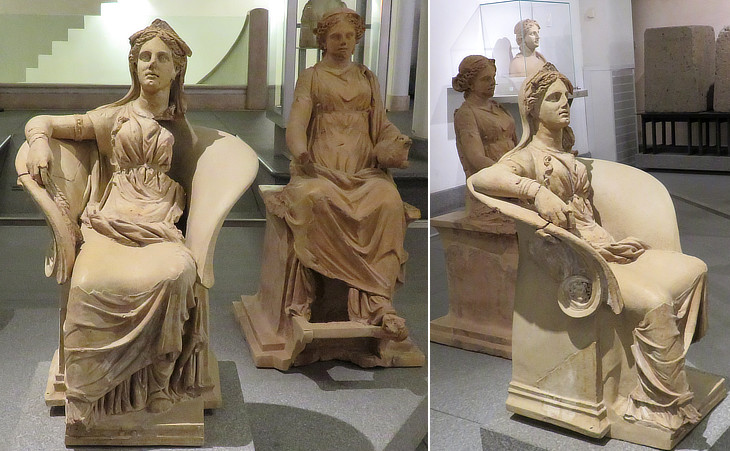
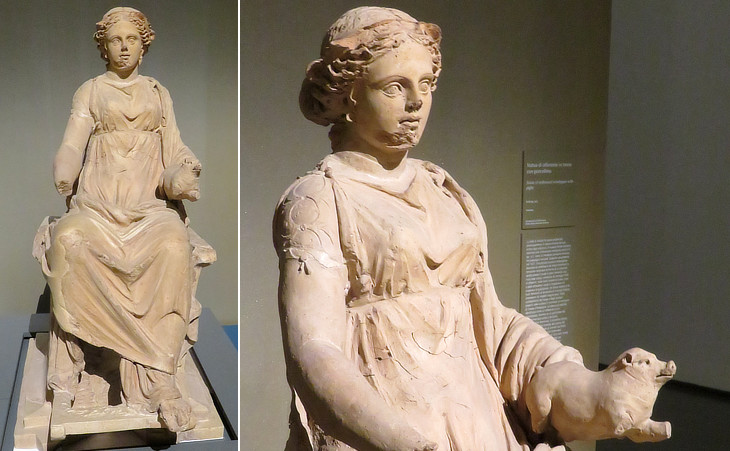
A sanctuary near Ariccia was dedicated to Demeter (Lat. Ceres) and Kore / Persephone (Lat. Proserpina) in their role of patrons of agriculture. Demeter holds ears of corn as symbol of crops. According to a tradition reported by Claudian the abduction of Kore occurred near a lake called by the Sicani Pergus, girt with a cincture of leafy woods close around its pallid waters. Deep down therein the eye of whoso would can see, and the everywhere transparent water invites an untrammeled gaze into its oozy depths and betrays the uttermost secrets of its pellucid gulfs. The lakes of Albano and Nemi were very close to Ariccia.
Whoever was the founder of this little town, we know that it never became a place of much importance, though Cicero speaks with praise of its inhabitants; but even in the time of Augustus it must have been inconsiderable, by the mention Horace makes of it as his first stage from Rome, and the moderate accommodation he found there.
The ancient history of Aricia is indeed confined to few particulars. We are told, that when Porsenna left the Janicule, after the daring actions of Horatius Cocles, Scevola, and Clelia, he sent his son Aruns to besiege Aricia; that the inhabitants were at first alarmed, but recovering their spirits, and assisted by auxiliaries from Cuma, came out to fight their enemies, who had however the advantage at the onset, but the Cumaeans rallied and defeated them. Knight
Just below the road to Ariccia, upon the right, is the tomb of Aruns, son of Porsenna. It is a huge square base with four cones rising from it, and a central chamber. Aruns was killed by Aristodemus of Cumae before Ariccia, which his father had sent him to besiege: his tomb was long supposed to be the monument of the Horatii and Curiatii.
Augustus J. C. Hare - Days near Rome - 1875
The offer of a piglet could indicate that maybe even in antiquity Ariccia was known for its "porchetta" (roasted baby pork), but the sacrifice of piglets was typical of the worship of Demeter and Kore during a festival dedicated to them (see a relief showing Hercules offering a piglet). The statues are dated late IVth century BC or early IIIrd century BC.
The territory of the Aricians not being very extensive, they were naturally tenacious of the little they possessed; and the dispute which took place between them and the Ardeates, on the subject of a field which was claimed by both nations, and afterwards appropriated to the Romans whom they had chosen as umpires, appears to be one of the principal features of their history. As this dispute happened about three hundred years after the foundation of Rome, and no farther mention is made of Aricia by historians, we may conclude that it experienced fewer vicissitudes than almost any other of the neighbouring states, during a long series of ages; for it is generally believed that it was built four hundred and fifty years before Rome, and it still occupies the same little eminence, wearing the same appellation, with only the addition of an article. Columella (a Roman writer on agriculture) stiles Aricia the Mother of onions; and the ancients often speak of it as famous for these and cabbages, which the gardens of modern Laricia still produce in singular perfection. Knight
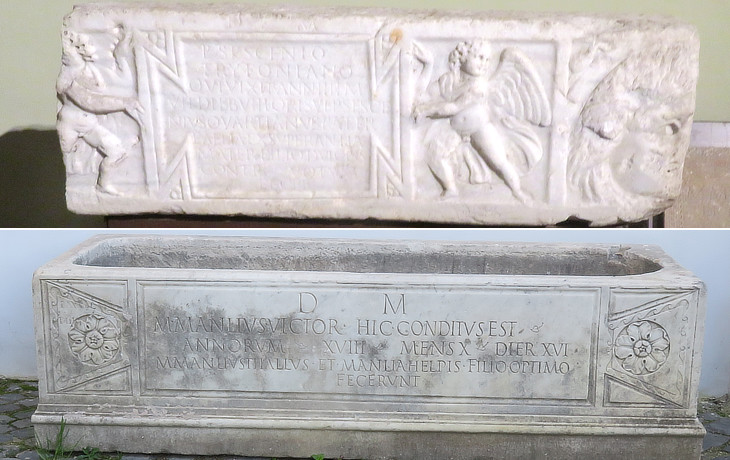
The two sarcophagi were made by the parents of the dead; both inscriptions (inside a typical Roman frame) state exactly the age at the time of death and in the case of Sescenius even the hours he lived. The Romans, at least those of the upper classes, had a horoscope made for their children and the time of birth, specified down to the hour was needed to determine the rising sign, a crucial piece of information. The parents of the child added that he passed away contra votum, i.e. notwithstanding their prayers and votive offerings. It can mean a blame against the Gods or a special piety, a commitment to the utmost care for the life of a person.
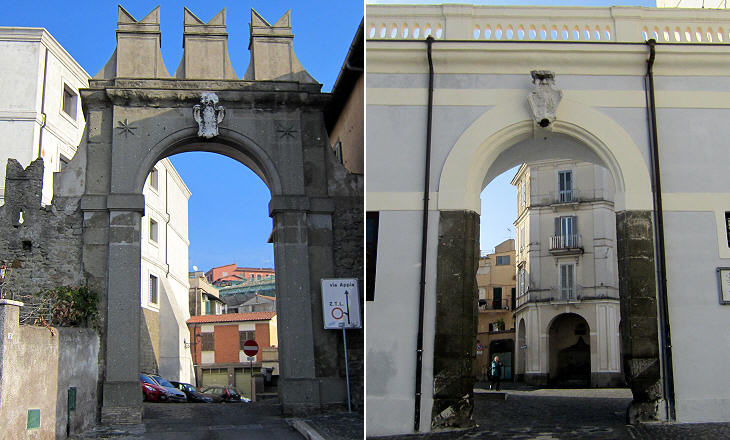
(left) Porta Romana; (right) Porta Napoletana
The situation of this little town is beyond description beautiful, but the streets have nothing to recommend them; and though they contain many comfortable dwellings, there is no house worthy of observation, except the palace of Prince Chigi. Knight
Similar to nearby Albano and Castel Gandolfo, Ariccia was for many centuries a fiefdom of the Savelli who in 1661 sold it to Agostino Chigi, Prince of Farnese and Cardinal Flavio Chigi,
nephews of Pope Alexander VII. The new owners made radical changes to the small medieval town and gave a
very urban aspect to its section near Porta Napoletana.
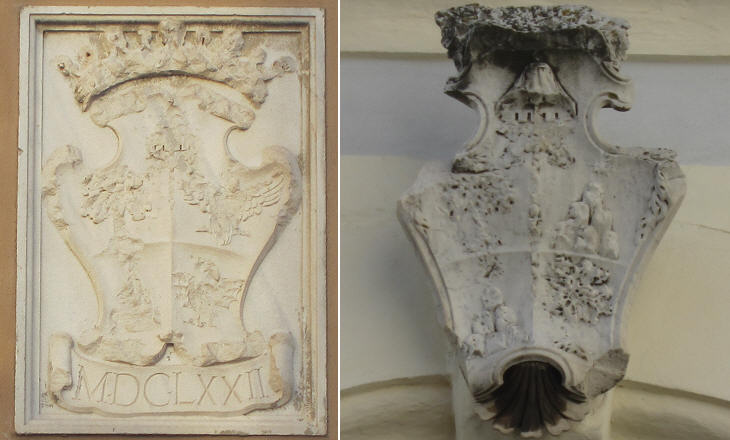
Coats of arms: (left) Agostino Chigi and his wife Maria Virginia Borghese on a 1672 building near Porta Romana;
(right) Pope Alexander VII at Porta Napoletana (the image used as background for this page shows another coat of arms of the Pope
inside S. Maria dell'Assunzione)
Cardinal Flavio Chigi was superintendent of the general affairs of the Papal State,
an office which granted him many opportunities for enrichment; his cousin Agostino could rely on the large dowry of his wife Maria Virginia Borghese, who was the daughter of Paolo Borghese, a relative of Pope Paul V and Olimpia Aldobrandini, niece of Pope Clement VIII; in addition Maria Virginia Borghese was the stepdaughter of Camillo Pamphilj, nephew of Pope Innocent X.
In the XVIIth century the dowry of a Roman noblewoman implied such a financial effort that it could not be provided to all daughters.
Agostino Chigi and his wife had eleven daughters; one of them married Emilio Altieri, Prince of Oriolo, a nephew of Pope Clement X,
while the other ten entered a nunnery.
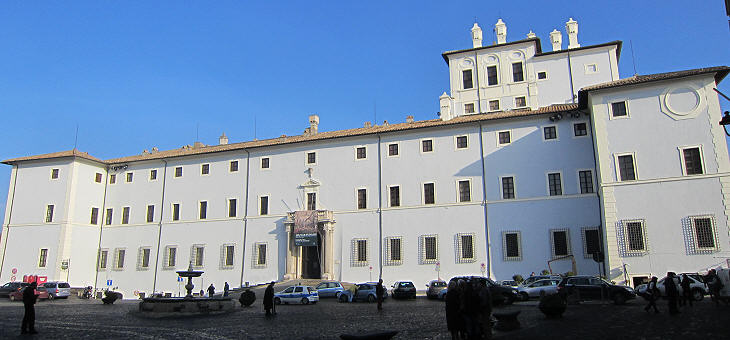
Near the gate which leads to Naples, is a square with a fountain in the middle: one side is occupied by the church and contiguous houses for the canons; the other by the palace; and at the extremity, towards the Campagna and sea, is a parapet and balustrade, whence the view of the valley is delightful. Knight
When the Chigi became one of the most important Roman families they found out that the other great families had large villas at
Frascati and Castel Gandolfo and they decided that their residence at Ariccia should
not be inferior to those of their rank. They asked Gian Lorenzo Bernini, assisted by Carlo Fontana, to turn the existing Savelli palace into a
stately mansion.
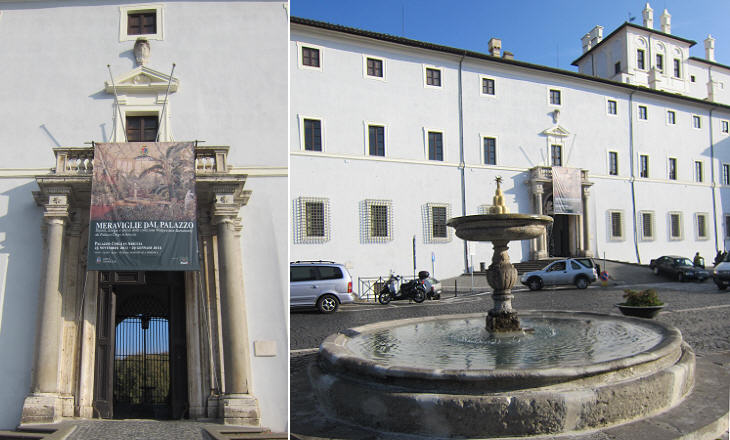
(left) Portal of Palazzo Chigi; (right) one of the two fountains opposite Palazzo Chigi
February 1787. We made a stop at the gates of a park which the owner, Prince Chigi, might be said to retain but not to maintain.
Perhaps it is why he does not want anyone to look at it. It has turned into a complete wilderness - trees, shrubs, weeds, creepers grow as
they like. wither, tumble down and rot. The valley of the park is enclosed by a high wall, but there is a little lattice gate through which
one can peer into it and see the hill slope beyond.
J. W. Goethe - Italian Journey - Translation by W. H. Auden and Elizabeth Mayer - Collins
Ariccia became the property of the Chigi family in 1661, to whom it still belongs, and of whose inattention to its improvement its present squalid condition gives but too convincing evidence.
Rev. Jeremiah Donovan - Rome Ancient and Modern - 1842
The size of the palace at Ariccia was such that in the XVIIIth century the Chigi preferred to build a much smaller villa
along Via Nomentana within easy reach of Rome and they did not care to properly maintain their properties at Ariccia and at Formello along Via Cassia. The Chigi retained possession of the palace until 1988 when they ceded it to the City of Ariccia which opened it to the public. Its interior is covered in a separate page.
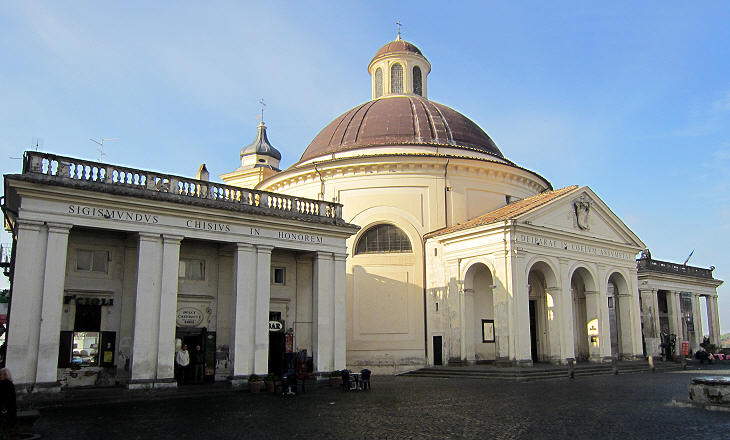
Bernini was commissioned in 1662, and two years later the church was finished. Its basic form consists of a cylinder
crowned by a hemispherical dome with a broad lantern. An arched portico of pure, classical design is placed in front of the rotunda, counterbalanced at the far end by the sacristy which juts out from the circle but is not perceived by approaching visitor.
Here also are the two bell-towers of which only the tops are visible from the square.
Rudolf Wittkower - Art and Architecture in Italy - 1600-1750 Penguin Books
In 1657-1662 Bernini worked at the restoration of the Pantheon and in particular of its portico
which was in part occupied by small houses. Bernini cleared the ancient temple of all medieval additions
which hid its original shape and he also made some sketches for an overall redesign of the area surrounding the building.
When the Chigi commissioned him the church for Ariccia he probably developed those sketches for emphasizing the Pantheon-like shape of S. Maria dell'Assunzione by adding two lateral porticoes which
frame it. The inscription makes reference to a restoration made by Prince Sigismondo Chigi in 1771.
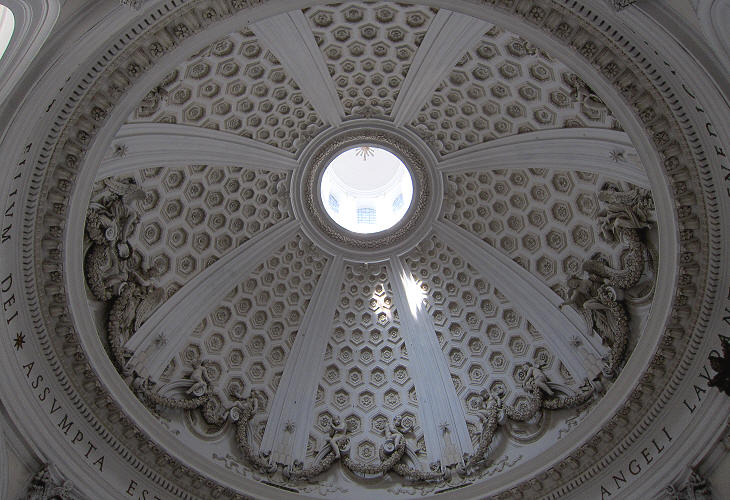
The interior too shows unexpected relations to the Pantheon. (..) In the zone of the dome, which again shows the combination of coffers and ribs. Wittkower
Most of the light in the interior of the church comes from a very large lantern which resembles the opening at the centre of the Pantheon dome.
According to tradition angels threw flowers during the Assumption of Mary. The event is remembered by flower festoons and angels by Paolo Naldini;
they occupy only the lower part of the dome as if Bernini did not want to divert the attention of the viewer from the stucco design of the ceiling
(see the similar domes of S. Andrea al Quirinale and S. Tommaso di Villanova at Castel Gandolfo, two other churches designed by Bernini in the same period).
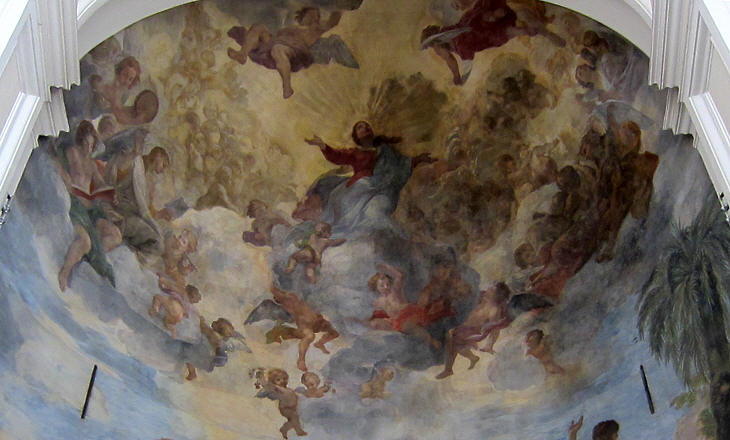
Apse painted by il Borgognone depicting the Assumption of Mary
The church is an elegant building of a circular form: over the principal altar is a large picture by Bourguignon, representing the assumption of the Virgin Mary, with a group of the Apostles at the bottom. The colouring is harmonious, and the attitudes well contrasted. The houses for the chapter form a crescent, and the whole of this square has a good effect. Knight
Guillaume Courtois was a French painter from Bourgogne who spent most of his life in Rome where he was known as il Borgognone (you may wish to see the coat of arms he designed for his Roman home and other works by him at Valmontone and S. Giovanni in Laterano).
Bernini commissioned him the only brightly coloured element inside the church;
the fresco has some features of what is known as illusionistic painting and which reached its apex in the ceilings of
il Gesù and S. Ignazio.
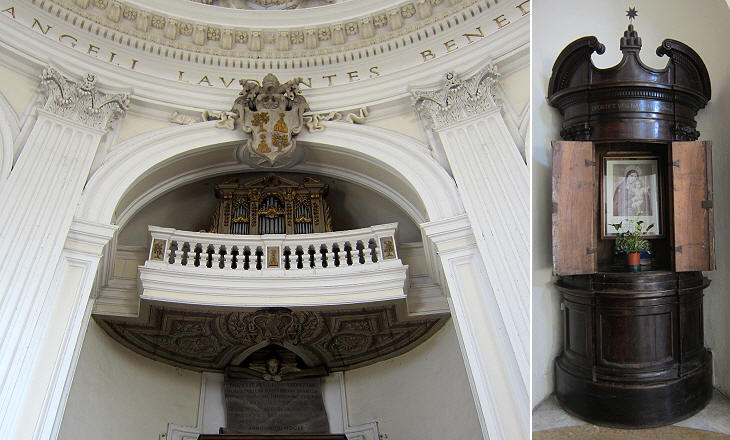
(left) Organ: (right) confessional box
References to Pope Alexander VII and his heraldic symbols (six mountains and a star) were placed by Bernini at many points inside the church (see two of the six coats of arms of Alexander VII which Bernini designed at Piazza S. Pietro). The Chigi preferred to be buried in their family chapel at S. Maria del Popolo in Rome (which was redesigned by Bernini too), rather than in S. Maria dell'Assunzione.
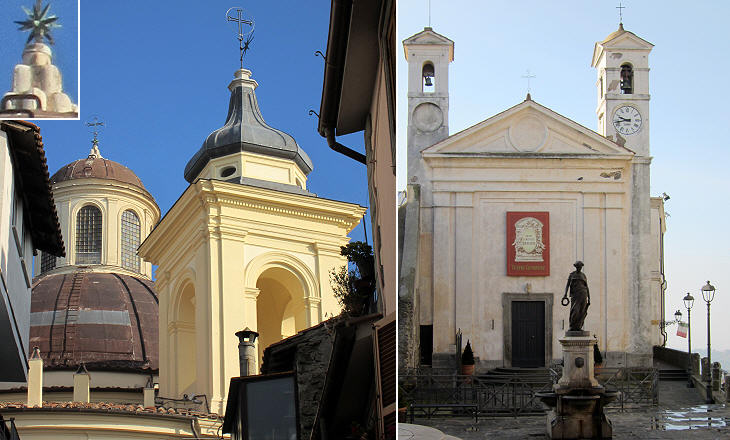
(left) Dome and one of the two bell towers; (right) S. Nicola
In 1634, at the request of Pope Urban VIII, Bernini added two small bell towers to the Pantheon to emphasize its function as a church. They were placed above the portico; it was an unfortunate addition and in the XIXth century they were pulled down.
At S. Maria dell'Assunzione Bernini chose a less evident location and he built them on the back of the apse.
Luigi Bernini, brother of Gian Lorenzo, was entrusted by the Chigi with the design of some minor buildings at Ariccia, including S. Nicola.
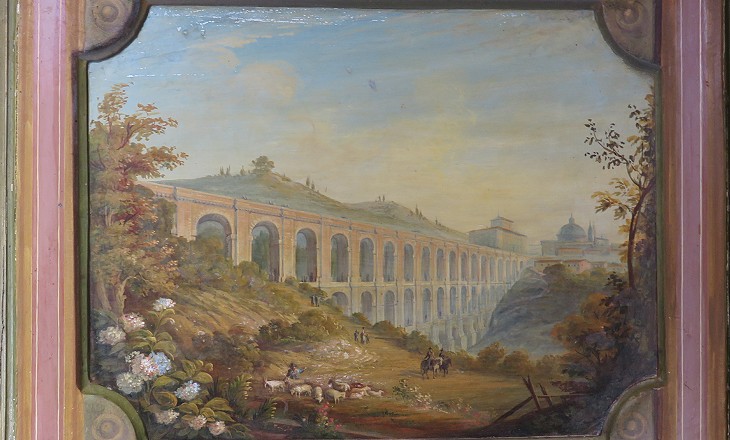
Painted cupboard in the Vatican Library showing Ariccia in ca 1860
The town is now entered from Albano by a grand viaduct,
700 feet long, whence the view is exquisitely lovely, on the
left over the Campagna, on the right looking into the depths
of the immemorial wood known as the Parco Chigi. The rich country upon which we look down was as famous in ancient as in modern times for the produce of its vineyards. Lariccia is now chiefly remarkable for the huge Palace of the Chigi family built by Bernini for Alexander VII. It is noble and imposing in its proportions, as it rises on huge buttresses from the depths of the ravine. Hare
In 1854 Pope Pius IX celebrated the completion of an imposing bridge which shortened the distance between
Albano and Ariccia.
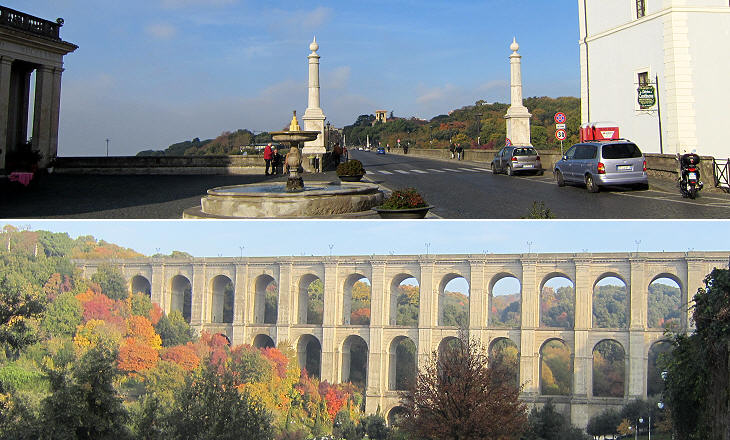
Ponte di Ariccia seen from Piazza di Corte (above) and from the valley below Ariccia (below)
Ponte di Ariccia was rebuilt after having been damaged during WWII. In 1997 nets were placed at the sides of the bridge to deter people from attempting suicide.
Galoro is a monastery belonging to Florentines of the order of Vallombrosa (a branch of the Benedictine order), who always choose romantic situations, and have here established themselves on a most delightful spot. The church is neat, has an elegant cupola, and makes a picturesque object for Laricia and the neighbourhood, but the paintings in it have no particular merit. The house is large and commodious, with gardens, orchards, and vineyards. Knight
Bernini was asked by the Chigi to
redesign a sanctuary (S. Maria di Galloro) outside Ariccia on the road to Genzano which housed a miraculous image of Mary. The sanctuary and the adjoining monastery were closed during the French annexation of the Papal State; in 1817 the monastery was assigned to the Jesuits who held there sessions of Spiritual Exercises, sets of meditations and prayers until 2016, when the building was assigned to a local charity.
Visit Palazzo Chigi of Ariccia.
Next step in your tour of the Environs of Rome: Nemi
Excerpts from Giuseppe Vasi 1761 Itinerary related to Ariccia:
Giuseppe Vasi
|