
All images © by Roberto Piperno, owner of the domain. Write to romapip@quipo.it.


Notes:
Page revised in September 2024.
All images © by Roberto Piperno, owner of the domain. Write to romapip@quipo.it.
Notes:
Page revised in September 2024.
 Lanuvio (Civita Lavinia)
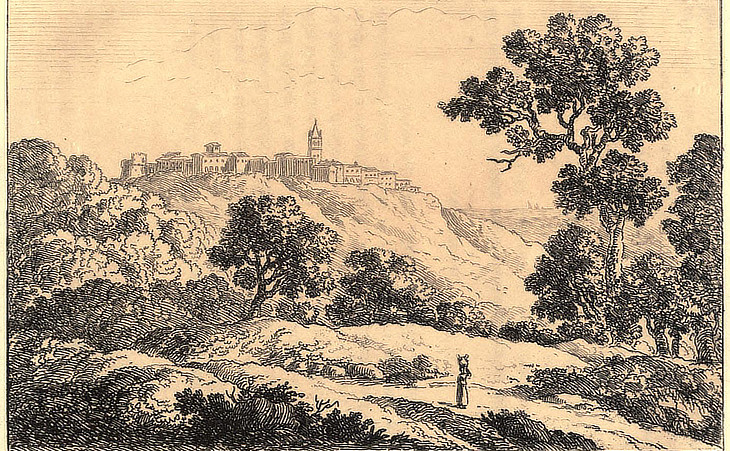
Civita Lavinia from "Ellis Cornelia Knight - Description of Latium: or, La Campagna di Roma - 1805"
Civita Lavinia.
A small town five miles distant from Albano, passing through Laricia and Gensano. Antiquaries differ considerably in their suppositions with respect to its ancient name; but there appears little doubt of its being called Lanuvium in the time of the Roman Republic, Aeneas is said to have built a city which he named Lavinium, in compliment to his wife Lavinia, not far removed from Laurentum, which belonged to her father, King Latinus. It is highly probable that these three cities became one; and it is certain that inscriptions have been found at Civita Lavinia, with the words: S. P. Q. Lanuvensis.
Ellis Cornelia Knight - Description of Latium: or, La Campagna di Roma - 1805
Lanuvio was called Civita Lavinia until 1914 because according to a medieval tale it was the ancient Lavinium, the town founded by Aeneas, a Trojan prince, in honour of Lavinia, daughter of Latinus, king of the Latins, the ancient Italic tribe associated with the foundation of Rome.
At Vasi's time this account was already dismissed as false and the town was identified with ancient Lanuvium, whereas Lavinium was thought to have stood at Castello di Pratica near the coast.

Views of Lanuvio from south-east (above) and north-west (below)
The view of the town is very similar to that depicted by Knight, but many of the houses, walls and towers were rebuilt after they were bombed in 1944 during the battle which followed the Allied landing at Anzio. Because of its location on a hill accessible only from one side Lanuvium enjoyed that security which in antiquity was of paramount importance in the development of settlements.
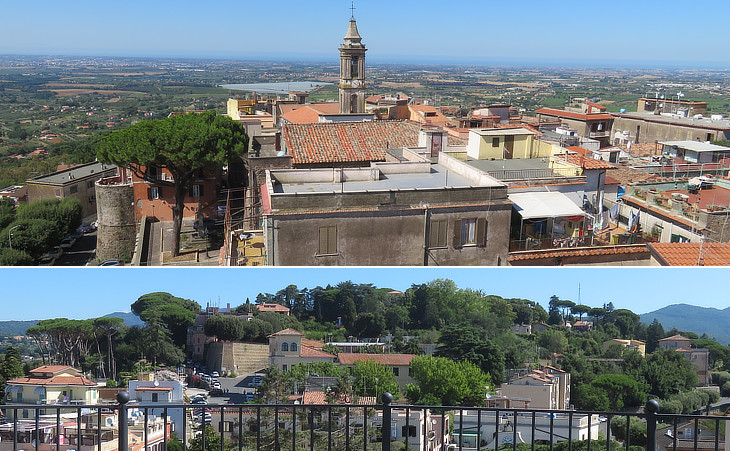
Views from the round medieval tower at the entrance to Lanuvium: (above) the town and the plain towards the Tyrrhenian Sea; (below) Colle San Lorenzo, the site of the shrine to Juno Sospita
Lanuvium; Now Civita Lavinia.
A town of 799 inhabitants, beautifully placed on a
projecting hill attached to the western point of the
Alban Mountain. Lanuvium was one of the confederate cities which sent deputies to the Mons Albanus. The town occupies a very small space, on a ridge; with a steep and almost
precipitous descent on the north and south, and a rapid
declivity on the west, running down to the plain. At
the western extremity is a building of larger blocks,
high and of antique appearance. This may be the cell of the temple of Juno, and has much of the appearance
of the temple of that goddess at Gabii. Many courses of blocks yet remain, and the stone alone is sufficient
to impart an air of antiquity not possessed by buildings of imperial times. The situation of the platform on which it stands, is commanding with regard to three of its sides: on the fourth is the town.
Sir William Gell - The topography of Rome and its vicinity - 1834
The site of the shrine has been identified outside the medieval town; it consisted of a series of terraces on the slope of a hill leading to a cave preceded by a portico, so its overall appearance resembled the sanctuary of Fortuna Primigenia at Palestrina. According to Pliny the Elder in the Ist century AD it was in a state of abandonment, although an inscription indicates it was restored by Emperor Hadrian.

Ancient walls of Lanuvium from "Sir William Gell - The topography of Rome and its vicinity - 1834" (see them below in this page)
The walls of Lanuvium are of irregular blocks of peperino, or of one of the softer volcanic stones. They have great solidity of appearance, though the larger blocks scarcely exceed six feet in length, by three feet four inches in height. They also bear marks of high antiquity; though, from the nature of the stone, this perhaps would have been the case, even had they been less ancient. A specimen is given, from the portion below the temple, and close to the road down to the plain. Gell

View of the (now demolished) gate of the town from "Augustus J. C. Hare - Days Near Rome - 1875" (with a depiction of Mount Circeo which does not correspond to reality)
We took a little carriage in the piazza of Genzano in which we rattled merrily down the hill-side for about two miles to Civita Lavinia occupying the site of the ancient Lanuvium, and remarkable as the birth-place of the Emperors Antoninus Pius and Commodus, of T. Annius Milo the enemy of Clodius, of Roscius the comedian, and of L. Murena who was defended by Cicero. (..) Lanuvium was celebrated for the worship of Juno Sospita, and when it took part with the other Latin cities against Rome and was defeated, its inhabitants were not only unpunished, but admitted to the rights of Roman citizens, on condition that the temple of their goddess should be common to the Romans also. Civita Lavinia is approached by a terrace commanding a grand view across the Pontine Marshes to the Circean mount. It stands on the edge of the promontory and is surrounded by dark walls of peperino, in many places apparently of great antiquity. Curious old mediaeval houses are everywhere built upon the walls, and are highly picturesque, and near the gateway is a very fine machicolated tower.
Augustus J. C. Hare - Days Near Rome - 1875
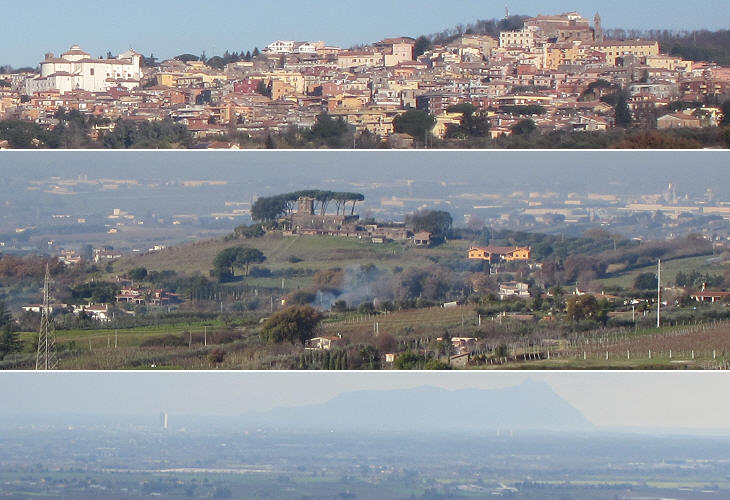
Views (in descending order): 1) towards Genzano (the large white church on the left is SS. Trinità while S. Maria della
Cima and Palazzo Sforza Cesarini are at the top of the town); 2) towards Montegiove, a medieval tower on the site of ancient Corioli;
3) towards the former Pontine Marshes with Mt. Circeo in the background; see also the view towards Velletri and Mount Artemisio
To one of the turrets is affixed a ring of iron, which the inhabitants affirm to be the same to which Aeneas fastened his vessel at his arrival in Italy, but the sea must have retreated nine miles to give any probability to this fable. A little beyond this tower is one of the most extensive views in this country: we distinguished from it sixty miles of sea, the Pontine marshes, mount Circello, and numberless towns in the Campagna: from another spot is a pleasing view of Velletri, and mount Artemisio. Knight
Standing out from the main line of hills, below Genzano are two projecting spurs. The higher is Monte Due Torri once crowned by two towers, of which only one is now standing, the other lying in ruins beside it. The lower, covered with vineyards and fruit gardens, and only marked at the summit by a low tower and some farm buildings, is now called Monte Giove, but is almost universally allowed to have been the famous "Corioli", the great Volscian city, which gave the title of Coriolanus to its captor, C. Marcius, and which was once at the head of a confederation almost too strong for Rome.
Hare
Similar to nearby Corioli, Lanuvium was inhabited by the Latins, whose main town was Alba Longa. After the Romans seized and destroyed Alba Longa, the remaining Latin towns joined in a league and sought the help of the Volscans who controlled a vast territory spreading from Velletri to Terracina. The Romans continued their expansionistic policy and in the Vth century BC Corioli was conquered and destroyed by Gaius Marcius,
a Roman commander who for this achievement was named Coriolanus. Later events of his life inspired Shakespeare's tragedy by the same name.
Unlike Corioli, Lanuvium was not destroyed by the Romans and it became a prosperous, albeit small, town.

Museo Nazionale Romano: armour and helmet of a warrior (Vth century BC thus contemporary to the Roman conquest of Corioli) found near Lanuvio
Lanuvium condidit Diomedes ex Ilio advectus, ut scribit Appianus in secundo Bellorum Civilium.
Martino Filetico, a XVth century humanist, reported that Lanuvio was founded by Diomedes, king of Argos after he returned from the War of Troy. Filetico found this information in a book written by Appian of Alexandria, a IInd century AD historian. In 1934 the discovery near Lanuvio of what appeared to be a roughly cut sarcophagus led to finding the elaborate equipment of an important man who was at the same time a warrior
and an athlete, as he was buried with his armour and helmet and with his exercising equipment (a discus, a strigil for scraping sweat, a pouch containing sand to dry the hands).
The anatomical rendering of the breastplate indicates a Greek influence as well as the elaborate parade helmet of
bronze, silver, gold and glass paste (the eyes are outlined in silver, the irises picked out in gold).
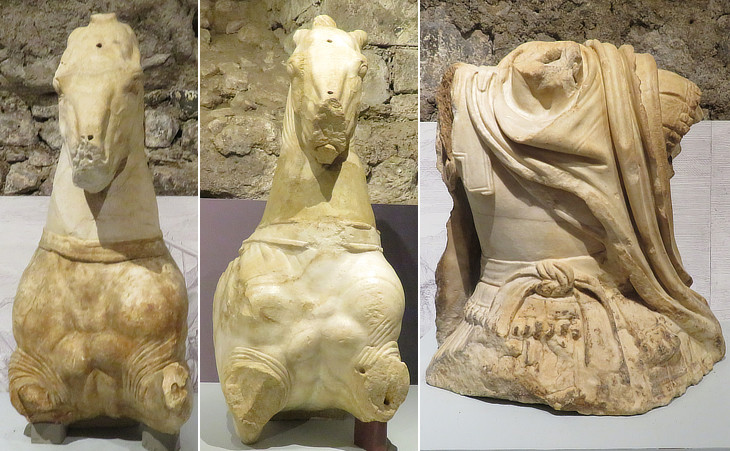
Museum of Lanuvio - Cellars of Palazzo Colonna (from the Leeds City Museum): statues (Parian marble - Ist century BC) of horses and soldiers which were discovered by Lord Savile Lumley, British Ambassador to Italy, in the area of the Sanctuary of Juno Sospita (Colle San Lorenzo) between 1884 and 1892
Its modern appellation, Civita Lavinia, so strongly resembling the ancient name of the neighbouring Pratica, (Lavinium,) was for some time the source of much difficulty to antiquaries; but two inscriptions show, that Lanuvium was once called Lanivium, whence the corruption easily follows. (..) Much of Aelian's account of Lavinium can apply only to Lanuvium. Aelian, for instance, says, that "at Lavinium was an extensive and shady grove, and near it the temple of the Argive Juno; and in the grove was a large and deep cave, the den of a dragon." it is plain, this must relate to Lanuvium, where, says Livy, were the temple and grove of Juno Sospita, common to the inhabitants and to the Romans. (..) Livy mentions the Juno of Lanuvium more than once. Lib. xxi. 62, he says, "among other prodigies, it was affirmed that the spear of Lanuvian Juno vibrated spontaneously, and that a raven flew into the temple;" and again: (ibid.,) "forty pounds of gold were sent to Lanuvium, as an offering to the goddess." Gell
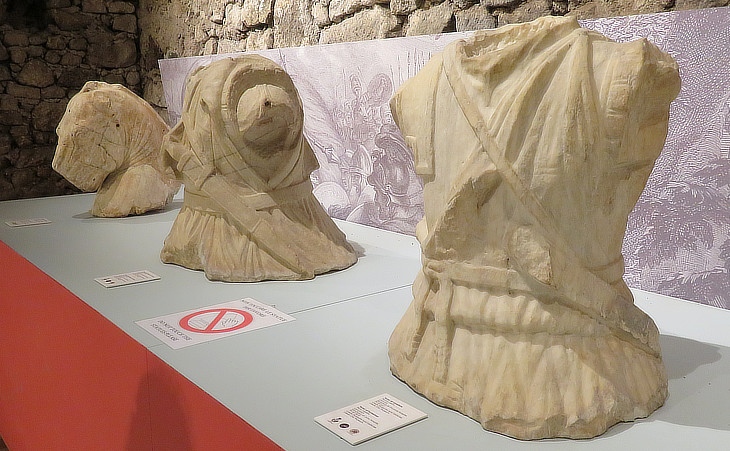
Museum of Lanuvio - Cellars of Palazzo Colonna: other statues of horses and soldiers which were discovered by Lord Savile Lumley; in 1896 he donated and split his collection between Leeds Philosophical and Literary Society (as Leeds Museum was known then) and the British Museum. In 1941 locations around Leeds were bombed. The bombing caused much damage and destruction to the museum's collections including the statues from Lanuvium. The soldiers are not Roman legionaries, but rather Macedonians and the overall group of statues is thought to represent a battle between Alexander the Great and the Persians
In another place, Livy says, (xxiii. 31,) "the statues at Lanuvium in the temple of Juno Sospita, shed blood, and a shower of stones fell round the temple;" and in lib. xxiv. 10: "the crows built nests in the temple of Juno Sospita at Lanuvium." These various quotations, leave us without a doubt as to the existence of a temple of Juno at Lanuvium. Cicero also, in Orat. pro Mur. ad fin., speaks of the sacrifices made by the consuls to Juno Sospita, in connexion with the "municipium honestissimum " of Lanuvium. Gell
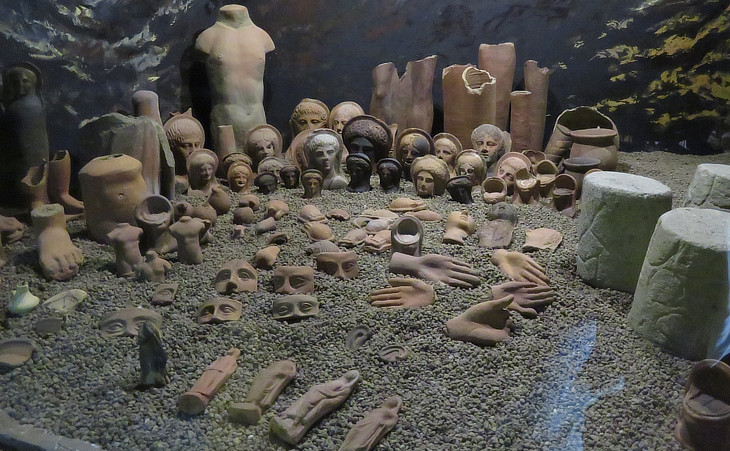
Museum of Lanuvio - Hall of the Stipe (Trove) di Pantanacci: terracotta ex-votos which were discovered in 2012 by Italian authorities in a cave between Lanuvio and Genzano; they were most likely related to the sanctuary of Juno Sospita; three white stones which are decorated with scales were perhaps part of a statue of the snake or dragon which guarded the cave of the sanctuary
The shape and nature of the ex-votos bear witness to numberless cases of recovery performed by Juno, including some related to the tongue. Similar deposits have been discovered in Rome and its environs, e.g. at Lucus Feroniae and at Ponte di Nona. The cave where the offerings were found was the gathering point of spring waters which were thought to be beneficial in curing illnesses and wounds.
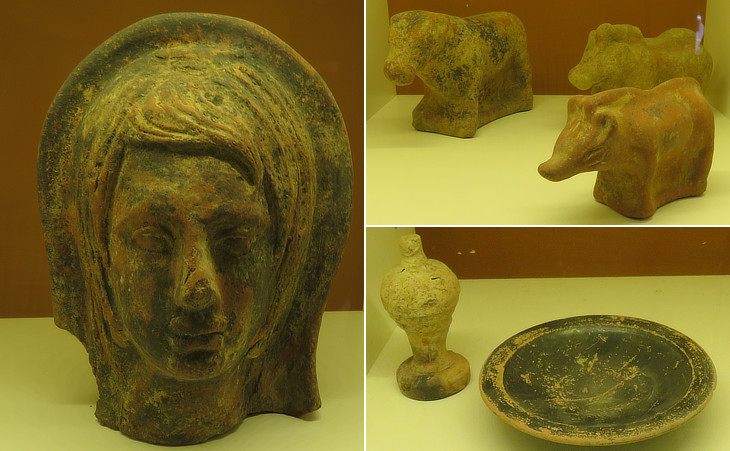
Museum of Lanuvio - Hall of the Stipe di Pantanacci: other terracotta ex-votos (see a votive piglet at Ariccia)
Lanuvium, from of old, is guarded by an ancient serpent: the hour you spend on such a marvellous visit won't be wasted; where the sacred way drops down through a dark abyss, where the hungry snake's tribute penetrates (virgin, be wary of all such paths!), when he demands the annual offering of food, and twines, hissing, from the centre of the earth. Girls grow pale, sent down to such rites as these, when their hand is rashly entrusted to the serpent's mouth. He seizes the tit-bits the virgins offer: the basket itself trembles in their hands. If they've remained chaste they return to their parents' arms, and the farmers shout: 'It will be a fertile year.'
Propertius: The Elegies - Book IV: 8 - Translated by A. S. Kline
The economy of Lanuvium was based on the sanctuary dedicated to Juno Sospita (she who favours); the goddess was worshipped also in Rome in one of the three temples which make up S. Niccolò in Carcere. The origin of the sanctuary was linked to ceremonies aimed at favouring good harvests. A sacred snake was housed in a cave and during a ceremony it was offered flat bread by virgins. When the offer was refused the event was seen as a bad omen and the virgin was sacrificed to appease the goddess.
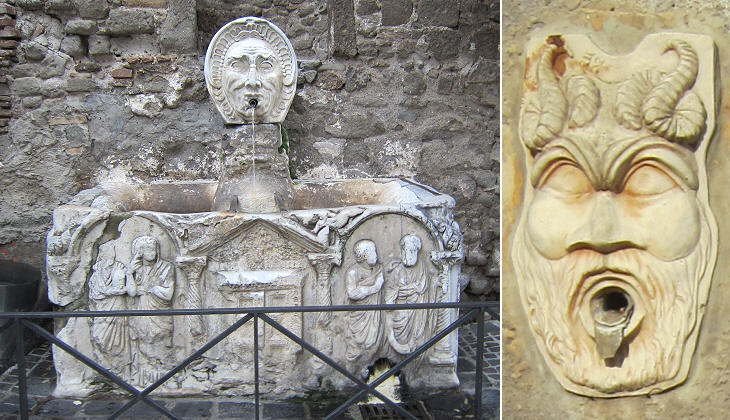
(left) Fountain made up of an ancient sarcophagus and a theatrical mask; (right) another theatrical mask
The town is very interesting; every thing bearing marks of remote antiquity. Many beautiful fragments of ornamental sculpture in stone, and marble, lie scattered about in the streets; and in most of the walls are stuck pieces of cornices or columns. Knight
In the little piazza is a magnificent sarcophagus, now used as a fountain. Hare
The sarcophagus was donated to the town in 1675 by Duke Filippo Cesarini, who had found it in one of his properties along Via Appia. It is dated IIIrd century AD and it depicts two couples at the sides of the Gate of Hades (see a finer example at Musei Vaticani).
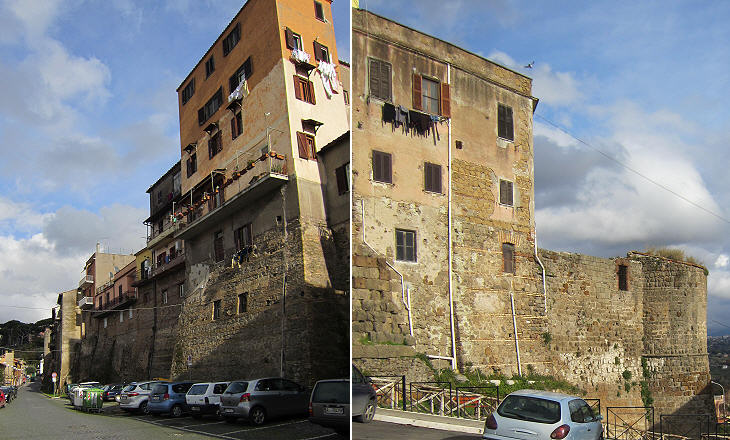
Walls of Lanuvio
The Romans built walls on the slopes of the hill to obtain large terraces; these walls were utilized during the Middle Ages to protect the town, which, because of its proximity to the sea, was subject to Saracen raids.
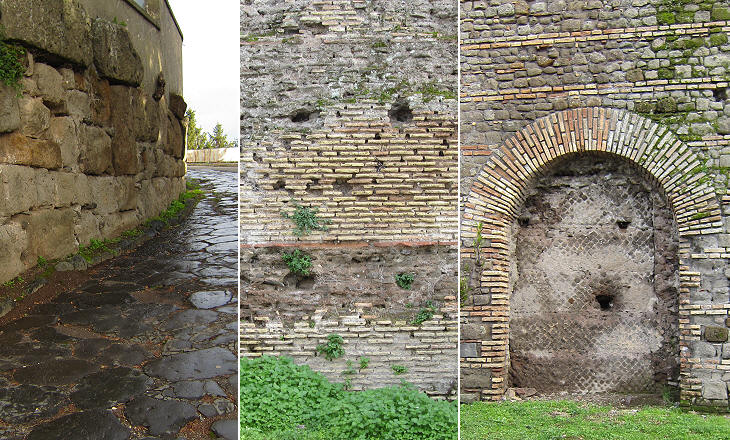
Roman construction techniques: (left) a wall made up of large peperino blocks and a section of a
Roman road; (centre) "opus latericium";
(right) "opus reticulatum"
There are interesting remains of a wall which certainly was built in the first ages of Rome. It is composed of large square stones, and over it are vestiges of another wall also of a very ancient date, though not equal to the former; it is of that sort of construction which is called opus reticulatum, from its resemblance to the meshes of a net. On the first, remains part of a buttress which proves its having had ornaments. Another portion of the building appears to be of the lower ages. Knight
A walk around the medieval town and to nearby S. Maria delle Grazie allows the observation of parts of ancient Roman buildings
(niches, platforms, arches) which were incorporated into the walls in addition to other walls which indicate that Lanuvium
was larger than the medieval town.
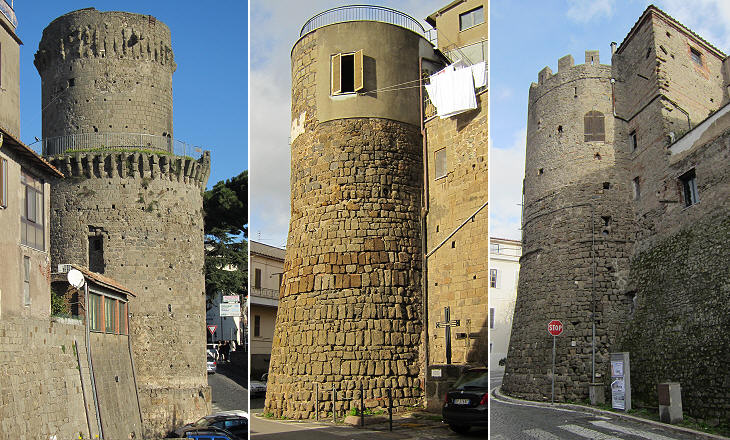
Towers of Lanuvio: that on the left (which protects the entrance to the town) was strengthened by
Cardinal Guillaume D'Estouteville in the second half of the XVth century when he resided in Velletri
The town is a small fortification with turrets at the corners. A tower, exposed to the south-east, is in ruins on that side, and entire towards the north-west : the reason assigned for it, is the noxious effect of the scirocco winds to which it is exposed, and of the exhalations from the Pontine marshes in its vicinity. Knight
During the XVth century the history of Lanuvio became strictly linked with that of Genzano because the two towns
were a possession of the Colonna, however also the titular cardinals of Velletri wanted to have influence over Lanuvio;
the diocese of Velletri was united to that of Ostia and the cardinal-bishop
of Ostia/Velletri was the Dean of the Sacred College of Cardinals, the second highest office in the Roman Catholic hierarchy.
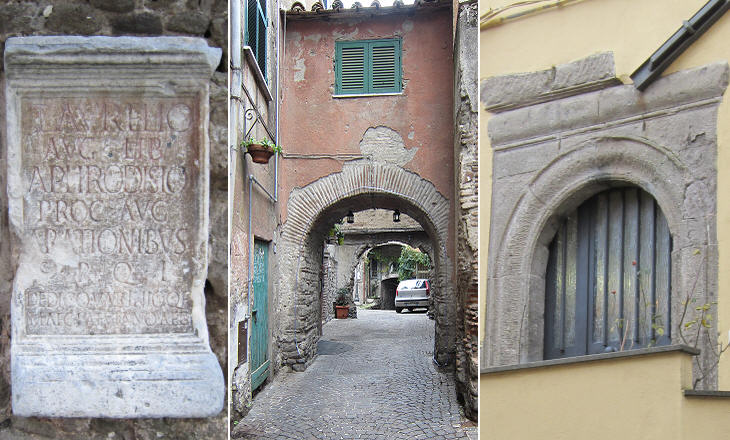
In the streets of Lanuvio: (left) honorary inscription to T(itus) Aurelius Aphrodisius, a libertus (freedman) of Emperor Antoninus Pius who was the officer "a rationibus", i.e. the secretary of finance in the Roman Empire in charge of the imperial treasury;
(centre) medieval arches; (right) Renaissance window
The town, being constructed of old and dark coloured blocks of peperino, has a singular air of antiquity; and its gloomy and narrow streets give to it the appearance of a town in the middle ages. It is indeed probable that the houses are very old: and the square blocks of which they are built, seem to have been taken from the temple and its precincts. Gell
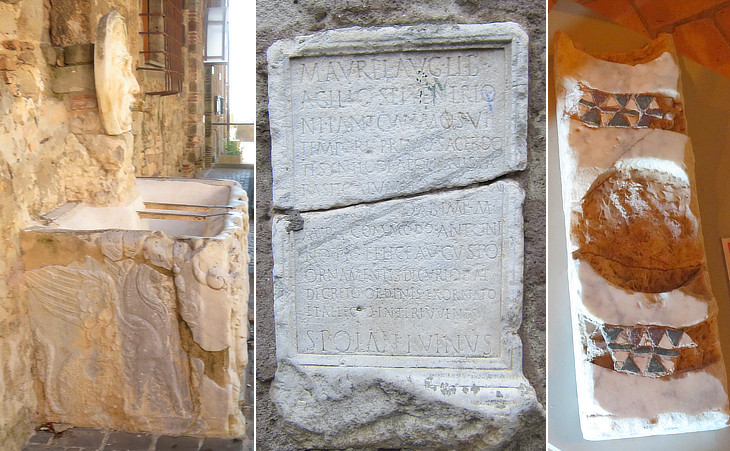
(left) Side of sarcophagus showing a mythical beast; it is dated IInd century AD and it is similar to a relief in a sarcophagus at San Saba; (centre) honorary inscription to Agilius Septentrio, an imperial freedman and a famous pantomime (late IInd century AD); (right) Museum of Lanuvio: fragments of the lost Cosmati decoration of Collegiata di S. Maria Maggiore
The area inside the walls is very tiny, yet it retains memories of the long history of the town, including a small ancient relief showing a triton which can be seen in the image used as background for this page.
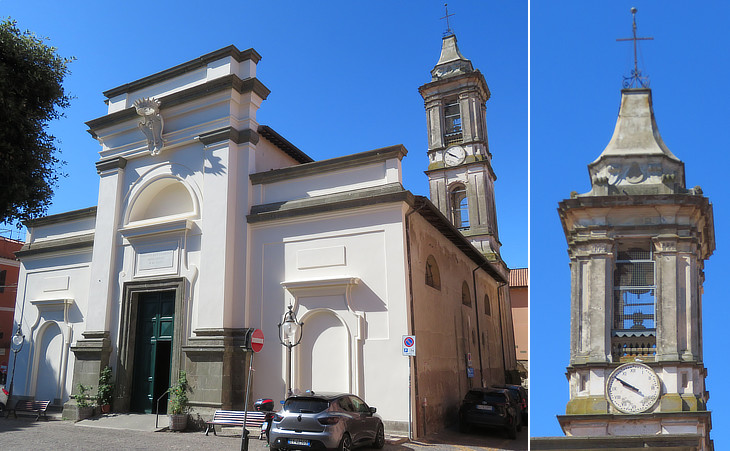
(left) Collegiata di S. Maria Maggiore; (right) bell tower
The church is neither beautiful nor interesting; there is a crucifix with the three Maries, said to be by Raphael, and covered with a glass. The steeple is by Borromini, and has a very modern appearance amongst so many ancient fabrics. The canons have 300 crowns a-year, a salary superior to any other in this part of the country, on account of the air, which is very unwholesome in autumn. Knight
Similar to Genzano, Lanuvio was sold by the Colonna in 1563 and in the following year it was acquired by Giuliano Cesarini, a relative of the Colonna as he married Giulia Colonna, daughter of Prosperetto.
The Cesarini set their residence at Genzano and did not care much about a small Colonna palace at Lanuvio, but they rebuilt Collegiata di S. Maria Maggiore, the only church inside the walls; the façade was redesigned in 1675 and the bell tower was built in 1680 (and repaired in 1714 after it was damaged by lightning).
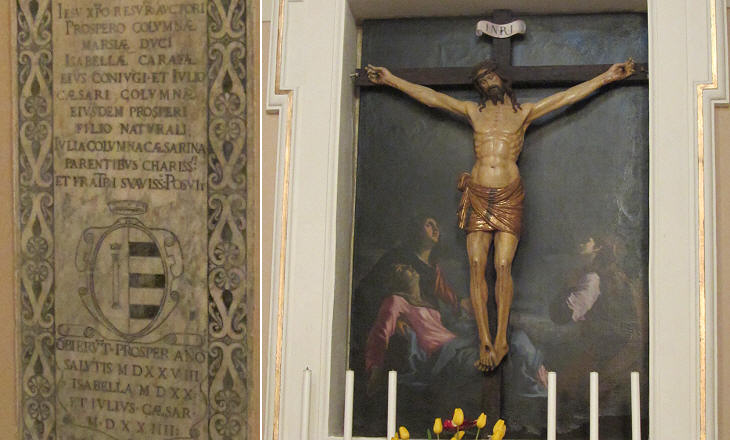
Collegiata di S. Maria Maggiore - interior: (left) funerary inscription celebrating Prosperetto Colonna and Isabella Carafa; (right)
Crucifixion by Giovanni Battista Gaulli known as il Baciccio
The Colonna, in addition to their many fiefdoms in the Papal State, had many possessions in the Kingdom of Naples.
The Carafa were an important Neapolitan family and they became known in Rome when Oliviero Carafa was appointed cardinal in 1467. A sort of family alliance was signed (prior to 1520) when Prosperetto Colonna married Isabella Carafa. In 1556 the rivalry between the two families was the cause of Guerra di Campagna, a war between Pope Paul IV (a Carafa) and King Philip of Spain who supported the Colonna.
Giulia Colonna, daughter of Prosperetto and Isabella, greatly suffered because of the conflict between the families of her deceased parents and she wanted to celebrate them and the lost harmony between Colonna and Carafa by placing a funerary inscription with the coats of arms of the two families.
In 1675, when Collegiata di S. Maria Maggiore was being redesigned, Giovanni Battista Gaulli was working at the ceiling of il Gesù, his masterpiece, but he accepted a minor commission by the Cesarini and he painted the wall of a chapel behind a wooden crucifix. He portrayed Mary and two other women as if the crucifix was part of the painting. The combination of different art forms and materials in the decoration of chapels was typical of that period (see other examples at Acquapendente and Civita Castellana).
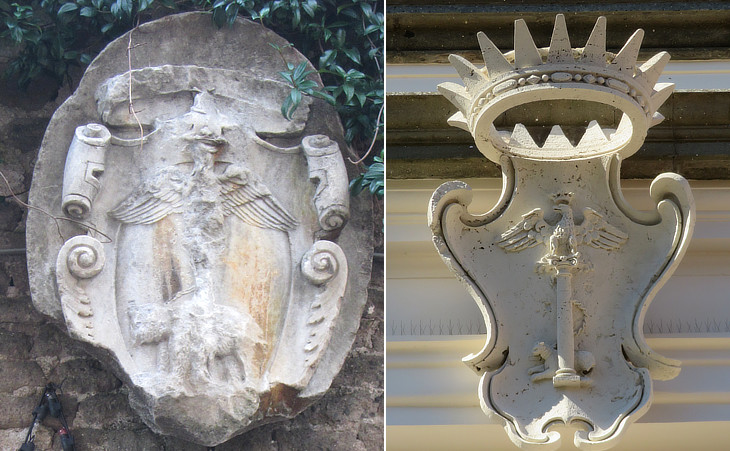
Coats of arms of the Cesarini at the entrance to the town (left) and on the façade of Collegiata di S. Maria Maggiore (right)
The coat of arms of the Cesarini caused some criticism because of its components, which seemed to be "borrowed" from those of more important families. According to a popular saying: "After they have given back the eagle to the emperor, the column to the Colonna and the bear to the Orsini, the Cesarini are left with just the chain (of the bear)."
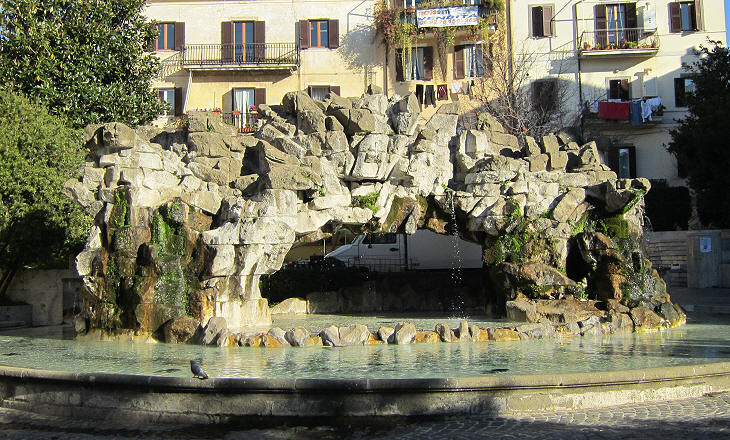
Fountain by Carlo Fontana
The Cesarini found great difficulties in building an aqueduct at Genzano, because that town is on the ridge of a volcanic crater and it was difficult to find a source of water which was located on higher ground. Lanuvio is situated at a lower level than Genzano and the Cesarini reactivated a Roman aqueduct which carried water to a large fountain outside the entrance to the town. It was designed by Carlo Fontana, a scholar of Bernini, who was inspired by his master's Fontana dei Quattro Fiumi. The fountain was completed by the statues of two snakes and it was meant to represent the cave of Juno's shrine.
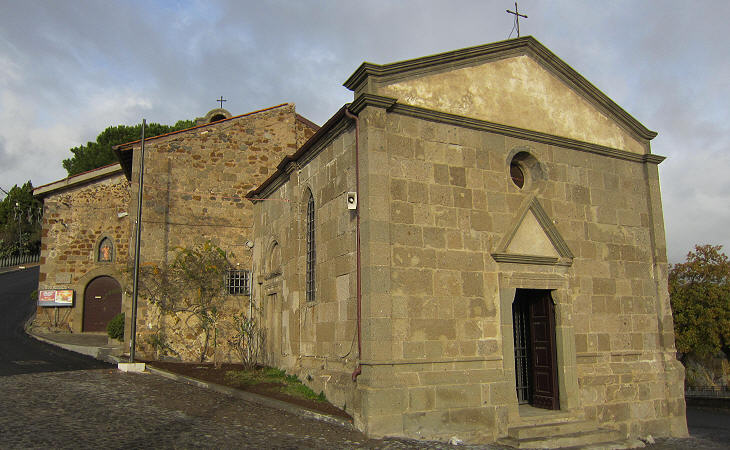
S. Maria delle Grazie
This small church half a mile from Lanuvio was built to house a miraculous image; its exact date of foundation is unknown. Its current aspect is mainly the result of a restoration/enlargement of 1523 which gave the interior a typically Florentine Renaissance appearance, because of the contrast between white walls and the black stone utilized to emphasize architectural elements.
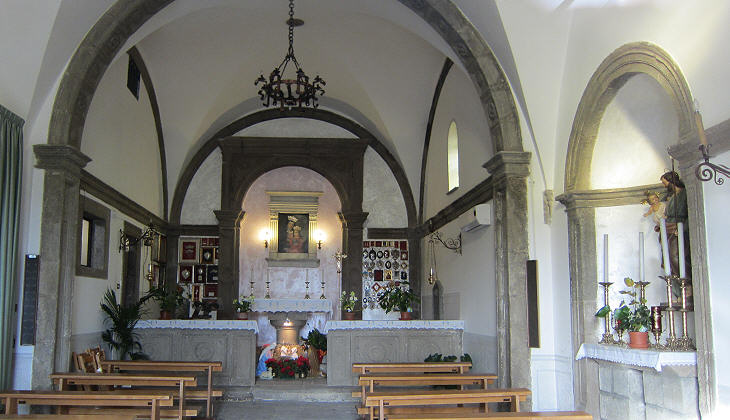
Interior of S. Maria delle Grazie
Next step in your tour of the Environs of Rome: Other Castelli Romani
Excerpts from Giuseppe Vasi 1761 Itinerary related to Lanuvio:
Giuseppe Vasi
|


