
All images © by Roberto Piperno, owner of the domain. Write to romapip@quipo.it.


Notes:
Page revised in April 2024.
All images © by Roberto Piperno, owner of the domain. Write to romapip@quipo.it.
Notes:
Page revised in April 2024.
 - Medieval Rome
In this page:
Rome between Longobards and Franks
The Holy Roman Empire: a Short Renaissance
A New Threat: the Saracens
Saeculum Ferri (Iron Century)
The Ottonian Emperors
Iconography
In 711 the Arabs (or the Moors, as they were usually called) invaded the Christian Visigoth Kingdom of Spain
and in just eight years they conquered almost all the Iberian peninsula with the exception of some northern mountainous regions.
In 721 they crossed the Pyrenees Mountains and moved into southern France: in 732 they planned an overall invasion of France,
but at the battle of Tours (also known as the battle of Poitiers) they were defeated by Charles, a duke of the Franks, a Germanic tribe who ruled
over northern France, Belgium, Holland and parts of Germany.
Because of his victory, which stopped the Muslim expansion in Europe, Charles became known as Charles Martel (the Hammer)
and he gained unconditional authority over the Franks, although he was not their king.
In 736-37 he launched a series of successful campaigns against the Arab strongholds in southern France (e.g. Arles)
with the help of Liutprand, King of the Longobards: in this way the Franks entered the Italian political scene; the popes saw them as defenders
of Christendom and as defenders of the Roman Church from the Longobard and Byzantine interferences.
Charles Martel had never cared about becoming king, even when the throne had remained vacant for several years, but his son Pepin the Younger (aka
Pepin the Short) who had inherited from his father the actual rule over the Frankish kingdoms decided to assume the title of king.
He applied to Pope Zacharias to get papal endorsement of his appointment and based on this he was crowned in 752. It was not such a
remarkable event for the history of France, but it was a very significant development in
the history of the Roman Church: the Pope and not the (Eastern Roman) Emperor was asked to assign a royal title.
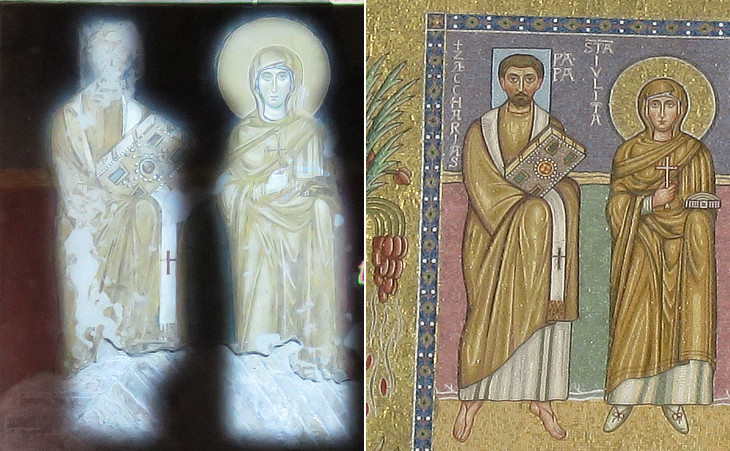
(left) S. Maria Antiqua - Cappella di Teodoto: part of a fresco portraying Pope Zacharias holding the Gospel next to St. Judith (ca 750); (right) S. Maria Liberatrice: modern mosaic showing the same subject; the head of the Pope is placed inside a "nimbus", a blue square, to indicate he was living at the time of the painting. The chapel was made at the initiative of a Byzantine officer; the portrait of the Pope is an indication of his prestige
The links between the Franks and the popes became even stronger when Pepin declared war against the Longobards
who had threatened the papal possessions around Rome: Pepin forced the Longobards to return to the Pope, rather than to the Byzantine emperor, the city of Ravenna and the nearby region which they had occupied a few years earlier. It was another step in recognizing the Pope as the ultimate
authority of the Christian world, a role insofar attributed to the Byzantine emperor.
In 768 King Desiderius, who was born at Brescia, one of the main Longobard duchies, tried to contain the Franks' growing threat by marrying his daughter Desiderata to Charlemagne, Pepin's son, but Charlemagne did not hesitate to repudiate his wife and to
invade Italy in 773 to help Pope Adrian I. By 776 Charlemagne conquered northern Italy and was crowned King of the Longobards.
| E quando il dente longobardo morse la Santa Chiesa, sotto le sue ali Carlo Magno, vincendo, la soccorse. (Dante, Paradiso, Canto VI vv. 94-96) |
And when the tooth of Lombardy had bitten The Holy Church, then underneath its wings Did Charlemagne victorious succor her. Translation by Henry Wadsworth Longfellow |
Many locations in Italy claim of retaining evidence of Charlemagne's passage, e.g. Sutri, or even of that of Roland, one of his twelve paladins, e.g. Rome.

Portico of S. Pietro: epitaph dedicated by Charlemagne to Pope Adrian I
Charlemagne and Pope Adrian I developed such
a close relationship that at the Pope's death in 795 Charlemagne himself dictated an epitaph: the text was
most likely edited by his adviser Flaccus Alcuinus (Alcuin of York) or by Theodulf, bishop of Orleans.
The epitaph was carefully engraved on black stone of Tournai in imitation of some ancient inscriptions and it was placed in S. Pietro. When the old basilica was replaced by the new one, the inscription was relocated to the portico built by Carlo Maderno for Pope Paul V.
Unfortunately it was positioned at a such high level that few notice it and it is very difficult to read it.
Charlemagne regarded the Pope as a father and wrote the epitaph with tears in his eyes PATREM LACRIM(I)N(I)S KARLUS HAEC CARMINA SCRIBSI.
Pope Adrian owned Domus culta Capracorum, a large estate along Via Cassia, near today's Campagnano.
Pope Leo III, the successor of Adrian I, was deposed in 799 by relatives of the dead pope. He was confined to a monastery, but he managed to escape and he eventually reached Charlemagne in Germany to seek his help. Charlemagne escorted the Pope back to Rome in November 800 and he eventually convinced the Romans to accept again Leo as their bishop. At the Christmas Mass held in S. Pietro Leo crowned Charlemagne and gave him the title of Imperator Romanorum. Whether Charlemagne knew beforehand and had agreed to being appointed emperor is uncertain, whether the Pope meant to establish a new Roman empire (the Holy Roman Empire) is uncertain too.
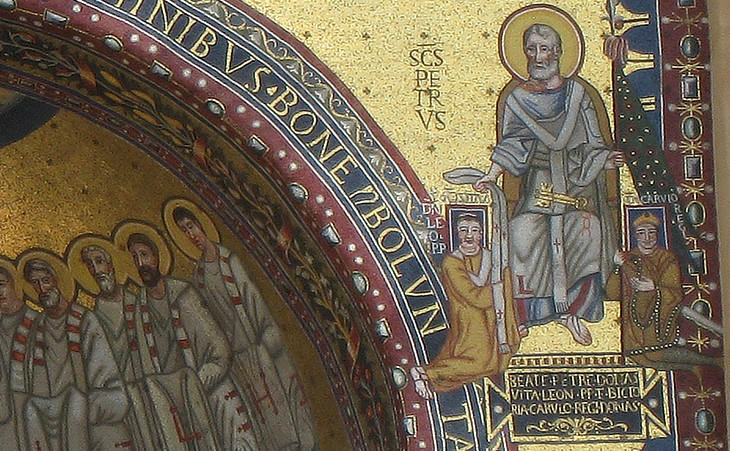
Tribune of Triclinio Leoniano: XVIIIth century mosaic based on those of the banqueting hall of Pope Leo III; the inscription says: "Beate Petre donas vita(m) Leon(i) p(a)p(ae) e(t) bictoria(m) Carulo regi donas". It represents the partition of the religious and the secular power between Pope Leo III and Charlemagne
Most likely Pope Leo saw in Charlemagne the new emperor of the only empire he knew, that of Constantinople:
in his mind the throne was vacant. Irene, widow of Emperor Leo IV, had ruled for years on behalf of her child Constantine VI, but had been ousted from power
by her son when he was appointed emperor in 790 at the age of 19. Irene however plotted against her own son and
in 797 Constantine was taken prisoner, his eyes were gouged out and he was left to die from his wounds. Irene, who had no other sons,
reigned on her own, but the Pope regarded her as an usurper (read more about her life).
Charlemagne did not make any actual attempt to claim the throne of Constantinople (apart from a probable attempt to marry Irene) and he eventually
reached an agreement with Irene's successor on using a slightly different title which avoided frictions between the two powers.
While the immediate effects of Charlemagne's coronation were limited, their
long-ranging impact was a major one for the history of Rome,
which returned after centuries to have a political role, through the acts of its bishop, whose appointment was no longer subject
to the endorsement of the Byzantine emperor. Pope Leo III in order to substantiate the new
role of the pope through an appropriate lifestyle improved his Lateran residence by building
two banqueting halls one of which was embellished
with mosaics portraying Charlemagne and the Pope.
Charlemagne was regarded by the Roman Church and by posterity as a new Constantine and his statue faces
that of the ancient emperor in the portico of S. Pietro. You may wish to see the Palatine Chapel which Charlemagne built at Aachen and its treasury.

S. Prassede - Cappella di S. Zenone: mosaic portraying (left to right) Teodora (Pope Paschal's mother),
St. Prassede, the Virgin Mary and St. Pudenziana (see a page on the mosaics in the churches of Rome)
Under the protective umbrella of Charlemagne and for a few years after his death in 814, Rome enjoyed a period of peace and of economic development. Pope Paschal I (817-24) decorated with mosaics S. Cecilia, S. Maria in Domnica and S. Prassede. In this church the Pope built a chapel (dedicated to a rather obscure martyr) where he buried his mother. The whole chapel is decorated with mosaics based on an extremely vivid contrast of colours (the image used as background for this page shows another detail of them).

Musei Vaticani: detail of Pope Paschal's wrought silver box containing a cross (the inscription: "Paschalis episcopus plebi Dei fieri iussit" means that it was made by order of Paschal); it shows (left) Jesus between the Virgin Mary and St. Peter and (right) Jesus, the Virgin Mary, St. Peter and the other Apostles in a vineyard
In 732 Charles Martel had stopped the Muslim expansion in continental Europe,
but not that in the Mediterranean Sea where the Arabs occupied Crete in 826 and
then began the conquest of Sicily. It took them eighty years to complete
it because Taormina, the last Byzantine stronghold, fell into their hands only in 902,
but before achieving their final goal they started to raid
the coasts of southern Italy. They were called Saracens, a word most likely meaning easterners,
a reference to their point of origin.
Because of this threat in 842 Pope Gregory IV built a fortified village near Ostia, pompously called Gregoriopolis. In 846 the Saracens landed at the mouth of the Tiber and they did not bother about Gregoriopolis, but they moved
towards Rome; they were not numerous enough to be able to seize Rome, but they sacked S. Pietro and the adjoining neighbourhood,
which were not protected by the city walls.

A section of Passetto near Castel Sant'Angelo showing the structure of the walls built by Pope Leo IV
The whole authority of the Pope rested on him being the successor of St. Peter and
Pope Leo IV who became pope in 847 swiftly acted so that the tomb of the first bishop of Rome could not be violated a second time.
Between 847 and 853 walls (Leonine Wall) were erected to protect the basilica and the
various hospices for the pilgrims which existed next to it, e.g. Schola Saxonum. It was the first urban development Rome
saw after many centuries: it showed that the pope started to take initiatives which were typical of a sovereign.
Pope John VIII (872-882) turned
the area around S. Paolo fuori le mura, which also was sacked by the Saracens, into a fortified burg (Giovannipoli).

Museo dell'Alto Medioevo: floor mosaic of a hall which belonged to the Bishops of S. Rufina (aka Selva Candida) in the western suburbs of Rome beyond Casino Sacchetti; it was found in the 1960s
In ca. 900 the Saracens destroyed a medieval settlement which records indicate was a bishopric see named after Saint Rufina, a IIIrd century martyr. Pope Sergius III (904-911) was unable to save it from total ruin. In the early XIIth century the diocese of S. Rufina was formally merged with that of Porto.
The popes for centuries were appointed with the formal endorsement of the Byzantine emperors: Pope Leo III had interrupted that practice which was replaced by a less formal agreement expressed by Charlemagne and his successors. The popes of the first half of the IXth century relied very much on the support of the heirs of Charlemagne. The continuous dynastic quarrels however weakened the power of the various Carolingian kings among whom the possessions of Charlemagne had been split. Towards the end of the IXth century and for a long period afterwards the election of the pope was heavily influenced by Roman families, who did not hesitate to commit all sorts of crimes to ensure their candidate was appointed. This period is called Saeculum Ferri or Obscurum to mean a regression towards a very primitive state.

Detail of Ovid's Iron Age of Man, a fresco by Pietro da Cortona in Palazzo Pitti in Florence; "Truth, modesty, and shame the world forsook; Fraud, avarice, and force, their places took." Metamorphoses - Book I - Translation by Samuel Garth and John Dryden
In this context two episodes stand out: the legendary appointment of a woman (Pope Joan)
and the trial of Pope Formosus (891-96), whose corpse was exhumed by his successor, charged with heresy, sentenced to death, mutilated and finally thrown in the Tiber.
Pope John X (914-28) managed to contain the requests of the Roman families and at the same time to
form a coalition with the towns of Gaeta, Capua, Naples and Amalfi to eradicate the Saracens from their permanent settlement
near Minturno. In 915 he personally took part in the battle which put an end
to the threat of a Saracen invasion. In 928 the Pope was deposed, jailed in Veroli and eventually killed at the instigation of Marozia, daughter of the Count of Tuscolo, a town near Frascati,
who in 931 managed the election of her own son to the pontificate. For the next twenty years the popes
were puppets in the hands of Marozia and after her death of her other son Albericus, who obtained the
title of Princeps Romanorum. He was so powerful that in 954, feeling he was about to die, he forced
the Roman clergy to promise that the new pope would be his son Octavian (Pope John XII).

View of the Aventine hill between (left) S. Alessio and (right) S. Maria del Priorato from S. Pietro in Montorio; this easily defensible section of the hill belonged to Marozia and Albericus was born there
The lack of a strong administration of the city of Rome started a process which in the course of the following centuries led to a partition of the city itself among the most powerful families.
Pope John XII was only 18 at the time of his election and his behaviour was far from meeting the minimal
moral requirements of his office, to the point that his opponents called him the new
Caligula. In an attempt to expand the Papal State John stirred a
conflict with the feudal lords of northern Italy and sought the help of Otto, Duke of the Saxons and King of the Germans.
In 962 Otto came to Rome and was crowned by Pope John XII
emperor of the Holy Roman Empire of the German Nations, a title which lasted until 1806 (see my pages on Vienna, the city of the last Roman emperors).
The new emperor signed a document (Privilegium Ottonianum) in which he guaranteed
the independence of the Papal State. Relations between the Pope and the Emperor soon deteriorated and in a
matter of months Otto returned to Rome and convened a synod of bishops that deposed John who fled to Corsica from where
he managed to incite a revolt against the new pope. John returned to Rome where he died three months later: according to tradition he was thrown out of the window
by a jealous husband who had discovered him in bed with his wife.
Otto had no difficulties in imposing the appointment of popes whom he liked; he
was granted Ius exclusivae, the power of vetoing a candidate from being elected pope, a privilege which he transmitted to his successors, who made use of it until 1903.
His son Otto II, who had married a Byzantine princess,
maintained a strong control over the actions of the popes, but he died in 983 at the age of 28,
leaving a heir (Otto III), just three years old.
In 997 the Crescenzi, an important Roman family, profited of the vacuum of power which followed the death of Otto II and
rebelled against Pope Gregory V, cousin of the emperor and first German pope. Gregory fled to his cousin who in 998 marched with an army towards Rome.
The Crescenzi tried to resist in Castel Sant'Angelo, but in vain; eventually their leader was beheaded and their faction (temporarily) crushed.
Otto set his residence in Rome and
probably under the influence of his mother, he adopted elaborate Byzantine court ceremonies. At the death of his cousin he engineered the election of one of his advisers who became Pope Sylvester II, a
choice of name which established a link with Pope Sylvester I who allegedly had received from Constantine the donation of the city of Rome. Otto saw himself as a new Constantine and he donated the town of Fano to the Pope.

S. Gregorio Magno al Celio: fresco (attributed to Pomarancio) portraying St. Romuald, a Benedictine monk prescribing a
penitence to Otto III: to walk barefooted to a sanctuary on Mount Gargano in southern Italy
Otto III and Sylvester II lived in the very last years of the first millennium: the year 1000 was thought to be the end of the world and many tried to purge themselves of their sins. The young emperor who had imposed or tolerated blinding, mutilation and other extreme and cruel punishments sought the advice of leading religious figures. He made several pilgrimages, he favoured the construction of Abbazia di Grottaferrata and he built S. Bartolomeo all'Isola.
The following links show works of art portraying characters and events
mentioned in this page; they open in another window:
The Coronation of Charlemagne by Raphael (1517) at Palazzo Apostolico.
The Trial of Pope Formosus by Jean Paul Laurens (1870).
The Coronation of Otto III Xth century miniature.
Otto III and St. Nilus a fresco by Domenichino at Grottaferrata.
Next page: Part II: Medieval Rome
III - The Investiture Controversy
Previous pages: Part I: Ancient Rome:
I - The Foundation and the Early Days of Rome
II - The Early Republican Period
III - The Romans Meet the Elephants
IV - Expansion in the Eastern Mediterranean Sea
V - Pompey and Caesar
VI - Augustus
VII - From Tiberius to Nero
VIII - The Flavian Dynasty
IX - From Nerva to Marcus Aurelius
X - A Century of Turmoil (180-285)
XI - From Diocletian to Constantine
XII - The End of Ancient Rome
Part II: Medieval Rome:
I - Byzantine Rome


