
All images © by Roberto Piperno, owner of the domain. Write to romapip@quipo.it.


Notes:
Page revised in May 2025.
All images © by Roberto Piperno, owner of the domain. Write to romapip@quipo.it.
Notes:
Page revised in May 2025.
 SS. Pietro e Marcellino
Links to this page can be found in Book 3, Map A3, Day 1, View C9, Rione Campitelli and Rione Monti.
The page covers:
The plate by Giuseppe Vasi
Today's view
SS. Pietro e Marcellino
SS. Quattro Coronati
- Oratorio di S. Silvestro
Sacello della Madonna
Tempio di Iside e Serapide

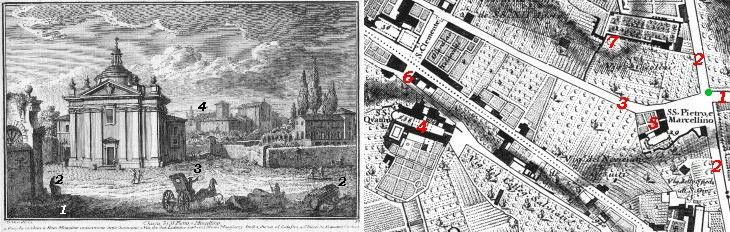
Giuseppe Vasi dedicated his 1753 book of etchings showing the seven basilicas and other ancient churches of Rome to Pope Benedict XIV, the reigning pope. This may explain why he included a view of SS. Pietro e Marcellino in the book. It was a very minor ancient church, but one which the Pope had completely rebuilt in 1751.
SS. Pietro e Marcellino was located at the intersection of two important streets, but it was surrounded by villas (e.g. Villa Giustiniani Massimo, of which Vasi shows a portal opposite SS. Pietro e Marcellino) and farmed areas so that the view has a landscape atmosphere rather than an urban one. In the background Vasi showed SS. Quattro Coronati, a church which retained its medieval appearance.
The view is taken from the green dot in the small 1748 map below.
In the description below the plate Vasi made reference to: 1) Street leading to Porta Maggiore;
2) Street leading from S.
Giovanni in Laterano to S.
Maria Maggiore (i.e. Via Merulana, aka Via Tabernola);
3) Street leading to Colosseo;
4) SS. Quattro Coronati. The small map shows also 5) SS. Pietro e Marcellino (before it was redesigned); 6) Sacello della Madonna; 7) site of Tempio di Iside. The dotted line delineates the border between Rione Campitelli (left) and Rione Monti (right).
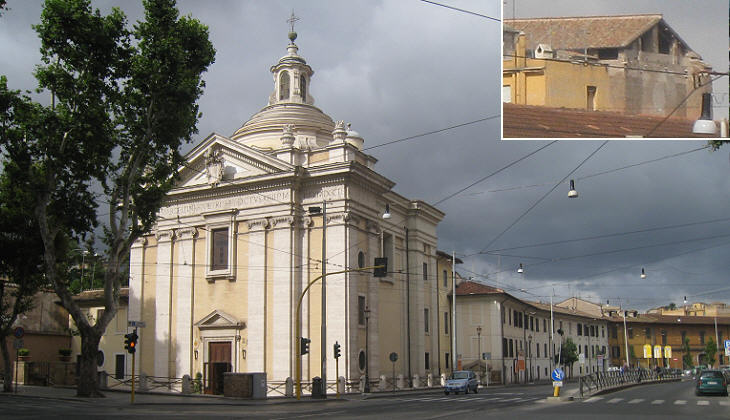
The view in June 2010 (in the inset the roof of SS. Quattro Coronati)
Today the crossroads between the street leading to Colosseo and Via Merulana is very busy (the photo was taken on an early Sunday morning). When Vasi drew his etching the nunnery behind the church was yet to be built; it now obstructs (together with later construction) the view of SS. Quattro Coronati, of which only a roof can be seen, but a view similar to that of the plate can be seen from the parallel street which marks the border between the two rioni.
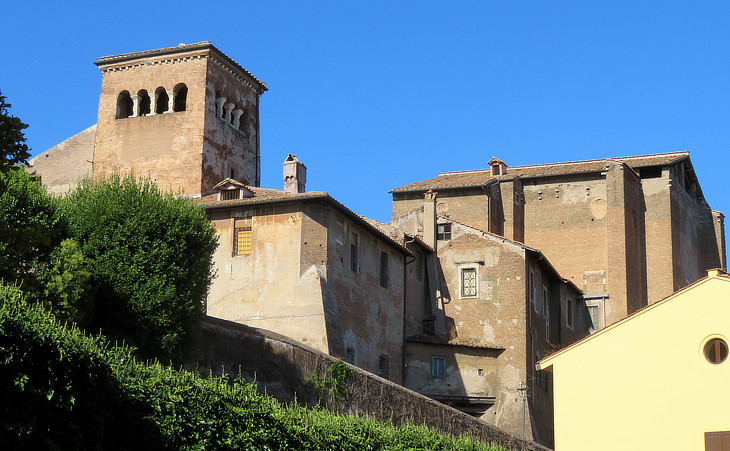
The view of SS. Quattro Coronati from Via di S. Giovanni in Laterano in August 2021
The small map shows that the section of Via Merulana leading to S. Giovanni in Laterano was very steep; in order to adapt it to modern traffic requirements the level of the ground near the church was raised so that today SS. Pietro e Marcellino is in a sort of a hole. Via Merulana was enlarged and S. Matteo, a small church which Vasi showed in his 1781 Map of Rome, was pulled down.
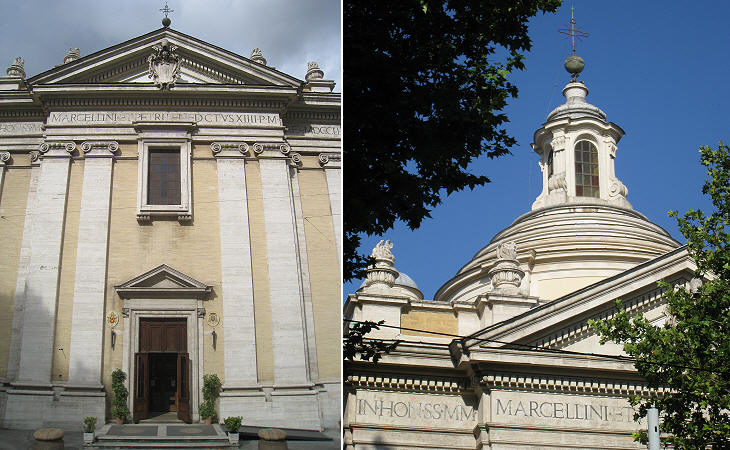
(left) Façade; (right) dome
SS. Pietro e Marcellino was designed by Girolamo Theodoli, a nobleman and architect. He was Marquis of S. Vito and Earl of Ciciliano. The new church is indicative of the transition from Baroque to Neoclassical architecture.
The neat design of the façade without the curved lines which were still in fashion at the time (e.g. in the new façade of S. Croce in Gerusalemme), must have pleased Pope Benedict XIV. The Pope disliked some restorations of ancient churches, including the new loggia of S. Maria Maggiore, because of their excessive decoration.
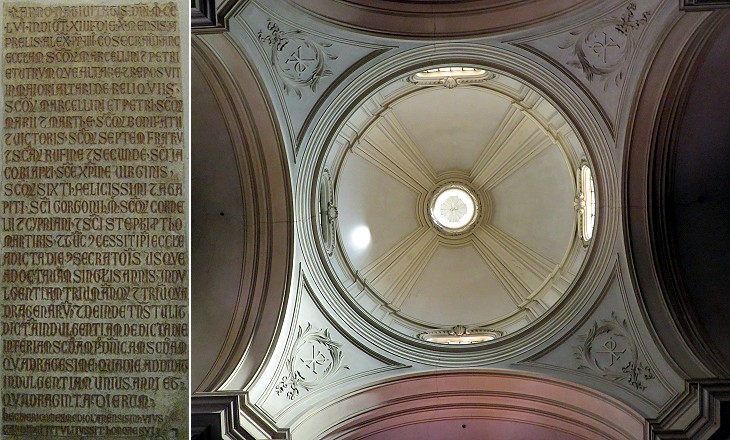
(left) 1256 inscription celebrating the restoration of the church and the relocation of the saints' relics; (right) interior of the dome
Sts. Peter and Marcellinus were two martyrs of the early IVth century; a church was dedicated to them on the site where they were buried, three miles from Porta Maggiore; according to an inscription dictated by Pope Alexander IV in 1256 their bodies were relocated to their church inside Rome.
You may wish to see SS. Pietro e Marcellino as it appeared in a 1588 Guide to Rome. A 1674 rather detailed guide to the churches of Rome by Filippo Titi mentions the church, but without any references to works of art it contained or its architecture. Apart from the 1256 inscription the interior is entirely new.
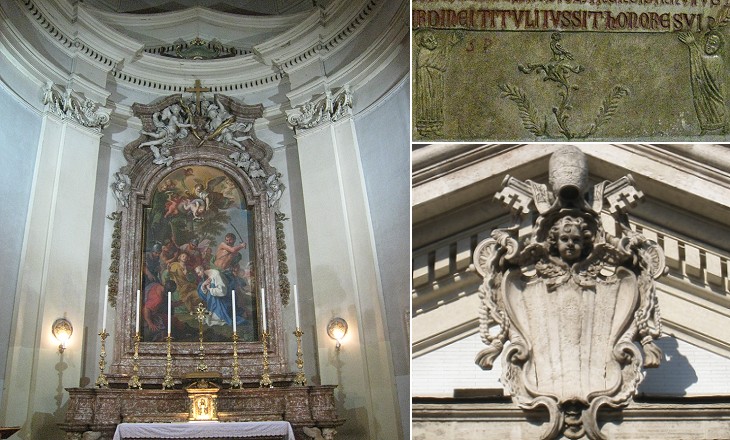
(left) Main altar with a painting by Gaetano Lapis depicting the beheading of the two martyrs; (right-above) 1256 relief showing the two saints and a phoenix, symbol of Resurrection, above a branch of tree; (right-below) coat of arms of Pope Benedict XIV (shown because of the angel's kiss curl)
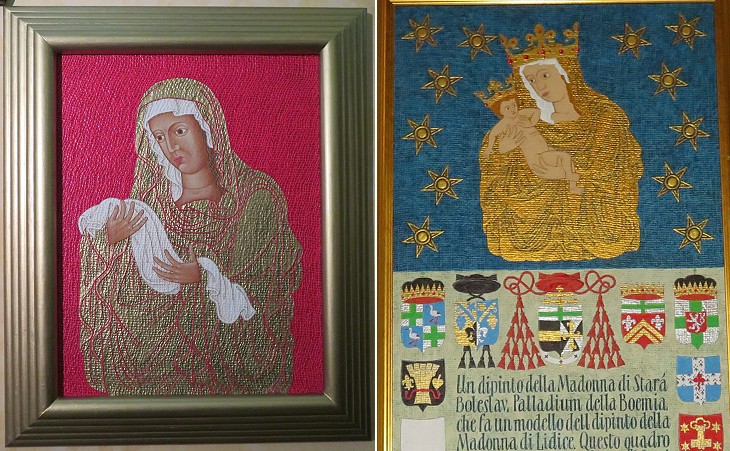
Two very recent additions to the works of art of the church: paintings by Zdirad Cech
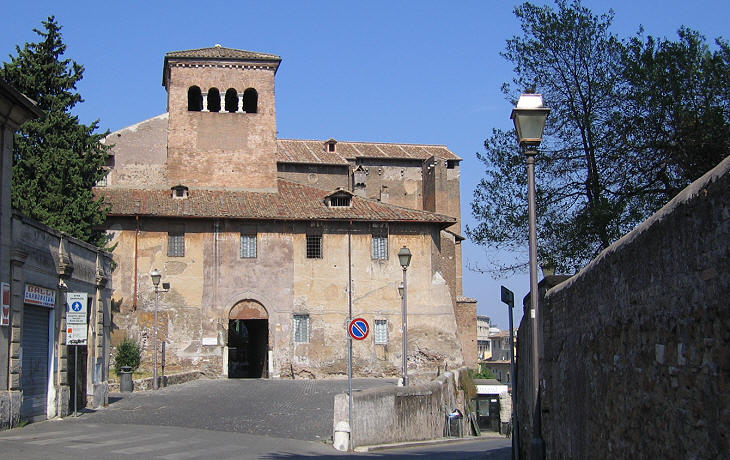
Via dei SS. Quattro Coronati (the street to the right leads to Colosseo which is partly visible)
Following the lane of S. Stefano Rotondo - skirted by broken fragments of Nero's aqueduct - almost to its debouchment near St. J. Lateran, and then turning to the left, we reach the quaint fortress like church and convent of the Santi Quattro Incoronati crowned by a stumpy campanile of 1112. The full title of this church is "I Santi quattro Pittori Incoronati e i cinque Scultori Martiri," the names which the Church attributes to the painters being Severus, Severianus, Carpoforus, and Vittorinus; and those of the sculptors Claudius, Nicostratus, Sinforianus, Castorius, and Simplicius, - who all suffered for refusing to carve and paint idols for Diocletian.
Augustus J. C. Hare - Walks in Rome - 1873
While SS. Pietro e Marcellino is today immersed in the noise and pollution caused by cars and buses, at a few hundred yards from this church, SS. Quattro Coronati still lives in its medieval past. Similar to S. Saba and other medieval churches it is protected by walls and its bell tower (the first of Rome) clearly had a defensive purpose.
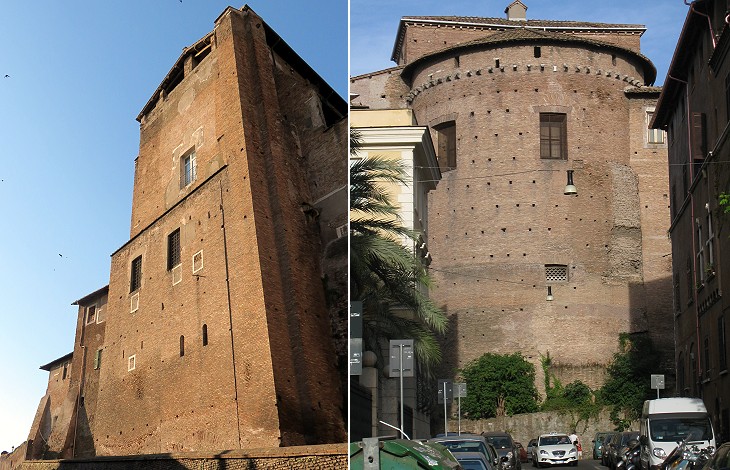
(left) Medieval walls supporting the monastery; (right) apse
Because two sides of the complex are built on the edge of a hillock, the northern wall and the apse are supported by impressive substructures; in particular the wall of the apse retains masonry elements which indicate that the church was built upon a Late Roman basilica which probably belonged to a private house.
A reference to Titulus Sanctorum Quattuor Coronatorum has been found in the records of a 595 synod. In the IXth century Pope Leo IV largely restored the early church; according to art historians the complex was then composed of a large basilica preceded by an atrium, the entrance to which was protected by a tower.
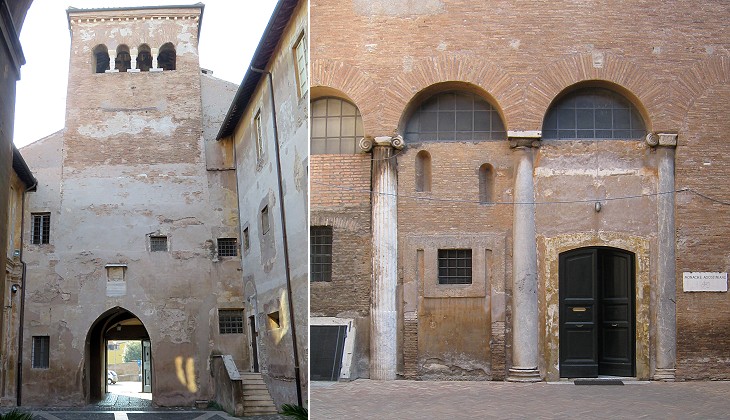
(left) Tower of the outer courtyard and the exit to Rome; (right) inner courtyard: columns which separated the nave from the right aisle
and which were included into the wall of a Benedictine monastery, today an Augustinian nunnery
This church was rebuilt by Leo IV. a.d. 850; and again rebuilt in its present form by Paschal II., who consecrated it afresh in a.d. 1116. It is approached through a double court, in which are many ancient columns, - perhaps remains of a temple. Some antiquaries suppose that the church itself was once of larger size, and that the pillars which now form its atrium were once included in the nave. Hare
In 1084 Robert Guiscard sacked Rome and set fire to SS. Quattro Coronati; Pope Paschal II re-consecrated the church in 1116 (he restored also S. Lorenzo in Lucina and S. Bartolomeo all'Isola), but its size was reduced to the final part of the nave and the apse; the initial part of the nave was not rebuilt and it became the current inner courtyard of the complex; the aisles of the original basilica were included into a Benedictine monastery. The reconstruction of SS. Quattro Coronati was completed in the early XIIIth century by a fine cloister.
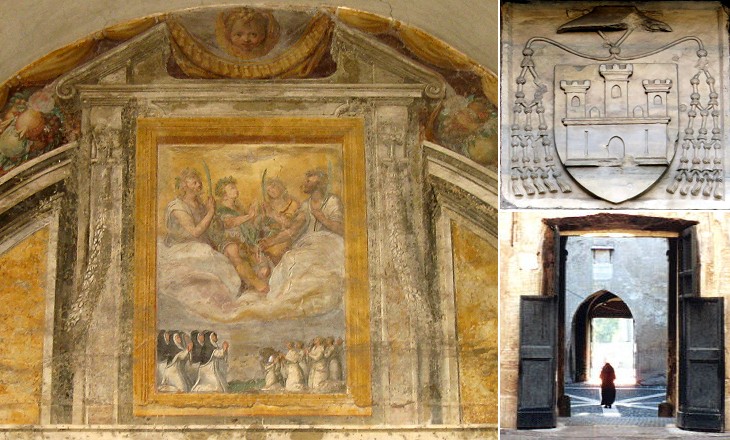
(left) Fresco above the entrance to the church depicting Augustinian nuns and orphans praying to the Four Crowned Martyrs; (right-above) coat of arms on the tower; it belongs to Cardinal Alfonso Carrillo de Albornoz, nephew of Cardinal Gil de Albornoz, who promoted a restoration of the complex in the early XVth century; (right-below) a nun on her way to Rome (also in the image used as background for this page)
It was subsequently repaired by several Pontiffs , and also by Card. Carrillo , in the time of Martin V., as is recorded by an inscription in its inner vestibule.
Rev. Jeremiah Donovan - Rome Ancient and Modern - 1843
During the XIIIth and XIVth centuries the monastery was modified in order to house the residence of some powerful cardinals, including Cardinal Benedetto Caetani, who became Pope Boniface VIII in 1294.
In 1562 Pope Pius IV assigned the complex to Augustinian nuns, who still live there.
You may wish to see the church as it appeared in a 1588 Guide to Rome.
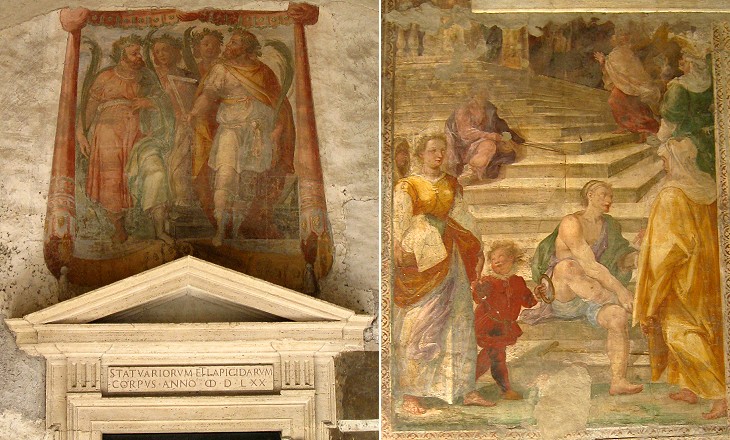
(left) Fresco depicting the Four Crowned Martyrs above the entrance to the office of the stonecutters' guild; (right) late XVIth century fresco in the outer courtyard depicting the Presentation to the Temple
According to the prevailing tradition the saints to whom the church was dedicated were four sculptors who refused to work on a statue of Asclepius, Greek god of medicine, and who for this reason were put to death by order of Emperor Diocletian; the reference to Coronati (Crowned) is probably due to the fact that they were portrayed wearing wreaths symbolizing their martyrdom (see a VIth century mosaic at Ravenna portraying a procession of martyrs). Because of the trade of the saints the guild of sculptors (statuariorum) and stonecutters (lapicidarum) bought an oratory of the monastery in 1570. Eventually sculptors joined Accademia di S. Luca, the guild of Roman artists, which at the beginning was reserved to painters only.
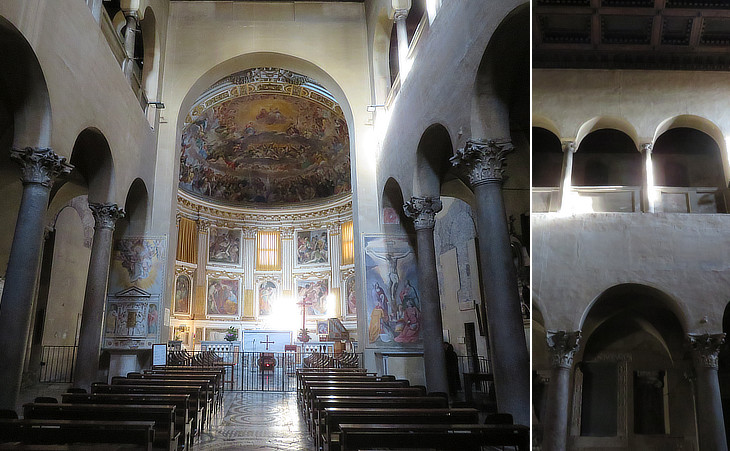
(left) Interior; (right) gallery
The church is divided into a nave and two small aisles by eight granite columns, over which rises a sort of superstructure, in the manner of the ancient basilics, adorned with eight similar but smaller columns. Donovan
The interior of the church retains the 1621-1627 decoration of the apse, but most of the other additions to the medieval church were removed in 1912-1916. Galleries reserved to women or catechumens can be seen also at S. Agnese and S. Lorenzo fuori le mura.
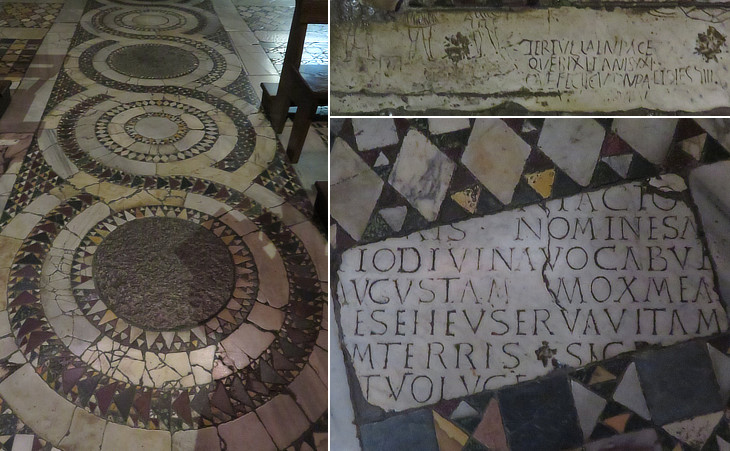
(left) Detail of the floor with "opus Alexandrinum" decoration (it will evolve into Cosmati work); (right) Christian tombstones: (above) Tertulla who lived 21 years and to the left fragment of a relief depicting the three youths in the furnace; (below) the epithaph is composed of elegiac couplets
The floor, which is much worn, had been a handsome specimen of of opus Alexandrinum. Donovan
"As they were digging near the Church of the holy four crown'd Martyrs, several Epitaphs were taken up; and I was told one of them was that of Pontius Pilate; and close by is a Vineyard full of broken Pieces of Figures, and square Stones to make Bases for Pillars. The Owner of the Ground digging, found several Lime Kilns, made in later Age. I fancy those Pieces of Stone had been laid there to make Lime. (Flaminius Vacca in 1594).
The Travels of the Learned Father Montfaucon from Paris thro' Italy - 1712 translation
See the similar floor of the Lower Church of S. Clemente.
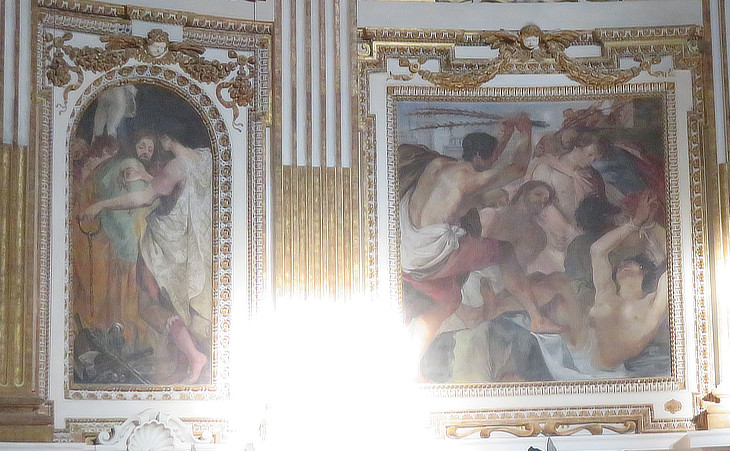
Apse: two paintings portraying the sculptors being led to their martyrdom and their fustigation
In the tribune the under range of paintings represents the conversion, martyrdom etc. of the five sculptors, Clandius, Nicostratus, Symphorianus, Castorius and Simplicius, whose relics are preserved in this church; the second range represents the sufferings and death of the four crowned martyrs. Donovan
In 1608 Giovanni Garzia Millini was created Cardinal-Priest of SS. Quattro Coronati and in 1610 Vicar for the Diocese of Rome, a very important position which made of him the closest advisor to Pope Paul V, exception made for Cardinal Scipione Borghese, nephew of the Pope. He promoted a thorough modernisation of the apse of the church. See his bust by Alessandro Algardi.
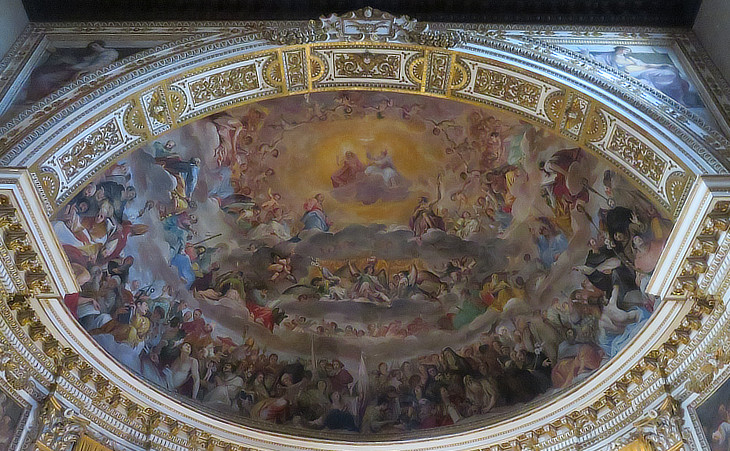
Ceiling of the apse with a fresco depicting saints and angels in Heaven by Giovanni di S. Giovanni aka Giovanni Mannozzi
Above the cornice is a glory, much admired for the excellence of the design and the freedom of the execution, all by Mannozzi called Giovanni da S. Giovanni. Donovan
Cardinal Millini employed for the design and decoration of the apse the same Florentine artist who decorated his family chapel at S. Maria del Popolo.
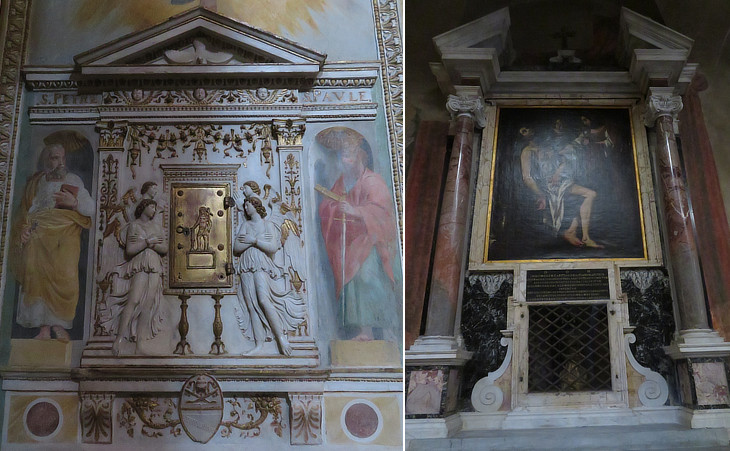
(left) Repository for the Holy Oil with the coat of arms of Pope Innocent VIII attributed to Andrea Bregno or Luigi Capponi; (right) Altarpiece portraying St. Sebastian being removed by the pious matron Lucina from the sewer where he had been thrown into; the reliquary containing the head of the martyr is behind the altar
Gilded repositories for the Holy Oil or small marble altars were very popular in the second half of the XVth century. See other examples at S. Maria in Trastevere, S. Gregorio al Celio and at Perugia.
Over the next altar, in the left aisle, is a S. Sebastian, by Baglioni: the head of the martyr is preserved over the altar, having been enclosed in a silver case by Gregory IV., and placed here by Leo IV. Donovan
According to tradition in 826 the relics of St. Sebastian in the Vatican were given to the Abbey of Saint-Médard de Soissons, at that time the greatest Benedictine monastery in France. The head however was placed in a silver case which was relocated to SS. Quattro Coronati. Eventually in 1218 other relics of the saint were moved to the basilica dedicated to him. The altar was erected in 1632 by Cardinal Girolamo Vidoni who replaced Cardinal Millini as Cardinal-Deacon of SS. Quattro Coronati.
Giovanni Baglione, nowadays chiefly known as the biographer of sixteenth and early seventeenth-century Roman artists (The Lives of Painters, Sculptors, Architects and Engravers - 1642), belongs essentially to the late academic
phase of Mannerism. An exact contemporary of Caravaggio's, he was the artist's bitter
enemy. However, for a brief moment of his career, and even earlier than the rank and
file of the Caravaggisti, he was overwhelmed by the impact, altough never fully understanding the implications, of the great master's work.
Rudolf Wittkower - Art and Architecture in Italy 1600-1750.
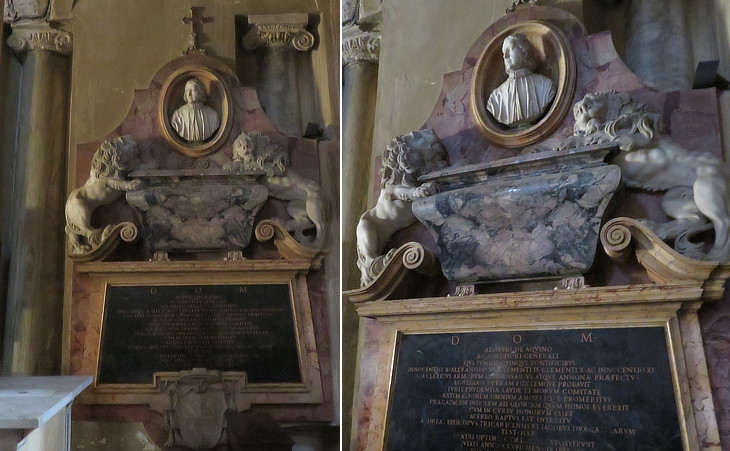
Monument to Luigi d'Amico
Next comes the handsome monument of Mons. Aloysio di Aquino, who died in 1679. Donovan
The monument was erected by his brothers Andrea who was Bishop of Tricarico and Giacomo who was Duke of Carsoli, both towns being in the Kingdom of Naples. He worked under five popes from Innocent X to Innocent XI and he held important positions in the government of the Papal State. The monument shows some characteristic features of Baroque monuments i.e. the use of coloured marbles, the head of the dead turned towards the altar, references to heraldic symbols (the lions), but there is no record of which sculptor designed it.
Turning to the tombs
of the higher and lower clergy, of aristocracy and bourgeoisie, we find that the variety
of types is immense. (..) The leading motif in tombs from about 1630 onwards is the figure of the deceased
represented in deep adoration, turned towards the altar. Wittkower
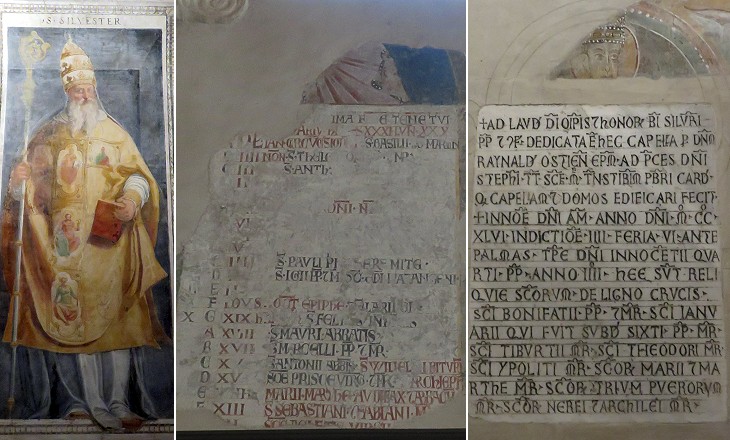
(left) Pope St. Sylvester I in a fresco attributed to Raffaellino da Reggio (after 1570); (centre) a XIIIth century calendar with names of saints in the antechamber of the oratory (see a similar ancient calendar at Veroli); (right) 1246 inscription celebrating the construction of the oratory and the relocation of relics to it
The annexed Camaldolese convent was converted by Pius IV., in 1560, into a female orphan-house, placed under the care of resident Augustinian Nuns. It is entered by a rude vestibule and two atria with porticos, in the inner one of which is a door to the right opening into a very ancient chapel dedicated to S. Sylvester, and now belonging to the Confraternity of Sculptors. Donovan
When the oratory was built relations between Pope Innocent IV and Emperor Frederick II were very tense and the frescoes which cover the walls of the building were meant to visually depict a cornerstone of the assumed supremacy of the Popes over the Emperors. The Donation of Constantine was eventually considered a forgery after Lorenzo Valla, a humanist, proved in 1440 that the Latin used in the document was inconsistent with that spoken in the IVth century.
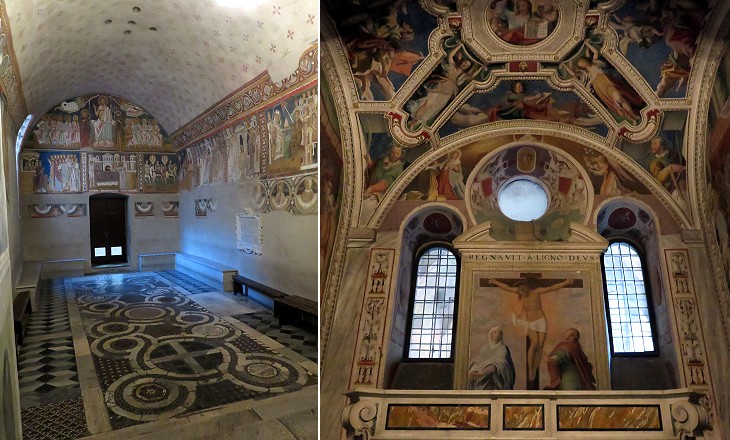
(left) View from the altar; (right) frescoes behind the altar attributed to Raffaellino da Reggio
This chapel is now only used for the devotions of a guild of marble-cutters, and open for mass on but one Sunday - the last - in every month. Hare
The stonecutters' guild made some changes to the final part of the oratory and placed some marble inscriptions along the walls, but overall they did not damage the XIIIth century aspect of the building. You may wish to see a directory of churches and chapels belonging to guilds.
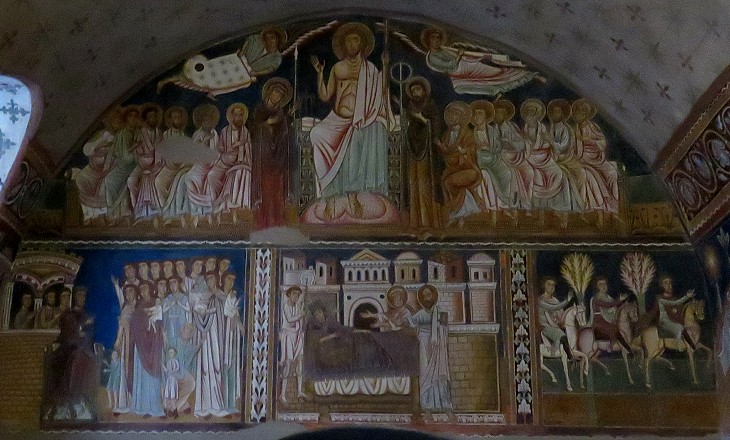
Frescoes on the rear façade
We see Constantine dismissing, consoled and laden with gifts, the mothers whose children were to be slaughtered to provide a bath of blood, the remedy prescribed - but which he humanely rejected- - for his leprosy, his punishment for persecuting the Church while he yet lingered in the darkness of paganism; we see the vision of St. Peter and St. Paul, who appear to him in his dreams, and prescribe the infallible cure for both physical and moral disease through the waters of baptism; we see the mounted emissaries, sent by the emperor to seek St. Sylvester. (..) The largest composition on these walls, which completes the series, represents the Saviour enthroned, amidst angels and apostles. Hare
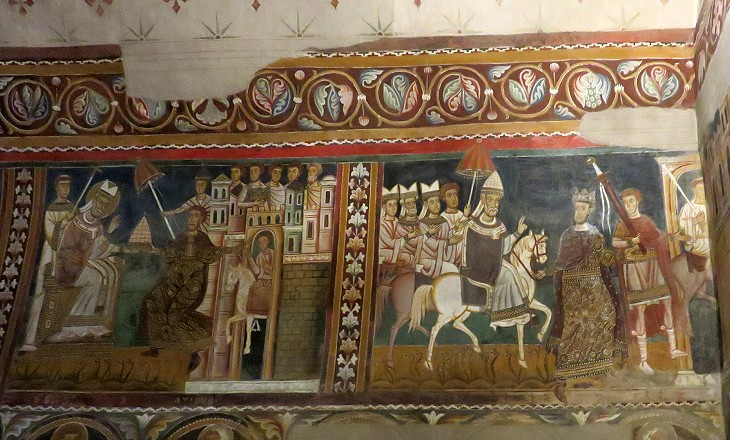
XIIIth century frescoes depicting Emperor Constantine offering the tiara (papal crown) to Pope St. Sylvester I (left) and the Emperor escorting the Pope to Rome (right)
We see the pope on a throne, before which the emperor is kneeling, to offer him a tiara - no doubt the artist intended thus to imply the immediate bestowal of temporal sovereignty (very generally believed the act of Constantine in the first flush of his gratitude and neophyte zeal) upon the papacy; lastly, we see the pontiff riding into Rome in triumph, Constantine himself leading his horse, and other mitred bishops following on horseback. Hare
Dante - Inferno - Canto XIX: 115-117
Ahi, Costantin, di quanto mal fu matre, | Translation by H. W. Longfellow
Ah, Constantine! of how much ill was mother, |
Dante made reference to the Donation of Constantine, a document which claimed that Emperor Constantine donated the City of Rome and the entire Western Roman Empire to Pope St. Sylvester I. The poet was not supportive of the papal role in worldly affairs which originated from that decision.
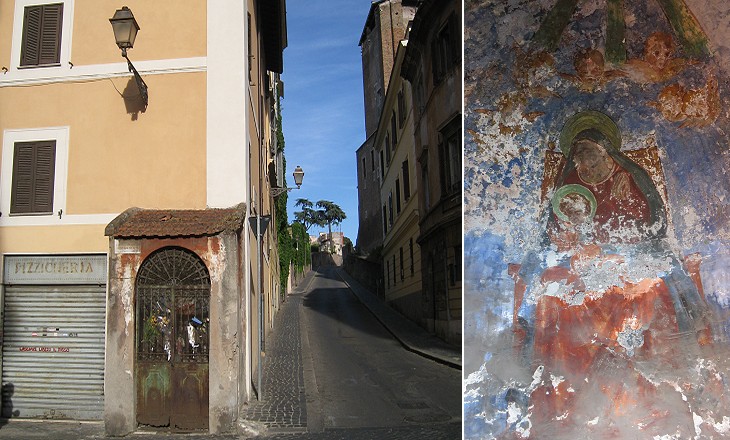
(left) Sacello della Madonna and Via dei SS. Quattro Coronati; (right) sacred image
At the foot of the slope leading to SS. Quattro Coronati there is what is likely the most ancient
sacred image of Rome. It is located along the itinerary followed by the procession which accompanied the newly elected pope (and Bishop of Rome) to S. Giovanni in Laterano for the formal ceremony during which he took possession of his diocese.
The madonnella is most likely a XVth century painting, but the existence of a sacred image located at this site is documented since the year 1000.
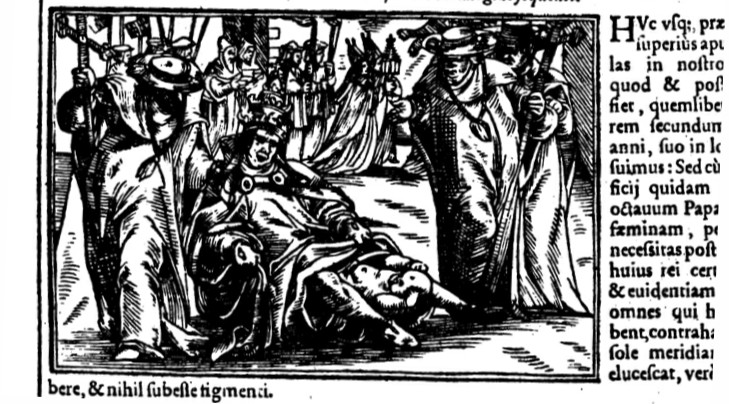
The delivery of Pope Joan; illustration from Johann Wolf, Lectionum memorabilium et reconditarum (1600)
According to a legendary account in the IXth century a female pope (Pope Joan) was caught by labour pains at this spot, her sex was discovered and she was stoned to death. The tale was used by Protestants as an example of the wickedness of the Popes, thus stirring a reaction.
I think it not
amiss to examine a little this Fable of a she Pope,
or of a Pope Joanne. I am not affraid at all to call this a fable,
both for the unlikliness of it in general; as also for the suspected authority of Its first broachers;
the contrarieties in the story and the little credit
given unto it by the learnedest adversaries of
the Roman Church. (after a long dissertation) If I have
been a little too long in this digression you will
pardon me: We are all debtors to Truth and
all Men ought to be glad to see themselves disabused.
Richard Lassel - The Voyage of Italy, or a Compleat Journey through Italy in ca 1668. He was a Roman Catholic priest.
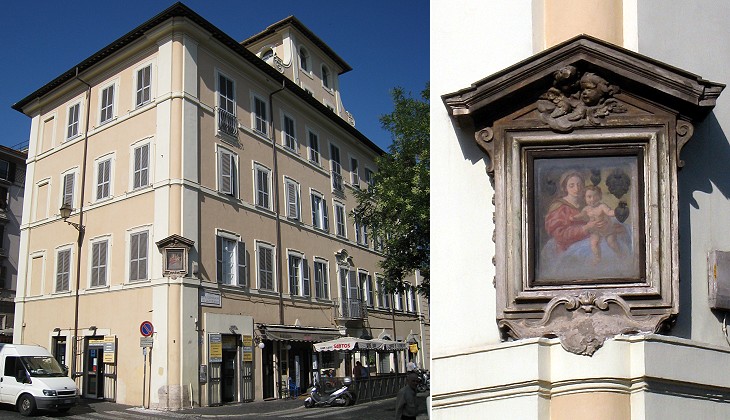
(left) XVIIIth century building; (right) madonnella
A madonnella in much better shape is located on an elegant XVIIIth century building near Sacello della Madonna and opposite S. Clemente.
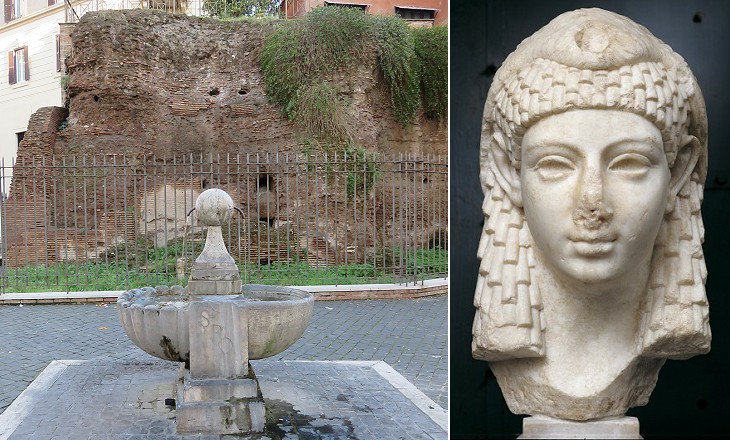
(left) Tempio di Iside e Serapide; (right) statue of Isis found at the site and now at Centrale Montemartini
Regio III - Isis et Serapis, one of the fourteen regiones into which Rome was divided by Emperor Augustus, was named after a temple dedicated to these Egyptian deities. The exact location of the temple is uncertain, but today a large wall with niches is believed to have been a monumental fountain of one of the terraces which made up the temple. Its shape is assumed to have resembled Santuario della Fortuna Primigenia at Palestrina (on a smaller scale). It was most likely built in 80 BC by Consul and Pontifex Maximus Quintus Caecilius Metellus Pius which indicates that the worship of Egyptian deities by the Romans preceded the conquest of that country. It is referred to as Isium Metellinum to distinguish it from Isium Campensis, another large temple to Isis in Rione Pigna.
Next plate in Book 3: Ruine dell'antico Tempio dei SS. Pietro e Marcellino.
Next step in Day 1 itinerary: Basilica di S. Giovanni in Laterano.
Next step in your tour of Rione Monti: Chiesa di S. Clemente.
Next step in your tour of Rione Campitelli: Chiesa di SS. Giovanni e Paolo.
Excerpts from Giuseppe Vasi 1761 Itinerary related to this page:
Chiesa de' SS. Pietro e MarcellinoNe' primi secoli della Chiesa fu questa eretta, e poi da Gregorio III. rifatta; come pure da Alessandro IV., e finalmente da Clemente XI. fu conceduta a' monaci Siriaci di sant' Antonio. Il Pontefice Benedetto XIV. la rifece da' fondamenti col disegno del Marchese Teodoli e poi la concedè alle religiose di santa Teresa, che stavano presso s. Lucia alle botteghe oscure, dette le Ginnasie, le quali vi hanno fatto un ampio monastero, ed hanno ornata la chiesa con quadri moderni.Chiesa de' SS. Quattro CoronatiIncontro alla riferita chiesa, e sull'alto del colle si vede quella de' ss. Quattro Coronati, eretta da Onorio I. che fu del 630. nel luogo, ove i ss. Fratelli soffersero il martirio. Da san Leone IV. furono collocati in questa chiesa i corpi de' detti Santi con altri cinque corpi di ss. Martiri, e Pasquale II. vi aggiunse un gran palazzo, in cui per qualche tempo abitarono i sommi Pontefici; ma poi da Pio IV. vi fu adattato un conservatorio per le povere zittelle orfane, e vi si mantengono sotto la cura di alcune religiose Agostiniane, fino a tanto che prendano stato. Nel portico evvi una piccola chiesa dedicata a s. Silvestro Papa, che dalle pitture e memorie, che vi si osservano, sembra assai antica. La chiesa poi fu riattata ed ornata di pitture dal Card. Mellino Vicario di Urbano VIII. Prima di entrare in chiesa, sonovi alcune pitture a fresco credute di Raffaello da Reggio; nel primo altare a destra si vede la natività del Signore stimata del Naldini, e le pitture nell'altare del Crocifisso sono di persona ignota; quelle però nella tribuna con diversi santi Martiri sono belle opere di Giovanni da s. Giovanni. Il s. Sebastiano dall' altra parte è del Cav. Baglioni, e la ss. Annunziata, del suddetto Giovanni. |


