
All images © by Roberto Piperno, owner of the domain. Write to romapip@quipo.it.


Notes:
Page revised in April 2024.
All images © by Roberto Piperno, owner of the domain. Write to romapip@quipo.it.
Notes:
Page revised in April 2024.
 Villa Altieri sul Monte Esquilino
Links to this page can be found in Book 10, Map A3, Day 2, View B8 and Rione Monti.
The page covers:
The plate by Giuseppe Vasi
Today's view
Villa Altieri
Villa Astalli
Villa Giustiniani - Massimo
Frescoes of Villa Giustiniani - Massimo (in a separate page)
Exhibits from the Museums (Castra Equitum and Horti Lamiani)

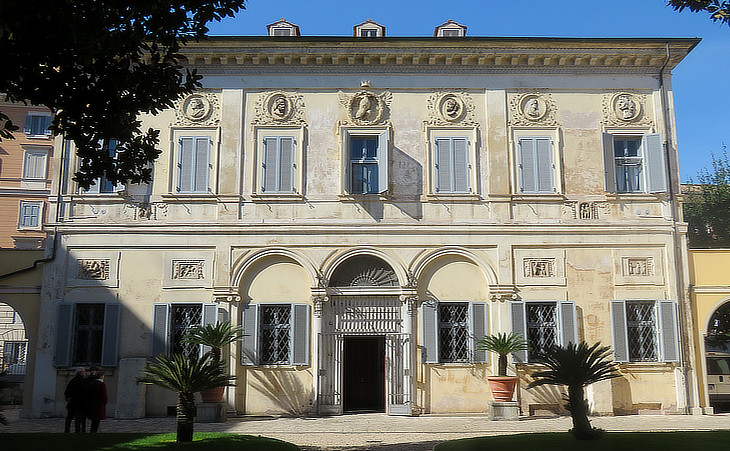
Villa Altieri was designed in ca. 1670 by Giovanni Antonio de' Rossi for the family of Pope Clement X. The villa is located midway between S.
Maria Maggiore and S. Croce in Gerusalemme.
It had a front and a back garden and as Vasi points out from one garden
you could see the other one through an empty space on the ground floor.
The hidden garden had a famous maze and the two gardens were connected
through unusual arches.
The view is taken from the green dot in the small 1748 map here below.
In the description below the plate Vasi made reference to: 1) Acqua Claudia aqueduct (the branch built by Emperor Nero); 2) Fountains and steps leading to the lower part of the gardens; 3) Hole in the Casino and fountain in the hidden garden. 1) is shown in another page. The small map shows also 4) Villa Astalli; 5) Villa Giustiniani Massimo; 6) Area of Horti Lamiani.


The view in June 2009
The Casino (today a school) is all that is left of the whole villa. Areas within the walls of Rome became so valuable after 1870 (when the city became the capital of Italy) that the owners of this and other adjoining villas could not resist the temptation of selling them. The Casino was modified by the addition of another storey and by the closure of the loggia.

(left) Staircase; (right) passage leading to the (lost) garden
Giovan Antonio de' Rossi (1616-95), produced
some works that might be described as transitional between the High and the Late Baroque. This is less obvious in his ecclesiastical (e.g. L'Immacolata Concezione) than his secular buildings. (..) Reserve and an immaculate sense of proportion are the virtues of his style (..) which predestined him to play an important part in the development of XVIIIth century architecture.
Rudolf Wittkower - Art and Architecture in Italy - 1600-1750 - Penguins 1958
De' Rossi was a contemporary of Gian Lorenzo Bernini, who introduced naturalistic elements (rocks)
into the design of palaces (e.g. at Palazzo di Montecitorio).

(left) Statue of a triton; (right-above) ancient relief and base of a statue of a member of the "Fabri Navales" guild of Ostia; (right-below) statue of a fish
At one point the Casino was even used as a prison for women; it is understandable why the statues which embellished the staircase and the roof were removed. The only remaining fountain shows the influence of Bernini's works.

British Museum: ancient Roman fresco depicting the Rape of Proserpina (Persephone/Kore)
The Altieri decorated their villa with some ancient statues and inscriptions and with paintings found in 1674 near Isola Farnese in a Roman tomb (Sepolcro dei Nasoni). These paintings soon deteriorated, but copies were drawn and described by Gian Pietro Bellori, curator of antiquities for Pope Clement X and better known as an art historian. Some of the extremely restored paintings were eventually sold to the British Museum.

(left) Double coat of arms of the Altieri; (right) main gate decorated with the heraldic symbol of the Altieri; the image used as background for this page shows another Altieri coat of arms
The Altieri had a large palace in Rome (designed by Giovanni Antonio de' Rossi) and another one at Oriolo Romano, one of their fiefdoms. Their heirs had a lavishly decorated chapel at S. Maria in Campitelli.

Casino of Villa Astalli
The small casino of Villa Astalli was built in the second half of the XVIIth century; at that time it was essentially a farmhouse, although it was decorated with stucco busts and friezes. Today it is located near one of the busiest crossroads of Rome. A storey has been added to the original building. The Astalli were a prominent Roman family in the Middle Ages, but they lost power and wealth until Pope Innocent X chose Cardinal Camillo Astalli as one of his closest advisors. He was a relative of Donna Olimpia Maidalchini, sister-in-law of the Pope. The Astalli owned the fiefdom of Sambuci.

Details of the decoration
Casino of Villa Giustiniani Massimo
In 1566 Ottoman Sultan Suleyman the Great conquered the island of Scio (today Chios) which was a possession of the Genoese Giustiniani family. Giuseppe, a member of this family, moved to Rome and became a prominent figure of Roman society thanks to the family's enormous wealth; his son Vincenzo bought a palace near S. Luigi dei Francesi and the fiefdom of Bassano and in ca. 1600 he built a villa between that of the Astalli and S. Giovanni in Laterano. The Casino was designed by Carlo Lambardi who designed also the façade of S. Prisca for Cardinal Benedetto Giustiniani, brother of Vincenzo. The Giustiniani had a lavishly decorated chapel at S. Maria della Vittoria.

Heraldic symbols of the Giustiniani (see other coats of arms at Bassano)
The coat of arms of the Giustiniani of Scio was a castle with three towers. In 1413 Emperor Sigismund allowed the Giustiniani to add the imperial eagle to the castle. The Emperor was at war with Venice and he favoured the Genoese in return for their financial support. Coats of arms of the Giustiniani can still be seen in the fortifications of Scio.

(above) Ancient reliefs: (left) Bellerophon taming Pegasus; (right) Achilles at Scyros, where the hero disguised himself as a girl;
(below) stucco with the Pamphilj heraldic symbol and relief portraying the Muses
The Giustiniani embellished their town palace with a very fine collection of ancient statues and reliefs. Andrea Giustiniani, heir of Vincenzo, married Maria Flaminia Pamphilj, niece of Pope Innocent X and he embellished the façade of the casino with ancient Roman reliefs (mainly fronts of sarcophagi).

Ancient reliefs: (above-left) "dextrarum iunctio" (joining the right hands), an act which was part of the Roman wedding ceremony; (above-right) Mithra slaying the Bull; (below) Rape of Proserpina
Some reliefs can be associated with the marriage with Maria Flaminia Pamphilj. They were almost all "completed" by the addition of missing parts, similar to what had been done at Casino di Villa Medici where this type of decoration was first introduced. Casino Pamphilj del Bel Respiro has a similar decoration.

Relief portraying Meleager who is about to kill his uncles
Meleager's killing of the Calydonian Boar was the subject of many ancient reliefs. The hunt however, notwithstanding the killing of the boar, did not have a happy ending.
Meleager, himself, pressed his foot down on the head of the deadly creature, and said to Atalanta 'Girl from Nonacria, take the prize
that is mine by right, and let my glory be shared with you.' Then he gave her the spoils, the hide bristling with hair, and the head remarkable
for its magnificent tusks. She delighted in the giver no less than the gift, but the others were envious, and a murmur ran through the whole company.
Of these, Plexippus, and Toxeus, the sons of Thestius, Meleager's uncles, stretching their arms out, shouted loudly: 'Come on, girl, leave them alone:
do not steal our titles to honour, and do not let too much faith in your beauty deceive you, lest your love-sick friend turns out to be no help to you.'
And they took the gifts away from her, and denied him the right to give them. The descendant of Mars could not bear this, and bursting with anger,
gnashing his teeth, he said: 'Learn, you thieves of other men's rights, the difference between threats and actions', and plunged his iron point into
Plexippus's chest, he expecting nothing of that kind. Meleager gave Toxeus, who stood in doubt, wanting to avenge his brother, but fearing his brother's
fate, scant time for doubt, and while his spear was still warm from the first brother's murder, he warmed it again with the second brother's blood.
Ovid - Metamorphoses - Book VIII - translation by A. S. Kline.
For more quotations from Ovid's Metamorphoses you may wish to see this page.

Plates from "Edward Wright - Some Observations made in France, Italy etc. in the years 1720, 1721 and 1722"
There are four other smaller antique Vases with Basso-Relievo's on one side only of each; they stand at the four Corners of a little Square. They represent Hercules in the Garden of the Hesperides. A Triton carrying off a Nymph. A Faun picking a Thorn out of a Satyr's Foot. The fourth seems to be Venus and Adonis. (..) There is in it an antique Basso-Relievo, which is valued not so much for the Workmanship, for that is indifferent enough, but for the Subject: It is a Votum to Aglibolus and Malachbelus, Deities of the Palmyreans, by which are understood the Sun and Moon; for the Moon was sometimes worship'd as a masculine Deity. Wright

(left) Tombstone of Avonia Crhesima who lived 68 years, 7 months and 10 days; (centre) tombstone with bust of Iulia Procula (late Ist century AD); (right) statue assumed to portray Emperor Justinian
In the Villa are abundance of busts, several fine Statues, Basso-Relievo's and Inscriptions.
One I observ'd, was made to a most highly esteem'd wife. (..) Another to a Wife who had liv'd with her Husband forty eight Years. Another to a Son, the Loss of whom is much lamented. (..) Another to a Daughter, wherein the odd Hours of her Life are express'd. (..) Among the Statues, there is one of (..) Giustinian the Emperor. Wright
A very small garden retains some Roman tombstones and a pastiche of ancient and modern parts which the Giustiniani claimed as the depiction of the Byzantine emperor; it decorated their villa outside Porta del Popolo until 1752 (the property was eventually sold to the Borghese).

(left) Relief believed to portray Alexander the Great; (right) another round relief
In 1803 the villa was sold to the Massimo who thus enlarged their properties in the area; in 1821-1828 the German painters Schnorr, Koch, Veit, Overbeck and Fuhrich decorated its interior
with frescoes showing scenes from Ariosto, Dante and Tasso (see them in a separate page). They were called Nazarene from their clothing and hairstyle; their paintings were a reaction to Neoclassicism.
The gardens of Villa Giustiniani Massimo are lost: their main gate was moved to Villa Mattei. In 1948 the Casino was bought by the Franciscan Fathers of the Holy Land to whom it still belongs.

Museo Nazionale Romano: relief from Castra Equitum which depicts the Sun god crowned by solar rays, the Moon goddess bearing a crescent on her hair, and an old man, perhaps the priest Ulpius Chresimus. The inscription says "Soli Invicto pro salute Imp(eratorum) et Genio n(umeri) eq(uitum) sing(ularium) eorum M. Ulp(ius) Chresimus sace[rd(os)] Iovis Dolich[eni] [dedicavit]" - Dedicated to Sol Invictus and to the Genius of the Imperial horseguards for the emperors' health, by M. Ulpius Chresimus, priest of Jupiter Dolichenus.
Emperor Septimius Severus reorganized the defence of Rome: he stationed a legion he trusted at Albano and in the city he built two barracks for cavalrymen. Emperor Constantine instead went in the opposite direction and he greatly reduced the number of soldiers who protected the city by dissolving the Praetorian Guard and by closing the barracks of the cavalrymen. One of these barracks was identified near Villa Giustiniani and an interesting relief was found there in 1885. It shows that Roman soldiers were fascinated by beliefs they learnt about during their campaigns in the eastern provinces of the Empire. Doliche was an ancient town very near today's Gaziantep in south-eastern Turkey. According to recent archaeological studies, reliefs and inscriptions indicate that the cult of Jupiter Dolichenus had elements in common with those of Mithra, Sol Invictus and Isis. Clear evidence of the cult of Jupiter Dolichenus has been found in Roman towns near the Rhine, e.g. Frankfurt, and the Danube, e.g. Carnuntum, borders. The cemetery of the horsemen was situated along Via Labicana (today Casilina).

Musei Capitolini: (left - from Castra Equitum) altar dedicated to Silvanus (first half of the IInd century - see a relief on another altar and inscriptions indicating the sites of shrines to the god); (right) stela of freedman Tiberius Iulius Xanthus (it was found between Villa Altieri and Porta Maggiore)
Silvanus is portrayed with a crown composed of grain ears, a bundle of grain in his left hand and a sickle in his right hand; at his feet are a dog and an altar with a flame. See a fine relief portraying Antinous as Silvanus.
That Tiberius employed the services of a
masseur in assisting him to preserve his good health may be
inferred from the following inscription from Rome, although a
different interpretation is possible: Ti. Julio Aug. lib. | Xantho
tractatori | Ti. Caesaris et | divi Claudi | et subpraef. classis |
Alexandriae | Atellia Prisca uxor | et Lamyrus f. heredes. | v. a.
LXXXX: seem to represent the services of the tractator or his feminine
counterpart as employed merely for pleasure.
Clara A. Holtzhausser -
An Epigraphic Commentary on Suetonius' Life of Tiberius - 1918
Tiberius Julius Xanthus, who lived to the remarkable age of ninety before dying in Rome, had two claims to fame. One was that he was the deputy to the commander of the Classis (Fleet) Alexandrina at some time during his career. His tombstone also proudly recorded his role as a tractator of the emperors Tiberius and Claudius. The principal meaning of tractator at the time was masseur, but the word had also other meanings such as official or manager.

(left/centre) Musei Capitolini: statues found in 1874 in the area of "Horti Lamiani": Recumbent Dionysus/Bacchus and Esquiline Venus; (right) "A Sculptor's Model" by Sir Lawrence Alma-Tadema (1877); the Esquiline Venus is hidden by the palm frond
The large areas in the eastern part of Rome where popes and cardinals built their villas had been used for the same purpose by the ancient (and wealthiest) inhabitants of the city.
They were called horti, a word that initially indicated a sort of family kitchen garden, but which in the Ist century AD was used with reference to large suburban villas. Horti Sallustiani, Horti Liciniani and Horti di Mecenate are some of the best known ancient villas inside the walls of Rome.
In the XVIth century the Farnese gave this name to their villa on the Palatine.
After 1870 Villa Altieri and neighbouring Villa Palombara were divided up and used for new developments; in 1874 ruins of a villa which had belonged
to Lucius Aelius Lama, a consul and a friend of Emperor Tiberius, came to light. We know that the property eventually was acquired by the imperial family.
The works of art which were found at Horti Lamiani were placed there in the IInd century AD.
The discovery of the statue of Venus attracted a great deal of public attention and it became known as the Esquiline Venus. See a page on a small museum which was recently opened on the site of the Horti and another one on Greek Art in Rome.

Musei Capitolini: group of statues found in 1874 in the area of "Horti Lamiani" and portraying Emperor Commodus as Hercules and two tritons
I have myself seen a gallery
two hundred and seventy-six feet long, the pavement of
which was inlaid with the rarest and costliest specimens
of alabastrine-agate. (..) All these things
were found in November, 1875. On Christmas eve of the preceding year, while our men were excavating (..) at the north end of the
gallery mentioned above, the ground gave way, giving us
access to a crypt or cellar on the floor of which we found lying the celebrated bust of Commodus in the character of
Hercules, flanked by two tritons or marine centaurs.
Rodolfo Lanciani - New Tales of Old Rome - 1901

Musei Capitolini (from "Horti Lamiani"): (left) marble floor; (right) gilt metal decorations of furniture
As regards the furniture of this delightful palace, I find the following description of a piece discovered in September of the same year (..) eighty or ninety yards from the room in which the statues were found: "It is not possible to ascertain the exact shape of this extraordinary piece of furniture, which had the frame of hard wood, encrusted with gilt metal, and studded with precious stones". Lanciani
Move to a second page showing the frescoes inside Casino Giustiniani Massimo.
Next plate in Book 10: Casino della Villa Mattei.
Next step in Day 2 itinerary: Chiesa de' SS. Vito e Modesto.
Next step in your tour of Rione Monti: Porta Maggiore.
Excerpts from Giuseppe Vasi 1761 Itinerary related to this page:
Villa AltieriFu questa eretta nel Pontificato di Clemente X. nel cui casino fra l'altre rarità sonovi i disegni delle pitture trovate nel sepolcro de' Nasoni, e nella villa deliziose fontane, e ameni viali. |


