
All images © by Roberto Piperno, owner of the domain. Write to romapip@quipo.it.


Notes:
Page revised in April 2024.
All images © by Roberto Piperno, owner of the domain. Write to romapip@quipo.it.
Notes:
Page revised in April 2024.
 Bassano, Monterosi and Campagnano
You may wish to see a map showing the towns covered in this section first.
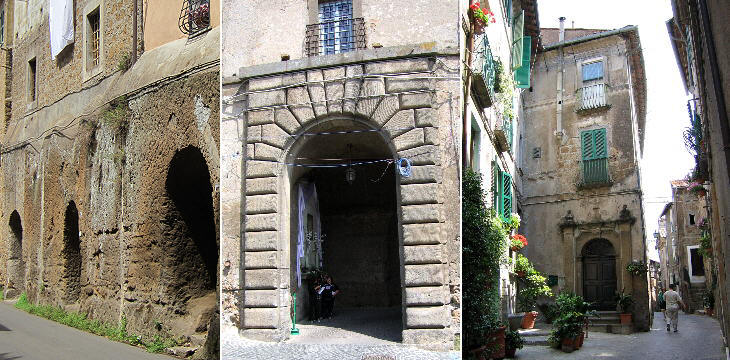
Bassano was probably founded in the XIth century by inhabitants of Sutri and after the 1870 annexation of the Papal State to the Kingdom of Italy and until 1964 its official name was Bassano di Sutri (today it is Bassano Romano).
In the XIIth century it became a minor fiefdom of the Anguillara, a family who controlled most of the territory around Lake Bracciano.
In 1595 Bassano was bought by Vincenzo Giustiniani. The Giustiniani were a very wealthy Genoese family who ruled over the island of Scio (Chios) in the Aegean Sea from 1347 to 1566, when they were ousted by the Ottomans. Giuseppe Giustiniani, the father of Vincenzo, settled in Rome and bought a palace there. His son decided he needed a fiefdom in order to be admitted into the Roman aristocracy (the Giustiniani had a mercantile background) and he also bought a villa near S. Giovanni in Laterano.
The Giustiniani gave a Renaissance appearance to their new acquisition, by levelling the surface of the volcanic rock upon which Bassano stands and by opening into it a gate leading to their palace and to the town. The main street is still dedicated to a charitable member of the family.
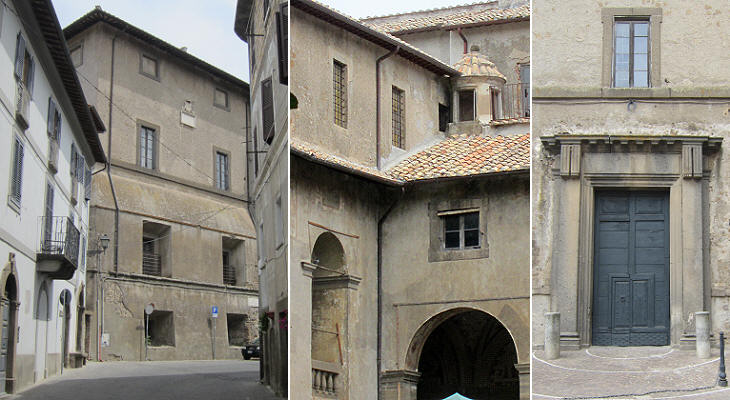
Palazzo Giustiniani: (left) rear side resembling a fortress; (centre) detail of the main courtyard with traces of
frescoes; (right) main portal
The Giustiniani were admitted into the Roman aristocracy by Pope Paul V who gave them the title of Marquises of Bassano in 1605.
Pope Innocent X, whose niece married a Giustiniani, improved their status by appointing them Princes of Bassano.
The Giustiniani established links with the most important Roman families through marriages. In 1777 Caterina Giustiniani married Baldassarre
Odescalchi, a member of the family of Pope Innocent XI, and the Odescalchi inherited the title of Princes of
Bassano in the XIXth century. This family however did not care much about their palace at Bassano, probably because they already
had a castle/palace in a better location at Bracciano which is not far away.
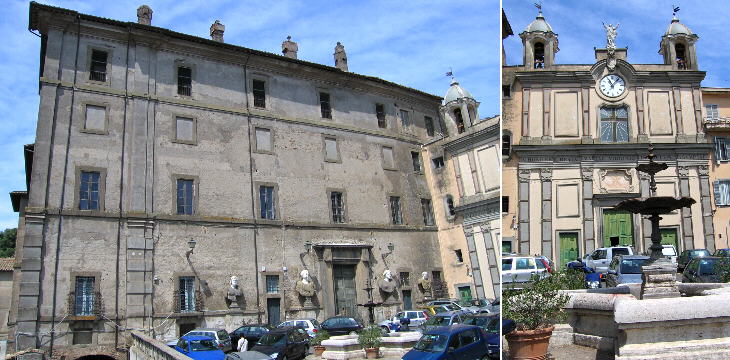
(left) Palazzo Giustiniani; (right) Santa Maria Assunta
Vincenzo Giustiani built a large palace which was linked by a bridge to a garden with a small casino. The building included a chapel and a small theatre and it was decorated with frescoes. After a long period of abandonment in 2003 it was acquired by the Italian State; the frescoes of the main halls have been restored, but the building is almost entirely empty. You can see its interior in a separate page.
In 1703 the Giustiniani promoted the enlargement and renovation of the parish church near their palace.
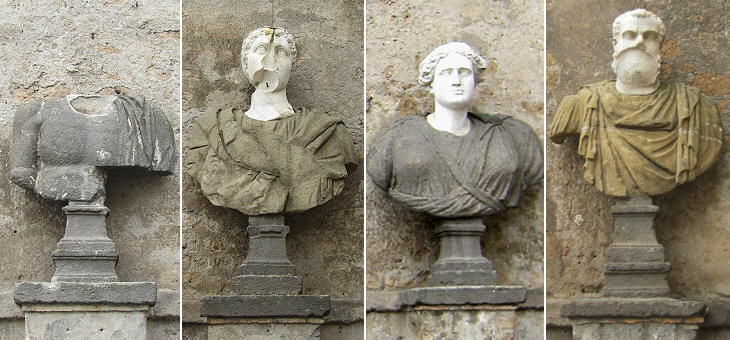
Four ancient busts (heads of the IInd century AD) at the sides of the portal of Palazzo Giustiniani. The head of the first bust was stolen in March 2012
Vincenzo Giustiniani was a great and competent collector of works of art and not only of ancient sculptures as he bought 15 paintings by Caravaggio. He published a detailed and illustrated catalog of his own collection (Galleria Giustiniana - 1631): its two volumes document more than 300 sculptures, reliefs and paintings. This explains why the main square of Bassano is decorated with four busts, although not very representative of the collection. Most of the works of art collected by Vincenzo Giustiniani were bought in 1826 by the King of Prussia and can be seen in Berlin.
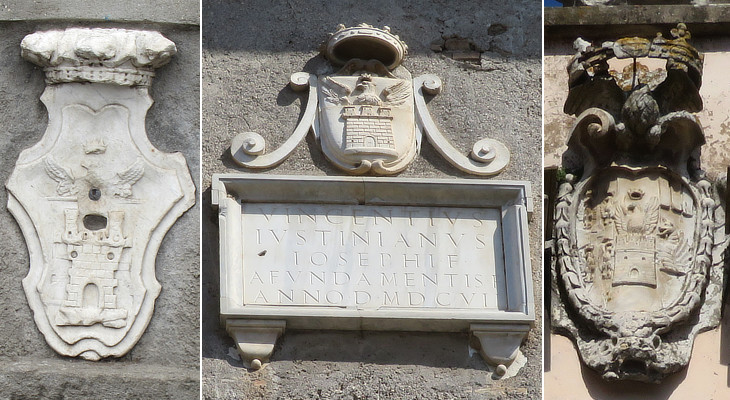
Coats of arms of the Giustiniani: (left) on the bridge they built to facilitate the access to Bassano; (centre) on the rear side of their palace
with an inscription celebrating the completion of the gardens in 1605 (Vincentius Iustinianus Josephi F. Hortos e regione pretoria cultu magnifico
adiecit A.D. MDCV); (right) on S. Maria Assunta between those of the Gonzaga, the family of the Dukes of Mantua (left - in 1661 Carlo Benedetto
Giustiniani married Caterina Gonzaga) and of the Boncompagni Ludovisi, the families of Pope Gregory XIII
and Pope Gregory XV (right - in 1706 Vincenzo III Giustiniani married Costanza Boncompagni Ludovisi)
Move to the page on Palazzo Giustiniani.
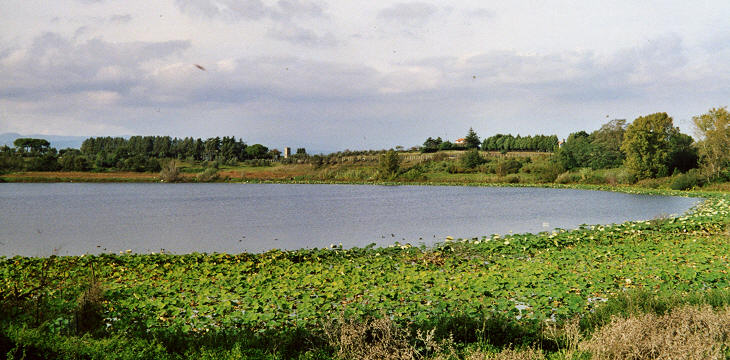
The volcanic pond of Monterosi aka Lake Janula, after Janus, a Roman god
The main crater of an extinct volcano formed Lake Bracciano. Several minor craters created shallow ponds which were subsequently drained to reclaim their land, but not that at the junction between Via Cassia and the roads to Ronciglione and Nepi, near the tiny town of Monterosi.
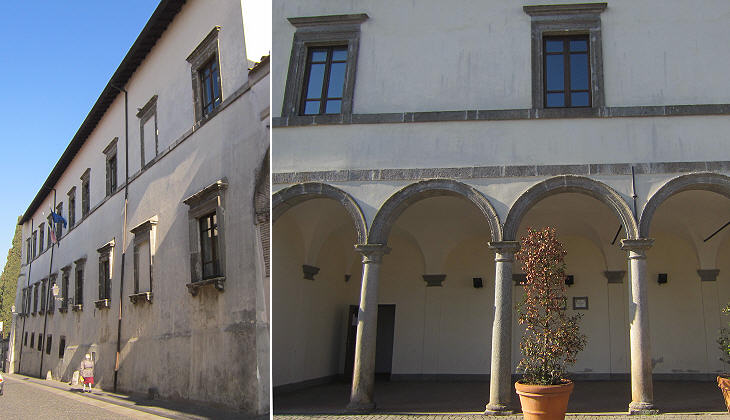
Views of the Altieri/Del Drago palace, a former monastery
Monterosi is situated 23 miles north of Rome and it was mentioned in several XIXth century guide books. The horse-drawn coaches carrying Charles Dickens in 1844 and Ferdinand Gregorovius in 1852 left Ronciglione early in the morning, reached Monterosi at midday and entered Porta del Popolo in the afternoon. In that period Monterosi was stricken by malaria and foreign travellers would have been surprised to know that in the XVIIth century the Altieri, the family of Pope Clement X, had tried to turn the small village into a modern town (as they had done with more success at Oriolo on the opposite side of Lake Bracciano).
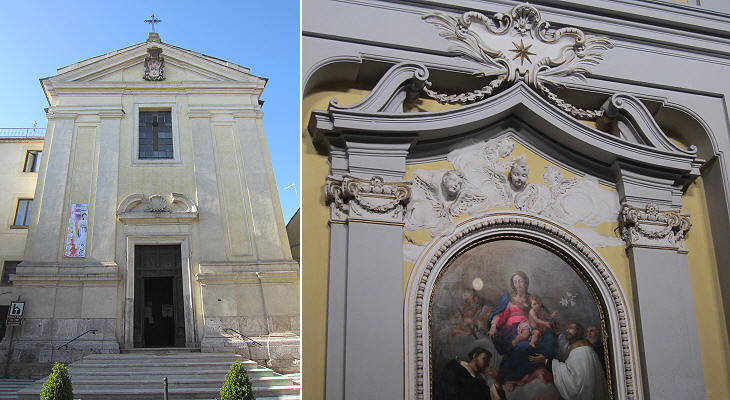
(left) S. Croce; (right) detail of its decoration
The main church of Monterosi was renovated by Cardinal Lorenzo Altieri (his coat of arms can be seen in the image used as background for this page). Some sources attribute the design of the church and of the family palace to Giovanni Battista Contini. The eight-pointed stars which decorate the interior are a reference to the heraldic symbol of the Altieri.
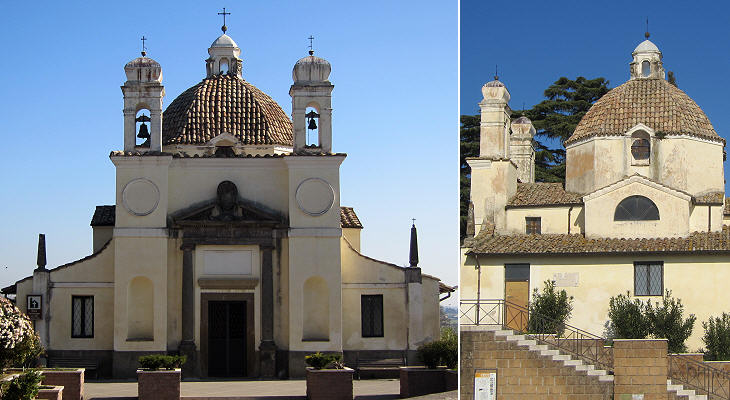
S. Giuseppe
This church was built very near Via Cassia, probably as a chapel for pilgrims. Notwithstanding its small size it has all the features of a Late Renaissance Roman church.

Borgo Aldobrandino: (left) Madonna della Neve; (right) what the owners (wrongly) claim to be the oldest house of Monterosi
The part of Monterosi which is located on higher ground is known as Borgo Aldobrandino, because it was developed by the family of Pope Clement VIII Aldobrandini. Madonna della Neve was adjoined by a small hostel for pilgrims so it was probably built for the 1600 Jubilee Year.
The 1871 census recorded a population of 867 inhabitants at Monterosi, but today, thanks to an upgrading of Via Cassia, the small town is considered within commuting distance from Rome and its population has grown considerably.
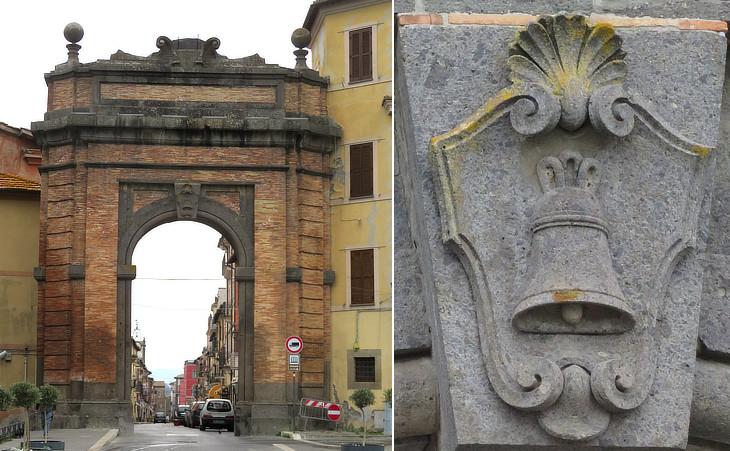
(left) Porta Romana, built in 1714-1734 after an enlargement of the town; (right) a large bell on its keystone, the symbol of Campagnano
I shall never forget my anxiety as the distance grew short between me and the dethroned capital of the world: the miles across the dreary campagna seemed interminable; the horses, though stimulated to a gallop by the spur of the bribed postilion, appeared to crawl and the delays at Baccana, the last miserable poststation, leaving scarce fifteen miles more to accomplish, put my patience to the utmost stretch of endurance.
H. Noel Humphreys - Rome, and Its Surrounding Scenery - 1840
From Monterosi to Rome (23 M.). The road almost exactly
coincides with the ancient Via Cassia. About 6 M. farther the brink of a crater is attained
in which the somewhat unhealthy village of Baccano (*Posta) lies;
in the vicinity is a mephitic pond; to the W. lie the two small
lakes of Stracciacappa and Martignano (Lacus Alsietinus). Traces
of ancient drains (emissarii) are distinguished on the l. side of the
road.
Baedeker's - Rome and Central Italy - 1875
(We followed) the Via Cassia as far as
the posthouse of Baccano, the ancient "Ad Baccanas," 18
miles from Rome. It is situated in the crater of a volcano,
afterwards a lake, which was drained in very early times.
Two miles further north lies Campagnano, a village with a
few insignificant Etruscan and Roman remains.
Augustus J. C. Hare - Days Near Rome - 1875.
Another source of annoyance and even of personal
danger to travellers lay in the unsettled state of public
security. (..) The crossing of the forest called the Silva Alsietina on the Via Cassia,
was considered so dangerous that private travellers were
obliged to place themselves under the protection of
police patrols, or of the escort accompanying government officials.
Rodolfo Lanciani - Wanderings in the Roman Campagna - 1909
XIXth century travellers were not interested in making a short detour from Via Cassia to visit Campagnano which stood on high ground between two ravines. It was most likely named after settlers from Campania, the region north of Naples, but its symbol is a bell (It. campana).
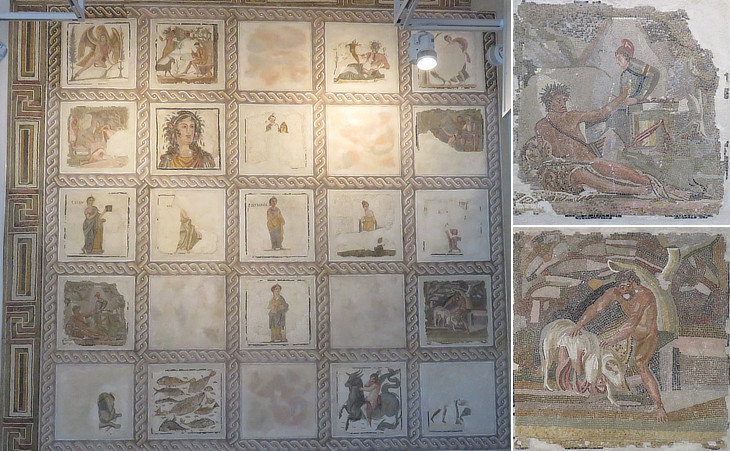
Museo Nazionale Romano; floor mosaic from Villa di Baccano and two details showing (above) a giant shepherd and (below) Ulysses escaping from the cave of Polyphemus (see a statue depicting the same event); another mosaic from the villa portrayed charioteers
In the last days of the Papal State a private landowner discovered in his farm near Baccano the remains of an ancient Roman villa. The excavations he conducted were meant to find something which he could sell on the antiquarian market. Columns and other marble materials were immediately sold. Some floor mosaics in relative good conditions were cut into square panels in order to facilitate their sale. In 1876 the Italian State bought most of them and archaeologists partially reconstructed a large floor mosaic, which in origin was made up of 32 panels, rather than 25. The mosaics were made in the early IIIrd century AD, at the time of the Severian dynasty.
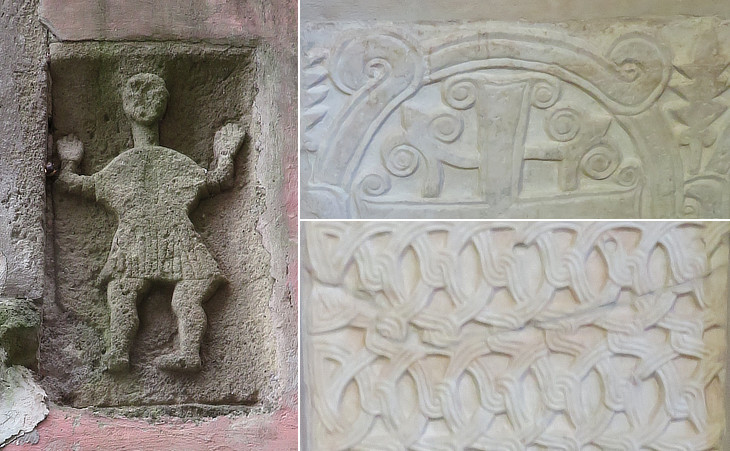
(left) "Tifo"; (right) S. Giovanni Battista: "plutei" from an earlier church
The foundation of Campagnano is due to an initiative of Pope Adrian I who owned most of the land on the eastern side of Via Cassia from the site of ancient Veii to Nepi. In the late VIIIth century he founded Domus culta Capracorum, a large estate, fully self-sufficient for a mixed economy of grains and vineyards, olives, vegetable gardens and piggery with its own grain mill, smithies and tile-kilns. Campagnano, Formello, Isola Farnese (Veii) are all settlements which originated from Domus culta Capracorum, after Capracorum, its administrative centre, was destroyed by the Saracens.
Tifo, the name given to a rough relief portraying a man in a praying posture which was eventually placed in a side street of the medieval town and some marble parapets in the parish church are dated IXth century. Campagnano was first mentioned in 1076 in a document certifying the sale of some houses.
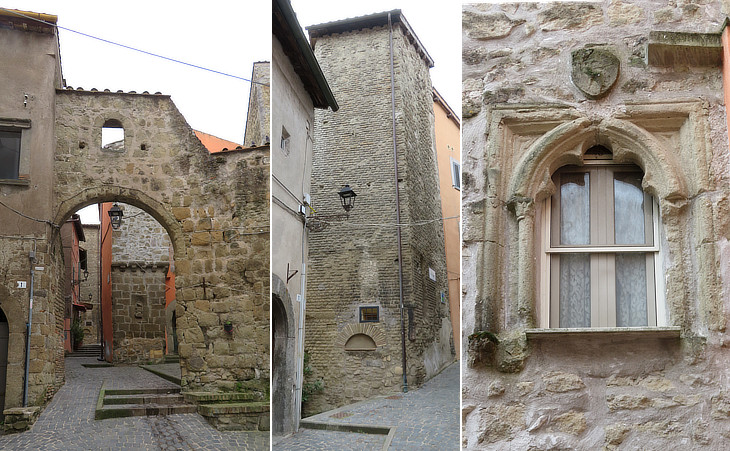
(left) Gate of a medieval fortified area; (centre) tower; (right) "Finestra della Principessa" (Princess' Window)
In 1271 the castrum (castle/town) of Campagnano was acquired by Cardinal Riccardo Annibaldi with the agreement of the local authorities. The Annibaldi strengthened the fortifications of the town (see a tower they built in Rome); the access to Campagnano was protected by a castle which was pulled down in 1882 to make room for a new town hall (see below), but the ancillary fortifications which stood behind it still exist. The Annibaldi established a good relationship with their subjects by granting them charter of rights which were periodically renewed.
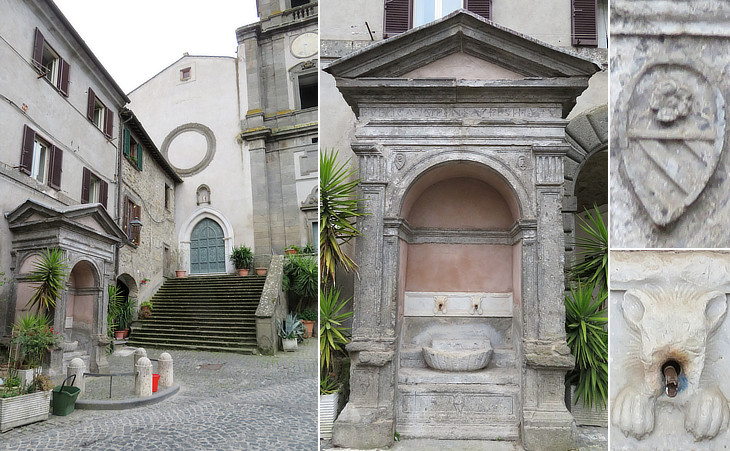
(left) Fontana Secca (Dry Fountain) and S. Giovanni Battista, the parish church; (centre) the fountain (1520); (right) details showing the Orsini coat of arms and the head of a bear, the Orsini heraldic symbol
During the XIVth century some properties of the Annibaldi at Campagnano were sold to the Orsini of Bracciano. In 1410 the whole town became a property of the Orsini who already controlled Formello. In 1481 Virginio Orsini, a cunning condottiere, was formally appointed Earl of Campagnano by Pope Sixtus IV. The Pope had been elected with the help of Cardinal Latino Orsini (see his funerary monument in Rome). Most of the Renaissance monuments of Campagnano are due to initiatives promoted by the Orsini.
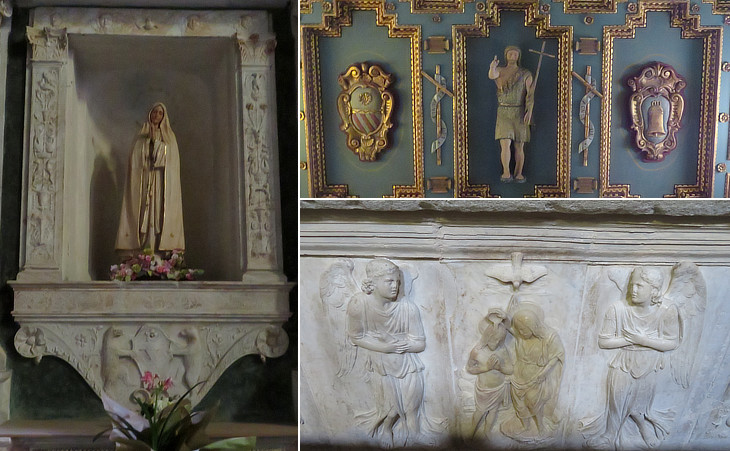
S. Giovanni Battista: (left) altar offered by the Orsini; (right-above) wooden ceiling of the nave; (right-below) Renaissance relief depicting the Baptism of Jesus
Campagnano was not a bishopric see, but the Orsini embellished its parish church as if it were a cathedral. The Orsini gave three popes to the Church - Celestine III, Nicholas III, and Benedict XIII - as well as twelve cardinals and many bishops and prelates, so they felt they should show their religious zeal in a visible manner.
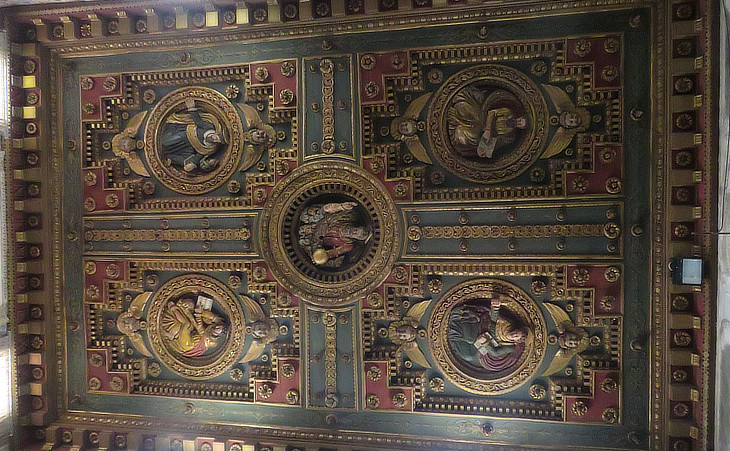
S. Giovanni Battista: 1582 ceiling of the presbytery portraying God the Father and the Four Evangelists
Giacomo del Duca is an architect and sculptor who is best known for having assisted Michelangelo in his last projects. He worked for Cardinal Alessandro Farnese iuniore to complete the grand palace of Caprarola and the fine wooden ceiling of the presbytery is attributed to him. The cardinal was often a guest of the Orsini at Campagnano, on his way to Caprarola. You may wish to see other XVIth century wooden ceilings in Rome.
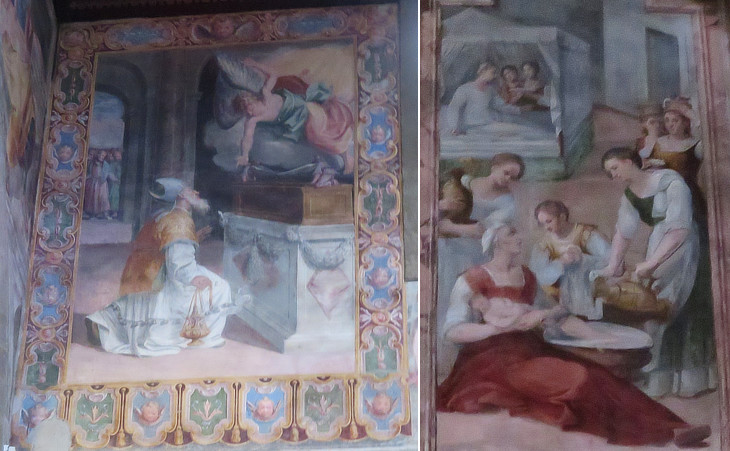
S. Giovanni Battista: frescoes attributed to the Zuccari brothers; the tapestry-like frame of the left fresco can be noticed also in paintings in the transept of S. Giovanni in Laterano and at S. Susanna
Taddeo and Federico Zuccari worked for years at the fresco decoration of Palazzo Farnese di Caprarola and, similar to Giacomo del Duca, they were also asked to contribute to that of S. Giovanni Battista. You may wish to see Cappella di S. Giacinto at S. Sabina, which was entirely decorated by Federico Zuccari.
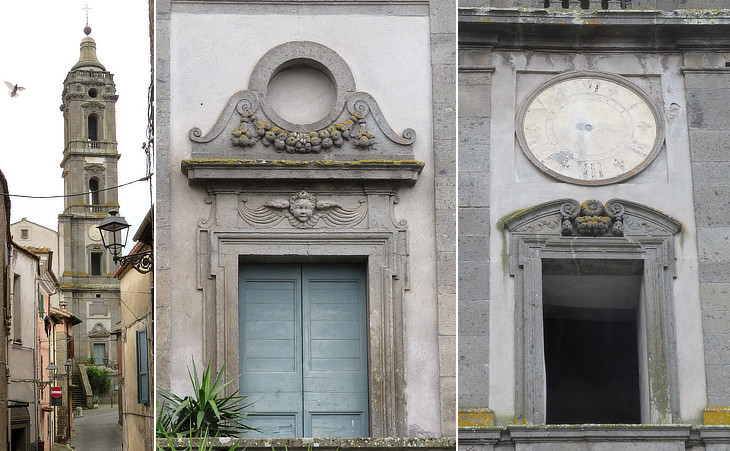
S. Giovanni Battista: bell tower with clock which indicated the Italian Hour
The very tall bell tower was built in 1602, but it owes some of its baroque features to a restoration of the year 1700. Its tip is decorated with the symbol of the town.
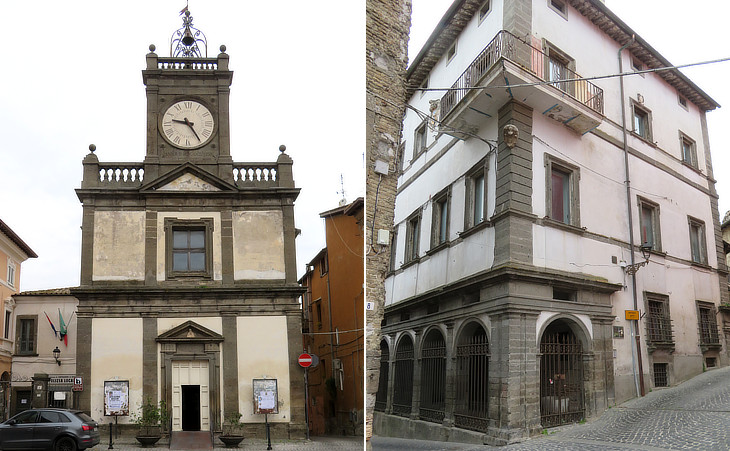
Renaissance buildings: (left) Chiesa del Gonfalone; (right) Palazzo Galli
The church was built in 1575 and had a neat design until 1864 when a clock tower was built above it. At that time the centre of Campagnano had moved away from the square of S. Giovanni Battista and the new location of the public clock marked the development of the town.
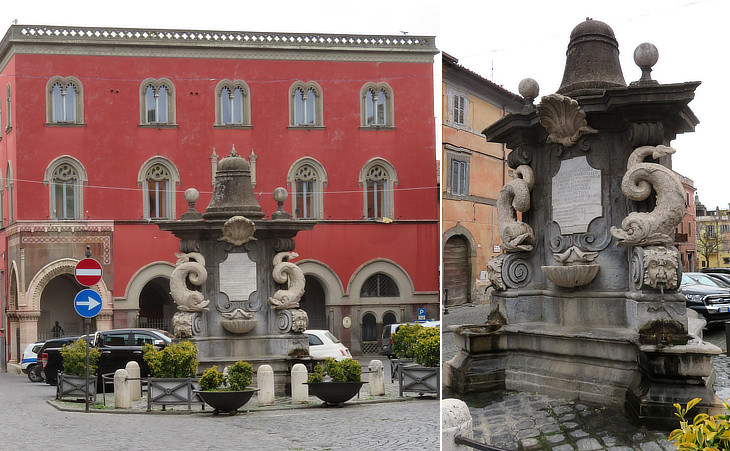
Fontana dei Delfini and the Town Hall which was built in 1882 on the site of the medieval castle
In 1659 Cardinal Flavio Chigi, nephew of Pope Alexander VII, bought the fiefdoms of Campagnano and Formello from the Orsini. His heirs were given the title of Princes of Campagnano. The Chigi promoted the enlargement of the town and the construction of Porta Romana. In 1753, at the initiative of Prince Agostino Chigi III, a Renaissance fountain was restored and partly redesigned.
From Civitavecchia to Civita Castellana - other pages:
Introduction and Civitavecchia, Allumiere and Tolfa
Civitavecchia - Terme Taurine
Archaeological Museum of Civitavecchia
Oriolo Romano and Capranica
Bassano - Palazzo Giustiniani
Sutri
Nepi and Castel Sant'Elia
Civita Castellana
Museum of Agro Falisco at Civita Castellana


