
All images © by Roberto Piperno, owner of the domain. Write to romapip@quipo.it.


Notes:
Page revised in December 2025.
All images © by Roberto Piperno, owner of the domain. Write to romapip@quipo.it.
Notes:
Page revised in December 2025.
 Trevignano and Anguillara
If you came to this page directly, you might wish to read a page on Bracciano first.

(above) Monte di Rocca Romana (left) and Trevignano (right) seen from the Orsini Castle of Bracciano; (below) enlargement showing old Trevignano
The magnificent lake, anciently known as Lacus Sabatinus, originally a volcanic crater, lies nestled between gentle mountain ranges and graceful shores.
To the north it is surrounded by a small wooded mountain range, from which the Monte di Rocca Romana rises as a black volcanic peak, no more than 2000 feet high. This cone is visible everywhere in the Etruscan landscape, as in the Latin is Monte Cavo above Lake Albano. Below it lies the town of Trevignano on the bank.
Ferdinand Gregorovius - Das Schloss der Orsini in Bracciano - 1870
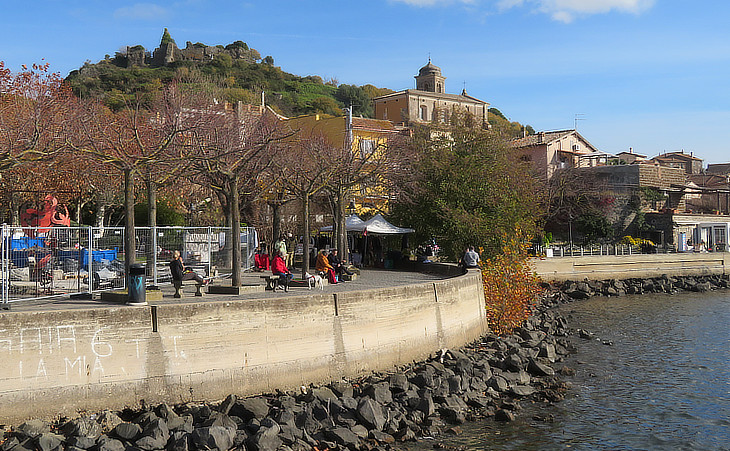
Trevignano is located on the northern shore of Lake Bracciano; the town was built on a small promontory which could be easily fortified. Today many Romans have built their second homes in the area to the west of the town because of its southern exposure, but in 1870 when Gregorovius visited Bracciano, the shores of the lake were marshy and very unhealthy.

Trevignano was a very small settlement; it was surrounded by walls and it had two gates, one of which (Torre dell'Orologio) is still the main entrance to the historical section of the town.

Roman memories in the main square (see also those in the Museum of Bracciano)
During the Ist century BC wealthy Romans built villas on the shores of Lake Bracciano, an added attraction being the presence of some hot mineral springs (Aquae Apollinares Novae) which are still utilized for the treatment of arthritis. Trevignano was built on top of one of these villas and sections of ancient walls have been identified inside some medieval buildings. The area around Trevignano was the starting point of Aqua Traiana, an ancient aqueduct which was repaired by Pope Paul V and which is best known as Acqua Paola.

Ruins of the Orsini castle
Trevignano is dominated by the ruins of a castle built in the XIIIth century and named after the Orsini who acquired it in 1378. It was extensively damaged towards the end of the XVth century when the troops of Pope Alexander VI attacked the Orsini possessions around the lake.

S. Maria Assunta seen from the castle
The parish church of Trevignano was renovated in the XVIth century by the Orsini. In 1693 Trevignano was sold to the Del Grillo, a family who owned a palace near the Forum of Augustus. One of the reasons behind the financial ruin of the Orsini was extravagant spending by Anne Marie de la Trémoille, the beautiful wife of Duke Flavio Orsini in 1675-1698.

The circular bay to the east of Trevignano on a sunny and on a misty day
Trevignano is adjacent to a circular bay which was created by the collapse of a secondary crater of the volcano which gave origin to Lake Bracciano.

Views of Anguillara: (above) from the Orsini Castle of Bracciano; (below) from the road from Trevignano
Finally, on the right there is a high headland with a dark towered place jutting out into the lake. This is Anguillara. (..)
Historical life was centred around the lake only in the three towns. You see them there constantly in front of you. They occupy the sides of a triangle at equal distances from one another, and only they interrupt the charming silence of these banks with the idea of human culture. (..)
It was our intention to walk along the lake to Anguillara. (..)
We had to walk along the bank in the direction of Anguillara over many swampy stretches, and finally a large herd of cattle with magnificent bulls threatened to completely cut off our path. We called a shepherd who protected us for some distance with his lance and shouted command words to the bulls. The man (..) took us to a place where he had set up his lonely throne. This was a hollow on the bank overshadowed by a tree. We sat down there and looked with delight at the blue lake in front of us, from which fish were springing up here and there, and the idyllic herds of cattle and horses that populated the shore far and wide. They sought the water in order to cool themselves, but sometimes they became agitated and ran along the bank screaming when the evil swamp fly tormented them.
We reluctantly gave up the hike to Anguillara; for as close as the place appeared because of the transparency of the air, it was still far from us. Gregorovius
Today Anguillara can be easily reached by suburban trains from Rome and because of this it has a large population of commuters who live in modern buildings
near the railway station. Its official name is Anguillara Sabazia; the epithet Sabazia was added in 1872 to distinguish it from another Italian town
by the same name near Padua. Sabazia is a reference to Lacus Sabatinus, the Latin name of Lake Bracciano.

(left) Porta Maggiore, the main gate of Anguillara; (right) main street
Anguillara attracted me because of the history of its counts, many of whom were famous senators of Rome in the 14th century. Orso dell'Anguillara, as senator of Rome, crowned Petrarch on the Capitol in 1341. (..) A hundred years later, the Count of Anguillara was the terrible Eversus, a powerful, far-feared dynast of Etruria at the time of Eugene IV and Pius II. After his death, Paul II had his eleven castles conquered. (..) This line came to an end at that time, but Anguillara later passed to Virginius Orsini and his bastard Charles. Eversus is still remembered today by (..) his coat of arms on the outer wall of the Lateran Hospital, for which this criminal had made a pious donation. Gregorovius

(left) Main street; (centre) Vicolo della Grondarella, a vaulted passage showing sections of "opus reticulatum" an ancient Roman construction technique; (right) bell tower of the parish church (Collegiata di S. Maria Assunta) and a small oratory (Arciconfraternita della Misericordia e di S. Giovanni Decollato)
The historical part of the town is untouched, but it is rather desolate because it is no longer the centre of community life.
Similar to Trevignano, Anguillara was built on the ruins of ancient Roman villas, such as that belonging to Rutilia Polla, a Roman matron of the time of Emperor Trajan, who is mentioned in Justinian's Digest (a VIth century compilation of Roman law) for having bought ten feet of ground around the lake near Anguillara. The reason why the matron was mentioned in the Digest is that some years later the level of the water rose and Roman law experts had to decide whether the ten feet of land owned by Rutilia Polla were those which were under water, or those around the water.

(left) Fountain with the symbols of the town; (right) Rocca di Anguillara
The Count of Anguillara's coat of arms has two crossed snakes or eels. At least I thought these lines were eels and also believed that the name Anguillara was derived from the Anguille of the lake. But in Bracciano I convinced myself of my mistake: I was told that the lake was rich in pike and carp, but not in eels; and finally the location of Anguillara itself taught me that the real name must be Angularia, because in reality this castle stands on a promontory that forms a corner in the lake. Gregorovius
Two eels (It. anguilla) are the symbol of Anguillara and many think the town was named after them, while the origin of the name
is due to the angle made by the coastline at that location, because of a secondary crater of the volcano. In 1776 a fountain decorated with two bronze eels was built near Porta Maggiore.
The entrance to Anguillara is protected by walls and by la Rocca, a large circular tower.

Circular bay to the east of Anguillara
Similar to Trevignano, Anguillara was sold to the Del Grillo in 1693.
Return to Bracciano and its castle.
Introductory page on Ferdinand Gregorovius
Other walks by Ferdinand Gregorovius:
The Roman Campagna: Colonna and Zagarolo; Palestrina; Cave; Genazzano; Olevano; Paliano; Anagni
The Ernici Mountains: Ferentino, Frosinone,Alatri, Ceccano, Ceprano, Fiuggi (Anticoli di Campagna), Piglio and Acuto
The Volsci Mountains:
Valmontone; Segni and Gavignano; Norma; Cori
On the Latin shores: Anzio; Nettuno and Torre Astura
Circe's Cape: Terracina and San Felice
Subiaco, the oldest Benedictine monastery
Small towns near Subiaco: Cervara, Rocca Canterano, Trevi and Filettino.


