
All images © by Roberto Piperno, owner of the domain. Write to romapip@quipo.it.


Notes:
Page revised in April 2024.
All images © by Roberto Piperno, owner of the domain. Write to romapip@quipo.it.
Notes:
Page revised in April 2024.
 - Medieval Rome
In this page:
The Ostroghothic Kingdom
The Greek-Gothic War
New Invaders: the Longobards
Rome during the Byzantine Rule
The Rising Role of the Pope
The Donation of Sutri
Iconography
In 476 Odoacer was appointed Dux Italiae by Zeno, the
Eastern Roman Emperor, but very soon he ran into conflict with his formal master. After having regained
Sicily from the Vandals, Odoacer expanded his influence over the territories between the Danube
and the Adriatic Sea; these territories (Pannonia and Dalmatia)
belonged to the former Western Roman Empire, but Zeno regarded them as a
natural extension of his provinces in the Balkans.
Zeno had allowed the settlement in Pannonia,
today's western Hungary, of the Ostrogoths (Eastern Goths), who had been forced out of their land by the Huns. In 488 he
appointed Theodoric, king of the Ostrogoths, Patricius Italiae,
thus inviting him to attack Odoacer. Theodoric, unlike other barbarian leaders, had received a formal
education at Constantinople, where he had spent his youth as a
hostage; at the imperial court he had acquired military skills and had served as senior officer in the Byzantine army.
The Ostrogoths crossed the Alps and soon forced Odoacer to retreat to Ravenna, which was protected by a ring of marshes. The siege
of Ravenna lasted three years. Eventually Theodoric convinced Odoacer to surrender by promising
him he would retain a share of power;
Theodoric kept his promise for just a few days as very soon he personally killed his rival during a banquet.
According to the traditional Germanic rules, the Ostrogoths claimed for themselves one third
of the land, but Theodoric managed to contain the resentment of the Italians by
leaving in their hands the administration of the state, by appointing consuls and by adding to his name that
of Flavius, a clear reference to Constantine's dynasty.

Small amphitheatre or oval manège built by Theodoric inside the Stadium of Domus Flavia. He visited Rome in 500 and made some repairs/changes to the palaces on the Palatine, which must have been half ruined, probably in consequence of the earthquake mentioned in the contemporary inscriptions of the Coliseum
The reign of Theodoric (the Great) can be summarized in the formula two nations, one state: the Goths were Arians, while the Italians followed the Nicene creed, the Goths took care of the military defence of the country, while the Italians retained control of trade and of the economy, both Goths and Italians retained their own laws, for instance those ruling family matters. Notwithstanding these difficulties for at least thirty years Theodoric managed to control the hostility between the two communities: this achievement was helped by his foreign policy: he acquired a prominent position as political and religious leader of the Arian Germanic kingdoms of western Europe and he was therefore able to grant Italy a long period of stability and peace which led to an economic recovery. He embellished Ravenna with churches and other monuments, including his mausoleum.

(left) Museo Nazionale Romano: fragment of an inscription from Teatro di Balbo which is dated late Vth century/ early VIth century. It celebrates the generosity of an unmentioned person "domini atque magni animi" (master and big-hearted) for having improved the conditions of the whole of Italy; it could refer to Theodoric; (right) Museo del Foro: brick found on the Palatine with the stamped inscription: REG(nante) D(omino) N(ostro) THEODE/RICO (B)O(N)O ROME
The memory of Theodoric is inseparably connected with Rome, and such Romans as forget the outrages committed by their own forefathers, during the barbarous Middle Ages, upon the monuments of antiquity, may associate with the name of the Goths the recollection that, to the benefactor of Italy in a seven and thirty years' reign is owing the preservation of these monuments. Italian historians have shown themselves without prejudice in extolling the virtues of the great Gothic hero.
Ferdinand Gregorovius - History of the city of Rome in the Middle Ages v. 1 - 1894
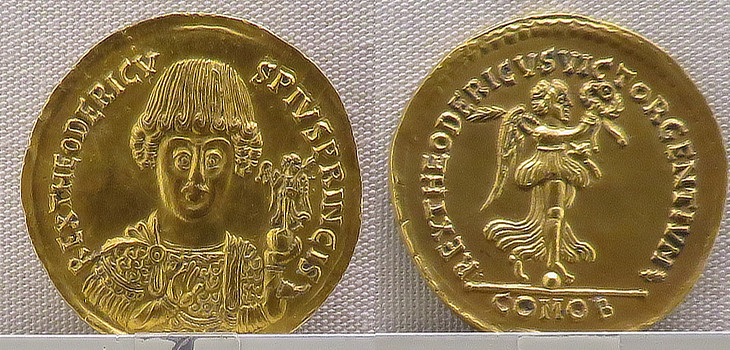
Museo Nazionale Romano: golden coin of the value of three "solidi" minted by Theodoric; inscriptions: King Theodoric Pious Prince and King Theodoric Conqueror of the Nations; notice the hand in a blessing gesture
At the end of Theodoric's reign quarrels arose with Emperor Justin I, who had oppressed the Arians living
in his territories. The king retaliated by persecuting some members of the old
Roman aristocracy. At his death in 526, relations between Ostrogoths and Italians
had worsened considerably. In Italy, after the fall of the Ostrogothic kingdom, his memory was damned.
The Goths living in Rome had their own churches: S. Agata dei Goti was one such church: it was
dedicated to the saint in 592 when the Arrianorum ecclesia was acquired by Pope Gregory the Great, but its name retained a reference to its former owners.

S. Pudenziana: mosaic of the apse (Vth century): detail (see a page on the mosaics in the churches of Rome)
We often associate Christian mosaics with a set of isolated characters on a golden or otherwise uniform background, chiefly because of those at Constantinople; the mosaics of S. Pudenziana show that initially Christian mosaics in Rome continued to follow the naturalistic approach of classic art and patterns of its iconography: Jesus was portrayed as an ancient senator wearing a traditional robe; at his left St. Paul was crowned in the same way the emperors returning from a victorious campaign were crowned, e.g. Titus; each character was given a very distinctive face; both the portrayal of the characters and the depiction of buildings showed compliance with perspective laws: although the city in the background was supposed to represent Jerusalem, it actually showed the temples and basilicas of Rome.
Athalaric, Theodoric's grandson and heir, was just ten years old when he became king.
He died in 534 without defining a clear line of succession: the contrasts among the Ostrogoths over who should
succeed Athalaric attracted the attention of Byzantine Emperor Justinian, who in 527 had
succeeded his uncle Justin. He thought the time had come to reunify the Roman empire under
a sole emperor and a sole creed.
In 533 Justinian's general Belisarius conquered the Kingdom of the Vandals in Africa. From there Belisarius
led a relatively small army into Sicily and, having easily conquered the island, he then landed in southern Italy.
He captured Rome in 536 and managed to defend the city against the Goths, who on that
occasion cut all the aqueducts of Rome. He then moved northwards and eventually in 540 he took Ravenna.

(left) "Torre di Belisario" between Porta Pinciana and Porta Salaria; (right) upper part of the right tower of Porta S. Paolo with a brick cross
Belisarius strengthened the defence of Rome by raising the height of some towers. According to tradition he also founded S. Maria a Trevi. He was then recalled to Constantinople
by Justinian because of threats on the eastern border of the empire; when he returned to Italy in 544, the Ostrogoths had regrouped
under the leadership of Totila, who had regained control of northern Italy with the exception of Ravenna and seized Rome. The last race in Circus Maximus occurred in 549 at the initiative of Totila.
Belisarius retook Rome, but without enough troops and supplies he was unable to conclude
the war. Justinian replaced him with Narses who eventually in 555 completely defeated the Ostrogoths
and restored the imperial rule over the whole of Italy. Justinian and his court were celebrated in large mosaics at S. Vitale in Ravenna.

(left) SS. Cosma e Damiano; (right) detail of the apse mosaic portraying St. Peter, St. Cosmas and St. Theodore
During the Ostrogothic rule some buildings of the Roman Forum were converted into churches:
Amalasuntha, Theodoric's daughter, gave to the Pope a library of Tempio della Pace and the adjoining circular
Tempio di Romolo: the two buildings were united to form a church
dedicated to Sts. Cosmas and Damian. Pope Felix IV (526-30) decorated the apse with a
very fine mosaic, which shows the development of new patterns. It is interesting to observe
that St. Peter was portrayed as an ancient Roman senator, while St. Theodore, a military saint, was depicted
as an imperial courtesan wearing an elaborate
silk dress which covered him almost entirely; he also wore socks. Nudity had been a cornerstone
of classic art; this mosaic shows how much things had changed.
The Greek-Gothic war had a very negative impact on the population of Rome: the effects of the
war were amplified by a pestilence, known as the plague of Justinian: the initial outbreak most likely originated
in Egypt, but it rapidly spread throughout the empire:
the plague did not go away for almost two centuries and during this period each generation
knew a more or less devastating pestilence.
The Byzantine administration did not have time to prompt the
economic recovery and the re-establishment of trade and communications,
when another misfortune hit Italy.
In 568 new invaders crossed the eastern Alps and rapidly gained control of northern Italy: they were
called Longobards, after their long lances or beards (eventually they gave their name to Lombardy, the region
around Milan).

Museo dell'Alto Medioevo in Rome: gold decoration of a Longobard saddle found in a grave
Similar to the Ostrogoths, the Longobards came from Pannonia (where they had been
allowed to settle by Emperor Justinian) and they were Arians. Unlike the Ostrogoths, however,
they were not familiar with the Roman civilization and did not have enough military strength
and skills to complete their conquest of Italy. The Byzantines, who could rely on a large
fleet, retained control of a coastal strip both along the Adriatic and the Tyrrhenian seas and of Sicily.
The Longobards did not have a centralized
government structure and their kings had only a nominal power over the local dukes
(the country was divided into 36 duchies, e.g. Cividale and Brescia): the unity of Italy was broken and never restored
for the following thirteen centuries. The Longobards did not conquer Rome, but they raided its countryside in 579 contributing to its impoverishment and abandonment. Pope Pelagius II, the founder of S. Lorenzo fuori le mura, had to pay a large amount to convince them to lift their siege.

S. Gregorio Magno al Celio (its monastery was founded by St. Gregory the Great): fresco (attributed to Pomarancio) portraying the vision of St. Gregory the Great
The gloomy events of the VIth century were in part enlightened by the action of St. Benedict,
the founder of western monasticism, who lived as a hermit at Subiaco and eventually founded many important monasteries. His motto Ora et labora (pray and work) led his followers to become involved in farming and
in preserving the ancient scientific knowledge.
In 590 a Benedictine monk became pope. Gregory I (St. Gregory the Great),
had also a civilian background and
had spent six years in Constantinople as representative of his predecessor Pelagius II.
The winter of 590 hit Rome in three ways: a flood, a famine and a pestilence:
Pope Gregory was leading a procession to S. Pietro, when, above the
fortified tower, which once had been Hadrian's Mausoleum, he saw an angel
sheathing his sword, a sign that the pestilence was coming to an end.
Pope Gregory realized that Rome could get little help from the Exarch, the Byzantine governor of Italy
who resided in Ravenna, and he almost took into his own hands the administration of Rome. In 593
the Longobards reached again the gates of Rome and according to tradition Gregory confronted
the Longobard king Agilulf on the steps of S. Pietro and convinced him to retreat. As a matter of fact it is more likely
that Gregory, who belonged to gens Anicia, a wealthy Roman family, paid for the siege to be ended.
With the help of Theodolinda, wife of two consecutive Longobard kings, Gregory favoured
the conversion to the Nicene Creed of prominent members of the Longobard aristocracy.
Historians see this and other actions by Gregory,
such as his role in the conversion of the Anglo-Saxons kingdom, as the first signs of the
future role of the popes as Western Patriarchs, a title that Pope Benedict XVI has chosen
to give up due to political sensitivities in 2006.
Rome was ruled by a Dux, who reported to the Exarch and who resided in the surviving buildings of the former imperial palace. The Longobards established a strong duchy at Spoleto in central Italy, and they easily cut communications between Ravenna and Rome when their relations with the Byzantines were tense (which was the usual situation). They had a garrison at Fara Sabina in the Tiber Valley and they controlled most of the inland territories of southern Italy through their Duchy of Benevento. The presence and the action of the Byzantine Dux must have had some periods of interruption, during which the popes had to act in his place by taking care of the administration of Rome. Notwithstanding Rome's historical relevance, the ruling Byzantine emperors treated it as a remote province of their empire.

Museo Nazionale Romano: "solidi" (golden coins) of Byzantine Emperors and their mints: (left) Justinian (Constantinople); (centre) Phocas (602-610 - Rome); (right) Constans II (641-668 - Ravenna)
Justinian's dream of restoring the ancient Roman empire was abandoned by his successors who had great difficulties in containing the threats posed by nomadic tribes such as the Avars in the Balkans and by the Sassanids in the Near East. Emperor Heraclius (610-41) dropped the Roman title of Augustus in favour of the Greek Basileus (see an example in a Byzantine fortress) and he replaced Latin with Greek as the Empire's official language. He engaged in a long war with the Sassanid King Khosrau II who had occupied Syria, Palestine and Egypt and was able to drive him off and eventually to defeat him in 627. But the long war had so much weakened both the Byzantines and the Sassanids that a few years later they were not able to resist the Arabs, who by 642 occupied Mesopotamia and most of Persia, as well as Syria, Palestine and Egypt.

Courtyard of Palazzo Mattei di Giove: imaginary XVIIth century portraits of Byzantine emperors
During the Byzantine administration because the Dux and a number of other Byzantine officers resided in the imperial palace, the Roman Forum retained its role of city centre. The reigning Byzantine emperors were celebrated by changing inscriptions on existing monuments or statues. Colonna di Foca was a column taken from a fallen building and placed on a base to celebrate Emperor Phocas in 1608. The main church used by the Byzantine officers and their families was dedicated to the Virgin - Santa Maria (Antiqua) - and it was built by enlarging an existing vestibule placed at the beginning of the steps leading to the imperial palace. In 625 Curia Julia, the hall which housed the Senate's meetings, was turned into a church dedicated to St. Hadrian of Nicomedia and an adjoining building became a chapel dedicated to St. Martina.

(left) S. Maria in Cosmedin: inscription celebrating the Byzantine "Dux" for having made a donation to the church;
(centre) S. Anastasia: reliquary; (right) S. Anastasia: martyrdom of the saint by M. Cerruti (1722)
A series of churches were built at the foot of the south-western part of the Palatine: S. Teodoro, S. Giorgio al Velabro, S. Anastasia and
S. Maria in Cosmedin. Saints Theodore, George, Anastasia (in Gr. Resurrection) were particularly venerated by the Byzantines.
While in the eastern provinces of the empire the worship of the saints (at that time mainly martyrs killed
during the persecutions) was subject to criticism,
in Rome many churches were dedicated to them.
The saints were also celebrated by honouring their relics (on a few occasions their entire bodies, more often
fragments of their bones); the reliquary of S. Anastasia
has relics of more than twenty saints: they are kept in containers which have the shape
of the part of the body from which the fragments were taken.
The cult of the saints had a great importance in favouring the acceptance of the
Christian faith in a city which for centuries had had a religion based on a variety of deities,
each of whom presided over a sacred location or an activity.
Depending on their background, the martyrs were regarded as patrons of the various craftsmen and
some of them, depending on aspects of their martyrdom, were regarded as
having a role in fostering the recovery from specific diseases. In the following centuries the Comuni, the town-states which arose in many parts of Italy placed themselves under the
protection of a saint; in their frequent naval battles, the Venetians shouted San Marco,
the Genoese replied San Giorgio and then they happily slaughtered each other.
At the time of Justinian the emperor was the de facto head of the Church: the appointment of bishops (and even of the four great patriarchs of Rome, Constantinople,
Antioch and
Alexandria) by the local clergy
had to be endorsed by the emperor.
Justinian himself convened an ecumenical council in Constantinople to condemn
new Arian, Nestorian and Monophysite writings, which he regarded as dangerous for the religious unity
of the empire. The pope, as the bishop of Rome was called, was regarded by the emperor as
having a supremacy among the patriarchs, but this privilege was easily withdrawn when the pope's views
did not meet the emperor's wishes.
For this reason some popes were deposed, imprisoned, exiled and even killed by order of the Byzantine emperors.
The decline of the Byzantine empire and its inability to effectively protect
Rome gradually led the popes to take a greater role in the government of the city, regardless of their religious views and of their country of origin.
Egypt had fallen into Arab hands in 642; the Arabs continued their move westwards
and in 698 they conquered Carthage, thus cutting trade routes between Rome
and northern Africa through which the city received most of its grain supplies.
After having vainly called for Byzantine help, the popes felt they had to find alternative sources of supply and they developed
direct "diplomatic" relationships with the Germanic kingdoms of western Europe.

S. Clemente: detail of the "transennae"; for other examples of "transenna" see a basilica at
Ephesus and remains of churches at Nicaea
In 663 Emperor Constans II visited Rome for twelve days: it was a short but rather rapacious visit
as he ordered the shipment to Constantinople of the bronze tiles of the Pantheon (which in 608 had been converted into a church); the bronze tiles never reached Constantinople, as they ended up in Arab hands. Constans II was welcomed by the pope, but he reaffirmed the emperor's role establishing
that the pope should report to the Patriarch of Ravenna, as that city was the seat of his exarch.
Works of art had travelled the other way round (from Constantinople to Rome) when Pope John II
(533-535) embellished
S. Clemente with elegant transennae forming a parapet separating the altar from the nave. They came
from Constantinople where they were developed as a form of elegant decoration which refrained
from all references not only to animal life, but even to the vegetable world: the letters of the Pope's name (JOHANNES) were used to decorate some transennae in what can be regarded as a sort of Byzantine calligraphic art (see other monograms at Constantinople and at Parenzo). The image used as a background
for this page shows a detail of another transenna at S. Clemente.
During the VIIth century the Longobards slightly expanded their territories in Italy by conquering Genoa
and the Italian Riviera, but they
were unable to unify them in a strong kingdom.
In 718 Emperor Leo III managed to resist an Arab siege of Constantinople and in 726 he faced
another Arab attack. The conflict between the Byzantines and the Arabs
had clear religious connotations: the latter claimed that the original Christian monotheism
had been turned into a pagan idolatry and cited the worship of images as supporting evidence of their claim.
In 727 Leo III thought that he would deprive the
Arabs of this justification by prohibiting paintings and statues inside religious buildings (iconoclasm).
In Italy Leo's edict was immediately opposed by Pope Gregory II and revolts broke out in Ravenna
and other towns. The Emperor retaliated by placing the Byzantine territories in Sicily and southern Italy under the authority of the Patriarch of Constantinople. The Longobards, who had abandoned the Arian creed, profited from the unrest and King Liutprand invaded the Byzantine possessions in northern Italy and easily occupied them from Bologna to Ancona, with the sole exception of Ravenna (which capitulated
in 737).

View of Sutri
In 728 Liutprand advanced towards Rome and sacked Nomentum, but at Sutri, a Byzantine castle which he had conquered, he was met by Pope Gregory II who convinced
him to withdraw his troops: in this context the king donated to the Pope the town of Sutri and other
nearby castles (e.g. Orte) which were eventually called Patrimonium Petri and became the first territory
under the formal rule of the pope.
A few years later the donation of Sutri was felt to be an inappropriate basis on which to justify the temporal
(related to worldly matters) power of the popes and a forged document (Donation of Constantine) claimed that Emperor Constantine had donated the city of Rome and the entire Empire to Pope Sylvester I.

(left) S. Maria in Cosmedin: detail of an VIIIth century mosaic from S. Pietro; (right) S. Saba: VIIIth century relief portraying a falconer
The Arab invasion of Palestine and Syria forced some
communities of monks to seek refuge in Rome where they founded the monasteries
of S. Saba and SS. Vincenzo e Anastasio alle Tre Fontane, thus
increasing the importance of eastern culture in Rome. Between 685 and 752 eight out of ten popes
were either of Greek or of Syrian origin.
The worship of images continued to produce fine mosaics: Pope John VII (705-07)
commissioned for S. Pietro a cycle of mosaics of which
only one has survived (now in S. Maria in Cosmedin): it demonstrates a skilled knowledge
of this technique while a relief at S. Saba, which is attributed approximately to the same period, testifies to the dramatic loss of expertise in a field where Rome had excelled. It is a rare case of
a Roman early medieval work of art not portraying a religious subject.
The following links show works of art portraying characters and events
mentioned in this page; they open in another window:
Belisarius as a beggar at Porta Pinciana by Jacques-Louis David at Palais des Beaux-Arts in Lille.
St. Gregory the Great by Peter Paul Rubens (1577-1640) at S. Maria in Vallicella.
Theodolinda crowns her second husband - XIXth century engraving.
The Donation of Constantine by Giovanni Francesco Penni (1496-1528) at Palazzo Apostolico.
Next page: Part II: Medieval Rome
II - The Iron Age of Rome
Previous pages: Part I: Ancient Rome:
I - The Foundation and the Early Days of Rome
II - The Early Republican Period
III - The Romans Meet the Elephants
IV - Expansion in the Eastern Mediterranean Sea
V - Pompey and Caesar
VI - Augustus
VII - From Tiberius to Nero
VIII - The Flavian Dynasty
IX - From Nerva to Marcus Aurelius
X - A Century of Turmoil (180-285)
XI - From Diocletian to Constantine
XII - The End of Ancient Rome


