
All images © by Roberto Piperno, owner of the domain. Write to romapip@quipo.it.


Notes:
Page revised in November 2022.
All images © by Roberto Piperno, owner of the domain. Write to romapip@quipo.it.
Notes:
Page revised in November 2022.
 Sutri - The Ancient Town
You may wish to see a map showing the towns covered in this section first.

Plan of Sutri from "George Dennis - The Cities and Cemeteries of Etruria - 1878 edition" (see a general view of the town today in the historical section)
Sutri is situated
on a long insulated rock of volcanic
tufa, forming, in combination with the
ravines by which it is surrounded, an
exceedingly striking picture. A bridge
formerly connected it with the high
table-land adjoining, but it was destroyed by the French in 1798.
John Murray - Handbook for travellers in central Italy - 1843
It was a bright but cool morning in October, when I left the comfortless inn of Baccano, and set out for Sutri. (..) Like most of the ancient towns in Southern Etruria, Sutrium stood on a plateau of rock, at the point of junction of two of the steep ravines which furrow the plain in all directions, being united to the mainland of the plain only by a narrow neck. The extent of the town, therefore, was circumscribed; the low but steep cliffs which formed its natural fortifications forbade its extension into the ravines. Veii, whose citadel occupied a similar position, crossed the isthmus, and swelled out over the adjoining table-land, just as Rome soon ceased to be confined to the narrow plateau of the Palatine. But the same principle of growth seems not to have existed in Sutrium, and the town appears never to have extended beyond the limits prescribed by nature.
George Dennis - The Cities and Cemeteries of Etruria - 1848
Sutri was thus precluded from attaining the dignity of a first-rate city, yet on account of its situation and strong natural position it was a place of much importance, especially after the fall of Veii, when it was celebrated as one of "the keys and gates of Etruria;" (claustra portaeque Etruriae); Nepete, a town similarly situated, being the other. As a fortress, indeed, Sutrium seems to have been maintained to a late period, long after the neighbouring Etruscan cities had been destroyed. (..) Sutri has four gates; one at the end of the town towards Ronciglione, another at the opposite extremity, and two on the southern side. (..) It is said that the two at the extremities have been formed within the last century. (..) Over that at the western end the claims of the town to distinction are thus set forth - "SUTRIUM ETRURIAE CLAUSTRA, URBS SOCIA ROMANIS COLONIA CONJUNCTA JULIA. Dennis

Southern side of Sutri showing evidence of ancient walls near Porta Franceta
The modern town occupies the site of the ancient, and is probably composed of the same materials. Not that any of the ancient "Sutria tecta" (roofs of Sutri) are extant, but the blocks of tufo of which the houses are constructed, may well have been hewn by Etruscan hands. (..) There are some fine fragments of the ancient walls on the south side of the town, and not a few sewers opening in the cliffs beneath them. (..) Though Sutrium was undoubtedly an ancient Etruscan city, we know nothing of its history during its independence. The first mention made of it is its capture by the Romans. It is singular that, in all the notices we have of it, we find it engaged in war, not like Veii with the Romans, but with the Etruscans. It was taken from the latter at an early period, probably in the year urbe condita 360 and in 371, it was made a Roman colony. From the date of its capture, so soon after the fall of Veii, it seems probable it was one of the towns dependent on that city; yet it is nowhere mentioned in such a connection. It was celebrated for the fidelity to its victors displayed in several sieges it sustained from the confederate Etruscans. The first and most remarkable was in the year 365, when it was besieged, as Livy tells us, by almost the whole force of Etruria, and compelled to surrender; and the miserable inhabitants were driven out, with nothing but the clothes on their backs. As the sad train was pursuing its melancholy way on foot towards Rome, it chanced to fall in with the army of Camillus, then on his road to relieve their city, which he imagined still held out. The dictator, moved by the prayers of the princes of Sutrium, by the lamentations of the women and children, bade them dry their tears, for he would soon transfer their weepings and wailings to their foes; and well did he keep his word. That self-same day he reached the town, which he found an easy prey, for the gates were unguarded, the walls unmanned, and the victorious Etruscans intent only on gathering the spoil. In a very short time he was master of the place; the Etruscans submitted almost without resistance, and ere night he restored the inhabitants to their homes, and reinstated them in their possessions. Thus Sutrium was taken twice in one day. Dennis

(left) Museo del Patrimonium: list of the Pontifices (highest religious magistrates) of Roman Sutri; (right) Town Hall: inscription celebrating Emperor Caracalla
Sutrium is subsequently mentioned by several ancient writers, and the last indication of its existence in classic times is given by an inscription of the time of Adrian. It seems never to have shared the fate of Veii - to have lain uninhabited and desolate for centuries; for its existence can be traced through the middle ages down to our own times. Dennis
Sutri adopted the political system which existed in Rome, including the appointment of a Pontifex Maximus, an office which was highly regarded by Emperor Augustus. The list of pontifices covers approximately a period from 41 BC to the middle of the Ist century AD. The town does not retain monuments of its Roman past inside the walls, because medieval and modern buildings have replaced them, but many reliefs, statues and inscriptions can be seen in its Town Hall and in two museums which were opened in the 2010s namely Museo del Patrimonium (Petri) in a former hospital and Museo di Palazzo Doebbing in the Bishop's Palace.
On descending from the Porta Romana, a perpendicular face of rock, on the right hand,
is seen tilled with sepulchral chambers,
many of which have traces of columns,
pediments, and architectural facades.
Several of these have apparently been
fronted with stone of a different quality,
but these ornaments have been removed,
and nothing remains but the cavities
which received them. These chambers
are well worthy of examination; and
indeed Sutri has been so little explored
that it offers a more ample field perhaps than any other Etruscan settlement so easily accessible from the high
road. Murray
As we approach the town on the Roman side, the rocks
on the left of the road are filled with tombs. They are cut in
the tufa, but many seem to have been fronted with more
durable stone-work. The cliffs are crested by grand old ilexes
which hang downwards in the most luxuriant masses of
foliage, unspoilt by the axe.
Augustus J. C. Hare - Days Near Rome - 1875.

S. Maria del Parto (Our Lady of Deliverance)
To the right rose a most picturesque height, crowned with a thick grove of ilex. Over a doorway in the cliff was this inscription: - "Here stay thy step; the place is sacred to God, to the Virgin, to the repose of the departed. Pray or pass on." Dennis
Several tombs had apparently been thrown together at a very early period of Christianity, and formed a
very long narrow Christian church, of which the pavement,
roof, pillars, and seats were all one, and all carved out of
the living rock. Hare
The church is part of a small archaeological area and it can be visited for only a few minutes in order to preserve its frescoes which are shown in page two.

S. Maria del Parto: interior
I entered, and found myself, first in an Etruscan sepulchre, and then in a Christian church - a little church in the heart of the rock, with three aisles, separated by square pillars left in the tufo in which the temple is excavated, and lighted by windows, also cut in the rock which forms one of the walls. It is believed by the Sutrini to have been formed by the early Christians, at a time when their worship was proscribed within the town. That it is of early date cannot be doubted. (..) A cavern adjoining the vestibule of the church, now a charnel-house, was full of human bones. The vestibule itself had originally been an Etruscan tomb, and the church, in all probability, another, enlarged to its present dimensions. Dennis
From the antechapel or entrance tomb,
still surrounded with its couches for the dead after the manner of Etruria, one looks down an avenue of low pillars
green with damp, and separated from the aisles by rock-hewn seats, to the altar, beyond which, from an inner sanctuary,
a light streams in upon the gloom. (..) It is a touching and most unearthly sanctuary, and carries one back to the earliest times
of Christian life and Christian suffering more forcibly than
the most celebrated Roman catacomb. Hare

Museo del Patrimonium: relief depicting Mithra slaying a bull (see a finer relief in Rome); it was found in 1896 in the environs of Sutri, but the exact location was not recorded at the time
What Hare believed was a symbol of Christian sufferings was instead a symbol of Christian triumph. Prior to being turned into a church, the long hall had most likely been a mithraeum, the gathering place of the followers of Mithra, a Persian god widely worshipped in Rome during the IIIrd century AD. Ceremonies took place in underground sites rather than in temples and were attended by small groups of initiates.
In 392, at the time of Emperor Theodosius, the Christian faith became the official religion of the Roman Empire and eventually the mithraeum was turned into a church. Many mithraea were found at Ostia.
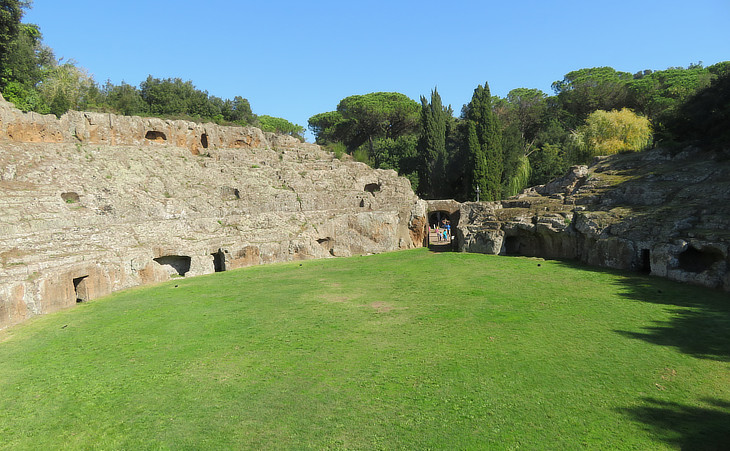
View of the Amphitheatre from its south-western side
At the
foot of another insulated eminence is
an ancient amphitheatre excavated in the tufa, and so
perfect as to deserve perhaps to be regarded as unique. The steps are worn
in some places, but all its corridors and
vomitories and six rows of its stages are
preserved. In a few places some brickwork may be recognised, but only where
there existed obvious deficiencies in the
rock; with this exception the amphitheatre has no masonry. Murray
On the top of the cliff, in which the church is excavated, stands the villa of the Marchese Savorelli, in a beautiful grove of ilex and cypress, which had attracted my eye on leaving the gate of Sutri. I walked through the grove to the further edge of the cliff, and lo! the amphitheatre of Sutri lay beneath me - a structure which, from its unique character, and picturesque beauty, merits a detailed description. Imagine a miniature of the Colosseum, or of any other amphitheatre you please, with corridors, seats, and vomitories; the seats in many parts perfect, and the flights of steps particularly sharp and fresh. Imagine such an amphitheatre, smaller than such structures in general, not built up with masonry, but in its every part hewn from the solid rock, and most richly coloured - green and grey weather-tints harmonising with the natural warm red hue of the tufo; the upper edge of the whole not merely fringed with shrubs, but bristling all round with forest trees, which on one side overshadow it in a dense wood, the classical ilex mingling with the solemn cypress; - and you have the amphitheatre of Sutri. The imagination of a Claude or a Poussin could not have conceived a sylvan theatre of more picturesque character. Dennis

View of the side of the Amphitheatre beneath Villa Savorelli
This curious relic of antiquity is an ellipse - the arena being, according to my measurement, one hundred and sixty-four feet in length, by one hundred and thirty-two in its greatest breadth. The doors in the podium open into a vaulted corridor which surrounds the arena. This corridor, with its doors, is of very rare occurrence found elsewhere, I believe, only at Capua and Syracuse. Above the podium rise the benches; at the interval of every four or five is a praecinctio or encircling passage, for the convenience of spectators in reaching their seats. (..) Above the upper corridor, on that side of the amphitheatre which is over-hung by the garden Savorelli, rises a wall of rock, with slender half-columns carved in relief on its face, and a cornice above, but both so ruined or concealed by the bushes which clothe the rock, as to make it difficult to perceive their distinctive character. In the same wall or cliff are several niches or recesses, some upright, high enough for a man to stand in; others evidently sepulchral, of the usual form and size of those in which bodies were interred. The upright ones, being elevated above the level of the praecinctio, were probably intended to hold the statues of the gods, in whose honour the games were held. Dennis

Amphitheatre: (left) steps leading to the upper part of the building; (centre) recess for special seats; (right) half-column in the cornice
Another peculiarity in this amphitheatre is a number of recesses, about half-way up the slope of seats. There are twelve in all, at regular intervals, but three are vomitories, and the rest are alcoves slightly arched over, and containing each a seat of rock, wide enough for two or three persons. They seem to have some reference to the municipal economy of Sutrium, and were probably intended for the magnates of the town. (..) This amphitheatre only within the last ten or twelve years has been cleared of the rubbish which had choked and the trees which had covered it for centuries, so that its existence was unknown to the early writers on Etruscan antiquities. We are indebted for its excavation to the antiquarian zeal of the Marquis Savorelli, its present proprietor. Dennis

Exterior of the Amphitheatre (south-western side) and one of the two entrances
The exterior of this structure exhibits no "arches upon arches," no corridors upon corridors - it is in keeping with the simplicity and picturesque character of the interior. Cliffs of red tufo in all the ruggedness of nature, coloured with white and grey lichens, hung with a drapery of ivy or shrubs, and crowned with the circling diadem of trees, with the never-to-be-forgotten group of ilexes and cypresses on the table-land above - Sutri itself, at a little distance on another rocky height, the road running up to its open gate, and its church-spire shooting high above the mass of buildings - the deep dark glens around, with their yawning sepulchral caverns, dashing the scene with a shade of mystery and gloom. Dennis
It is startling, when one turns
aside from the road and crossing a strip of green meadow
passes through a gap in the rocks, to find oneself suddenly in a Roman Amphitheatre, perfect in all its forms,
almost in all its details, with corridors, staircases, vomitories, and twelve ranges of seats one above the other, not
built, but hewn out of that solid rock, all one with the cliffs
which outwardly make no sign. Hare
Hare has made a great deal of delightful experience easier, but we hardly know whether to thank him. We see the mighty annual herd of tourists looming up behind him, and we sigh over the kindly obscurity that he has dispelled. It was thanks to their being down in no guide-book that he found many of the places he describes so charming; but he breaks the charm, even while he commemorates it, and he inaugurates the era of invasion.
From Henry James' review of Hare's book - The Nation 1875.
James was rather too pessimistic on the impact of Hare's book. The amphitheatre is now part of a small archaeological area, but it still charms the visitors. It was probably built at the time of Emperor Augustus when the population of Sutri was increased by the arrival of Roman veterans.

Museo di Palazzo Doebbing: Efebo di Sutri
A little down the road, in a range of tufo cliffs, are many sepulchral caverns; some remarkable for their sculptured fronts. (..) The father of the artist who accompanied me round Sutri (..) made profitable excavations. He had opened tombs in the ground above the sculptured cliffs, and had brought to light vases, bronzes, and other valuable relics of Etruscan date. Sutri has been so little explored, that it is probable many treasures of antiquity are yet to be found in its neighbourhood. The tombs hollowed in the cliffs have been rifled ages since, but those below the surface, with no external indications, have in some cases escaped the researches of former plunderers. It is among these alone that art-treasures are to be expected. Dennis
The finest Roman work of art which was discovered at Sutri is not related to the sepulchres. It was found by chance in 1912 outside the town in a field which did not show evidence of ancient buildings. Most likely it was buried in the ground on purpose. At first the statue was thought to portray Apollo, but it does not show any specific symbol of the god. The young man was probably holding a mirror to check his hairstyle. It is very similar to statues which were found in rich houses of Pompeii. It was kept at Museo Nazionale Romano at Palazzo Massimo, but in 2016 the City of Sutri managed to get it back.
 |
The Italian HourIn a country where everyone enjoys the day but the evening even more. sunset is an important moment. (..) Here when night falls, the day consisting of evening and morning is definitely over, twenty-four hours have been spent, and time begins afresh. (..) One soon gets used to it.J. W. Goethe - Italian Journey - Verona, September 17, 1796 - Translation by Elizabeth Mayer and W. H. Auden. This clock on the bell tower of S. Silvestro at Sutri was geared to indicate the Italian hour. It shows 6 rather than 12 hours and it has just one pointer (in this clock a ray of the sun, a heraldic symbol of Pope Urban VIII) ). The pointer reached 6 at sunset and this in every period of the year, because the clock was reset every two weeks to take care of the changes in the duration of daylight, thus the Italian hour indicated what was left of the day before sunset. When J. W. Goethe visited Italy in 1786 the Italian hour was still used in all parts of the country; he gave a very detailed explanation of how it worked in Italian Journey. The French occupation of Rome at the beginning of the XIXth century introduced the European hour, but in 1815 the State of the Church returned to the Italian hour and in 1827 Stendhal explained it to the readers of Promenades dans Rome. S. Pietro, S. Agnese in Agone, and Trinità dei Monti had two clocks which showed both the Italian and the European hour (which was called Ultramontana - beyond the mountains - with reference to the Alps). |
Move to Medieval and Modern Sutri.
From Civitavecchia to Civita Castellana - other pages:
Civitavecchia, Allumiere and Tolfa
Civitavecchia - Terme Taurine
Archaeological Museum of Civitavecchia
Oriolo Romano and Capranica
Oriolo - Palazzo Altieri
Bassano, Monterosi and Campagnano
Bassano - Palazzo Giustiniani
Nepi and Castel Sant'Elia
Civita Castellana
Museum of Agro Falisco at Civita Castellana


