
All images © by Roberto Piperno, owner of the domain. Write to romapip@quipo.it.


Notes:
Page revised in May 2024.
All images © by Roberto Piperno, owner of the domain. Write to romapip@quipo.it.
Notes:
Page revised in May 2024.
 at Madonna di Bracciano
All XVIIIth century travellers remarked on the poor state of the countryside north of Rome. President
Charles de Brosses wrote in 1739: The popes who, starting from Pope Sixtus V, did so much to embellish Rome, did nothing to
promote farming in the countryside, where one cannot see a single house, a single tree.
The popes followed a policy
of controlling the final price of the main agricultural commodities, which they tried to keep as low as possible by forbidding
the exportation of these crops and by directly importing them to reduce the impact on prices of occasional shortages (you may wish to see the granaries they built).
This policy eventually depressed the return of farming investments and favoured the concentration of the land in the hands
of Roman noble families or of religious institutions. These owners preferred to invest in the urban development of Rome rather
than in their farms. After the completion of the unification of Italy in 1870 a series of land reform bills favoured
the development of small properties and promoted intensive agriculture.

(left) 1924 Map of the area covered in this section; the red dots indicate locations which are covered in other pages of this website, namely Malborghetto, Prima Porta, Sepolcro di Nerone and Ponte Molle (Milvio); (right) Madonna di Bracciano, near La Storta
Storta, or La Storta, is a small village on the Via
Cassia, consisting of little more than the post-house and
its appurtenances; it stands on a high situation, and is rather more than nine miles from Rome.
Sir William Gell - The topography of Rome and its vicinity - 1834
This page deals with the countryside immediately north of Rome which
is in the process of being absorbed by the expansion of residential areas. The main road crossing the area is Via Cassia which
starts immediately after Ponte Milvio. At an old little chapel called Madonna di Bracciano three roads (marked in green in the map)
branch off Via Cassia and lead to some locations which still give an idea of the Roman countryside in the past centuries.

Fountain and watering trough at Osteria Nuova
The road is a carriage road; but it is not at all times a good one, beyond the Osteria Nuova, near Galera. Gell
At Madonna di Bracciano a road (Via Clodia) branches off Via Cassia to the left and leads to Bracciano. It joins Via Cassia again near
Sutri. At Osteria Nuova, the first crossroad, a hedge hides a 1749 fountain meant both for human and animal utilization.

Details of the fountain
The inscription commemorates the gift of a free water supply by Pope Benedict XIV to Collegio Germanico (an institution founded by Pope Gregory XIII in the second half of the XVIth century to promote Catholicism in Germany) which owned most of the land south of the Bracciano Lake.

Aqueduct with inscription and coat of arms of Pope Paul V near S. Maria di Galeria
Below Anguillara, the lake forms a little bay, from
the end of which, the river Arrone once carried off the
superfluous waters. At present the river is much reduced by the canal or aqueduct, which supplies the
splendid fountain of the Acqua Paola, anciently conducted by Trajan from sources above this lake. (..) The aqueduct is regulated by
a sluice, at a building called, as is usual in such cases, the Bottino. Gell
The Roman aqueduct was reactivated in 1612 by Pope Paul V and ended at Fontanone dell'Acqua Paola. The Pope placed his coat of arms and a lengthy inscription also where the aqueduct crossed Via Aurelia.

En route to S. Maria di Galeria
This road passes through a dreary country, by the
Osteria Nuova and the Osteria del Fosso, near Galeria; and thence through a still more bare
and desolate district. (..) Galeria was a small Etruscan city, beautifully situated on a little detached hill overlooking the valley of
the Arrone, at about sixteen miles from Rome, and on
the road to Bracciano. It may be seen from near the
Osteria del Fosso, but the beauties of the spot are not
to be distinguished without a near approach. Gell
The road to Bracciano turns to the left,
over a most dreary thistle-grown part of the Campagna, with
here and there a deep cutting in the tufa, and banks covered
with violets and crowned with golden genista. Only a short time ago the medieval town of Galeria had ninety inhabitants. Now
it has none. There is no one to live in the houses, no one
to pray in the church. Malaria reigns triumphant here,
and keeps all human creatures at bay. Even the shepherd
who comes down in the day to watch the goats which are
scrambling about the broken walls, would pay with his life
for passing the night here.
Augustus J. C. Hare - Days Near Rome - 1875.

S. Maria di Galeria: (left) entrance; (right) a "trattoria" under the pergola to the right of the entrance
Not far to the eastward is the convent of Santa
Maria in Celsano, prettily situated in the midst of a
cultivated and fertile country. (..) This is a large convent, near the depopulated town
of Galeria. The country around
belonging to the convent, is well cultivated, (forming a strong contrast to the barrenness of the country
toward Bracciano,) and is embellished with numerous
cypresses. Gell
At Osteria Nuova a short road leads to S. Maria di Galeria, the main farm of the estate belonging to Collegio Germanico.
Houses, stables and storerooms are arranged around a large courtyard which can be accessed only through a gateway decorated with a coat of arms of Pope Gregory XIII.

S. Maria di Galeria: main courtyard
The area was owned by Collegio Germanico until 1980 and it was not split into small parcels. S. Maria di Galeria is no longer a farm and in October 2012, when the pictures which illustrate this page were taken, its buildings were in the process of being refurbished.

S. Maria di Galeria: (left) coat of arms of Pope Gregory XIII; (right) relief above the entrance to the church
Santa Maria in Celsano, the church of S. Maria di Galeria, houses an image of the Virgin Mary which dates back to the early XIVth century. The portal has an interesting although much damaged relief showing the Virgin Mary in the act of stepping on a snake and a basilisk and of taming a lion and a dragon (Super aspidem et basiliscum ambulabis, conculcabis leonem et draconem - Psalms 91-13). The basilisk, a fabulous reptile, was a symbol of lust and in the late XVth century syphilis was also called the basilisk disease.

Details: A) 1822 clock in the courtyard indicating the Italian Hour; B) coat of arms of Pope Gregory XIII on a farm
near Osteria Nuova; C) column containing a siphon of the old aqueduct; D) ancient sarcophagus
Hoc tunc Vei fuere. Nunc fuisse quis meminit? Quae reliquiae? Quod vestigium?
(That, then, was Veii. Who remembers its existence now? What are the remnants? What are the traces?)
Florus - The Epitome of Roman History - 1.6.11 (early IInd century AD)

(left) Woods in the site where remains of Veii were found; (right) view of Isola Farnese
Travellers usually push on to La Storta, the first post-house from Rome, and beyond the ninth milestone on the Via Cassia. Hence it is a mile and a half to Isola by the carriage road; but the visitor, on horse or foot, may save half a mile by taking a pathway across the downs. When Isola Farnese comes into sight, let him halt awhile to admire the scene. A wide sweep of the Campagna lies before him, in this part broken into ravines or narrow glens, which, by varying the lines of the landscape, redeem it from the monotony of a plain, and by patches of wood relieve it of its usual nakedness and sterility. On a steep cliff, about a mile distant, stands the village of Isola - a village in fact, but in appearance a large château, with a few outhouses around it.
George Dennis - The Cities and Cemeteries of Etruria - 1848
Immediately after Madonna di Bracciano a short road to the right leads to Isola Farnese, a hamlet
on a small volcanic tufa rock which was believed to be the acropolis of Veii, an ancient Etruscan town.
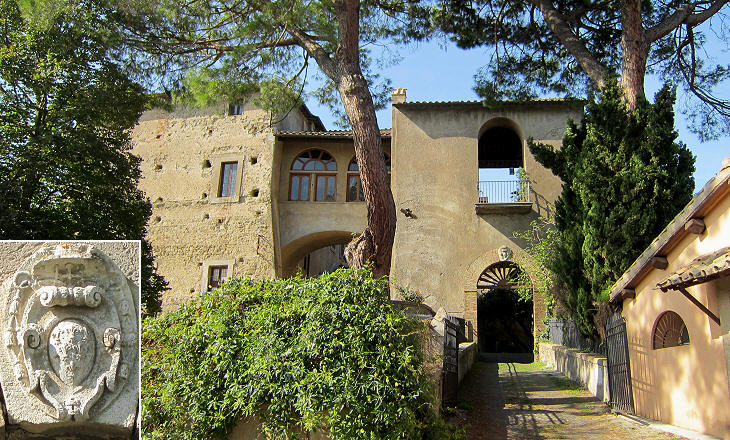
Farnese palace; (inset) coat of arms of a Farnese cardinal
At the last census the population was estimated at one hundred
and thirty-two; but the air is reputed unwholesome,
and at present half this number cannot easily be found.
There are several inscriptions in the village, which
belong to Veii. The deserted baronial house was formerly the property of the Farnese family. The site is exceedingly agreeable, and the great number of sepulchral excavations induce a belief that Isola was the
necropolis of Veii. Gell
Isola is a wretched hamlet of ruinous houses, with not more than thirty inhabitants. Even the palace, which belongs to the Rospigliosi family, is falling into decay, and the next generation will probably find the place uninhabited. Dennis
Isola Farnese belonged to the family of Pope Paul III who had several possessions north of Rome (Ronciglione, Caprarola,
Nepi and the Duchy of Castro). The main building was at the same time
a palace, a fortress and a farm.

(left) Entrance to Isola Farnese; (right) houses in the street leading to the palace
It is necessary to take Isola on the way to the ancient city, as the cicerone dwells there. This worthy, "Antonio Valéri at your service," is a big, burly man, swollen, you might think, with official dignity, did not his sallow cheek and haggard look betray the ravages of disease - the malaria fever, which either emaciates or bloats its victims. He who would make the tour of Veii must not expect to see numerous monuments of the past. Scarcely one Etruscan site has fewer remains, yet few possess greater interest. Veii lives in the page of history rather than in her extant monuments; she has no Colosseum, no Parthenon, no Pyramids. (..) The very skeleton of Veii has crumbled to dust.
Dennis
The site of one of the most celebrated cities of ancient Europe had been long a problem to perplex the antiquary; and on its discovery this once flourishing and martial city, still proud in its ancient reminiscences, is with difficulty recognised, having lost almost even its ruins. Of its stately edifices, its temples, theatres, forum, etc. scarcely a vestige remains; the bones of its inhabitants have crumbled into indistinguishable dust; and in their long sleep of oblivion their names and their memories have passed away as if they were not!
Rev. Jeremiah Donovan - Rome Ancient and Modern - 1844.

Parish church: (left) ancient inscription outside it; (centre) ancient capital used as a holy water font; (right) chapel with an elaborate decoration
In the little piazza are several relics of Roman domination, sculptural and inscriptive. Dennis
Isola Farnese has some decorated houses which indicate a degree of wealth, but in 1844 it was described by Rev. Donovan as a wretched village, the squalid population of which amounts to about 22 inhabitants. The small fiefdom was acquired by the Rospigliosi; according to Rev. Donovan the new owners let the Etruscan tombs in their estate to dealers in antiquities who caused great damage by searching for jewels and statues.

Museo dell'Agro Veiente at Formello (a town north of Isola Farnese): Tomba Campana (VIth century BC)
The solitary tomb which remains open in the necropolis of Veii was discovered in the winter of 1842-3. It is of very remarkable character, and its proprietor, the Cavaliere Campana, of Rome, so well known for his unrivalled collection of Etruscan jewellery, with that reverence for antiquity and excellent taste for which he is renowned, has not only preserved it open for the gratification of the traveller, but has left it with its furniture untouched, almost in the exact condition in which it was discovered.
When I first knew Veii, I had no interest in its necropolis; though a thousand sepulchres had been excavated, not one remained open, and it was the discovery of this tomb that led me to turn my steps once more to the site. As I crossed the ancient city, I perceived that the wood which had covered the northern side had been cut down, so as no longer to impede the view. The eye wandered across the valley of the Formello, and the bare undulations of the necropolis opposite, away to the green mass of Monte Aguzzo northwards, with the conical and tufted Monte Musino behind it, and the village of Formello on a wooded slope below - a wild and desolate scene, such as meets the eye from many a spot in the Campagna, and to which the baying of the sheep-dogs in the valley beneath me, and the sharp shriek of the falcon wheeling above my head, formed a harmonious accompaniment - and yet, whether from the associations connected with this region, or the elevating effect of the back-ground of glorious Apennines, it is a wildness that charms - a desolation that, to me at least, yields a delight such as few scenes of cultivated beauty can impart. From this point I descried the site of the tomb, in a hill on the other side of the valley of the Formello, where the deep furrows on its slopes marked recent excavations. The tomb, in compliment to its discoverer and proprietor, should be termed - Tomba Campana. Dennis
Marquis Giovanni Pietro Campana was a well-known collector, but to give prestige to the tomb which he found already violated and without grave goods, he placed vases and sphinxes coming from an excavation conducted near Orte. The tomb was characterized by two funerary chambers full of paintings, which have now almost completely disappeared. You may wish to see the painted tombs of Tarquinia.

Ashmolean Museum of Oxford: terracottas from Veii (ca 300 BC)
The city of Veii was not inferior to Rome itself in buildings, and
possessed a large and fruitful territory, partly mountainous, and partly
in the plain. The air was pure and healthy, the country being free
from the vicinity of marshes, which produce a heavy atmosphere, and
without any river which might render the morning air too rigid. Nevertheless there was abundance of water, not artificially conducted, but
rising from natural springs, and good to drink.
Dionysius of Halicarnassus - Roman Antiquities - Book XII.
The remains of this once populous Etruscan city
have, in the course of the last ten years, suffered so lamentably from spoliations perpetrated or permitted
by the owners of the soil, that it is necessary to take
particular notice of such relics as still attest the existence of a place of so much importance in the early
history of Italy. Gell
Vases, architectural elements, votive statues and other artifacts from Veii can be seen in all the major archaeological museums of the world, chiefly because of the importance given to the conquest of the town by Livy (Romans and Veientes were at war, and their rage and animosity were such that the end was clearly at hand for those that should be vanquished. Book V - Rev. Canon Roberts, 1912 translation). Veii blocked the northward expansion of Rome until it was seized and destroyed by Marcus Furius Camillus in 396 BC.

(left) Plan of Veii by Gell; (right) Collezione Patrimonio Regione Friuli Venezia Giulia: Francesco Caugic (1755-1828): Camillus enters the Temple of Juno
The story of the cuniculus, or mine of Camillus, is well known; how he carried up into the temple of Juno within the citadel (Arx) - how he himself led his troops to the assault - how they overheard the Etruscan aruspex, before the altar of the goddess, declare to the king of Veii that victory would rest with him who completed the sacrifice - how they burst through the flooring, seized the entrails and bore them to Camillus, who offered them to the goddess with his own hand - how his troops swarmed in through the mine, opened the gates to their fellows, and obtained possession of the city. (..) Of the cuniculus of Camillus no traces have been found. Not even is there a sewer, so common on most Etruscan sites, to be seen in the cliff beneath the Arx, though the dense wood which covers the eastern side of the hill may well conceal such an opening; and one cannot but regard these sewers as suggestive of the cuniculus, if it were not even a mere enlargement of one of them to admit an armed force. Dennis

Museo dell'Agro Veiente: coloured terracottas which decorated a building: (left) a side panel; (right) an antefix
One unusual field of pottery which became a particular Etruscan speciality was the creation of terracotta roof decorations. Terracotta panels were also used on the outside of buildings. They show scenes of a dinner or drinking party with guests lounging on benches; musicians and dancers (see some large panels at the Archaeological Museum of Viterbo). Antefixes were commonly placed on the eaves of a roof, in order to protect the end tiles from the elements. They often portrayed satyrs and gorgons who were believed to keep evil spirits at bay (see similar antefixes at Museo dell'Agro Falisco at Civita Castellana). The polychromy was obtained by a second or even third firing procedure.

Ruins of a sanctuary to Apollo and Minerva
Ten years have now elapsed since the author first visited the site of Veii; at which period he observed and noted on a plan, so many more vestiges than existed in the summer of 1830, that if the destruction or consumption of the materials of the ancient city be continued for a second ten years to the same extent, it is probable that not a stone will remain to testify to posterity the existence of this once potent rival of Rome. It is therefore of importance that an exact account should be given, not only of such vestiges as are yet to be found, but also of such as are known to have existed. The doubts which have been thrown over the early history of Rome, might, in all probability, in the course of another century, be extended, in default of monuments, to the story of the capture of Veii; and posterity might be induced by ingenious arguments, to discredit much of that which the present opponents of Livy and Dionysius are now willing to receive as portions of real history. Veii seems, indeed, peculiarly liable to be considered as a place of doubtful existence. Gell

Museo Nazionale Etrusco di Villa Giulia: painted terracotta statues from Veii depicting: (left) Latona with infant Apollo; (centre/right) Apollo and Minerva (VIth century BC)
Gell's fears that Veii could be forgotten would have been greatly allayed had he known that in 1916 archaeologists identified the site of a large sanctuary dedicated to Apollo and Minerva.

Museo Nazionale Etrusco di Villa Giulia: painted terracotta statues from Veii depicting Hercules (left) and Apollo (right) (VIth century BC)
Archaeologists found the fragments of painted terracotta statues of Apollo and Hercules fighting for the Ceryneian Hind which most likely stood on the roof of a large temple. The two gods were often portrayed fighting for the Tripod of Delphi. The Ceryneian Hind was captured by Hercules in his third labour (see a relief at Delphi and a Roman mosaic at Paros). The statue of Apollo is regarded as the most impressive example of the Etruscan life-size figure sculptures which decorated the roofs of their temples. Similar to other Etruscan statues, e.g. the Sarcophagus of the Spouses, it is characterized by an enigmatic smile.

(left) Section of the sanctuary where archaeologists found offers to Minerva; (right) a tunnel cut into the rock trough which water poured into a
pool adjoining the temple
The
extreme roughness of the ground renders an examination difficult; the
ascent is by no means inviting. It is lamentable, that
in a country so little cultivated, interesting traces of
antiquity, tending to confirm the truth of history,
should be suffered to disappear almost without record,
for the sake of a miserable and narrow stripe of corn,
and a few volcanic stones for mending the roads. Gell
The sanctuary was situated on a terrace in a very wooded area which was very difficult to reach and that today makes the sudden view of the ruins very evocative of past centuries (see the ancient shrine of Dodoni in the forests of Epirus).

(left) Portico of Palazzo del Vicegerente; (right) statue of Emperor Tiberius in the corridor linking
Museo Pio-Clementino to Braccio Nuovo
Following the line of the high ground to the east, I passed several other fragments of the ancient walls, all mere embankments, and then struck across bare down or corn-fields into the heart of the city. A field, overgrown with briers, was pointed out by Antonio as the site of excavations, where were found, among other remains, the colossal statue of Tiberius, now in the Vatican, and the twelve Ionic columns of marble, which sustain the portico of the Post-office at Rome. Dennis
Julius Caesar founded a town by the same name near the Etruscan one. Excavations in 1810-1814 led to the discovery of several inscriptions, some statues of the Ist century AD (now at Musei Vaticani) and sets of columns which were used to embellish Palazzo del Vicegerente and new S. Paolo fuori le Mura.

Museo Nazionale Etrusco di Villa Giulia: (left) VIIth century BC jug which was found at Monte Aguzzo in the Chigi property; (right-above) detail showing the three goddesses of Paris' judgement and a cavalryman; (right-below) ranks of hoplites (Greek soldiers with large painted round shields)
In 1882 chance excavations to enlarge a quarry led to the discovery of a tumulus-type tomb of a wealthy family of Veii. The jug which was found in the tomb was used for pouring wine at banquets and it was made at Corinth in ca 640 BC. It was decorated in a very detailed way with three painted and incised bands. You may wish to see a fine necklace which was found at Fidenae, a town allied with Veii.

Museo Nazionale Etrusco di Villa Giulia: Ist century AD mosaics depicting theatrical masks from Roman Veii
Recent archaeological investigations have found out that the mosaics decorated a thermal building which had also a religious purpose. The combination of a tragedy mask with a comedy mask can be noticed also in other mosaics, e.g. one found near S. Prisca.

Museo dell'Agro Veiente: votive terracottas and small statues which were found near Formello: among them a woman in oriental attire, an infant (see a similar one at Civita Castellana), Aeneas carrying Anchises and several statues of mothers holding a baby (see those at Capua)
The image used as background for this page shows a detail of the decoration of a VIIth century BC jar from the tomb in the Chigi property at Museo dell'Agro Veiente.
Move on to Formello and Sacrofano.


