
All images © by Roberto Piperno, owner of the domain. Write to romapip@quipo.it.


Notes:
Page revised in July 2026.
All images © by Roberto Piperno, owner of the domain. Write to romapip@quipo.it.
Notes:
Page revised in July 2026.
 Ponte Salaro
Links to this page can be found in Book 5 and in Environs of Rome.
The page covers:
The plate by Giuseppe Vasi
Today's view
Ponte Salaro
Fidenae
An April Walk to Via Flaminia (Torre Lazzaroni)

Ponte Salaro was named after Via Salaria, the road through which the inland regions north of Rome (such as Sabina) received the salt they needed for food preservation and cheese production. Ponte Salaro crossed
the Aniene near the point where this river flows into the Tiber; many foreign painters of the XVIIth and XVIIIth centuries depicted it in their Italianate landscapes, small oil paintings which they sold in their countries of origin; similar to them Giuseppe Vasi gave more relevance to the landscape than to the bridge in this 1754 etching; for a very different approach you may wish to see a view by Giovanni Battista Piranesi (it opens in another window) drawn at approximately the same time.
In the description below the plate Vasi made reference to: 1) Tavern; 2) Roman inscriptions;
3) Part of the Roman bridge; 4) Tower built by Narses; 5) Via Salaria towards Rome.
The small 1883 map shows: 1) Ponte Salaro; 2) Fontana
dell'Acqua Acetosa (which is covered in another page); 3) Via Flaminia.


The view in May 2010
Ponte Salaro was damaged and rebuilt several times since Vasi's etching; today's view would hardly be considered by a painter for inclusion in a landscape; only the tower above the tavern is still there and its tip is visible from the current bridge.

Ponte Salaro in 1840 by Friedrich Horner (by courtesy of Mr. Johannes Fichter)
The ancient Roman bridge was damaged during the Greek-Gothic War and it was repaired by Narses, a Byzantine general, who celebrated the event and his victorious campaigns by placing two long inscriptions at its centre. In 1799 the Neapolitans cut the bridge and the inscriptions fell into the Aniene. The tower on the bridge was most likely built in the VIIIth century and it was almost entirely rebuilt by Pope Nicholas V, who did the same at Ponte Nomentano; in 1840, as shown in the painting by Friedrich Horner, it did not exist any longer. In 1867 Garibaldi made an attempt to conquer Rome from the north with the help of an internal revolt. The French troops who defended the city blew up the bridge in order to check his advance and eventually defeated him near Mentana.

Modern bridge built on the foundations of ancient Ponte Salaro
The current bridge was built in 1870 and enlarged in 1930; a second bridge parallel to it was built after WWII to cope with the high volume of traffic caused by the urban development of Rome beyond the Aniene.

Ancient Roman tomb upon which a tower was built in the XIIIth century
The ancient Roman tomb at the base of the tower was popularly known as Sepolcro di Mario, a reference to Marius, the leader of a faction during the First Roman Civil War and whose body is said to have been exhumed and thrown into the Tiber four years after his death.
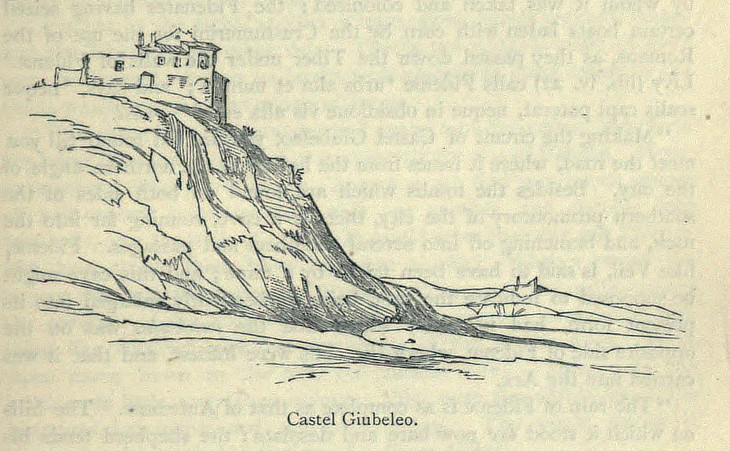
Castel Giubileo, the site of ancient "Fidenae" from "Augustus J. C. Hare - Days near Rome - 1873"
On the left of the road now rises an almost isolated hill, overlooking the valley of the Tiber, called Castel Giubeleo, from the farm-buildings upon it, which were erected by Boniface VIII. in the year of Jubilee. This hill is believed to have been the arx of ancient Fidenae.
Augustus J. C. Hare - Days near Rome - 1873
Dionysius of Halicarnassus (Roman Antiquities) gives forty stadia, or five miles, as the distance of Fidenae from Rome - probably from the ancient Porta Collina near Porta Salaria. At the fifth modern milestone is the Villa Spada, on this side of Castel Giubileo. (..) The city was large and may easily have filled the whole space between the fifth and sixth modern milestones, - or between the Villa Spada and Castel Giubileo. (..) Fidenae was an Alban colony but it is evident that the great mass of the original inhabitants were Etruscans. (..) The Fidenates were the constant allies of the Veientes, with whom they were probably connected by race. (..) By the fall and extinction of Veii, in the time of Camillus, the last hope of Fidenae was cut off; and the city, from that period, seems to have languished, and the population to have diminished.
Sir William Gell - The Topography of Rome and its vicinity - 1834

Museo Nazionale Romano: gold and glass paste necklace from a tomb of Fidenae (VIth century BC)
The faces of the rocks, in the vicinity, seem, in many places, to have been cut or quarried, possibly for building the walls of Fidenae. At the bridge, in the valley, one of the rocks is cut perpendicularly, and excavated into four or more caverns, like those commonly found in Etrurian cities. If these were sepulchres, and of ancient date, they were, probably, not within the city. Gell
The ruin of Fidenae is complete. The hills on which it stood are now bare and desolate: the shepherd tends his flock on its slopes, or the plough furrows its bosom. Its walls have utterly disappeared not one stone remains on another, and the broken pottery and the tombs around are the sole evidences of its existence.
George Dennis - The Cities and Cemeteries of Etruria - 1848
The initial part of this walk makes use of a very congested road which leads to a bridge across the Tiber; on the other side of the river, a cycling track offers the opportunity for visiting an area where many sport facilities are located.

The Mosque of Rome by Paolo Portoghesi seen from near Ponte Salaro

Tennis and soccer facilities

Views of Torre Lazzaroni. The tower is named after the family who bought it at the beginning of the XXth century; the Lazzaroni added to it medieval looking buildings, coats of arms and merlons. Similar to the tower of Ponte Salaro it was built above an ancient Roman tomb

Ippodromo Militare (Army Racecourse) di Tor di Quinto

Training grounds for golf and show jumping. Another golf player can be seen in the image used as background for this page

Cycling track near Via Flaminia
Next plate in Book 5: Fonte
dell'Acqua Acetosa.
Next step in your tour of the Environs of Rome: Ponte Nomentano.
Excerpts from Giuseppe Vasi 1761 Itinerary related to this page:
Ponte SalaroTre miglia fuori della porta Salara si vede il ponte del medesimo nome distrutto da Totila, e poi rifatto da Narsete nell'an. 39. dell'Imperio di Giustiniano, come si legge nella celebre iscrizione postavi dal medesimo. |


