All images © by Roberto Piperno, owner of the domain. Write to romapip@quipo.it.


Notes:
Page revised in September 2023.
All images © by Roberto Piperno, owner of the domain. Write to romapip@quipo.it.
Notes:
Page revised in September 2023.
 Collegio Germanico
Links to this page can be found in Book 9, Map C2, Day 4, View C6, Rione Ponte and Rione Sant'Eustachio.
The page covers:
The plate by Giuseppe Vasi
Today's view
S. Apollinare
Palazzo Altemps
Tor Sanguigna
Palazzo Baldassini

When Giuseppe Vasi published this etching in 1759 S. Apollinare and Collegio Germanico were one of the most recent additions to the monuments of Rome. The church was totally rebuilt in 1748 and the façade of the adjoining palace in 1755. They were both designed by Ferdinando Fuga at the request of Pope Benedict XIV. It is most likely that Vasi developed the plan for the book containing this etching when the Pope was still alive (he passed away in May 1758).
The view is taken from the green dot in the 1748 small map below.
In the description below the plate Vasi made reference to: 1) Palazzo Altemps; 2) Street leading to Strada dell'Orso;
3) Street leading to S. Agostino.
The map shows also 4) Collegio Germanico; 5) S. Apollinare; 6) Tor Sanguigna; 7) Palazzo Baldassini. The dotted line in the map delineates
the borders among Rione Ponte (left) Sant'Eustachio (lower right corner) and Rione Campo Marzio (upper right corner).

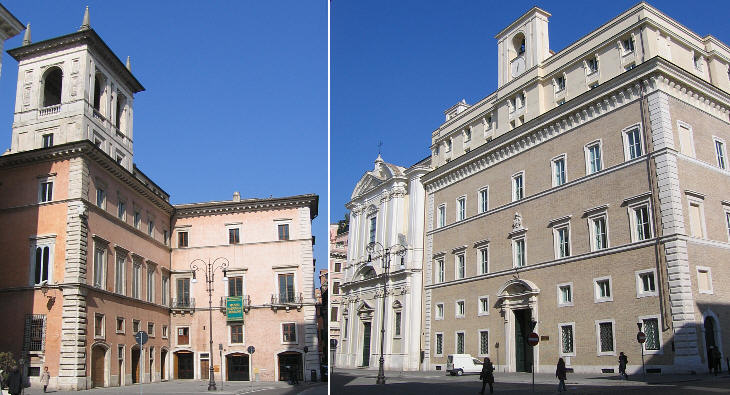
(left) Palazzo Altemps; (right) S. Apollinare and Collegio Germanico
Collegio Germanico has lost its proportions because of a top floor which was added in 1853 with a new clock. In 1776 it was enlarged with a new building near S. Luigi dei Francesi which had a façade identical to that designed by Fuga.
Palazzo Altemps is almost unchanged apart from the disappearance of a long balcony.
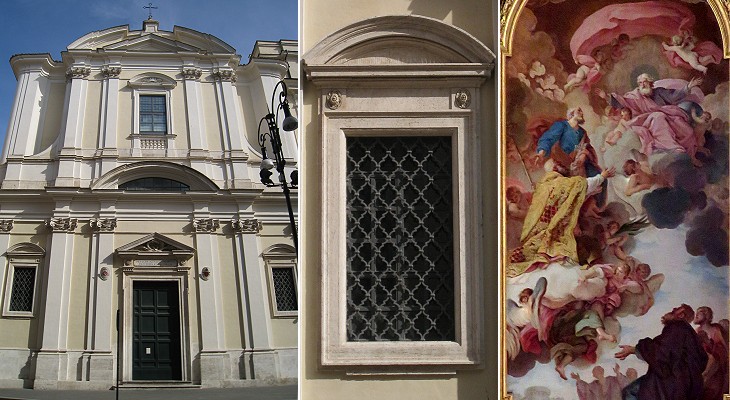
(left) Façade of S. Apollinare; (centre) one of the side windows; (right) Glory of St. Apollinaris by Stefano Pozzi in the ceiling of the nave
The original church was built in the VIIth century at a time when Rome was a Byzantine possession. The exarch, the governor of the Byzantine territories in Italy, resided at Ravenna and he had jurisdiction over Rome which was ruled by a dux. This explains why the church was dedicated to St. Apollinaris, a legendary disciple of St. Peter and the first Bishop of Ravenna to whom large basilicas were dedicated at Classe, the site of his martyrdom and in Ravenna itself.
The original church was repeatedly modified and the level of its floor was raised. In 1574 it was assigned to the Jesuits. You may wish to see it as it appeared in a 1588 Guide to Rome.
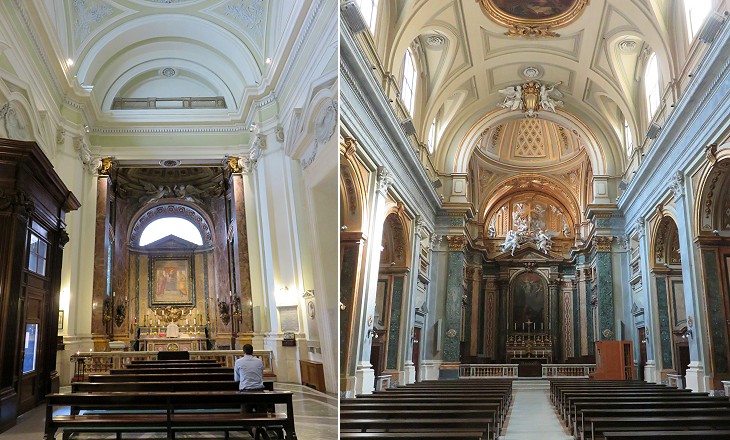
(left) Atrium which replaces an old portico; (right) interior
The old church had a portico with a fresco of the XVth century portraying the Virgin Mary which was the object of a special devotion. Fuga designed a sort of small church to house the sacred image. It has a south-north orientation whereas the new church is west-east oriented. Fuga paid special care to ensuring that the new church was well lighted, because the old one was renowned for its very dark interior.

(left) Dome; (right) St. Francis Xavier by Pierre Legros (1702)
The new church retained some of the works of art of the old one which were rearranged into new chapels. The statue of St. Francis Xavier is a fine work by Pierre Legros. The metal crab at the foot of the saint is a reference to an episode of his travels in the Far East: he lost a crucifix at sea during a storm and the crab brought it back to him. Pierre Legros worked for the Jesuits also at S. Ignazio and il Gesù.
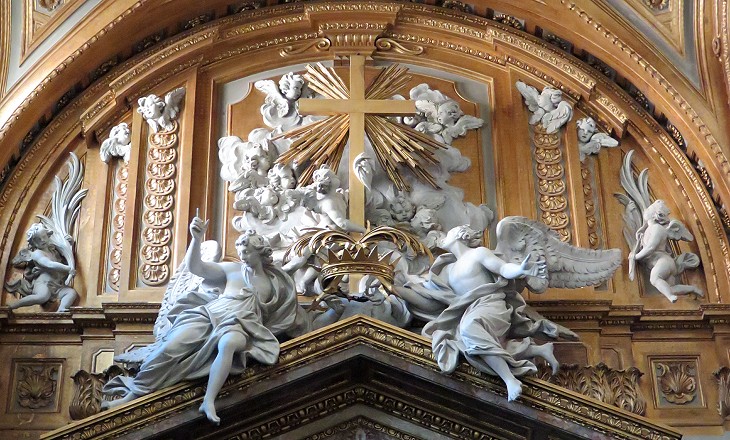
Marble angels and stucco cherubs above the main altar (1746) by Bernardino Ludovisi, another sculptor who worked for the Jesuits at S. Ignazio

Male goats, the main heraldic symbol of the Altemps: (above-left) at the top of the loggia with the five petaled rose of the Orsini (you may wish to see a page with other Roman loggias); (above-centre) in the courtyard fountain; (above-right) on a door); (below) on a monumental mantelpiece
Cardinal Marco Sittico Altemps was the son of Count Wolfgang Hohenems and Chiara Medici, sister of Pope Pius IV. He bought the palace in 1568 and he placed the heraldic symbol of his family (a rampant male goat) almost everywhere; in a few instances it was associated with the rose of the Orsini, because of the marriage of Roberto, Marco's natural son, to Cornelia Orsini in 1576. The palace was renovated between 1577 and the end of the century. Altemps is an Italian distortion of Hohenems.
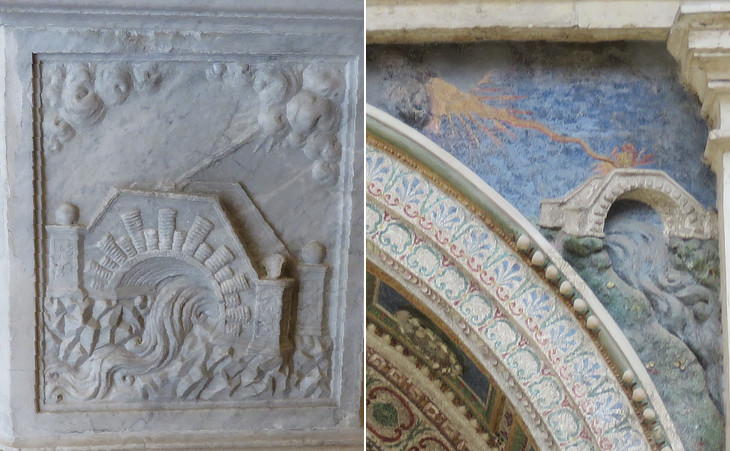
A bridge struck by a lightning, a less known symbol of the Altemps: (left) on a well head; (right) in the courtyard fountain
The symbol is thought to mean that the Altemps (the bridge) withstand human adversities (the dark water) and only divine intervention is superior to them. It might be based on Isaiah 45:8 You heavens above, rain down my righteousness; let the clouds shower it down and indicate the sense of justice of the family. A less elaborate interpretation suggests it derives from a family event, i.e. an ancestor of Cardinal Altemps falling from a bridge during a fight.

Coats of arms: (left) of Pope Pius IV (by looking more closely at it you will see the image used as background for this page); (centre) of Pope Leo XI; (right) of Roberto Altemps and Cornelia Orsini
The life of Marco Sittico Altemps was marred by a family tragedy: his son Roberto raped a young woman; usually such a crime, when committed by a nobleman, was covered up by providing the woman with a dowry and a husband. It was not so in this case because newly elected Pope Sixtus V decided to show that he was determined to enforce the rule of law in the Papal State and he sentenced Roberto to death. Vainly the old father invoked papal mercy by throwing himself at Sixtus' feet. He built a chapel in S. Maria in Trastevere in honour of Madonna della Clemenza as a sort of prayer for the soul of his son who is buried next to it. In 1595 the palace was inherited by his grandson Giovanni Angelo.
The courtyard was designed by Martino Longhi the Elder and it was decorated with stuccoes bearing the coats of arms of the Altemps and of the Orsini. It contains some of the ancient statues bought by the Altemps, but the palace is today best known for housing the collection which embellished Villa Ludovisi (it is one of the four locations of Museo Nazionale Romano).
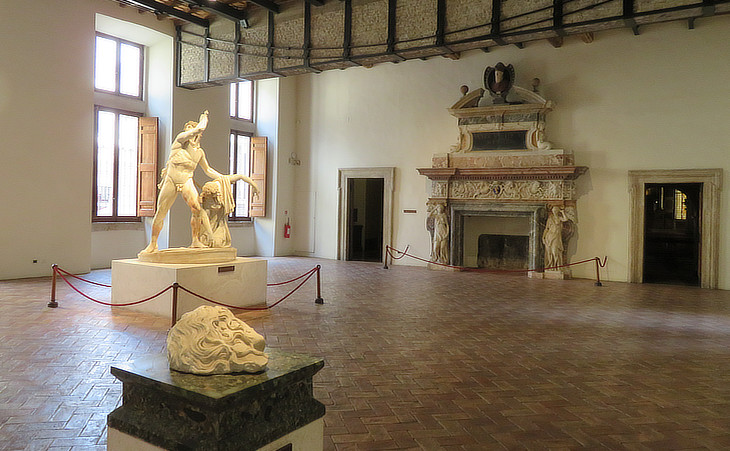
First Floor Great Hall with a monumental mantelpiece and the statue of the Ludovisi Gaul
During the XVIIIth century the Altemps rented the palace or parts of it. They eventually sold it in 1887 and the building was partitioned and redecorated. The Great Hall where the Altemps entertained their guests has been brought back to its original size and shape, but its decoration and furniture are lost.
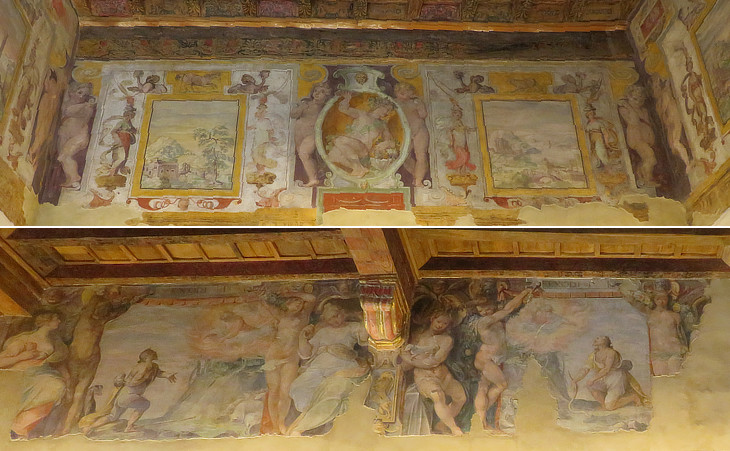
(above) Sala delle Quattro Stagioni (Hall of the Four Seasons) in the Apartment of the Cardinal; (below) Sala dei Palafrenieri (Hall of the Grooms)
Some rooms near the Great Hall retain the original decoration in the upper part of their walls. That in the Apartment of the Cardinal is based on small landscapes and grotesque subjects which are accompanied by images associated with the passing of time and the change of the seasons. The decoration of the Hall of the Grooms is based on the ten plagues inflicted by Moses on the Egyptians. The religious subjects however are depicted as a fake tapestry held by naked figures. These frescoes are attributed to Pasquale Cati who painted the walls of Cappella di S. Maria della Clemenza.
You may wish to see the frescoes of the Papal Apartment in Castel Sant'Angelo.
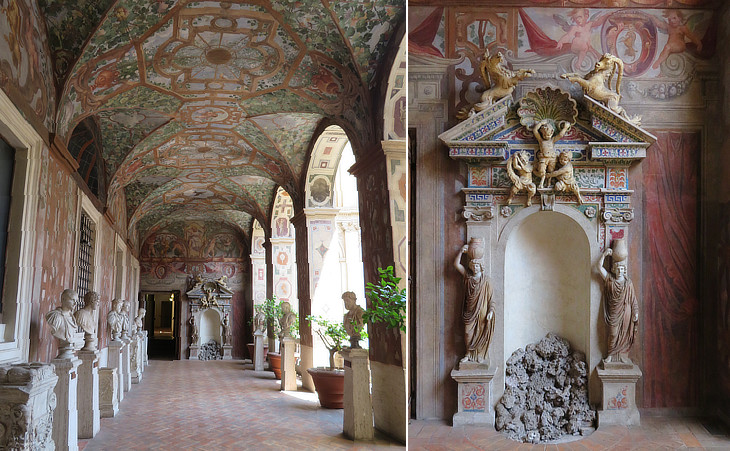
Northern loggia and the fountain at its end
The loggia was decorated as an outdoor garden with a small fountain similar to those which Cardinal Ippolito d'Este had in his palace at Tivoli. The frescoes on the ceiling completed the illusion.
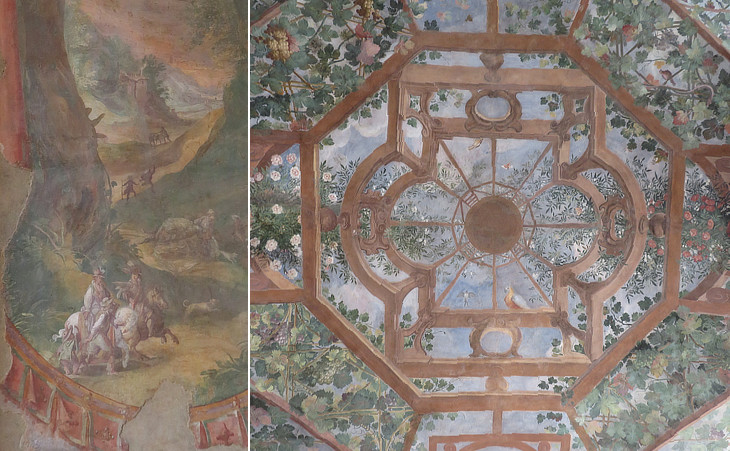
Northern loggia: (left) detail of a fresco on a side wall depicting a landscape and a hunting scene, a subject which was made popular in Rome by Flemish painters, e. g. Paul Bril; (right) ceiling depicting an aviary by Antonio Viviani which recalls to mind those at Villa Giulia and at Palazzo Farnese di Caprarola; see other works by Viviani at Palazzo Barberini and S. Girolamo degli Schiavoni
The palace was completed by Giovanni Angelo Altemps who built a chapel adjoining the northern loggia (you may wish to see a detail of its decoration). He owned also Palazzo Rospigliosi, a small villa outside Porta del Popolo, fiefdoms and other villas near Frascati, the town of Soriano al Cimino and the Duchy of Gallese.
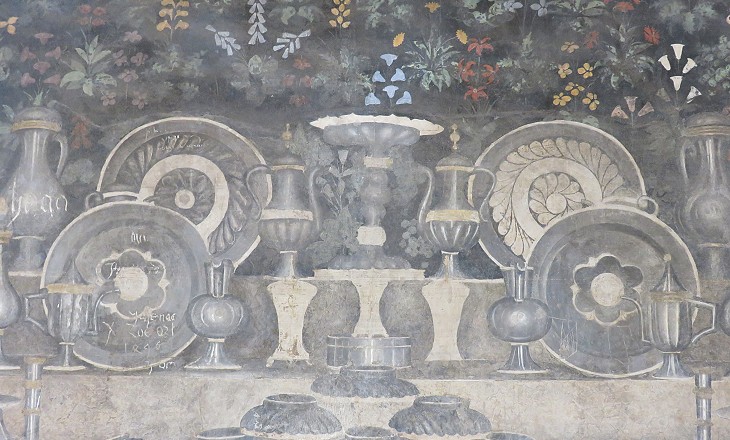
In 1982 Palazzo Altemps was bought by the Italian State and efforts were made to recover its original decoration. One room had a fresco depicting tableware, most likely that which was employed for the banquet of the wedding between Girolamo Riario, nephew of Pope Sixtus IV, and Caterina Sforza in 1477. The palace was originally built for the Riario. In 1511 they sold it to Cardinal Francesco Soderini of a Florentine noble family allied with the Medici.

Sala delle Prospettive, in origin it must have been similar to that at la Farnesina
Sala delle Prospettive was most likely painted in 1513-1517 by Maturino da Firenze and Polidoro da Caravaggio when the palace belonged to Cardinal Soderini. Polidoro da Caravaggio is best known for his graffito decoration of façades (e.g. at Palazzo Ricci).
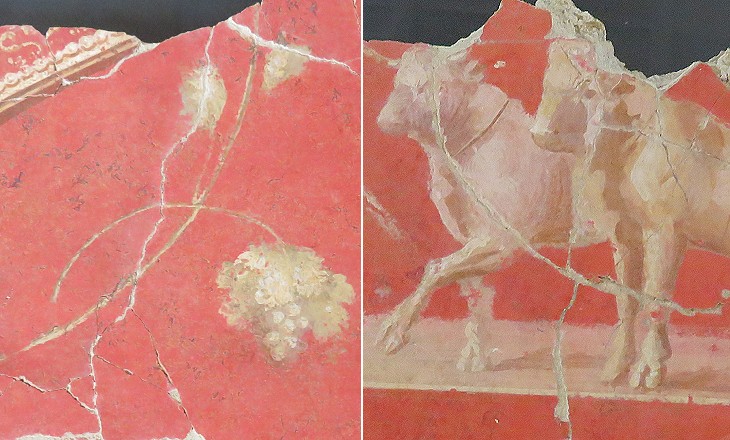
Fragments of Roman frescoes
By searching for evidence of the history of the palace in 1991 restorers discovered that the building stood over a Roman house of the Ist century AD. They recovered fragments of its frescoes; they were painted on a red background which is typical of Pompeii. The house was not very far from Stadio di Domiziano.
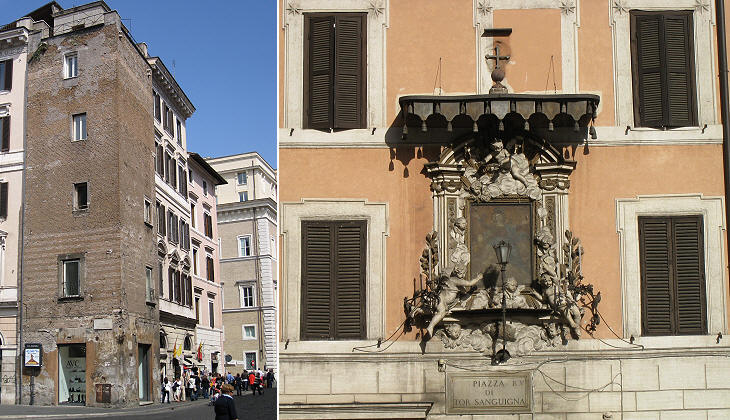
(left) Tor Sanguigna; (right) a very rich XVIIIth century "madonnella" in Piazza di Tor Sanguigna
Sanguigna means sanguine, but the name of this medieval tower is not associated with bloody events; it is just named after its owners, the Sanguigni family. The tower shows a structure made of layers of bricks and of layers of small blocks of tufa (i.e. opus listatum). The Sanguigni had embellished the old church of S. Apollinare, but when it was rebuilt in 1748 the family was extinct and these embellishments were lost. The palace opposite the tower has one of the finest madonnelle of Rome.
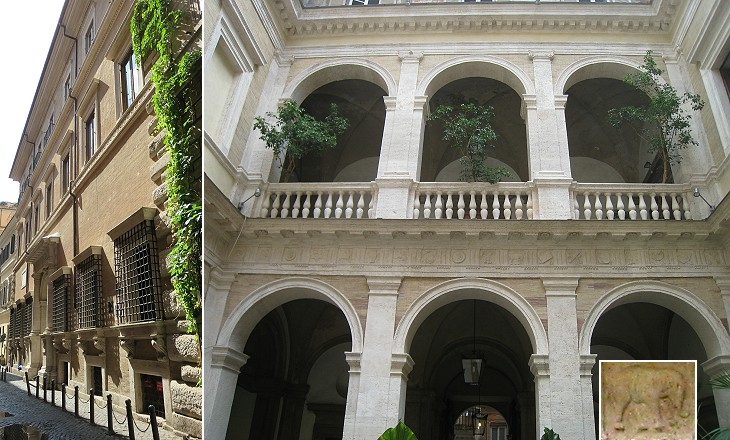
(left) Portal; (right) courtyard; (inset) detail of its decoration depicting an elephant
Palazzo Baldassini was quoted in Filippo Titi's 1674
Studio di Pittura, Scoltura et Architettura, which is considered the first detailed description of Renaissance and Baroque Rome, but it was forgotten in most of the guidebooks which followed.
Actually the narrowness of the street does not permit a proper view of the palace façade which was designed
by Antonio da Sangallo the Younger for Melchiorre Baldassini, an adviser to Pope Leo X.
The courtyard has a fine loggia, typical of Renaissance buildings, and a detail of its decoration is a reference to the Pope because it depicts Hanno, a white Indian elephant which was donated to him by the King of Portugal in 1514. Pope Leo was very fond of his big pet which attended processions and other ceremonies. You may wish to see Hanno in a fine drawing by Raphael (it opens in another window with an image of an actual Indian elephant at the Zoo of Rome) and a conventional depiction of an elephant prior to the arrival of Hanno.
Next plate in Book 9:
Collegio di Propaganda Fide.
Next step in Day 4 itinerary:
Chiesa di S. Simeone Profeta.
Next step in your tour of Rione Sant'Eustachio:
S. Salvatore alle Coppelle.
Next step in your tour of Rione Ponte:
S. Maria della Pace
Excerpts from Giuseppe Vasi 1761 Itinerary related to this page:
Collegio Germanico, e chiesa di s. ApollinareDa Adriano I. fu eretta questa l’anno 772. per abolire il nome di Apolline, che quivi aveva il tempio. Ottenuta poi da s. Ignazio di Lojola l'anno 1552. insieme col palazzo del Card. Pietro di Luna, già Antipapa, vi stabilì il collegio che poi da Gregorio XIII. fu provveduto di sufficienti entrate per lo mantenimento di cento alunni, che devono essere tutti Tedeschi. Da Benedetto XIV. fu fatta di nuovo la chiesa, ed il collegio con disegno del Cav. Fuga. Nel portico si venera la immagine della ss. Vergine, che era nell' antico portico, ed il battesimo di Gesù Cristo è opera di Gaetano Lapis. La volta della chiesa dipinta da Stefano Pozzi, ed il quadro nell' altare maggiore tutto ornato di preziosi marmi, e metalli dorati è di Ercole Ferrari Bolognese. La statua di s. Francesco Saverio è di Monsù le Gros, ed il s. Ignazio incontro di Carlo Melchion; il s. Giovanni Nepomiceno è di Placido Costanzi, ed il quadro incontro di Niccolò Ricciolini; quello nella sagrestia è Niccolò Bonito, e le pitture nella volta di Corrado Giaquinto.Palazzo AltempsIncontro alla riferita chiesa è questo palazzo adorno di statue, busti, e colonne di porfido, e di giallo antico; ma il maggior ornamento è la cappella domestica ornata similmente di marmi, e pitture, in cui fra le altre reliquie si conserva il corpo di s. Aniceto Papa cavato dalle catacombe di s. Sebastiano, in tempo di Clem. VIII. il quale lo donò a questa nobilissima famiglia; che perciò vi celebra ogni anno la festa, e l'ottava con pubblica solennità. Corrisponde questo palazzo in due altre piazze, una, che dicesi di Torresanguigna, e l'altra piazza Fiammetta, e vi sì vedono due nobilissimi palazzi uno de' Sagripanti, già Corsini, con disegno di Bramante, ed altro di Sampieri. |