
All images © by Roberto Piperno, owner of the domain. Write to romapip@quipo.it.


Notes:
Page revised in April 2022.
All images © by Roberto Piperno, owner of the domain. Write to romapip@quipo.it.
Notes:
Page revised in April 2022.
 Piazza Navona - page two
Links to this page can be found in Book 2, Map C2, Day 4, View C6 and Rione Parione.
The page covers:
Palazzo Lancellotti
S. Giacomo degli Spagnoli
Palazzetto del Vignola
Stadio di Domiziano
a previous page covers:
The plate by Giuseppe Vasi
Today's view
Palazzo Pamphilj
S. Agnese in Agone
Fontana dei Quattro Fiumi
Fontana del Moro
Fontana del Nettuno
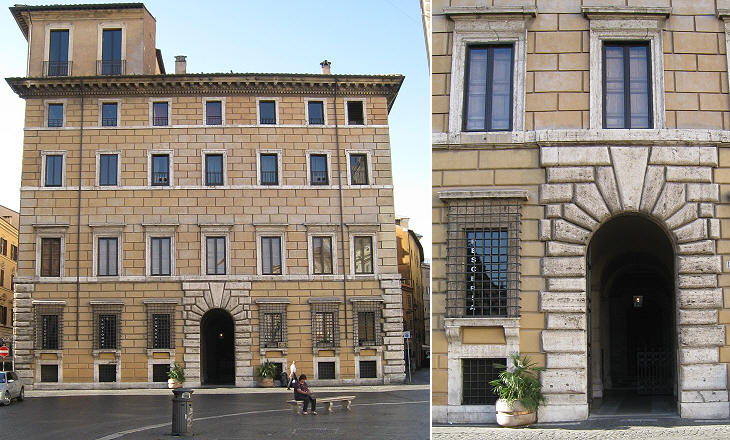
(left) Palazzo Lancellotti; (right) detail of its entrance
Most of the views of Piazza Navona are taken from its southern side. Thus Palazzo Lancellotti ends up by being neglected. It is a pity because this palace is a fine work by Pirro Ligorio. It was built in 1552 for Ludovico de Torres, Archbishop of Salerno. Other de Torres founded the nunnery of S. Ambrogio della Massima and restored S. Pancrazio. The building was acquired by the Lancellotti in the XVIIth century. Their main palace is situated in Via dei Coronari and a villa at Frascati is named after them.

(left) Courtyard; (right) ancient torso with a head portraying Alexander the Great. It resembles that in the former gardens of Villa Ludovisi. The image used as background for this page shows an ancient mask in another courtyard

(left) S. Giacomo degli Spagnoli (today Nostra Signora del Sacro Cuore); (right) eastern side of Piazza Navona
S. Giacomo degli Spagnoli was built in 1450 for the Spaniards from Castile and Leon. Those from Aragon, Catalonia and Valencia had a separate church in Via di Monserrato. S. Giacomo degli Spagnoli was among the most important churches of Rome for more than two centuries. The political decadence of Spain brought about that of the church. It was closed between 1829 and 1881 when its façade in Piazza Navona was redesigned. It had another (lost) façade opposite Archiginnasio della Sapienza. You may wish to see its two façades as they appeared in a 1588 Guide to Rome.
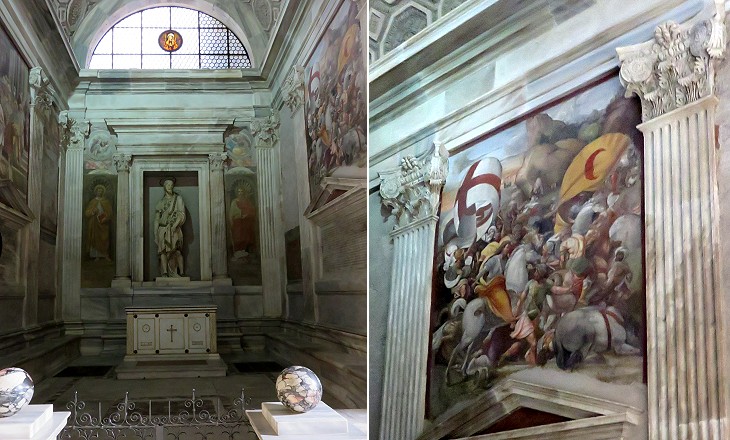
(left) Chapel designed by Antonio da Sangallo the Younger; (right) Battle of Clavijo by Pellegrino da Modena. This legendary battle was fought in 824 in northern Spain. The Christian army defeated that of the Emir of Cordoba with the help of St. James the Apostle who personally acted as commander
In 1936-1938 the size of the church was reduced to make room for a new street and its eastern section was demolished. The interior retains only a limited part of its XVIth century decoration. You may wish to see a directory of national churches in Rome.

Portal by Pietro Torrigiani (1500) and details of its decoration
The portal of the façade in Piazza Navona was moved to the new one opposite Archiginnasio della Sapienza. It shows a decoration which included military trophies, similar to what can be noticed in other churches of the same period, e.g. Santa Aurea at Ostia. The dolphins of the lintel are a decorative motif which was copied from Basilica di Nettuno which is not far away.
The church and the adjoining buildings, as well as other buildings belonging to the Spanish community are decorated with the xenodochion, a shell with a pin, a symbol of the pilgrims on the route to St. James of Compostela, a sanctuary in Northern Spain (xeno in Greek means foreigner). They wore a badge or an embroidery having the shape of a shell.

(left) Courtyard; (right) details of its decoration
Giacomo Barozzi da Vignola was a leading Italian architect in the 1540-570 period. Villa Giulia, Palazzo Farnese di Caprarola, il Gesù and Villa Lante di Bagnaia are some of the monuments he designed (they were often completed by other architects). His name is traditionally associated with an elegant Renaissance courtyard inside a house in the north-western section of Piazza Navona.

(left) Reconstruction of Stadio di Domiziano; (right) travertine external pillars and brick structure, similar to that of Colosseo
Not far from a House in the Street call'd Madama were found large Pilasters of Tivoli Stone (travertine), on one of which were the Remains of Steps, formerly us'd for Spectators to sit on, and thence they could see into the middle of the Amphitheatre. Such Steps as those were found in the present Brasier's Shops, which are at the end of the Navona Street. The like have also been seen in the Church of St. Agnes. (..) It is reported that Pasquin was found there, who I believe was at the upper end of the Amphitheatre, where the Festival was kept, and the Street still retains the Name of Agon.
Flaminius Vacca's 1594 account of discoveries of antiquities which took place in his lifetime, as quoted in "The Travels of the Learned Father Montfaucon from Paris thro' Italy - 1712"
The historical section of this website has some background information and other images of the stadium built by Emperor Domitian in 86 AD. Significant ruins were found in 1936 under three buildings in the northern section of Piazza Navona.

Southern side of Piazza Navona
You may wish to complete your tour of the monuments of Piazza Navona by visiting Palazzo Santobono Bracci at its southern end.
Next plate in Book 2: Piazza di Pasquino.
Next step in Day 4 itinerary: Piazza di Pasquino.
Next step in your tour of Rione Parione: Piazza di Pasquino.
Excerpts from Giuseppe Vasi 1761 Itinerary related to this page:
Chiesa di s. Giacomo degli SpagnoliDa un Infante di Castiglia fu da primo edificata questa chiesa sulla divisata piazza Navona, e poi riedificata l'anno 1440. da D. Alfonso Paradinas Vescovo di Rodrigo in Spagna, e fu dedicata a s. Giacomo Apostolo, ed insieme a s. Idelfonso Vescovo: e sebbene sia senza buon ordine di architettura è però ornata di nobilissime cappelle con marmi, sculture, e pitture celebri. Il quadro dell'Assunta nella prima cappella a destra è di Francesco da città di Castello, e le pitture nella volta sono di Pierin del Vaga; la Resurrezione, che siegue è di Cesare Nebbia, e la volta di Baldassar Croce. Le pitture sopra l'altare della Madonna sono del detto Nebbia, e la testa di marmo a destra della sagrestia è del Bernini. La statua della Madonna è di Tommaso Boschi, e le pitture di Giulio Piacentino. Il ss. Crocifisso nell'altare maggiore è del Sermoneta, e i due Santi laterali, di Onofrio Avellino; la statua di s. Giacomo nella cappella di fianco è del Sansovino allora giovane, e le pitture laterali di Pellegrino da Modena discepolo di Raffaelle. Le pitture a fresco, ed il quadro nella cappella di s. Diego sono di Annibale Caracci; alcune istorie però nella parte di fuori sono dell'Albani, e del Domenichino suoi allievi, e quelle nella sagrestia sono di Anastasio Fontebuoni. Unito a questa chiesa evvi lo spedale per li nazionali, e la casa per li Preti Spagnuoli, che ne hanno cura.Palazzo Lancellotti, e SantobonoA capo di piazza Navona sono questi due palazzi divisi dal vicolo, che dicesi della Cuccagna; a destra è quello de' Lancellotti, eretto con disegno di Pirro Ligorio. |


