
All images © by Roberto Piperno, owner of the domain. Write to romapip@quipo.it.


Notes:
Page revised in April 2026.
All images © by Roberto Piperno, owner of the domain. Write to romapip@quipo.it.
Notes:
Page revised in April 2026.
 Archiginnasio della Sapienza
Links to this page can be found in Book 9, Map C2, Day 4, View C6 and Rione Sant'Eustachio.
The page covers:
The plate by Giuseppe Vasi
Today's view
Archiginnasio (University) della Sapienza (Wisdom)
- S. Ivo alla Sapienza
- A Speaking Decoration
Biblioteca Alessandrina and Teatro Valle
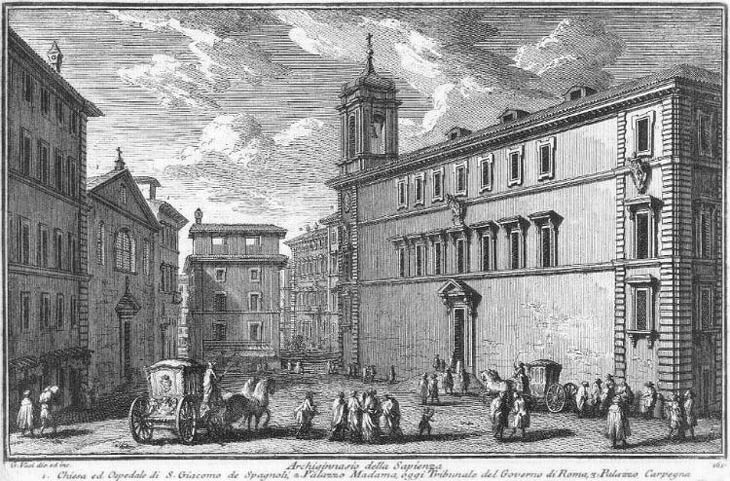
In 1759 Giuseppe Vasi published his ninth book of etchings showing the monuments of ancient and modern Rome. It covered a miscellanea of buildings ranging from colleges to hospitals and hospices for the poor. He opened it with a view of Archiginnasio della Sapienza, the most important high-level educational institution of Papal Rome (arch is a prefix meaning pre-eminent of its kind).
The view is taken from the green dot in the 1748 map below.
In the description below the plate Vasi made reference to: 1) S. Giacomo degli Spagnoli; 2)
Palazzo Madama; 3) Palazzo Carpegna. These monuments are shown in other pages. The small map
shows also 4) Archiginnasio della Sapienza; 5) S. Ivo alla Sapienza; 6) Biblioteca Alessandrina; 7) Teatro Valle. The dotted line in the small map delineates
the border between Rione Parione (left) and Rione Sant'Eustachio (right).


(left) The view in January 2009; (right) detail showing Palazzo Madama (left, with the flags), Palazzo Carpegna (centre) and the corner of Archiginnasio della Sapienza (right)
The very narrow street between Archiginnasio della Sapienza and S. Giacomo degli Spagnoli was enlarged in 1936-1938 by shortening the nave of the latter and building a new façade in a backward position; the block of houses which is visible at the centre of the plate was demolished so that the view reaches the left side of Palazzo del Collegio Germanico. Palazzo Madama is now hidden by Palazzo Carpegna which was pulled down and rebuilt in a slightly forward position, in line with the façade of Archiginnasio della Sapienza. The street was renamed Corso Rinascimento: see it from Palazzo Carpegna and near S. Andrea della Valle.

1) Bell tower with the heraldic symbols (three mountains and a star) of Pope Sixtus V; 2) inscription on the façade; 3) lantern of S. Ivo seen through the central window; 4) clock surrounded by bees, heraldic symbol of Pope Urban VIII who placed a sun, another of his heraldic symbols on the southern side of the building
The institution was founded by Pope Boniface VIII with the name of Studium Urbis and it was located in Trastevere. During the XVth century it was moved to Rione Sant'Eustachio and it became known as Archiginnasio della Sapienza (Wisdom) because Pope Sixtus V placed an inscription above its entrance with the following quotation: Initium Sapientiae Timor Domini (The Psalms 111, 10 - The fear of the Lord is the beginning of wisdom). Today the main university of Rome is named La Sapienza.

Courtyard: (left) eastern side with S. Ivo; (right) western side where the main entrance is situated
24th February 1645. We passed
the afternoon at the Sapienza, a very stately building full of good marbles, especially the portico, of admirable architecture.
John Evelyn's Diary and Correspondence - 1644-1645
In 1564 Pope Pius IV commissioned Pirro Ligorio a project for a total renovation of the buildings which housed Archiginnasio della Sapienza: in 1561 Ligorio had engraved Antiquae Urbis Imago (see a detail of it - it opens in another window), one of the first reconstructions of ancient Rome where he had shown his deep knowledge of classical architecture. His project for Archiginnasio della Sapienza was based on a large rectangular courtyard with two semicircular walls at its ends (a design similar to that he made for the courtyard of Casino di Pio IV in 1562).
Giacomo Della Porta, who actually built most of the current palace in the following years, made many changes to Ligorio's project, but the semicircular façade of S. Ivo della Sapienza in the courtyard is part of the original project.
You may wish to see a detail of the courtyard in the Hall of Fame of the website.

Dome
In 1632 Gian Lorenzo Bernini suggested the name of Francesco Borromini to Pope Urban VIII as a master builder capable of completing the construction of Archiginnasio della Sapienza; Borromini was a nephew of Carlo Maderno, a famous architect of the early XVIIth century, and at that time he was working as assistant to Bernini in the completion of Palazzo Barberini; the task he was assigned was rather limited: the completion of the courtyard, the construction of a small church at its eastern end and a second entrance from Piazza di S. Eustachio.
Borromini could only follow the pattern established by Della Porta for the courtyard, but he showed his ingenuity in the design of the church. Pope Urban VIII endorsed Borromini's 1642 project: it was relatively inexpensive (the decoration was based on stucco works), it evocated the Pope's heraldic symbol (the lantern was supposed to represent the sting of a bee) and it was supported by a rationale linked to wisdom.

Details of the decoration of the lantern (left), with heraldic symbols of Pope Innocent X, and of the dome (right) portraying the Lamb of God and the Scroll of the Seven Seals
Pope Urban VIII could not see the completion of the dome and of the lantern which occurred in 1650. They were therefore decorated with the heraldic symbols of the new Pope.
The image used as background for this page shows its very tip.
Archiginnasio della Sapienza had academic courses on Theology and Law and its church was dedicated to St. Yves, patron saint of lawyers, although the church was associated also with four other saints: Fortunatus, Leo, Luke and Pantaleon.

View of the interior of the dome with heraldic symbols of Pope Alexander VII
King Solomon was known for his wisdom and his seal had a hexagonal shape (up and down triangles) and so the plan of the church envisaged by Borromini was hexagonal with three concave sides and three convex sides; the triangles were also a reference to the Holy Trinity. The decoration of the interior was made in 1662 and therefore it bears the heraldic symbols of Pope Alexander VII.

(left) Interior of the lantern. You may wish to compare it with that at S. Andrea al Quirinale by Bernini; (right) "optical" pavement, similar to that at S. Giovanni in Laterano
S. Ivo alla Sapienza is regarded as Borromini's masterpiece, but in the late XVIIIth century and for most of the XIXth century art historians considered it the most striking example of the decline of Italian art after the peaks reached during the Renaissance (you may wish to see a page on how opinions changed during the centuries).
Among the great figures of the Roman High Baroque the name of Francesco Borromini stands in a category of its own. His architecture inaugurates a new departure.
Whatever their innovations, Bernini, Cortona, Rainaldi, Longhi and the rest never challenged the essence of the Renaissance tradition. Not so Borromini, in spite of the many
ways in which his work is linked to ancient and sixteenth-century architecture. It was
clearly felt by his contemporaries that he introduced a new and disturbing approach to
old problems.
Rudolf Wittkower - Art and Architecture in Italy 1600-1750 - Penguin Books 1958
This book and other essays by Wittkower have been fundamental in promoting a reassessment of the value of Borromini's very innovative architectural solutions.

(left-above) A laughing mask inserted in a capital; (left-below) an egg-and-dart classical motif which Borromini turned into a very new one; (right) detail of the stucco decoration with a limited use of golden elements as at S. Carlo alle Quattro Fontane

Initial phase: (left-above) dragon of Pope Gregory XIII; (left-below) dragon and eagle of Pope Paul V; (right) lion, pears, three mountains and star of Pope Sixtus V
The inner courtyard and the church show the heraldic symbols of the popes who one after the other contributed to building and decorating Archiginnasio della Sapienza and S. Ivo.

Borromini's phase: 1) lantern supposed to represent the sting of a bee, heraldic symbol of Pope Urban VIII; 2) dove with the olive branch and three fleurs-de-lis, heraldic symbols of Pope Innocent X; 3) six mountains, star and acorns, heraldic symbols of Pope Alexander VII; 4) stars of Pope Alexander VII; 5) bees of Pope Urban VIII; 6) star of Pope Alexander VII; 7) acorns of Pope Alexander VII

(left) Biblioteca Alessandrina (in the foreground a Roman basin near Palazzo Carpegna); (right) Teatro Valle
Returning to the portico and continuing to advance we meet the entrance into the library of the University, called the Biblioteca Alessandrina from Alexander VII., by whom it was founded, in 1661, and who consigned to it the valuable printed works that had belonged to Francesco Maria della Rovere, the last Duke of Urbino.
Rev. Jeremiah Donovan - Rome Ancient and Modern - 1843
Archiginnasio della Sapienza included Biblioteca Alessandrina named after Pope Alexander VII, who provided the students with a large library. He promoted also the construction of Biblioteca Angelica, which however was completed almost a century later. Biblioteca Gregoriana, Biblioteca Casanatense, Biblioteca Vallicelliana, Biblioteca Lancisiana and Biblioteca Corsini are other historical libraries of Rome, in addition to Biblioteca Vaticana.
During the season it is very difficult to obtain a box at the three great theatres, the Valle, Argentina, and Apollo.
John Murray - Handbook for travellers in the Papal States - 1843
Teatro Valle was inaugurated on January 7, 1727, the first day of carnival: Roman theatres were active only during the carnival period, but
notwithstanding the short season in the XVIIIth century they were a very profitable investment.
In December 1816 Gioacchino Rossini was commissioned an opera for the forthcoming carnival and he composed La Cenerentola (Cinderella) in a rush. The premiere at Teatro Valle on January 25, 1817 had
the same unfavourable reaction which had occurred a year earlier to Il Barbiere di Siviglia at Teatro Argentina, but eventually La Cenerentola became the hit of the season.
It was the last Italian opera buffa by Rossini and according to many his masterpiece. The façade of Teatro Valle was redesigned in 1821 by Giuseppe Valadier.
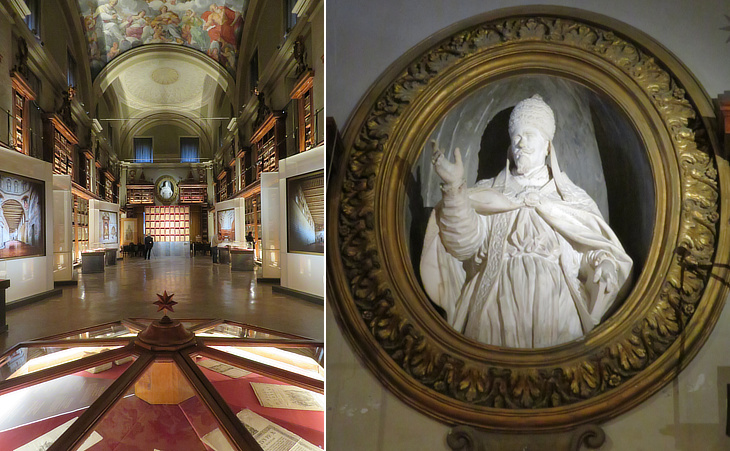
Biblioteca Alessandrina - interior with a bust of Pope Alexander VII by Domenico Guidi
And for Libraries you shall find here (..) that of the Sapienza (..) being open to all men every day with a courteous Gentleman to reach you any book, and a learned Manuscript in Folio addressing you to the authors that treat of any subject you desire to be informed of, which affords great help to the painful student.
Richard Lassels' The Voyage of Italy, or a Compleat Journey through Italy in ca 1668
The edifice consists of one spacious and lofty hall, erected by Borromini, the walls of which are lined with books in open cases and in its centre are two ranges of benches for the accommodation of readers, the cases of which are also filled with books. In a niche at the extremity of the hall is the half statue ia marble of Alexander VII, executed by Guidi and on the cieling is a fresco, by Majoli, representing Religion with the Four Evangelists and Four Great Doctors of the Church. Donovan
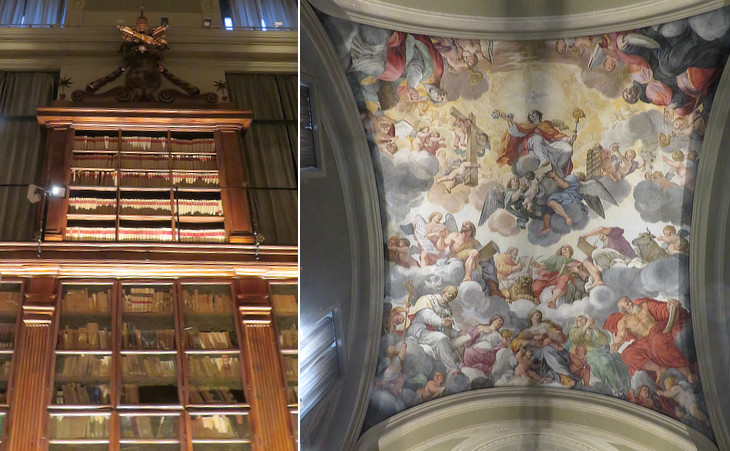
Biblioteca Alessandrina: (left) bookcase with the coat of arms of Pope Alexander VII; (right) fresco by Clemente Majoli depicting the Triumph of Religion (1662-1665); it follows a pattern established by Pietro da Cortona at Palazzo Barberini
It was subsequently augmented by Giuseppe Carpani, professor of Law in the Sapienza; and by Card. Flavio Chigi, nephew of Alexander VII. Since then it has been constantly on the increase and has had a considerable accession to its literary treasures in the present century, Del Medico, professor of surgery, having bequeathed to it his library, consisting principally of works on medicine, surgery and natural philosophy. Leo XII. ordained that Vatican duplicates should be sent to this library; and among those thus received are several works that had belonged to Card, de Zelada and to Cicognara. Its last considerable accession, in 1838, consisted of the library of Monsg. Gallanti, Treasury Assessor, composed principally of works on literature, Public Economy, Mathematics and Natural Philosophy. Altogether it now possesses about 50,000 volumes and it is the richest library in Rome in modern works, the number of which is daily on the increase. The library is intended principally for the use of the students of the University; but it is open not only to them but also to the Public, during all schoolhours. Donovan
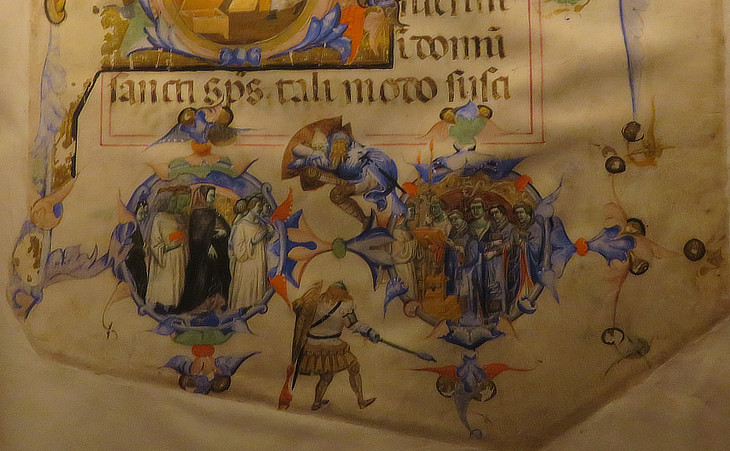
Biblioteca Alessandrina - 2025 temporary exhibition: detail from a XIVth century illuminated manuscript of Spedale di S. Spirito in Sassia
In the 1930s the University of Rome was relocated in a vast area (Città Universitaria) between the eastern walls of ancient Rome and S. Lorenzo fuori le Mura. The Biblioteca Universitaria Alessandrina was placed in the huge building housing the rector's offices. The whole complex of the old university was assigned to Archivio di Stato di Roma (The State Archives of Rome). The library is occasionally open to the public for ceremonies or temporary exhibitions.
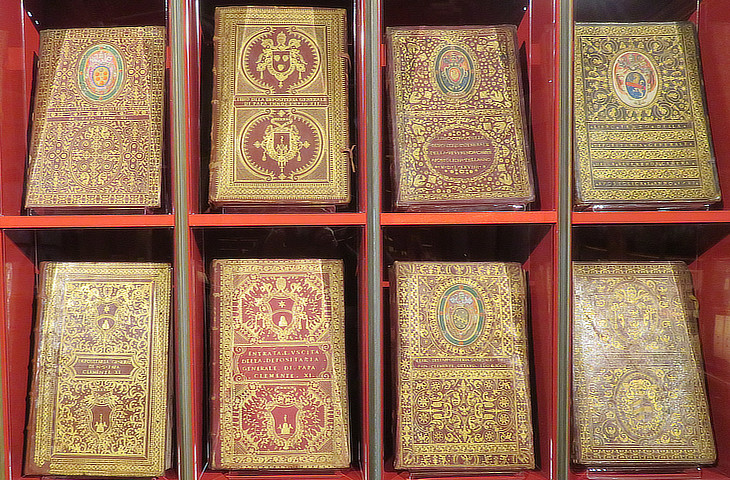
Biblioteca Alessandrina - 2025 temporary exhibition: "Libri della Depositeria Generale", books recording financial entries during the pontificates of Popes of the XVIth, XVIIth and early XVIIIth centuries
Next plate in Book 9: Prospetto principale del Collegio Romano.
Next step in Day 4 itinerary: Palazzo Madama.
Next step in your tour of Rione Sant'Eustachio: S. Eustachio.
Excerpts from Giuseppe Vasi 1761 Itinerary related to this page:
Archiginnasio della SapienzaEra già perduto lo studio delle scienze, non meno di quello delle belle arti, per le continue guerre d'Italia, e sciagure di Roma, quando s. Gregorio il grande pensò di rimetterlo. Innocenzo IV. stabilì quello dell'una, e dell'altra legge, Bonifacio VIII. eresse quivi le pubbliche scuole l'anno 1293. e Clemente V. vi stabilì le cattedre delle lingue, e altri Pontefici vi hanno aggiunto quelle di altre scienze. Il primo architetto della fabbrica fu il Buonarroti, o secondo altri il Bramante; ma poi fu terminata sotto Alessandro VII. dal Borromini, il quale fece nel gran cortile la chiesa con la cupola di una nuova invenzione, tanto nell'interno, che nell'esterno ammirabile. Fu dedicata a s. Luca Evangelista, a san Leone Magno, e a s. Ivo avvocato de' poveri, avendovi fatto il quadro Pietro da Cortona, ma per causa di morte fu terminato poi da Gio. Ventura Borghesi suo allievo. |


