All images © by Roberto Piperno, owner of the domain. Write to romapip@quipo.it.


Notes:
Page revised in July 2020.
All images © by Roberto Piperno, owner of the domain. Write to romapip@quipo.it.
Notes:
Page revised in July 2020.
 Chiesa di S. Simeone Profeta
Links to this page can be found in Book 6, Map C2, Day 4, View C5 and Rione Ponte.
The page covers:
The plate by Giuseppe Vasi
Today's view
S. Simeone Profeta
Palazzo Lancellotti
Palazzo Cesi
Palazzo Del Drago a Via dei Coronari
S. Salvatore in Lauro with references to:
- S. Maria in Posterula
- S. Salvatore in Primicerio (S. Trifone)
- Arco di Parma, Via and Teatro Tor di Nona
- Fontana del Leone
Palazzi di Via della Maschera d'Oro
Other Palaces in Via de' Coronari (Casa di Prospero Mochi, di Fiammetta and Palazzo Ruiz)
SS. Simone e Giuda (Immagine di Ponte)
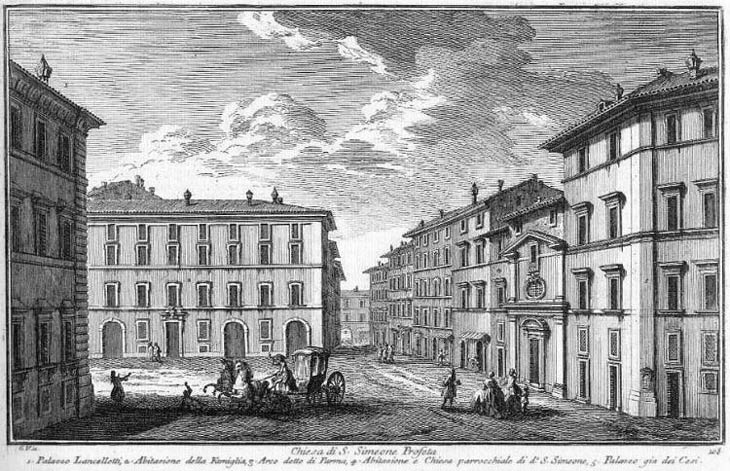
In 1756 Giuseppe Vasi published a book on the parish churches of Rome which was illustrated by twenty etchings. Five of the parish churches he chose have been demolished or deconsecrated so his book has acquired a particular interest because it shows corners of Rome which do not exist any longer or have been greatly modified. This etching shows an area close to the River Tiber which could be reached through Arco di Parma, a posterula (small gate in the ancient walls of Rome). In the 1880s the construction of high walls to prevent the river from flooding led to major changes to the neighbourhood.
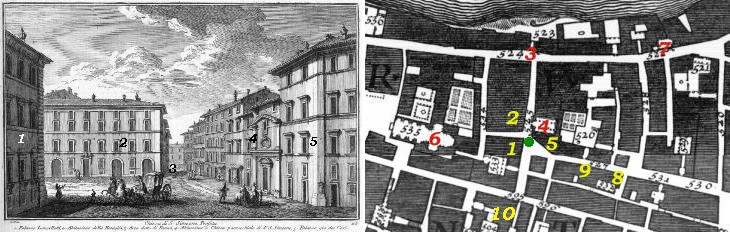
The view is taken from the green dot in the small 1748 map here below.
In the description below the plate Vasi made reference to: 1) Palazzo Lancellotti;
2) other buildings adjoining Palazzo Lancellotti; 3) Arco di Parma; 4) S. Simeone; 5) Palazzo Cesi.
The map shows also: 6) S. Salvatore in Lauro; 7) S. Maria in Posterula; 8) S. Salvatore in Primicerio; 9) Palazzo della Maschera d'Oro; 10) Palazzo Del Drago a Via dei Coronari.
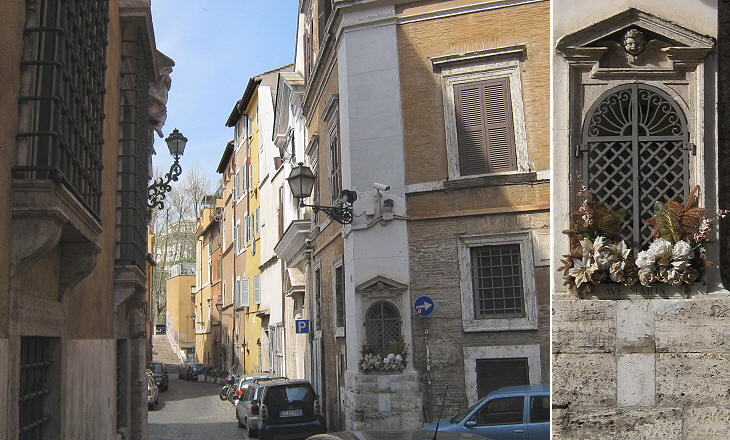
(left) The view in April 2009; (right) the sacred image shown in the left lower corner of the plate
Vasi had a talent for enlarging views. He supposedly drew sketches from slightly different points and then stitched them together in order to obtain a wide angle image, as he did in his 1765 Grand View of Rome. Arco di Parma does not exist any longer and the street leading to it rather than going down to the river now goes up to the lungotevere, the street above the new embankment.
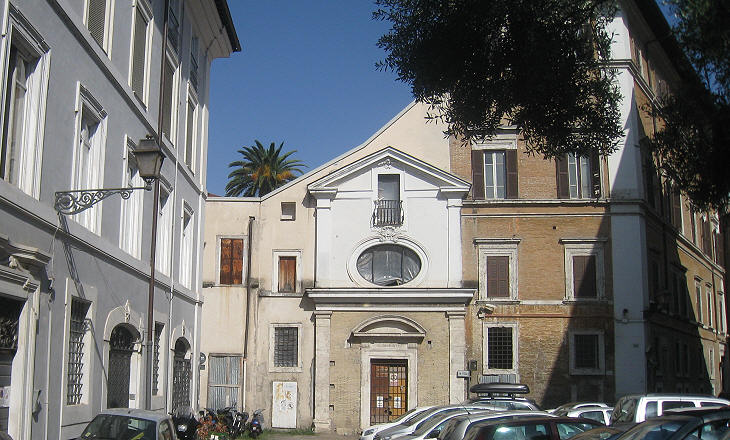
S. Simeone Profeta
This little church of very old origin was entirely rebuilt in 1610 by Cardinal Orazio Lancellotti, who was about to complete the construction of his nearby family palace. It was dedicated to Simeon, the God-receiver. The upper part of the façade was modified in 1741; in 1824 it ceased to be a parish church. The façade is the only remaining part of the church which was demolished in 1929. A painting which decorated the church can be seen at Galleria Nazionale d'Arte Antica di Palazzo Barberini.
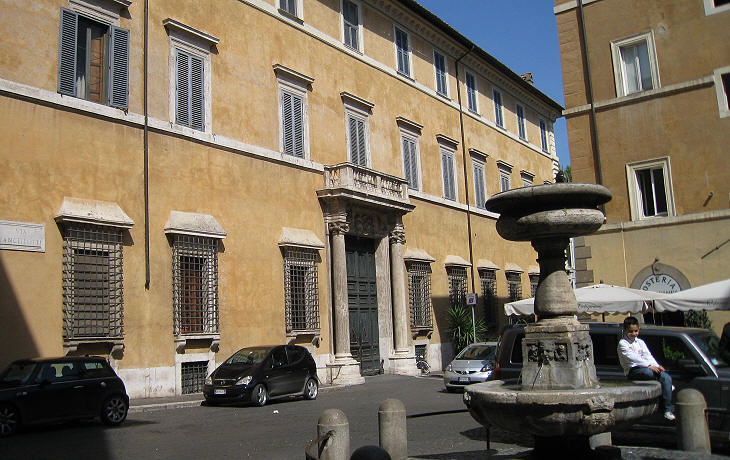
Palazzo Lancellotti
The plate shows only a corner of Palazzo Lancellotti which was begun by Daniele da Volterra and completed by Carlo Maderno. The small square in front of Palazzo Lancellotti was created in the 1930s by pulling down a small house; in 1973 it was embellished with a XVIth century fountain from Piazza Montanara.
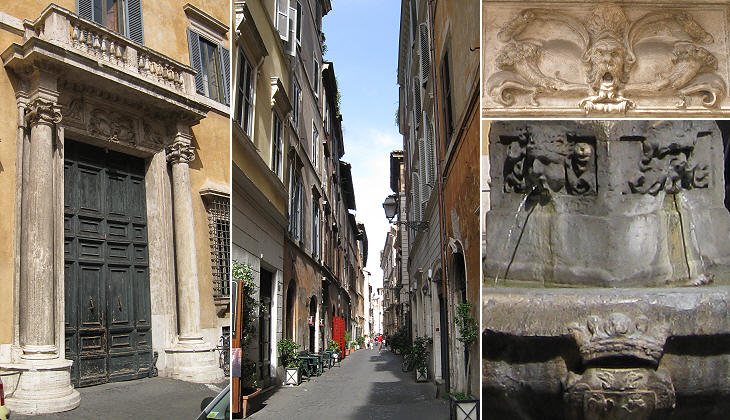
(left) Portal of Palazzo Lancellotti which is attributed to Domenichino; (centre) Via dei Coronari; (right - above) detail of the portal: (right - below) detail of the fountain
The street to the left of Palazzo Lancellotti is Via dei Coronari. It was opened by Pope Sixtus IV in ca 1475 to facilitate the access to S. Pietro and it was called Via Recta (straight street). There were many shops selling devotional goods to pilgrims including rosaries and small crowns, hence Coronari, its current name (but in the XVIIIth century it was aka Strada dell'Orso, because it was a prosecution of that street). Today it is renowned for its antique shops.
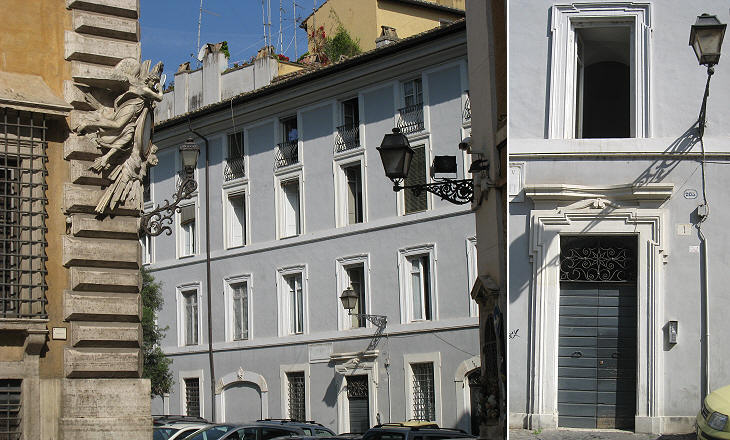
(left) Corner of Palazzo Lancellotti with a sacred image (you may wish to see that on the other corner) and building for the servants; (right) entrance to the building for the servants
The houses for the servants are shown in the plate and they still bear the star of the Lancellotti, which is shown in the image used as background for this page. The Lancellotti had another palace in Piazza Navona and a villa at Frascati. Discobolus Lancellotti, a famous statue found in 1781, is named after them because it was kept in their palace at Via dei Coronari.
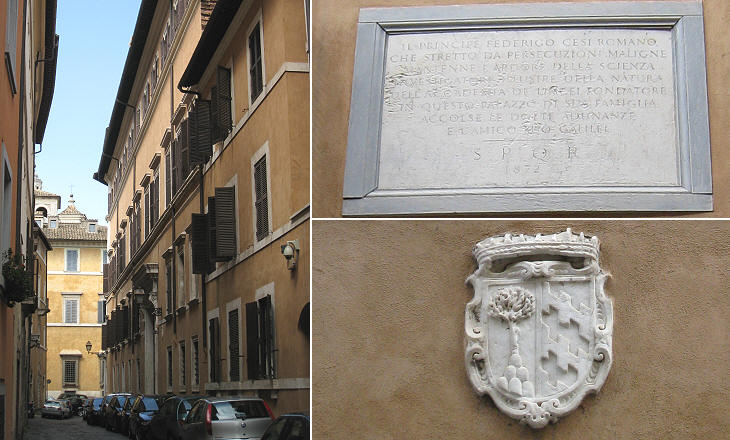
(left) Palazzo Cesi; (right - above) 1872 plaque celebrating Prince Federico Cesi and his friendship with Galileo Galilei; (right - below) coat of arms of the Cesi-Salviati
In the period 1560-1630 the Cesi were one of the wealthiest families of Rome. They had extensive possessions in Umbria. Members of the family built the façade of S. Maria in Vallicella and S. Caterina dei Funari and embellished Todi; Prince Federico II Cesi founded Accademia dei Lincei and protected Galileo Galilei; he married Isabella Salviati and added to the heraldic symbol of the Cesi (a tree on a mountain) the stripes of the Salviati. The Cesi had a larger palace in Borgo and another one near Porta Cavalleggeri which housed their collection of antiquities.
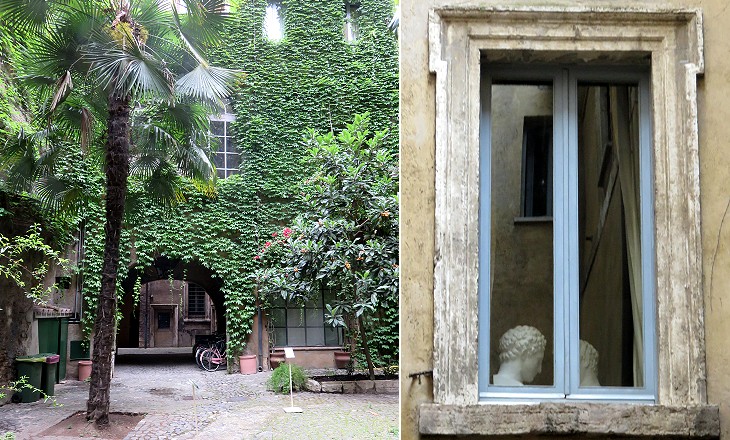
(left) Larger courtyard; (right) a window inside the smaller courtyard
The addition a Via dei Coronari is needed to distinguish a group of XVIth century houses opposite Palazzo Lancellotti from a large palace in Piazza delle Quattro Fontane which the Del Drago acquired in 1858 (in 1853 they bought the fiefdom of Filacciano). Their palace at Via dei Coronari is the result of the union of different buildings and it has a hidden garden inside one of the courtyards. Some of the rooms retain their late XVIth century decoration.

Details of the decoration of the ceilings which recall the frescoes of Palazzo Farnese di Caprarola
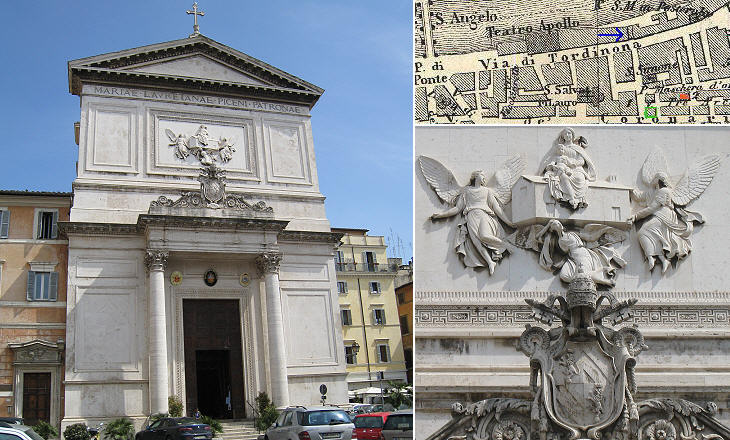
(left) S. Salvatore in Lauro; (right - above) 1880s map of the area (the building with a green border was pulled down to create the square in front of Palazzo
Lancellotti); (right - below) detail of the façade with a coat of arms of Pope Pius IX
The detail of the map shows the location of three churches near Palazzo Lancellotti.
S. Maria in Posterula was built in a small gate of the walls along the river and it was pulled down in the 1880s, together with Arco di Parma (marked with a blue arrow) and Teatro Apollo or Tor di Nona, one of the main theatres of Rome. Arco di Parma had this name because of a nearby (lost) palace which belonged to Cardinal Giangiacomo Schiaffinati, Bishop of Parma in 1482-1497.
S. Salvatore in Primicerio (the red dot in the map) is no longer a church. The appellation of the church is rather cryptic because primicerius is the name of a Byzantine officer and not of a site. It means primus in cera (first in wax) because the name of the officer was the first which was written on wax tablets containing administrative decisions. A chapel at S. Maria Antiqua was named after a primicerius. The church was aka S. Trifone (another church by this name was demolished in ca 1750 to make room for Convento di S. Agostino).
S. Salvatore in Lauro is dedicated to Our Lady of Loreto (the relief of the façade shows the angels carrying the Holy House from Nazareth to Loreto) and it is the national church of Comunità Picena, the inhabitants of the Marches, the Italian region on the Adriatic Sea which was part of the Papal State. They have their offices in a palace not far away. You may wish to see a directory of national churches in Rome.

(left) Fontana del Leone; (centre) fountain with an inscription celebrating Teatro Apollo (Tor di Nona); (right) old houses in Via di Tor di Nona
A little fountain, now next to S. Salvatore in Lauro and once in nearby Via di Panico, shows a
worn out lion's head. The inscription explains how a dragon, the heraldic symbol of Pope Gregory XIII, tamed the lion
and convinced the beast to provide such a useful utility. The fountain was supplied by Acqua Vergine.
Another fountain on the parapet along the river marks the site of Teatro Apollo. The inscription says that Trovatore and Ballo in Maschera, two operas by Giuseppe Verdi, had their first performance in this theatre. It mentions also that the theatre was built on the site of Tor di Nona, a tower of the ancient walls along the river which was the prison of Rome until the construction of Carceri Nuove by Pope Innocent X in 1655. It had a reputation for being a horrible place. It was very near Piazza di Ponte, the small square in front of Ponte S. Angelo, where most executions took place, including that of Beatrice Cenci in 1599.
The side of Via di Tor di Nona opposite Teatro Apollo was not demolished because of the changes made to the river banks. Its old and decaying buildings were occupied by squatters in the 1970s and only recently municipal authorities were able to recover and restore these houses, some of which still retain their Renaissance features and in particular the positioning of the windows in order to provide space for mural paintings. The squatters made use of this space and one of their mural paintings which portrayed a flying donkey was spared.
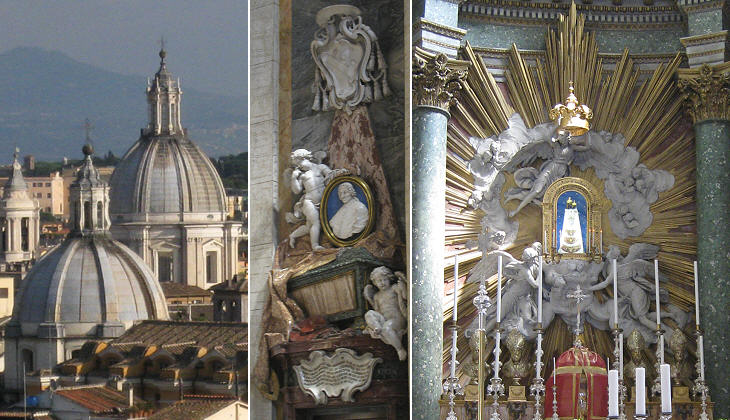
(left) Dome of S. Salvatore in Lauro and behind it that of S. Agnese in Agone seen from the terrace of Castel Sant'Angelo; (centre) Monument to Cardinal Prospero Marefoschi designed by Girolamo Theodoli with statues by Carlo Monaldi (it follows a pattern developed by Gian Lorenzo Bernini); (right) main altar
S. Salvatore in Lauro was severely damaged by a fire in 1591 (you may wish to see it in a 1588 Guide to Rome); at the time it was assigned to the Order of S. Giorgio in Alga, which was founded in 1404 on the islet by the same name in the Lagoon of Venice. The order was in a declining phase and it was eventually abolished in 1668. The reconstruction of the church was very slow even after it was bought by Comunità Picena; the church was completed in neoclassical style by Camillo Guglielmetti in 1862. It retains some elaborate late Baroque monuments and altars.
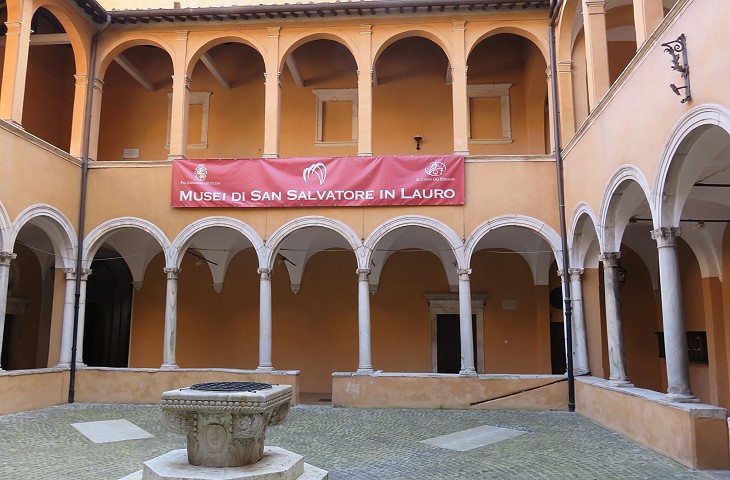
Large cloister
S. Salvatore in Lauro is adjoined by a large monastery with cloisters of the XVth and XVIth centuries and some works of art which were removed from the church. Since 1996 the premises of the monastery house temporary exhibitions.
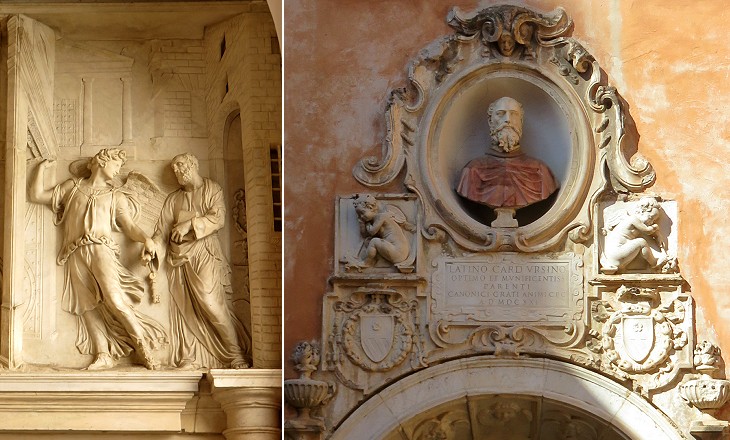
(left) Relief depicting St. Peter freed by an angel (XVIth century from a chapel of the church); (right) 1621 Monument to Cardinal Latino Orsini who died in 1477
Cardinal Latino Orsini rebuilt the church in 1449 and assigned it to the Order of S. Giorgio in Alga. The whole neighbourhood was marked by the presence of the Orsini who had a fortress/palace on a mound very near S. Salvatore in Lauro, from which they controlled the passage of pilgrims going to S. Pietro. The prison of Tor di Nona was previously known as Torre Orsina because it was part of the fortifications protecting the Orsini properties.
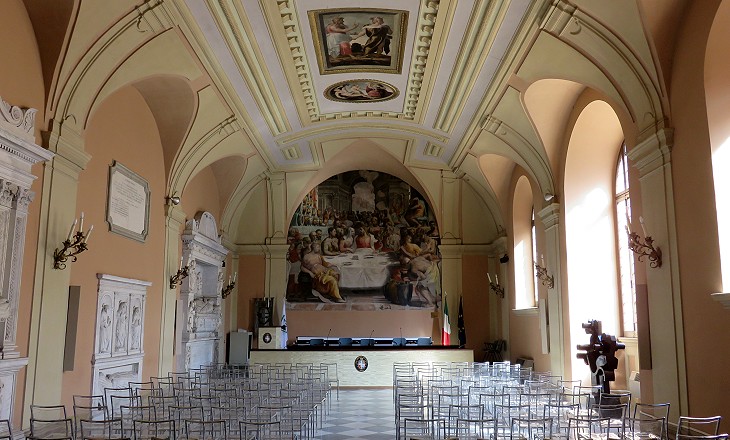
Refectory with a painting by Francesco Salviati (1550) depicting "The Marriage at Cana" (see other paintings by Salviati at S. Giovanni Decollato and at S. Maria dell'Anima)
The refectory of the monastery was turned into an oratory for the meetings of Comunità Picena in the XVIIth century and its decoration was in part redesigned. It is now used as a conference hall.
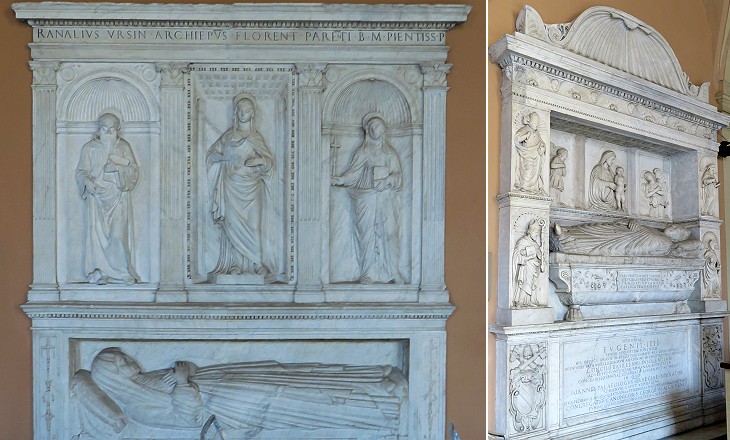
(left) Monument to Maddalena Orsini (d. 1474 - School of Mino da Fiesole) erected by Rinaldo Orsini, Archbishop of Florence his son, previously inside the church; (right) Monument to Pope Eugenius IV (d. 1447) by Isaia da Pisa, previously in S. Pietro Vecchio
The refectory houses two interesting funerary monuments of the Early Renaissance which were not meant to be there. Maddalena Orsini was the mother of Clarice Orsini who married Lorenzo il Magnifico, a marriage by which the Orsini established family bonds with the Medici, the de facto rulers of Florence.
Isaia da Pisa was a sculptor who specialized in low reliefs and was active in Rome in 1447-1464. You may wish to see his works at Basilica di S. Marco and S. Giovanni in Laterano. Mino da Fiesole (together with Andrea Bregno) is known too for his very fine reliefs in the late XVth century. In some instances art historians are in doubt about the actual sculptor as in the reliefs at Cappella Sistina. The monument to Pope Eugenius IV was removed from S. Pietro in ca 1565 at the request of the Order of S. Giorgio in Alga because its members feared that it could be damaged by the construction of the new basilica. The Pope had been a protector of the Order. It was not the only papal monument removed from S. Pietro Vecchio as you can see in a directory of papal monuments.
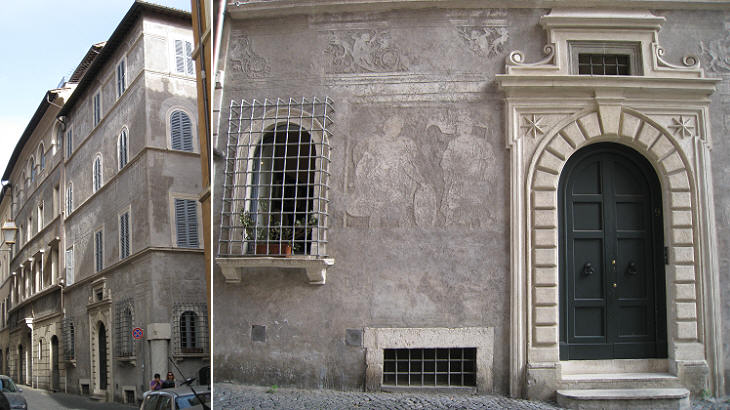
(left) Palazzo Milesi in Via della Maschera d'Oro and house No. 9 on the corner; (right) detail of No. 9 which belonged to the Lancellotti for a period of time
On the House call'd il Maschera d'Oro. Is painted the Rape of the Sabins (of part of which my Father has two several Drawings) pretty well preserv'd, except that part
of the Wall is broke just under the Window.
There was another Story which is now quite ruin'd; 'twas divided from this by the Cato
(painted as a Bronze of which my Lord Somers had the Drawing). Here is also the famous Friezes of the Apollo and Niobe; and
the Mutius Scaevola (of which last I think
my Father has the Drawing, Capital). But as
they are almost gone, part is plaster'd over
again. (..) These were painted on the Outside Walls in Chiaro-scuro by Polidoro.
Jonathan and Jonathan Richardson - Account of Some of the Statues, etc. in Italy - 1722
On Via della Maschera d'Oro (Golden Mask) Palazzo Milesi has a façade painted by Polidoro da Caravaggio, a pupil of Raphael. The subject of the paintings is the myth of Niobe, although many scenes were inspired by the reliefs of Colonna Traiana. The name of the street is due to a detail of the decoration showing a little boy hiding behind a golden mask. Parts of the paintings were revived in 2004. Next to it there is another Renaissance building with evidence of graffito paintings and decorations. Palazzo Istoriato and Palazzo Ricci are other Renaissance palaces with a similar decoration.

Paintings of Palazzo Milesi

(left) Detail of Casa di Prospero Mochi with the inscription "Tua Puta Que Tute Facis" (regard as yours what you have made yourself); (centre) "Casa di Fiammetta"; (right) window of Palazzo Ruiz
Via de' Coronari has several Renaissance buildings worth being mentioned.
The portal of the house of Prospero Mochi was designed in 1516 and it shows some typical elements of Renaissance architecture (the use of the arch, the entablature with a moral inscription, the lateral pillars). It is similar to that of the house of Teodoro Amayden.
Casa di Fiammetta is a (much restored) XVth century detached house at the end of Via de' Coronari. Fiammetta is the name
of a Florentine courtesan, who was "friendly" with Cesare Borgia, the preferred son of Pope Alexander VI and Vannozza Cattanei.
Palazzo Ruiz or Sacripanti is a Late Renaissance palace attributed to Bartolomeo Ammannati. It stands opposite Palazzo Altemps and its size was reduced in the early XXth century.
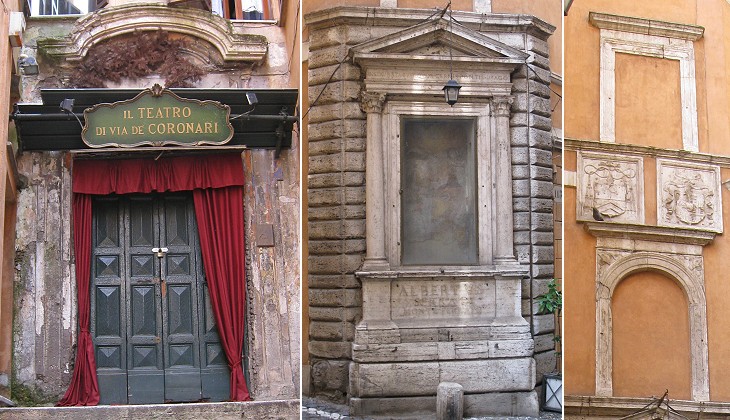
(left) SS. Simone e Giuda; (centre) "Immagine di Ponte"; (right) coats of arms of Cardinal Francesco Armellini de' Medici and Alberto Serra di Monferrato, a member of the Papal court
SS. Simone e Giuda was also known as S. Maria in Monticello, with reference to the small mound of the Orsini fortress.
It was dedicated to two Apostles: St. Simon the Zealot and St. Judas Thaddaeus. The tiny church was deconsecrated at the beginning of the XXth century and it was turned into a cinema, then into a restaurant and finally into a theatre. The only thing left is the XVIIIth century portal.
Via dei Coronari
has one of the oldest frames for sacred images which can be found in Rome. It was designed by Antonio
da Sangallo the Younger in 1523 for Alberto Serra di Monferrato (whose name is written below the image).
Next plate in Book 6: SS. Celso e Giuliano.
Next step in Day 4 itinerary: SS. Celso e Giuliano.
Next step in your tour of Rione Ponte: Palazzo Boncompagni Corcos.
Excerpts from Giuseppe Vasi 1761 Itinerary related to this page:
Chiesa di s. Maria in PosterulaEra questa chiesa unita all'antico palazzo Gaetani, che quì ebbe quella nobilissima famiglia prima del Pontificato di Bonifazio VIII. ma poi avendola egli conceduta ai monaci Celestini, vi stabilirono il loro collegio, che dicesi Urbano.Arco di ParmaPer quel che appare, era questo anticamente una porta per iscendere al Tevere, ora però serve per lo spurgo, e scarico dell'immondezze, che si raccolgono per la Città. Nel vicolo incontro corrisponde laChiesa di s. Simone ProfetaDa alcuni monumenti, che sono in questa chiesa si arguisce essere stata molto risplendente la sua antichità, ma poi per la vecchiezza minacciando rovina l'an. 1610. fu rifatta dal Card. Lancellotti. A sinistra di questa evvi il palazzo Cesi, e nel casamento incontro si vede dipinto in chiaro e scuro il ritratto di Raffaelle da Urbino, in memoria di aver ivi abitato quell'insigne pittore de' nostri secoli; ed appresso si vedono altre pitture fatte similmente dichiaro e scuro, che rappresentano diversi fatti degli antichi Romani, e sono opere ammirabili di Polidoro da Caravaggio, e del Maturino, allievi del detto Raffaello: ma per disavventura hanno molto patito. Evvi a sinistra il palazzo Lancellotti, e a destra laChiesa di s. Salvatore in Primicerio e Palazzo LancellottiQuasi niuna notizia si ha di questa antichissima chiesa consagrata l’anno 1113. ed ufiziata ora dalla compagnia di s. Trifone; e però passeremo ad osservare le statue, li busti, e bassirilievi antichi, co' preziosi quadri del palazzo Lancellotti. Fu questo edificato con disegno di Carlo Maderno; il portone però è del Domenichino; la strada laterale si dice de' coronari, perchè vi sono le botteghe di questi, e la scalinata, che si vede dall'altra parte della strada, porta alla piccola chiesa de' ss. Simone, e Giuda Apostoli, come fra poco diremo parlando del monte Giordano. Pigliando poi il cammino a destra, si trova laChiesa di s. Salvatore in LauroInsieme con questa chiesa fu eretto un monastero dal Card. Latino Orsini circa l'an. 1450. per li Canonici di s. Gregorio in Alga, i quali, poi riedificarono la chiesa col disegno di Ottavio Mascherini; ma essendo soppresso quell' ordine da Clemente IX. fu conceduta l'anno 1669. alla confraternita de' Marchigiani, i quali dedicarono la chiesa alla ss. Vergine di Loreto, e nel monastero eressero un collegio di nazionali. Nella chiesa sono delle cappelle ornate di marmi, e di pitture; fra le quali è rimarchevole il Presepio di nostro Signore nell'ultima cappella, per essere la prima opera di Pietro da Cortona; la ss. Vergine nell' altare maggiore è di Gio: Peruzzi d'Ancona, ed il s. Filippo Neri con altri Santi nella crociata è del Cav. Ghezzi. Indi scendendo per il vicoletto a destra della medesima chiesa. si torna alla strada dell'Orso, e piegando a sinistra in primo luogo ilTeatro di Tor di NonaErano quivi ne' secoli passati le carceri; dipoi fuvvi un magnifico teatro tutto costruito di materiali senza legno; ma essendo stato atterrato da Innoc. XI. ultimamente vi è stato rifatto di legno sul medesimo piantato dell' antico. |