
All images © by Roberto Piperno, owner of the domain. Write to romapip@quipo.it.


Notes:
Page revised in May 2025.
All images © by Roberto Piperno, owner of the domain. Write to romapip@quipo.it.
Notes:
Page revised in May 2025.
 Chiesa di S. Caterina della Ruota
Links to this page can be found in Book 6, Map C2, Day 7, View D6 and Rione Regola.
The page covers:
The plate by Giuseppe Vasi
Today's view
S. Girolamo della Carità
- Cappella Spada
- Cappella Antamoro
S. Caterina della Ruota
S. Tommaso di Canterbury (and Corte Savella)
Palazzo Mastrozzi and Palazzo cieco
S. Maria in Monserrato
S. Giovanni in Ayno
Palazzo Ricci
Courtyards and Madonnelle in Via di Monserrato
Casa di Pietro Paolo della Zecca

Giuseppe Vasi published in 1756 a book of etchings showing the parish churches of Rome. In some instances, e.g. S. Maria in Campitelli, they had a monumental aspect, but often they were rather small and uninteresting. In these cases Vasi gave more relevance to other buildings near them as he did in this plate in which S. Girolamo della Carità, a church belonging to a rich brotherhood, is in the foreground whereas S. Caterina della Ruota, the parish church, is depicted in the background. The two churches are located at the beginning of Via di Monserrato (from Piazza Farnese). This street followed the route of an ancient road leading to Ponte Trionfale; it eventually became one of the streets used by pilgrims to reach Ponte Sant'Angelo and from there S. Pietro. It was known as Via di Corte Savella, because of the prison which existed near the square shown in the plate; after this prison was closed in 1652 the street was named after S. Maria di Monserrato which is located further down the street.
The view is taken from the green dot in the small 1748 map here below.
In the description below the plate Vasi made reference to: 1) S. Girolamo della Carità;
2) S. Caterina della Ruota; 3) Palazzo Mastrozzi; 4) Palazzo cieco (blind).
The small map shows also: 5) S. Tommaso di Canterbury; 6) S. Maria di Monserrato; 7) S. Giovanni in Ayno; 8) Palazzo Ricci; 9) Casa di Pietro Paolo della Zecca.


(left) The view over S. Girolamo della Carità and Palazzo Mastrozzi in July 2009; (right) the view over S. Caterina della Ruota and the street leading to Via Giulia with Palazzo cieco in January 2009
Via di Monserrato is a rather narrow street and the churches are exposed to sunlight only in the period near the summer solstice; Vasi showed S. Girolamo della Carità in the afternoon, but in that period of the day the church is shaded by the opposite building, so the image above was taken in the morning. In order to show both S. Caterina della Ruota and Palazzo cieco it is necessary to wait for a winter day having a soft light.
Apart from this analysis of the difference between drawing and taking photos and without noticing the parked cars, this corner of Rome is "as it was".

(left) Detail of the façade; (right) portal
I went to St. Girolamo della Charita, a Church and House of good Priests, and most of them Gentlemen, living of their own expences, yet all in Community. S. Philipp Neri instituted them, and lived among
them thirty years.
Richard Lassels' The Voyage of Italy, or a Compleat Journey through Italy in ca 1668
In 1524 an old church dedicated to St. Jerome was assigned by Pope Clement VII to Arciconfraternita della Carità, a brotherhood he had founded when he was Cardinal Giulio de' Medici; its members mainly belonged to the Florentine community and St. Philip Neri (who came from Florence) lived in the adjoining hospital for many years.
In 1647, thanks to a substantial legacy by Fantino Renzi, one of its members, the brotherhood began a total renovation of the church with the assistance of Domenico Castelli (until 1657) and of Carlo Rainaldi.

(left) Interior; (right) Cappella Marescotti or di S. Giovanni Battista: details of its decoration with the joint coat of arms of the Marescotti (left) and of the Farnese (right)
The interior of the church strikes the viewer because of its rich decoration which was made possible by the legacy of Renzi and by the families who had their funerary chapels in the church. The Marescotti were Counts of Vignanello, a small town which Sforza Marescotti acquired by marrying Ortensia Farnese, a relative of Pope Paul III. Eventually the Marescotti changed their surname into Ruspoli, having inherited the properties of that family. Their name is associated with Palazzo Maffei Marescotti and Palazzo Rucellai Ruspoli.

(left) Front view; (right) Monument to Bernardino Lorenzo Spada (d. 1543) by Ercole Ferrata, see a similar earlier monument by Nicolas Cordier
(Borromini's minor works:) About 1660, Capp. Spada in
S. Girolamo della Carità laid out with colourful
marble decorations. Here the 'bizarre' idea of replacing the balustrade of the chapel by kneeling
angels who hold a piece of (marble) cloth between
them (allusion to Christ's pall?).
Rudolf Wittkower - Art and Architecture in Italy 1600-1750 Penguin Books 1958
The chapel of the Spada family was thoroughly redesigned by Virgilio
Spada, brother of Cardinal Bernardino Spada, who commissioned Francesco Borromini some improvements to his palace; because of this link many art historians believe that Borromini was involved in the design of the chapel. All the statues are works by pupils of Gian Lorenzo Bernini: two angels by Antonio Giorgetti hold a long marble cloth: they seem to block the access to the chapel, but the wings of the angel to the right are made of wood and are movable. You may wish to see more baroque angels.

(left) Marble floor; (right-above) portraits of ancestors of the Spada; (right-below) Monument to Giovanni Spada (d. 1247) who was portrayed as an ancient Roman senator by Cosimo Fancelli

(left) Front view; (centre) St. Philip Neri by Pierre Legros; (right) detail of the ceiling; it brings to mind the decoration of S. Andrea al Quirinale
Filippo Juvarra, a Sicilian architect, came to Rome in 1703 at the age of 25; in the nine years he spent in Rome he had only one opportunity to
show his skills. The Antamoro were very wealthy, but definitely not a major Roman family (their palace is known for a fountain by Bernini).
Their chapel was very small, but Juvarra, who had studied the works by both Borromini and Bernini,
made excellent use of the limited space.
During his stay in Rome he published a book of engravings showing the finest coats of arms of the Popes; he then left for Turin where he was able to fully express his talent. You may wish to see
Basilica di Superga, perhaps his masterpiece.

(left) Façade; centre) inscription celebrating Giuseppe Vasi; (right) ceiling from Cappella di S. Francesco d'Assisi with the heraldic symbols of Pope Sixtus V
This medieval church was redesigned in the XVIth century while its façade is an XVIIIth century work; in origin it was dedicated to the Virgin Mary and to distinguish it from the others it was called S. Maria in Caterina, perhaps the name of the founder; over time the exact meaning of this reference was lost and the church was eventually dedicated to St. Catherine of the Wheel, (S. Caterina dei Funari is another church dedicated to this saint).
The interior houses an inscription celebrating Giuseppe Vasi which was written by his son
Mariano. There is a reference to Palermo (he was born at Corleone, a town near Palermo). He is described as an architect, sculptor, painter and then his work as etcher and writer of a guidebook is
mentioned. Vasi was buried in S. Gregorio ai Quattro Capi.
The image used as background for this page shows his coat of arms.

Details of the façade after it was repainted with a light colour which replaced the dark one; see a page on the old colours of Rome

(left) Façade; (right) bell tower
Hard by stands the English Colledge, once an
Hopital for the English, and built by the English Merchants in Rome, to receive English Pilgrims in; because a poor English Woman had
been found worryed by Dogs, in the night, for
want of a Lodging. In the Church of this Colledge lies buried, Cardinal Alan, the last English
Cardinal of our Nation. Lassels. You may wish to read a 1594 account by Fynes Moryson, a Protestant, about the help he received from Cardinal William Allen or excerpts from Roma Sancta, a 1581 description of Christian Rome by Gregory Martin, an assistant to Cardinal Allen.
S. Tommaso
di Canterbury (St. Thomas Becket) stands opposite S. Caterina della Ruota. A house with a church for the English pilgrims was built here in 1363. The buildings were modified and enlarged several
times; in 1654 the Jesuits in charge of Collegio Inglese (the English Seminar) bought Corte Savella, one of the prisons of Rome, which stood next to their property and in 1685 they completed the construction of a new seminar, a very large building; also the bell tower was built at that time (it clearly shows the influence of Borromini). This major effort was due to Philip Thomas Howard who was created cardinal in 1675 and is also known as the Cardinal of Norfolk; he hoped to promote the conversion of his country by increasing the number of English Roman Catholic priests who had the opportunity of receiving an in-depth theological education.

(left) Interior; (right) Monument to Martha Swinburne, a girl of nine who died in Rome in 1778, by Cristopher Hewetson, an Irish sculptor who spent most of his life in Rome. Martha was one of the daughters of Henry Swinburne, an English travel writer best known for "Travels in the Two Sicilies. 1777-1780" who wrote a very long obituary (it opens in another window)
In 1798 the church was occupied by French troops and it was turned into a stable and later on it was damaged by fire. It was almost entirely rebuilt in 1866-1888; the entrance to the church from Piazza S. Caterina della Ruota is a neo Romanesque work by Pietro Camporese the Younger who is best known for having redesigned Palazzo del Vicegerente. The interior retains a small number of the monuments and gravestones it had before 1798.

(left) Monument to Sir Thomas Dereham; (right) Religion and Faithfulness by Filippo della Valle (see a page on the iconography of Virtues)
Sir Thomas Dereham was a close adviser to James Frances Edward Stuart (James III of England and James VIII of Scotland) aka the Old Pretender who set his residence in Rome in 1719 at Palazzo Muti Papazzurri. The monument was designed in 1739 by Ferdinando Fuga. The two statues representing Religion and Faithfulness are a fine work by Filippo della Valle.
You may wish to see a directory of national churches in Rome or see some images of the Brompton Oratory, a very Roman church in London.

(left) Overall view; (right) portal
Palazzo Mastrozzi is a late XVIIth century palace with a very elaborate stucco decoration; it was a palazzo da appartamenti, a building split into flats which were rented. You may wish to see a page on this kind of buildings.

Details of the windows
The windows were decorated with a variety of subjects (shells, masks, young women, etc.) and not with the heraldic symbols of the family owning the palace. Palazzo Mastrozzi, similar to S. Caterina della Ruota and many other more or less famous buildings of Rome, was recently repainted using the lighter tints which were in fashion in the XVIIIth century.

(left) Palazzo cieco; (right) detail of its decoration
Vasi mentions in the plate also a XVIIth century small palace (Palazzo cieco) with a fine shell decoration. He calls it cieco (blind) because the portal was walled (and still is).

(left) Overall view; (right) detail of the relief above the entrance
S. Maria in Monserrato is another of the "national" churches of Rome and more exactly the church of the inhabitants of Aragon, Catalonia and Valencia living in Rome. It is dedicated to Montserrat, the sanctuary near Barcelona which means "sawed mountain", thus Giovanni Battista Contini, the architect who worked at the completion of the church in 1673, designed a statue showing the Infant Jesus sawing a rock. The façade was initiated by Francesco da Volterra in 1593, Contini completed its lower part, whilst its upper part was added in the XIXth century, but in a way which is not consistent with the original project as depicted in a 1588 Guide to Rome.

(left) Interior; (right) Cappella di Monserrato
It is situate in the via di Monserrato and had originally belonged
to Arragon; but, after the dilapidation of the Spanish church of Castile, in the piazza Navona, in 1821, it became, as it still continues to be, the common church of the Spanish nation. Its interior is decorated with fluted Corinthian pilasters; is rich in gilt stuccos; and has a handsome marble floor.
Rev. Jeremiah Donovan - Rome Ancient and Modern - 1843
Similar to S. Tommaso di Canterbury the church was closed and damaged during the French occupation of Rome. In 1822 it was restored and some works of art which decorated S. Giacomo degli Spagnoli, the church of the Spaniards from Castile and Leon were moved there. Other changes were made in 1929.
Cappella di Monserrato reflects the troubled history of the church: it was designed at the beginning of the XVIIth century. The elaborate decoration of the main altar is attributed to Carlo Francesco Bizzaccheri, an architect of the early XVIIIth century, chiefly known for the design of Fontana della Bocca della Verità and some funerary monuments. The wooden statue on the altar is a 1950 copy of that which is worshipped at Montserrat.
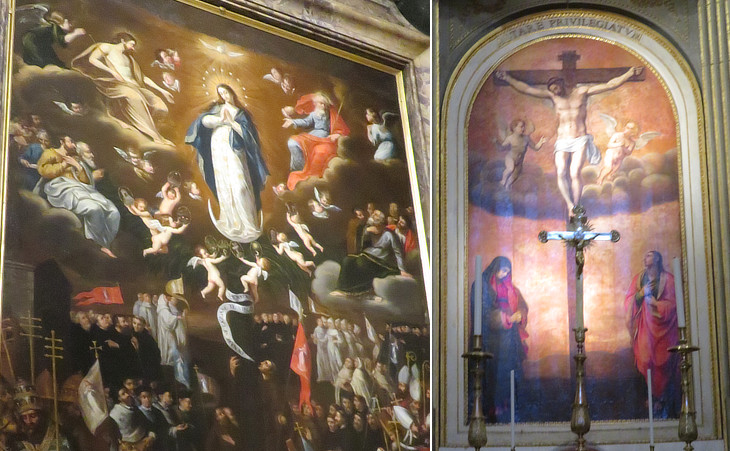
Works of art from S. Giacomo degli Spagnoli: (left) Madonna dell'Immacolata; (right) Crucifixion
To the left is the Madonna of the Immaculate Conception, Protectress of Spain, by an unknown hand. (..) Over the great altar is a Crucifixion, with the B. Virgin and S. John, an esteemed production from the pencil of Sermoneta. Donovan
The very crowded image of the Immaculate Conception is attributed to Luigi Cousin aka Luigi Primo, a Flemish painter (1606-1667) who spent more than thirty years in Rome. In 1651 he was elected Principe dell'Accademia di San Luca. The painting at S. Maria di Monserrato is one of his first Roman works (1633) and he had to strictly follow the instructions he was given by Cardinal Baltasar Moscoso y Sandoval, who spent all his life at the court of the Kings of Spain.
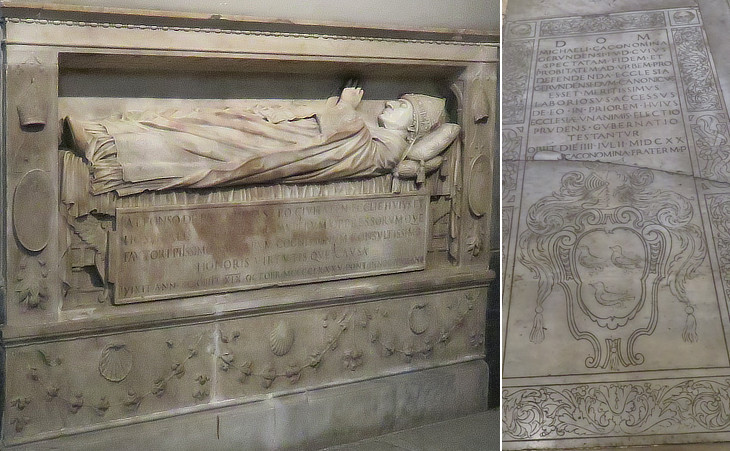
Tombs from S. Giacomo degli Spagnoli: (left) Monument to Bishop Alfonso de Paradinas (d. 1485) one of the first Roman works by Andrea Bregno; (right) 1620 tombstone of Miguel Caconomina from Girona
Alfonso de Paradinas settled in Rome in 1423 at a time when Papal authority had just been restored by the election of Pope Martin V. He held important positions at the Papal court and he promoted the construction of S. Giacomo degli Spagnoli. His funerary monument was decorated with shells, which were one of his heraldic symbols and at the same a symbol of the pilgrimages to St. James of Compostela.
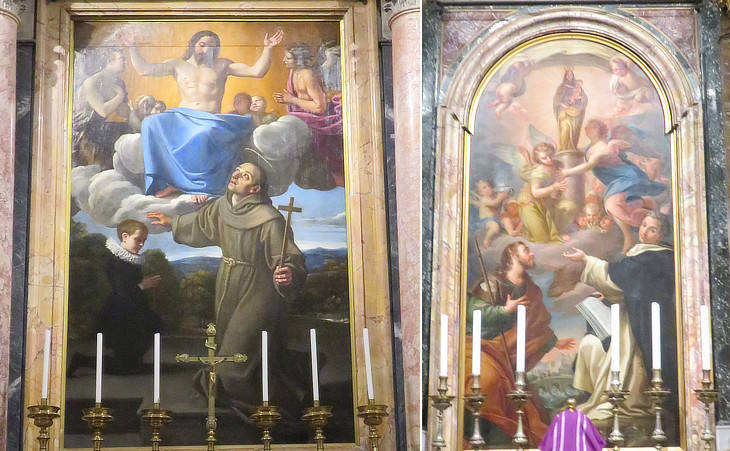
(left) Vision of St. Diego de Alcalà by Annibale Carracci or il Domenichino; (right) Madonna del Pilar (Column), a shrine at Zaragoza between St. James and St. Vincent Ferrer by Francisco Preciado de la Vega
In the first chapel to the right is a painting of S. Diego, contemplating a vision, by the master-hand of Annibal Caracci. (..) Over the altar of the next chapel is the Madonna della colonna, or an apparition made to S. James the greater in Spain, by Carlo Saraceni. Donovan
St. Diego de Alcalà, a Spanish Franciscan monk (1400-1463) was canonized in 1588 at the request of King Philip II of Spain because he attributed the recovery of his son Charles (the boy portrayed in the painting) to a miracle performed by the mummy of Diego.
St. Vincent Ferrer, a Spanish Dominican monk (1350-1419) was canonized in 1455. The altarpiece where he is portrayed is now attributed to Francisco Preciado de la Vega, a painter from Seville who settled in Rome in 1733 and who became Principe dell'Accademia di San Luca in 1749.
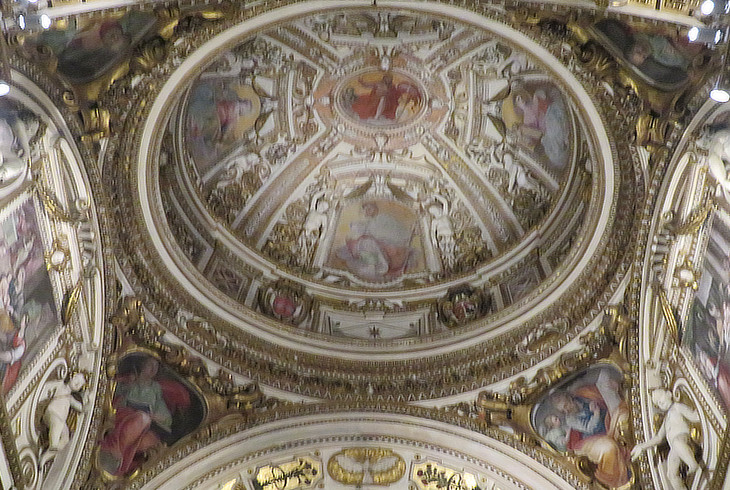
Cappella di Monserrato: ceiling with elaborate stuccoes which is attributed to Giovanni Battista Ricci
Giovanni Battista Ricci from Novara (1545-1620), one of the least solid maniera painters under Sixtus V, was given the task of designing the stucco decorations of the portico of S. Pietro. Since elegant and rich stucco decorations were the only field in which Roman Mannerists under Gregory XIII and Sixtus V had shown real inventiveness and originality, Maderno (or Ricci) here drew upon a vigorous, living tradition and created a work the excellence of which has always been acclaimed. Wittkower

(left) Madonna and Child with St. Anne (from S. Giacomo degli Spagnoli) by Maso del Bosco aka Tommaso Boscoli, a Florentine sculptor who helped Michelangelo in the completion of the Monument to Pope Julius II: (centre) Cappella di Monserrato: St. Raymond of Penyafort sailing on his cloak towards Barcelona by Giovanni Battista Ricci (see a similar miracle performed by St. Francis of Paula); (right) 1881 monument containing the mixed ashes of the two Borgia popes (Calixtus III and Alexander VI) by Filippo Moratilla.
To the right is S. Raymond of Pennafort, wafted from Majorca to the harbour of Barcellona on his cloak, one corner of which he has tied to his staff for a sail, a fact attested by the earliest historians of his life, cited in the bull of his canonization, and recorded by the erection of a chapel and tower on the place where he landed. (..) Note. The bodies of Calixtus III, and of his nephew Alexander VI. cased in a leaden coffin, lies without a record behind the great altar, having been removed from the Vatican grottos in 1610. Donovan
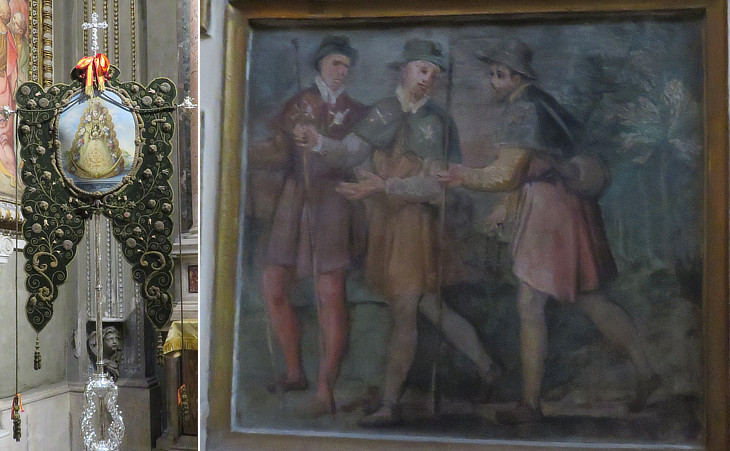
(left) Banner of Montserrat; (right) detail of a fresco decoration portraying pilgrims to Compostela

S. Giovanni in Ayno was a parish church until 1824. It was deconsecrated in 1895 and all its internal decoration is lost. The reference to Ayno has never been explained. It existed already in the XIIth century and it was larger than it is today; in the XVIth century it was downsized to make room for Palazzo Ricci and then rebuilt by Giusto Bonanni from S. Gimignano in Tuscany; the house of the parish priest was located in the adjoining building which is decorated with a fine XVIIIth century "madonnella".

(left) Overall view; (right) details of its graffito paintings
Palazzo Ricci is named after Giulio Ricci, who bought it in 1577; he was a nephew of Cardinal Giovanni Ricci who began the construction of Villa Medici. His son Orazio built a small house in Rione Parione.
The palace was built in the late XVth century and its decoration is due to Polidoro da Caravaggio, a pupil of Raphael, who became famous for being able to paint entire buildings; it must be said that in 1525 when he worked at this palace he was in his twenties so he was full of energy; after the 1527 Sack of Rome he left the city and went to Naples and Sicily where he reverted to traditional painting. Most of his Roman works are lost, but some are known through sketches and engravings (you may wish to see another building decorated by Polidoro in Via della Maschera d'Oro or his frescoes at S. Silvestro al Quirinale). The remaining paintings of Palazzo Ricci were recently restored; they show episodes of the history of Ancient Rome. The rear of Palazzo Massimi retains a painted wall of the same period.
Today the building is split into apartments. Mario Praz, a professor of English Literature at the University of Rome lived in one of them until 1969. You may wish the extraordinary collection of furniture and other items of the early XIXth century which he gathered there.

Courtyards: (left) Palazzo D'Aste Pericoli Sterbini; (right) Palazzo Incoronati Sacripante
Via di Monserrato provides additional material for the pages on the Fountains in the Courtyards of Rome and on the Roman "madonnelle".

Courtyard of Palazzo Capponi Antonelli: (left) stairs; (right) a wall decorated with graffito paintings
The courtyard of this palace most likely replaced a very short alley which branched off Via di Monserrato and led to a painted house.

(left) Near Palazzo Ricci; (centre) opposite Palazzo Incoronati; (right-above) in Palazzo Podocatari; (right-below) Roman inscription at the end of Via di Monserrato stating that Emperor Claudius enlarged the "pomerium" (the sacred boundary) of the City of Rome (see other similar inscriptions)

(left) Overall view: on the left Via del Pellegrino and on the right Via di Monserrato; (right) details of the paintings in Via del Pellegrino; (inset) coat of arms of the Habsburgs
Another Renaissance painted building is the house of Pietro Paolo Francisci, called della Zecca (Mint) as
he was in charge of the mint during the pontificate of Pope Paul II. Similar to Palazzo Ricci it was painted with scenes from the history of Ancient Rome. The paintings are almost entirely lost, but the building is still interesting for its design at the junction between Via del Pellegrino and Via di Monserrato. The two streets continue in Via dei Banchi Vecchi.
Pietro Paolo della
Zecca hosted in his home Eleanor of Portugal who married Austrian Emperor Frederic III of Habsburg in 1462: in memory of the event a relief with the Habsburg's double-headed eagle was walled on the right side of the building. In the XIXth century however the double-headed eagle became a symbol of the Austrian domination in Italy and soon after 1870, when Rome
became the capital of Italy, the relief was moved to the courtyard of S. Maria dell'Anima.
The letters AEIOU below the eagle stand for Austriae Est Imperare Orbi Universo (it is the role of Austria to rule over the whole world). You may wish to see some pages on Vienna, the City of the Last Roman Emperors.
Next plate in Book 6: S. Maria in Monticelli.
Next step in Day 7 itinerary: Palazzo Sacchetti.
Next step in your tour of Rione Regola: Palazzo Montoro.
Excerpts from Giuseppe Vasi 1761 Itinerary related to this page:
Chiesa di s. Caterina della RuotaMolto antica e ricca dovette essere questa piccola chiesa, poichè del 1166. fu da Alessandro III. unita al Capitolo di s. Pietro. Dicevasi prima s. Maria in Caterina, e s. Maria e Caterina, e però in essa fu trasportata la statua di detta Santa, che era nell'antichissimo monastero, atterrato per la fabbrica dell'Anfiteatro Vaticano, e prese il titolo di s. Caterina della Ruota, a distinzione di quella di Siena. Sono in essa delle pitture a fresco del Muziani, e di altri.Chiesa di s. Girolamo della CaritàA destra è questa venerabile chiesa eretta, come si crede, nella casa di s. Paola matrona Romana, perchè vi abitasse per qualche tempo il s. Dottore. Fu già collegiata, e poi vi stettero i frati Osservanti di s. Francesco fino all'anno 1519. allorchè Leone X. la concedè alla confraternita della Carità, la quale esercita varie opere di misericordia verso i poveri, specialmente co' poveri carcerati pagando loro le spese della carcerazione, e tenendo un Avvocato, ed un Curiale per le loro difese, anco civili. Mantiene per servigio della chiesa alcuni Preti dotti ed esemplari, fra' quali si annovera s. Filippo Neri, che vi abitò 33.anni, e si conserva ancora la sua stanza, in cui operò molti prodigj, e conversò con s. Carlo Borromeo, con s. Ignazio di Lojola, e con s. Felice Cappuccino, onde è ridotta ora in cappella ornata di marmi e di pitture. Fu rinnovata la chiesa l'anno 1660. col disegno di Domenico Castelli; il prospetto però fu fatto a spese di Fantino Renzi, il quale fece ancora l'altare maggiore con architettura del Cav. Rainaldi, ornato di marmi, di metalli, e di pietre dure, in cui è il famoso quadro di s. Girolamo dipinto dal Domenichino. La cappella a destra ornata tutta di marmi, metalli, e stucchi dorati, è disegno del Cav. Javarra, e la statua di s. Filippo Neri è scultura di Monsù le Gros. Le pitture nella cappella dall'altra parte sono di Durante Alberti; le sculture nella cappella accanto alla porta sono di Ercole Ferrata, il quadro di s. Pietro nella cappella incontro è del Muziani; il s. Carlo Borromeo nell'altra cappella è di un Torinese, e quello nell'oratorio annesso è del Romanelli. Indi passeremo alla vicinaChiesa di s. Tommaso degli InglesiFu questa da prima dedicata alla ss. Trinità, secondo che si legge, da Offa Re d'Inghilterra l'an. 630. e vi era unito uno spedale per i pellegrini di quella nazione: ma essendo dipoi cambiato da Gregorio XIII. in collegio di studenti della medesima nazione, il Card. di Nortfolche nel 1575. rifabricollo di nuovo, e si vedono nella sala i ritratti di alcuni, che nelle persecuzioni di Enrico VIII. e della Regina Elisabetta furono fatti morire. Quindi voltando a destra, evvi dopo pochi passi laChiesa di s. Maria di Monserrato, e di s. Giovanni in Aino
I nazionali di Aragona avevano fin dall'an. 1350. quì presso uno spedale; ma poi nel 1495. unendosi
con quei di Catalogna, e di Valenza edificarono questa chiesa in onore della santissima Vergine
sotto il titolo di Monteserrato, che si venera in Catalogna. Antonio da Sangallo ne fece il disegno,
fuor che il prospetto, rimaso perciò non compito. Carlo V. affinchè restasse provvisto lo spedale, si
assegnò 500. ducati annui nel Regno di Napoli, e però vi sta un convitto di Preti di quelle nazioni, che
ufiziano la chiesa ancora.
|


