
All images © by Roberto Piperno, owner of the domain. Write to romapip@quipo.it.


Notes:
Page revised in July 2024.
All images © by Roberto Piperno, owner of the domain. Write to romapip@quipo.it.
Notes:
Page revised in July 2024.
 Palazzo Ruspoli
Links to this page can be found in Book 4, Map B2, Day 1, View C6, Rione Colonna and Rione Campo Marzio.
The page covers:
The plate by Giuseppe Vasi
Today's view
Palazzo Ruspoli
Palazzo Peretti Ottoboni Fiano and Arco di Portogallo
Ara Pacis Augustae
Streets of the Shopping District (Via Borgognona, Via Frattina and Via della Vite)
Palazzo Della Genga

In the neighbourhood of the Palazzo Ruspoli, the street is no wider than elsewhere, but the pavements are higher. Here fashionable society congregates, and the stands and chairs are soon occupied or reserved. The most beautiful women of the middle class, in charming fancy dress and surrounded by their friends, expose themselves to the inquisitive looks of the passers-by.
J. W. Goethe - Italian Journey - January 1788 - translation by W. H. Auden and E. Mayer - Collins 1962.
Towards the dusk of the evening, the
horse-race takes place. (..) These are five or six horses, trained on
purpose for this diversion; they are drawn
up a-breast in the Piazza del Popolo, exactly where the Corso begins. Certain balls, with little sharp spikes, are hung along their sides, which serve to spur them on. (..) As soon as they begin to run, those
animals, by their impatience to be gone,
shew that they understand what is required
of them, and that they take as much pleasure as the spettators in the sport. (..) The
horses fly off together, and, without riders,
exert themselves to the utmost; impelled
by emulation, the shouts of the populace,
and the spurs above mentioned. They run
the whole length of the Corso; and the
proprietor of the victor is rewarded by a
certain quantity of fine scarlet or purple
cloth, which is always furnished by the
Jews.
John Moore - A View of Society and Manners in Italy - 1781
In his views Giuseppe Vasi did not show scenes of the Roman carnival and of the race which took place in the afternoon along Via del Corso; this 1754 etching however shows that the
palaces along the street had special facilities for watching the race: scalino di Ruspoli was the name given to the high step on the Via del Corso side of Palazzo Ruspoli;
chairs were placed on it during the race; they were reserved to the Ruspoli and their guests or they
were rented to members of the middle class. Nearby Palazzo Ottoboni did not have a proper façade along Via del Corso, but it had a long covered balcony which granted an excellent view of the race.

Galleria Nazionale d'Arte Moderna: Ippolito Caffi - The "Moccoletti" game - 1852 and Palazzo Ruspoli
The diversion of the Moccoletti, the last madness of the Carnival, is now at hand; and sellers of little tapers like what are called Christmas candles in England, are shouting lustily on every side, "Moccoli, Moccoli! Ecco Moccoli!" - a new item in the tumult. (..) As the bright hangings and the dresses are all fading into one dull, heavy, uniform colour in the decline of the day, lights begin flashing, here and there: in the windows, on the house-tops, in the balconies, in the carriages, in the hands of foot-passengers: little by little: gradually, gradually: more and more: until the whole long street is one great glare and blaze of fire. Then everybody present has but one engrossing object; that is, to extinguish other people's candles, and to keep his own alight; and everybody: man, woman, or child, gentleman or lady, prince or peasant, native or foreigner: yells and screams, and roars incessantly, as a taunt to the subdued, "Senza Moccolo, Senza Moccolo!" (Without a light! Without a light!) until nothing is heard but a gigantic chorus of those two words, mingled with peals of laughter. Read more of the description of the Roman carnival in 1845 by Charles Dickens.
The view is taken from the green dot in the small 1748 map here below.
In the description below the plate Vasi made reference to: 1) Strada dei Condotti towards Piazza di Spagna;
2) Strada dei Condotti towards Ripetta;
3) Palazzo Ottoboni;
4) Palazzetto S. Marco (Venezia) and Torre del Campidoglio. 1), 2) and 4) are shown in other pages.
The small map does not show Palazzetto Venezia and 4) indicates the location of Arco di Portogallo; 5) Palazzo Ruspoli; 6) Palazzo Della Genga; 7) Via Borgognona; 8) Via Frattina; 9) Via della Vite. The dotted line in the map delineates
the border between Rione Campo Marzio and Rione Colonna (lower right quarter).


(left) The view in June 2010; (right) enlargement showing Monumento a Vittorio Emanuele II at the end of Via del Corso which has replaced Palazzetto Venezia and Torre del Campidoglio; the modern pink façade of Palazzo Ottoboni can be seen on the right side of the street
Palazzo Ruspoli has lost its scalino and its loggia has been modified, but overall it retains its late XVIth century design; in 1888 Palazzo Ottoboni was given a façade along Via del Corso which has approximately the same height as Palazzo Ruspoli.

(left) View of Palazzo Ruspoli showing Piazza del Popolo at the northern end of Via del Corso; (right) Palazzo Ruspoli seen from Via Borgognona
In 1544 Pope Paul III started the construction of Via Trinitatis (aka Via dei Condotti or Via Condotti) which linked Porto di Ripetta with Platea Trinitatis, today's Piazza di Spagna; the street had the effect of favouring the urban development of the northern section of Via del Corso; the street was completed in 1550 and already by 1556 a rather large palace was erected at the corner between Via del Corso and Via dei Condotti. In 1583 the building was bought by Orazio Rucellai, a member of an important Florentine family; he commissioned Bartolomeo Ammannati, a famous Florentine architect, the enlargement and redesign of the palace which was completed in a few years. Ammannati designed in Rome also Villa Giulia, Villa Medici and Palazzo di Fiorenza.

(left) Northern side of Palazzo Ruspoli showing SS. Trinità dei Monti at the end of Via Condotti; (right) northern portal (the use of "bugnato" is typical of Florentine architecture)
In 1630 the palace was sold to the Caetani who made several changes to its internal layout and slightly modified the design of the northern façade; in the XVIIIth century the palace was acquired by the Ruspoli who enlarged it along Via Condotti.

(left) Decorated lamps of the northern portal; (right-above) detail showing the Ruspoli heraldic symbols; (right-below) 1780 inscription celebrating the enlargement of the palace in the XVIIIth century
Palazzo Ruspoli is very near Palazzo Borghese (along Via Condotti); the Borghese placed their heraldic
symbols everywhere on the exterior of the main palace and on the adjoining buildings and the Ruspoli decided to imitate them; two lamps are decorated with vines and grapes which appear in
the Ruspoli coat of arms and are also a reference to their fiefdom of Vignanello (nice small vineyard). They were also Princes of Cerveteri.
The image used as background for this page shows a coat of arms of Francesco Maria Marescotti Ruspoli and his wife Isabella Cesi in the courtyard of the palace.

(left-above) Sarcophagus in the courtyard; (left-below) inscriptions from gravestones in the courtyard; (right) Musei Vaticani: Silenus bearing infant Dionysus from Palazzo Ruspoli
The statue is maybe a copy of an original made by Lysippos in the IVth century BC. Silenus, a satyr, was the foster-father of Dionysus who was entrusted to his care by Hermes after his birth from the thigh of Zeus; it calls to mind similar statues of Hercules and his infant son.

January 2013: a new colour for Palazzo Ruspoli, more in line with that which it had in the past. You may wish to see a page on Rome Ten Years Ago

(left/centre) Parts of Palazzo Peretti; (right) details of the cornice showing three mountains, a rampant lion and pears, all heraldic symbols of the Peretti, the family of Pope Sixtus V
Piazza di S. Lorenzo in Lucina separates Palazzo Ruspoli from Palazzo Ottoboni which was initially built by the titular cardinals of that church. They gradually enlarged their residence and they eventually bought some houses on the other side of Via del Corso; they then built a covered passage above an ancient Roman arch to link their properties; the arch became known as Arco di Portogallo, after Jorge da Costa, from Portugal, who was the titular cardinal of S. Lorenzo in Lucina between 1488 and 1508. In 1624 the complex of buildings was sold to Prince Michele Peretti, a relative of Pope Sixtus V, who commissioned the redesign of those behind the apse of S. Lorenzo in Lucina.

(left) 1665 Inscription placed by Pope Alexander VII to celebrate the demolition of Arco di Portogallo; (right)
details of the windows of Palazzo Ottoboni Boncompagni showing the heraldic symbols of the Ottoboni (a double-headed eagle) and of the Boncompagni (a dragon)
As for the Arch called Arco di Portogallo in the
Via Flaminia mentioned in Roma antica it is I suppose demolished, for we could find nothing of it.
John Ray - Observations (..) made in a journey through part of (..) Italy in 1663
Pope Alexander VII Chigi took several actions to improve the central section of Via del Corso where he had his family palace; Arco di Portogallo was demolished because it narrowed the street.
Towards the end of the XVIIth century the Peretti properties on both sides of Via del Corso were bought by Marco Ottoboni, a relative of
Pope Alexander VIII; he was Duke of Fiano and the palace adjoining S. Lorenzo in Lucina became known as Palazzo (Ottoboni di) Fiano,
whereas that on the other side of Via del Corso at the corner with Via della Vite was called Ottoboni Boncompagni because the only
daughter of Marco Ottoboni married a Boncompagni.

Musei Capitolini: reliefs from Arco di Portogallo (but they were not made for that arch which perhaps was dedicated to Emperor Aurelian): (left) Emperor Hadrian delivering a speech; (right) Apotheosis of Sabina, his wife. You may wish to see the Apotheosis of Emperor Antoninus Pius and of his wife Annia Faustina and another relief found in Via del Corso which portrayed Hadrian

Ara Pacis Augustae
In 13 BC the Senate decreed to consecrate an altar to Pax Augusta, i.e.
the peace resulting from the victorious campaigns of Emperor Augustus in Spain and Gaul; an annual sacrifice took place at the altar. It was located near Horologium Divi Augusti, a gigantic sundial erected behind today's Palazzo di Montecitorio.
In 1568 fragments of the altar were found beneath Palazzo Ottoboni; they were bought by
Cardinal Giovanni Ricci and they ended up on the walls of Villa Medici and in Florence; other fragments were found
in the following centuries and were sold on the antiquarian market; in 1938 a thorough excavation campaign yielded other parts of the altar which was eventually reconstructed in a museum near Mausoleo di Augusto.

Museo dell'Ara Pacis (you may wish to see their website - it opens in another window): Monuments built by Augustus in "Campus Martius": 1) River Tiber; 2) Mausoleo di Augusto; 3) "Horologium Divi Augusti"; 4) "Ara Pacis Augustae"; 5) section of Via Flaminia which corresponds to today's Via del Corso
Behold by Tiber's flood (..)
With arms and trophies gleamed the field of Mars:
There to their daily sports the noble youth
Rushed emulous; (..)
(..) there they formed
Their ardent virtues.
John Dyer - The Ruins of Rome - 1740
The poetical account of Campus Martius (Field of Mars) by Dyer did not apply to the area at the time of Augustus, because it had been drained and its central section was chosen for the construction of large monuments, e.g. Pantheon, Basilica di Nettuno and Terme di Agrippa whereas the northern one was devoted to monuments celebrating Augustus.

Cast (left) and original (right) relief at the Louvre which was bought in 1868
The altar was reconstructed exclusively with original fragments and casts of those which were acquired by other institutions. For this reason some parts of the altar are missing.

Panel on the front of the altar. It depicts Aeneas making a sacrifice to the Penates, the sacred objects he rescued from Troy and carried with him to Italy (they are inside the small temple). Two boys bring fruit, wine and a sow for the ceremony. The sow led Aeneas to the site where he founded "Lavinium"
Augustan storytelling culminated in the sculptured masterpiece of the age of Augustus - the Ara Pacis Augustae. It is in this monument that Augustan storytelling crystallized and reached its apogee. (..) The altar became the vehicle by which the emperor and his advisers and designers chronicled the history of Rome and the related story of a youthful dynasty that leveraged a promising past into a vital present that presaged a visionary future.
Karl Galinsky - The Cambridge Companion to the Age of Augustus - Cambridge University Press 2005.

Panel on the rear of the altar. It depicts a personification of Saturnia Tellus (Earth) or Italy or Peace between those of Air (left) and Water (right)
One of the two panels on the rear of the altar is completely lost. The remaining one is of difficult interpretation as to exactly determine who is the woman portrayed at its centre, but its overall purpose is very clear. It could be called "The Fruit of Peace" for the general impression of abundance it conveys. The women and the children are all well fed and are surrounded by plants, animals and water. The billowing mantles (velificatio) of Air and Water are a symbol of their divine nature. They can be seen also in floor mosaics, e.g. in Tunisia and paintings, e.g. at Pompeii.

Section of one of the reliefs depicting a procession: it shows (left to right) four "Flamines maiores" (officers wearing a leather skull-cap with a chin-strap and a point of olive wood on its top), a "Flaminius lictor" (carrying a fasces, a symbol of authority) and Marcus Vipsanius Agrippa followed by his relatives
Two sides of the altar were decorated with a long relief showing a procession probably led by Augustus (you may wish to see him in a statue where he was portrayed as Pontifex Maximus - Highest Priest). It is interesting to remark that sex and age were not excluding factors for taking part in the procession.

Details showing children of Gens Julia, the imperial family, attending a procession (according to a hypothesis suggested by the management of the Museum): 1) Lucius Caesar (?), son of Marcus Vipsanius Agrippa and his third wife Julia, Augustus' daughter; 2) Gneus Domitius Aenobarbus, grandson of Ottavia, sister of Augustus. He married Agrippina and was the father of Emperor Nero; 3) Gaius Caesar, brother of Lucius Caesar; the two were nominated by Augustus as his successors, but they died before him; 4) a son of Marcus Vipsanius Agrippa and Marcella, his second wife; see the depiction of children at Trajan's Arch at Benevento and at Colonna Traiana
Many of the individuals attending the procession have been identified as members of Augustus' enlarged family. It is not a symbolic procession where all participants are similar and they differentiate only for a detail which indicates their role or status as in other monuments celebrating the deeds of an emperor, e.g. the Apadana of Persepolis. The true to life portrayal of the emperors and their relatives was a characteristic of Roman art until the IVth century AD; you may wish to see a detail of the Parthian Monument of Ephesus portraying four emperors attending a procession in a very naturalistic way which makes them immediately identifiable.

Decorative panels (the swan is perhaps a symbol of Venus, mother of Aeneas)
The panels are framed by a very elaborate decoration. It is evident that those who designed the altar did not want to encumber the viewer with too many panels depicting something. These motifs had an influence on the decoration of monuments in provincial towns e.g. at Cavaillon.
Fragment of the sacrificial table inside the altar
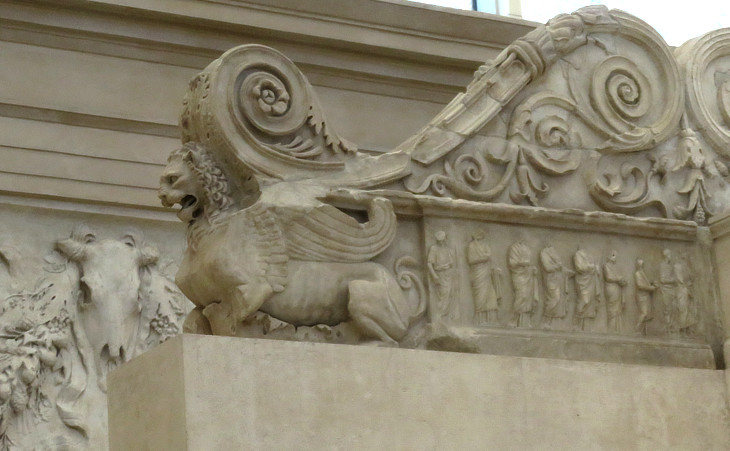
The interior of the altar was decorated with marble panels depicting bucrania and festoons. The table upon which sacrifices were performed, the actual altar, is almost entirely lost, exception made for two fragments which decorated its upper part. They show vegetable volutes above winged lions (or rather sphinxes with a lion head) and a small relief depicting a religious ceremony, perhaps that which was attended by the imperial family.

Museo dell'Ara Pacis: other ancient reliefs found in the 1920s near Palazzo Ottoboni

(left to right) Via Borgognona, Via Frattina and Via Della Vite (all seen from Via del Corso)
From the Piazza di Spagna, to go to St. Peter's, it is necessary to pass down one or two streets filled with little shops, outside and inside of which are displayed, for the especial temptation of strangers, (forestieri) a vast variety of real and fictitious antiques, gems, cameos, mosaics, bronzes, paintings, and prints. These lead into the Corso, the fashionable course of carriages, the only long straight street in Rome.
Rembrandt Peale - Notes on Italy, written during a tour in the years 1829 and 1830.
Via Condotti was the main of a series of parallel streets between Via del Corso and Piazza di Spagna which made up the Strangers' Quarter of XVIIIth century Rome.
Via Borgognona was also called Via Rucellai because it started from the entrance to Palazzo Rucellai Ruspoli; its name is a reference to the fact that it ends opposite Casa dei Borgognoni.
Via Frattina was named after fratte (bushes), an indication of the rural condition of the area before its development
in the late XVIth century; it starts opposite Piazza di S. Lorenzo in Lucina and it ends in Piazza di Spagna near Colonna dell'Immacolata.
Sunday 12 May, 1765. Yesterday . . . after dinner went to Corso like
one enragé and amused for last time. You're never to go back.
Now swear no libertinage.
Wednesday 22 May. Yesterday morning still baddish....
Went to Casenove's and had third girl. Resolved no more. Swear it.
From James Boswell's 1765 letters on the Grand Tour related to his visit to Rome.
Via della Vite (grape vine) starts opposite Palazzo Ottoboni and it ends at the southern side of Palazzo di Propaganda Fide; in the past it had a dubious reputation because the papal government authorized prostitutes to live and work there, not far from a S. Maria Maddalena delle Convertite, a convent for penitent prostitutes.
In the second half of the XIXth century travelling patterns changed in favour of railway; because Stazione Termini was located in a very different part of Rome the Strangers' Quarter lost most of its hotels
and cafés; it then became a popular shopping district; in recent times some of its historical shops were replaced by chain stores.

(left) Palazzo Della Genga forming an angle between Via del Leoncino (left) and Via di Fontanella Borghese (right); (right) XVIIIth century madonnella
This simple XVIth century palace was modified in 1612 when Pope Paul V Borghese straightened the section of Via Condotti between his family palace and Via del Corso (this section is currently called Via di Fontanella Borghese). The Della Genga family became famous in 1823 when Cardinal Annibale Della Genga, a strong advocate of reactionary policies, was elected Pope Leo XII.
Next plate in Book 4: Palazzo Borghese.
Next step in Day 1 itinerary: Chiesa di S. Lorenzo in Lucina.
Next step in your tour of Rione Colonna:
Piazza Colonna.
You have completed your tour of Rione Campo Marzio!
Excerpts from Giuseppe Vasi 1761 Itinerary related to this page:
Palazzo Ruspoli già GaetaniCon disegno di Bartolommeo Ammannati fu eretto questo magnifico Palazzo della nobilissima famiglia Gaetani, ed è riguardevole per la scala composta di gradini di marmo pario, per le statue, e per li busti, e bassirilievi antichi, che sono in esso.Palazzo FianoA destra della riferita chiesa si vede parte dell'antichissimo palazzo de' Cardinali Titolari della medesima, che poi fu posseduto dalla famiglia Peretti, indi de' Ludovisi, ed ora de' Duchi di Fiano Ottoboni. Si legge, che da un Cardinale Inglese fu fabbricato l'an. 1300. sopra le rovine di un grande edifizio, che dicevasi di Domiziano. Era appoggiato al medesimo un arco trionfale, che dal volgo fu detto di Tripoli, forse per i trofei, de' quali fu adorno; o pure per la vittoria di tre città avuta da quell'Imperatore. Fu detto ancora di Portogallo, da un Cardinale di quella nazione, che vi abitò. Il Nardini considerando i bassirilievi, che vi erano, lo credette di Marco Antonio, e stette in piedi fino al pontificato di Alessandro VII. il quale per rendere libera la strada del Corso, fece demolirlo: pose però nel casamento incontro una lapide per memoria di esso, e li bassirilievi furono posti in Campidoglio nel palazzo de' Conservatori. |


