
All images © by Roberto Piperno, owner of the domain. Write to romapip@quipo.it.


Notes:
Page revised in July 2026.
All images © by Roberto Piperno, owner of the domain. Write to romapip@quipo.it.
Notes:
Page revised in July 2026.
 Palazzo Colonna di Sciarra
Links to this page can be found in Book 4, Map B2, Day 1, View C7, Rione Colonna and Rione Trevi.
The page covers:
The plate by Giuseppe Vasi
Today's view
Palazzo Colonna di Sciarra
- Appartamento del Cardinale
- Fondazione Roma Collection
Palazzo Bonaccorsi and Palazzo Verospi
S. Maria Maddalena
delle Convertite (Palazzo Marignoli)

This 1754 etching by Giuseppe Vasi shows in the foreground a section of Via del Corso which at that time was regarded as a small square because it was slightly wider than the rest of the street. It was called Piazza Sciarra since all the palaces on its eastern (right)
side belonged to the Sciarra, a branch of the Colonna family; the last two buildings were linked by a covered passage known as Arco di Carbognano, after the name of a fiefdom of the Sciarra.
The etching shows also Via del Corso from Piazza Sciarra to its northern end at Piazza del Popolo.
The view is taken from the green dot in the small 1748 map here below.
In the description below the plate Vasi made reference to: 1) Palazzo Sciarra "per la famiglia" (people working for the Sciarra either as servants or in the administration of the family properties);
2) Arco di Carbognano;
3) Piazza del Popolo;
4) Street linking Piazza di Pietra with Fontana di Trevi. 3) is shown in another page.
The small map shows: 1) Palazzo Sciarra "per la famiglia"; 2) Arco di Carbognano; 3) Palazzo Sciarra (the main building); 4) Street linking Piazza di Pietra with Fontana di Trevi; 5) Palazzo Bonaccorsi; 6) S. Maria Maddalena delle Convertite; 7) Palazzo Verospi.
The dotted line in the small map delineates
the borders among Rione Colonna (left half and top right quarter), Rione Pigna (small area near the green dot) and Rione Trevi (lower right quarter).


The view in July 2009; (inset) Piazza del Popolo
In 1883, after the 1870 annexation of Rome to the Kingdom of Italy, a new city plan envisaged the enlargement of Via del Corso from Piazza Sciarra to Via Condotti; this led to the demolition of a series of buildings on the eastern side of the street except for Palazzo Sciarra; the small adjoining palace and Arco di Carbognano were pulled down to open a new street leading to Fontana di Trevi. Eventually the enlargement did not cover the whole section of Via del Corso included in the city plan, but only that between Palazzo Sciarra and S. Maria Maddalena delle Convertite.

Portal and details of its decoration showing some masks
The presence of the Colonna in this neighbourhood goes back to the XIth century. Their houses were protected by towers one of which was modified over the years until it was turned into the current palace.
The Colonna split into branches which were named after their fiefdoms; the Colonna di Paliano had their residence in Palazzo Colonna, the Colonna di Carbognano in this palace, but they were better known as Colonna di Sciarra after their ancestor Giacomo "Sciarra" (Quarrelsome) Colonna who slapped Pope Boniface VIII in the face in 1303.
The fine portal was built in 1630 by Orazio Torriani: he probably followed a drawing by Antonio Labacco, an assistant to Antonio da Sangallo the Younger. It is said that it was carved out of a single block of travertine. Torriani is best known for having designed S. Lorenzo in Miranda inside an ancient temple.
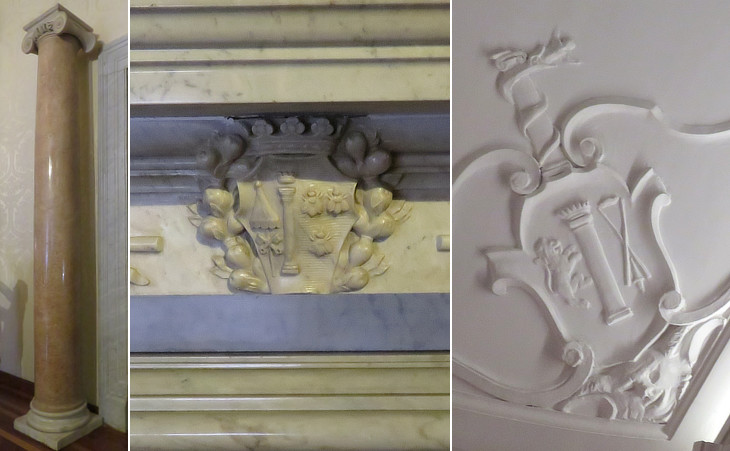
(left) A standing alone pink "lumachella" column, the heraldic symbol of the Colonna (see that at Palazzo Colonna di Paliano); (centre) Colonna Barberini coat of arms on a XIXth century mantelpiece; (right) another Colonna heraldic symbol on the ceiling of the great XIXth century staircase
Its gallery is not large, consisting as it does of four moderately sized rooms but it is one of the most select in Rome, comprising the beautiful collection which fell to the lot of Prince Sciarra Colonna on the division of the family paintings at the termination of the tedious lawsuit between him and his brother Prince Barberini, about the close of the last century.
Rev. Jeremiah Donovan - Rome Ancient and Modern - 1843
The Colonna di Carbognano in origin had the title of Princes of Palestrina, but they ceded that important fiefdom to the Barberini as a result of the marriage between Taddeo Barberini and Anna Colonna in 1627. The Barberini Colonna coat of arms can be seen at Palazzo Barberini and at other properties of the couple, e.g. at Nettuno.
In 1728 Giulio Cesare Colonna di Carbognano married Cornelia Costanza Barberini, the last of her family. Urbano, their first son, took the father's inheritance and the title of Prince Barberini Colonna di Sciarra, Carlo Maria, their second son, inherited his mother's properties and family name. In a couple's coat of arms the heraldic symbol of the husband is on the left and that of the wife on the right.
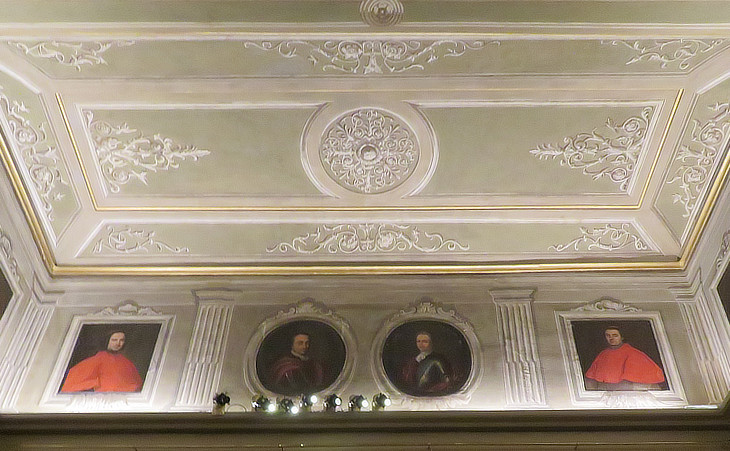
Sala dei Ricevimenti: portraits of members of the Colonna family
In the second half of the XIXth century the interior of the palace was almost entirely redesigned at the initiative of Prince Maffeo II (1850-1925) and it lost evidence of its former aspect (unlike what occurred at other nearby historical palaces, e.g. Palazzo Doria Pamphilj). The only tribute which Maffeo II paid to his ancestors was a series of 24 portraits, many of which depicted cardinals, because overall the Colonna of Paliano and of Carbognano had some 15 cardinals.

Musei Capitolini: (left) inscription from Arco di Claudio in the courtyard of Palazzo dei Conservatori; (right) relief from the western triumphal entrance to Tempio di Adriano, now in the main staircase of Palazzo dei Conservatori. It was found near Piazza Sciarra
At the time of ancient Rome the aqueduct of Acqua Vergine crossed the urban section of Via Flaminia (today's Via del Corso) very near Piazza Sciarra. The arch across the street was turned into a triumphal one, similar to Arco di Druso. It was dedicated to Emperor Claudius to celebrate his conquest of Britain; fragments of reliefs and inscriptions were found at different times during the construction of buildings on both sides of Piazza Sciarra. The final part of the inscription was reconstructed as follows: He received the surrender of eleven kings of the Britons defeated without any loss, and first brought barbarian peoples across the Ocean into the dominion of the Roman people.
The large relief shows Emperor Hadrian entering Rome where he is greeted by a personification of the City, which is very similar to that in the pedestal of Colonna di Antonino Pio. The two men with a laurel wreath are personifications of the Senatus (the older one) and of the Populus (the younger one) of Rome. Other reliefs portraying Hadrian were found at Arco di Portogallo in the northern part of Via del Corso. Some similar reliefs can be seen on the Arch of Trajan at Benevento.

Brussels Art & History Museum: bronze statue which was found in 1643 during the construction of new walls on the Janiculum. In 1667 Paolo Naldini added the head (portraying Emperor Septimius Severus) and the right arm and most likely the fine sandals. It was part of the Sciarra Collection
Among the works of art discovered in building these bastions, Bartoli mentions "many statues, one of which, of bronze, is now in the Barberini palace". The bronze statue represents Septimius Severus, and was probably set up in the garden of his son Septimius Geta. It was lately in the possession of Prince Sciarra, and must have shared the fate of the rest of his valuable collection.
Rodolfo Lanciani - The ruins and excavations of ancient Rome - 1897
The palace belonged to the Sciarra until the end of the XIXth century when Prince Maffeo II went bankrupt as a result of his too many real estate investments, which included the construction of Galleria Sciarra Colonna. The Sciarra had a villa on the Janiculum.

(left) Museo Nazionale Romano: circular pedestal of a statue depicting dancing maenads, female followers of Dionysus (from the Sciarra Collection); (centre) Centrale Montemartini: statue of Athena found in 1887 near Piazza Sciarra, the head is modern; (right) Musei Vaticani: statue of Emperor Augustus from Palazzo Verospi
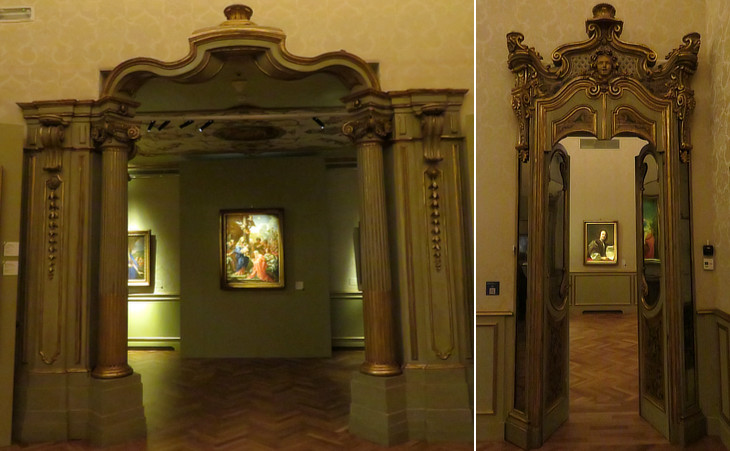
Columns and doors from the second floor apartment of Cardinal Prospero Colonna
On June 4th 1758 the French Cardinal Luynes arrived with secret instructions from his king. Great excitement was caused when on June 9th he handed to Cardinal Colonna di Sciarra the royal document appointing him Protector of France and on the following day officially communicated this news. Colonna was much liked on all sides and had for long enjoyed the confidence of many notabilities, so that he was in a position to initiate in the best possible way the less experienced Frenchmen into the state of the electoral negotiations. (..) Colonna being a man of much experience, with friends among the Italians, the position of the French was considerably strengthened by his appointment. (..) Clement XIII summoned a consistory for September 3rd, 1762, and in his allocution he pronounced all the resolutions of the French Parlements against the Society of Jesus to be null and void, the judgment of ecclesiastical institutes being the inalienable right of the Holy See. (..) Cardinal Prospero Sciarra Colonna, Protector of France, ostentatiously kept away from the Consistory.
Ludwig von Pastor - The History of the Popes - 1891
Cardinal Prospero Colonna, brother of Giulio Cesare Colonna, was made cardinal in 1743 and he supported the French cardinals during the conclave of 1758, his only remarkable deed. He asked and obtained from his brother to live in a newly decorated apartment in the upper floor of Palazzo Colonna di Sciarra.
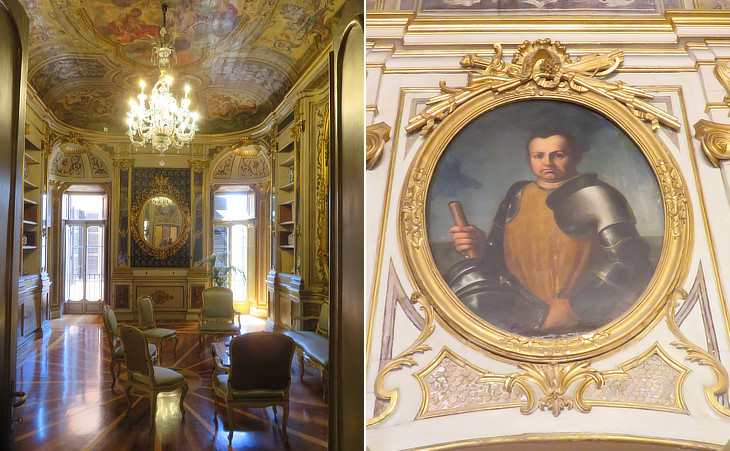
(left) Library; (right) portrait of Sciarra Colonna, after whom this branch of the Colonna is named
Part of the apartment was demolished in the XIXth century, but two small rooms in its private part (the Library and the Hall of the Mirrors) testify to the taste of the Cardinal and to the fashion of the time. A remarkable aspect of the decoration is that, apart from the portrait of an ancestor, nothing else refers to the family history, to its many fiefdoms or to its heraldic symbols which were customary subjects in Roman palaces of that time (see that of the Altieri at Oriolo). The two rooms were designed by Luigi Vanvitelli before the architect left Rome to design and build the Royal Palace of Caserta.
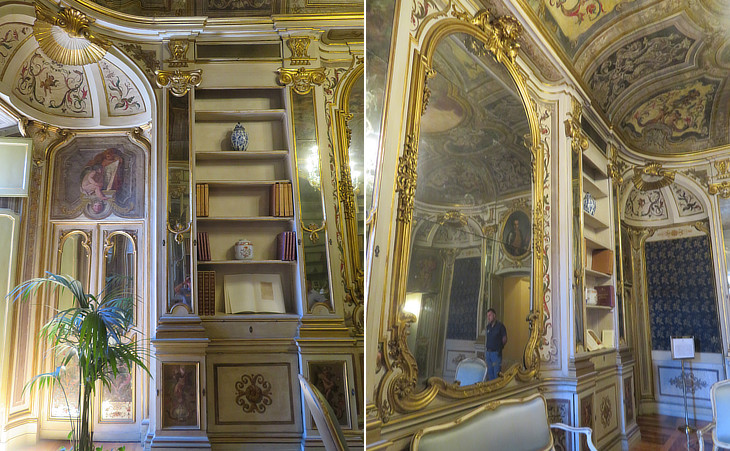
Long side of the Library
The name of the room is Biblioteca (Library), but sitting room would be a more appropriate name. The ceiling was lowered to create a more intimate and relaxed atmosphere, the shelves were not meant for many books nor the large mirrors were appropriate for a place where to read and meditate. In those years Cardinal Neri Maria Corsini opened Biblioteca Corsini to the public, but the apartment of Cardinal Prospero Colonna was a very private one and it was never mentioned by travellers and Roman guidebooks.
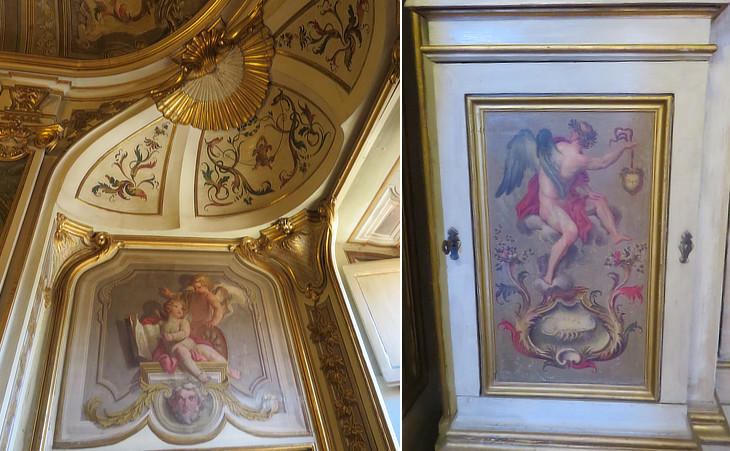
Library: (left) an allegory, perhaps one of the seasons; (right) a zodiacal sign (Scorpio)
The room was decorated by Stefano Pozzi (see his ceiling at S. Apollinare) with pleasant images of children and young men. The subject of the zodiacal signs was treated in a very simple way, unlike the Roman Renaissance tradition (see frescoes at La Farnesina and at Loggetta Mattei). In essence the decoration is characterized by a sense of "levity", pastel colour palettes and curving asymmetrical lines. These replaced the grand, serious tones of previous periods with charm and a focus on leisure.

Gabinetto degli Specchi (Room of the Mirrors)
Mirrors and painted mirrors became a decorative feature of many palaces after they were employed at Versailles for the Galerie des Glaces (1678-1684 - it opens in another window). You can see their use at Palazzo Doria Pamphilj, Amalienburg at Nymphenburg and at Villa Palagonia of Bagheria where they were partially painted. A room between the bedroom of the Cardinal and the Library is characterized by mirrors painted by Stefano Pozzi.
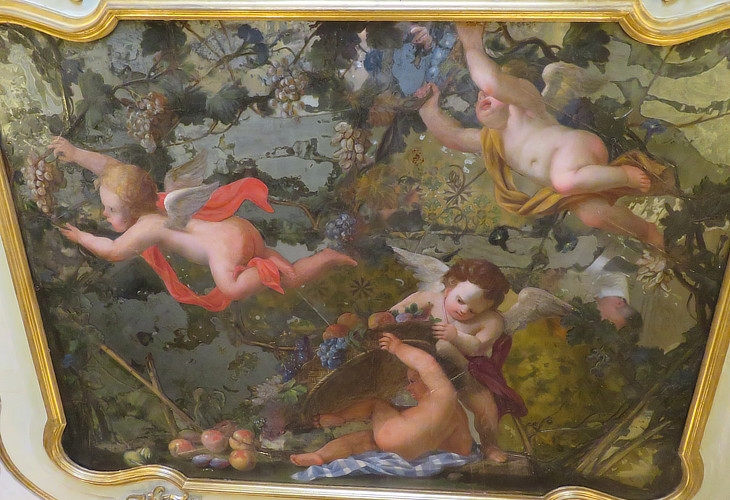
Gabinetto degli Specchi: ceiling depicting Cupids working in a vineyard
The leading Roman masters
continued to practise their feeble Late Baroque far into the eighteenth century. They believed themselves to be the legatees of the great Italian tradition and looked with scorn
upon its perversion. How deeply this was felt may be gathered from the anti-Rococo cry
raised in 1733 by Antonio Balestra, a pupil of Maratti: "All the present evil derives from the pernicious habit, generally accepted, of working from the imagination without having first learned how to draw after good models and compose in accordance
with the good maxims."
Rudolf Wittkower - Art and Architecture in Italy - 1600-1750
The ceiling is unusually low and the room is very small so the mirrors have the function to enlarge its size. Pozzi tested himself in depicting a subject which had a very long Roman tradition, from ancient sarcophagi to the mosaics of S. Costanza and to the portico of Villa Giulia.
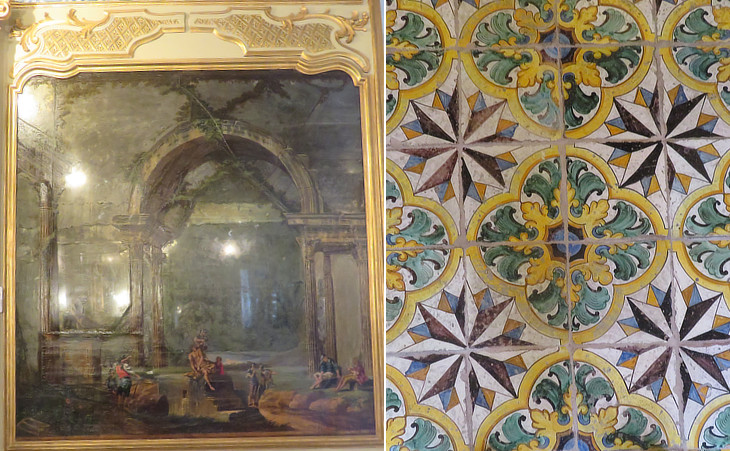
Gabinetto degli Specchi: (left) fantastic view of Roman ruins; (right) floor decorated by Neapolitan majolica tiles (tin-glazed pottery that is fired a second time)
The depiction of the ancient Roman monuments in a ruining condition was a favourite subject for landscape paintings which were highly sought after by foreign travellers. The plain depiction of the monuments, typical of the paintings by Caspar van Wittel was modified by the publication in the 1740s of Vedute di Roma, a series of highly dramatic etchings by Giovanni Battista Piranesi in which the ancient monuments were given a gigantic size and human beings were dwarfed to emphasize the overwhelming grandeur of Roman architecture (see his view of the Philosophers' Hall at Tivoli - it opens in another window). The painting by Pozzi testifies to this development of landscape paintings.
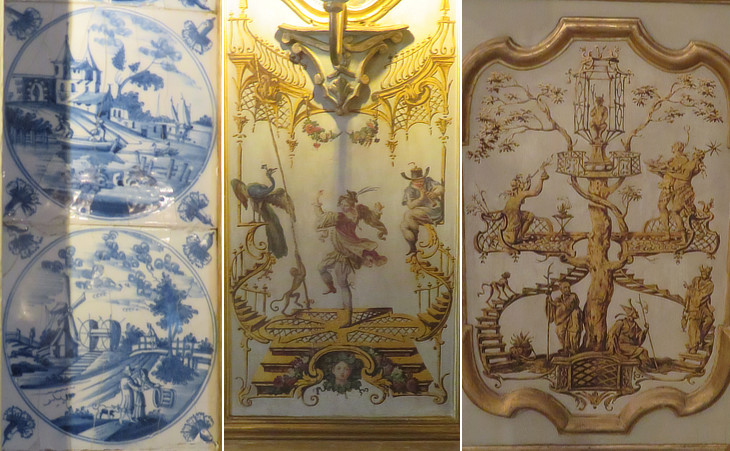
Gabinetto degli Specchi: (left) Delft tiles; (centre) an XVIIIth century development of the "Renaissance grotesque" decoration; (right) Chinese looking panel
Chinoiserie is a French term meaning "Chinese-esque" and it is used with reference to the adoption of Chinese patterns in European artefacts, e.g. at the Pagodenburg at Nymphenburg, and to a lesser extent in buildings. In western Europe these patterns were made known in the XVIIth century, first by the Jesuits and later on by the development of trade with China. See a page on Exoticism in XVIIth century Rome.
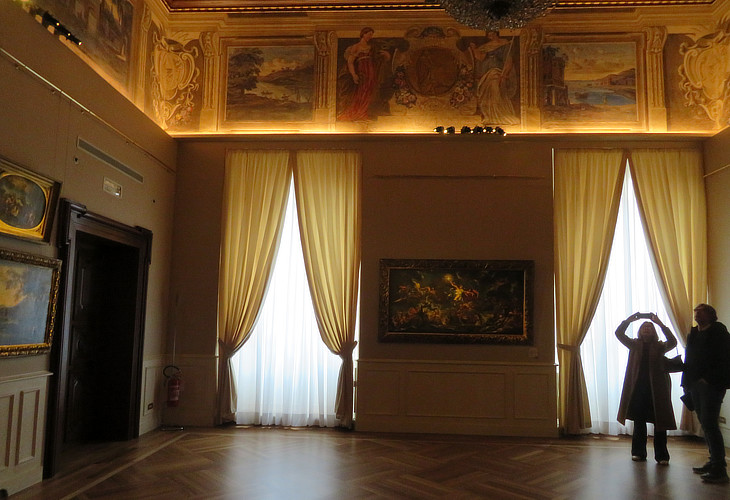
A hall of the permanent collection of Fondazione Roma
The gallery is small, but has the rare advantage of containing few inferior works, and is in this respect the most select gallery in Rome. Many of the best pictures were formerly in the Barberini collection.
John Murray - Handbook for travellers in central Italy - 1843
As the gallery is supplied with catalogues we shall content ourselves wtth selecting the best productions in each room. Donovan
The gallery included works by the Cav. D'Arpino, Gherardo delle Notti, Giovanni Bellini, Titian, Maratta, Lorraine, Bril, Sacchi, Poussin, Reni, Guercino, Carracci and many other masters.
The collection was sold piecemeal after Prince Maffeo II went bankrupt. The palace changed property many times. The new landlords were in most cases banks and the interior was redesigned to accommodate offices and similar facilities. It was eventually acquired by Fondazione Roma. Its history Roma dates back to 1539, with the establishment of the Monte di Pietà of Rome. It continued in 1937 when Cassa di Risparmio di Roma (a Savings Bank) incorporated the Monte di Pietà. Subsequently, the Fondazione Cassa di Risparmio di Roma was established and it inherited the original social welfare objectives of the Cassa di Risparmio. In 2007, the institution changed its name to Fondazione Roma, in order to highlight the evolution of its identity following the separation of banking activities from philanthropic ones. Fondazione Roma owns also Palazzo Cipolla (1874) opposite Palazzo Colonna di Sciarra. The former houses temporary exhibitions, the latter the permanent collection and occasionally some small temporary exhibitions (in this page some of the paintings were part of an exhibition on Carlo Maratti).
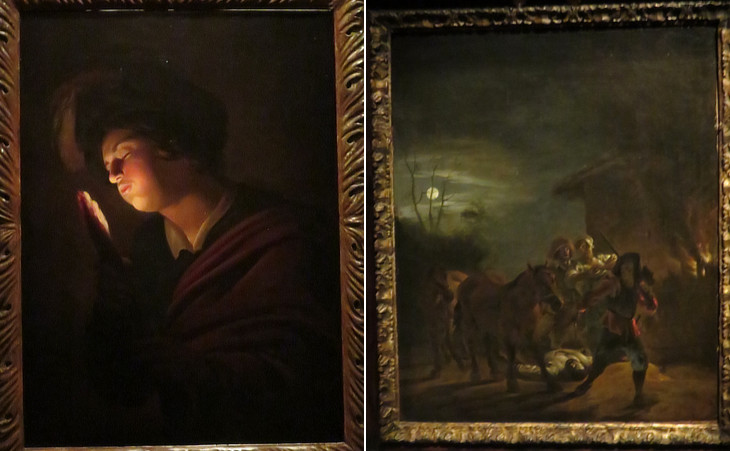
(left) A Boy Blowing on a Firebrand by Gherardo delle Notti (Gerard van Honthorst); (right) Night Robbery at a Farm by Pieter Van Laer, il Bamboccio (see a similar painting at Palazzo Spada)
Soon after 1620 Caravaggism in Rome had lost its appeal. It remained successful only in the popular genre in cabinet format, the introduction of which was largely due to the Haarlem artist Pieter van Laer, who was in Rome from 1625 to 1639. His so-called Bambocciate survived as an undercurrent with a long history of their own. Wittkower
Gherardo delle Notti, another foreign painter who was influenced by Caravaggio is best known for his candle or torch light effects (see another of his paintings at Chiesa dei Cappuccini).
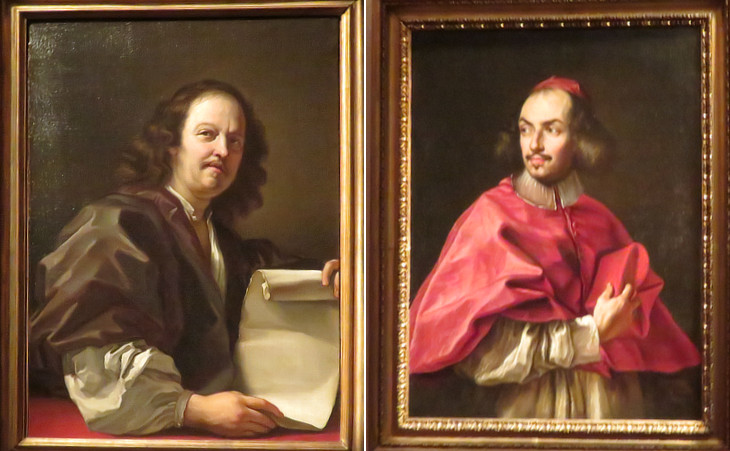
Carlo Maratti (aka Maratta)'s portraits: (left) Gaspare Marcaccioni (ca 1672); (right) Cardinal Jacopo Rospigliosi (1667) from the Fitzwilliam Museum
Almost all the great Late Baroque artists were excellent portrait painters - from Maratti
to Batoni and Mengs. It is an interesting aspect that their portraits were, as a rule, painted without theoretical encumbrances and therefore often speak to us more directly and more forcefully than their
grand manner. Wittkower
In his Life of Maratti, Giovan Pietro Bellori described the portrait of Marcaccioni by these words: "Nor any less praiseworthy is the portrait of Gasparo Marcaccioni, who being the accountant and chief minister of Cardinal Antonio Barberini deploys with both hands a book containing the first three even numbers etc..". In this version of the portrait Marcaccioni holds a blank parchment, but undoubtedly it deserves Bellori's praise. The three men were in friendly terms and Bellori regarded Maratti as the greatest painter of his time. The portrait of Cardinal Rospigliosi, nephew of Pope Clement IX shows that Maratti was part of the selected group of artists who worked for the Papal court.

Allegory of Summer and Autumn (1688) by Carlo Maratti - Private Collection
The classical wave surged far beyond the confines of the artistic capital
and threatened to quell a free development in such vigorous art centres as Bologna.
Moreover the classical point of view received literary support, not dogmatically perhaps,
from the painter and biographer of artists Giovanni Battista Passeri, the friend of Algardi
and Sacchi, and most determinedly from Giovanni Bellori (1615-96), the learned antiquarian, the intimate of Poussin and Duquesnoy, and the mouthpiece and universally
acclaimed promoter of the classical cause. Wittkower
Depictions of chariots in the sky became very popular for the decoration of ceilings, especially after those of Aurora (Dawn/Daybreak) by Reni and by Guercino in the early XVIIth century. At Palazzo Barberini the ceilings by Andrea Sacchi and by Pietro da Cortona show how the subject was approached by the classical and the High Baroque painters. Maratti who had studied with Sacchi followed in the footsteps of his master, whereas other painters of his time, e.g. Mattia Preti, followed in those of Cortona.
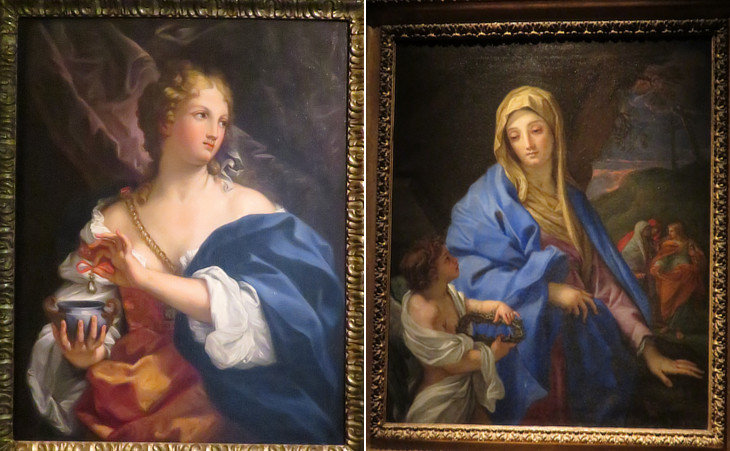
Carlo Maratti: (left) Cleopatra dissolves the pearl in the vinegar (Museo di Palazzo Venezia 1693-1695); (right) Adoration of the Crown of Thorns (Mainetti Collection 1700-1705)
There were two Pearls, the very largest that ever were known in any Age, and they were possessed by Cleopatra, the last Queen of Egypt; having descended to her by means of the Kings of the East. When Antony had feasted her Day by Day very sumptuously, and under the Influence, at one Time, of Pride and petulant Disdain, as a Royal Harlot, after undervaluing his Expense and Provision, he demanded how it was possible to go beyond this Magnificence: she replied, that she would consume, in one Supper, 100 hundred thousand Sestertii. Antony desired to learn how that could be possible, but he thought it was not. (..) She then commanded the second Table to be brought in. As soon as the Order was given, the Attendants placed before her one only Vessel of Vinegar, the Strength and Sharpness of which wasted and dissolved the Pearls. Now she wore at her Ears that most remarkable and truly singular Work of Nature. Therefore, as Antony waited to see what she was going to do, she took one of them from her Ear, steeped it in the Vinegar, and when it was liquefied, drank it.
Pliny the Elder - Historia Naturalis - Book IX
Maratti's painting technique consisted of a clearly articulated composition, clearly delineated figure outlines, and a careful use of colour. He made use of a a dark blue which he obtained by pulverizing lapis lazuli, especially for the mantles of his madonnas.
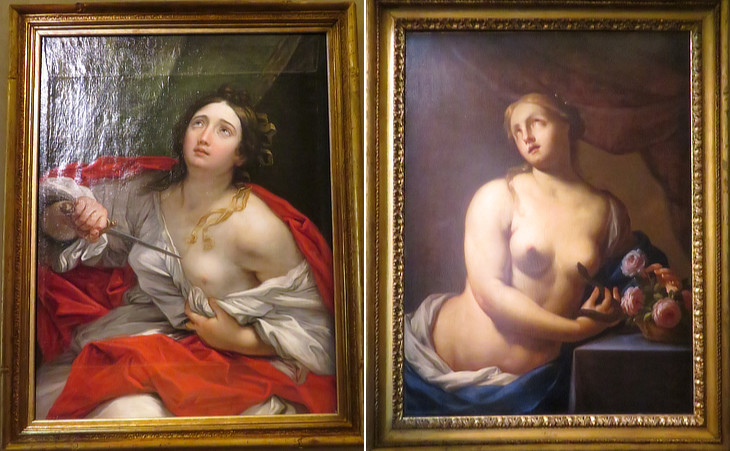
(left) Lucrezia by Carlo Maratti (1685 from the Gallery of the Royal Collections at Madrid); (right) Cleopatra by Francesco Trevisani (1718)
Maratti maintained a large studio with many pupils and collaborators. The recognition of his art extended beyond the borders of Italy. He created numerous works that today can be found in major museums and galleries throughout Europe. He left a major impact on his students and the artistic world. See other paintings by Trevisani and other followers of Maratti at Galleria Spada and at S. Cecilia.
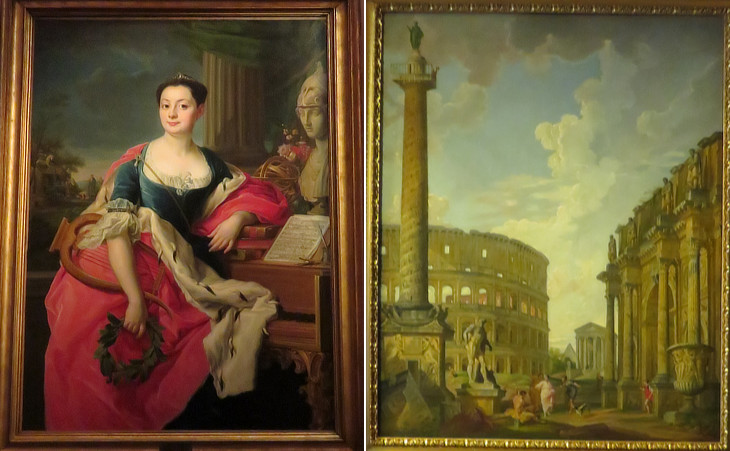
(left) Giacinta Orsini Boncompagni Ludovisi (as member of Accademia degli Arcadi) by Pompeo Batoni (1758); (right) Capriccio Italiano by Giovanni Paolo Pannini depicting Colonna Traiana, Ercole Farnese, Colosseo, Piramide di Caio Cestio, a temple, Arco di Costantino and a large "kantharos"
It was mainly three artists who made heroic attempts at leading Roman painting back to a sounder foundation: (..) and, finally, Pompeo Batoni (1708-87), by steering more decisively towards the newly rising ideal of the antique. In a varying degree, all three artists take up special position on the borderline between Rococo and Neoclassicism. These masters, and even Batoni in pictures farthest on the road to Neo-classicism, stuck tenaciously to Late Baroque formulae of composition. (..)
During the last thirty years of his life (he died in Rome in 1765) Gian Paolo Pannini was primarily engaged on topographical views of Rome, real and imaginary. (..) The boldness of Pannini's views, the sureness with which he placed his architecture on the canvas - clear signs of the trained quadraturista - the handling and placing of his elegant figures, the atmosphere pervading his pictures, the crystalline clarity of his colours, the precision of his draughtsmanship - all these elements combine into an art "sui generis", which had much influence on the majestic visions of Piranesi. Wittkower
Portraying Grand Tour travellers was Batoni's main occupation, but today he is best known for an iconic image of the Sacred Heart of Jesus at il Gesù. You may wish to see a large painting by Pannini where he shows all his talent.
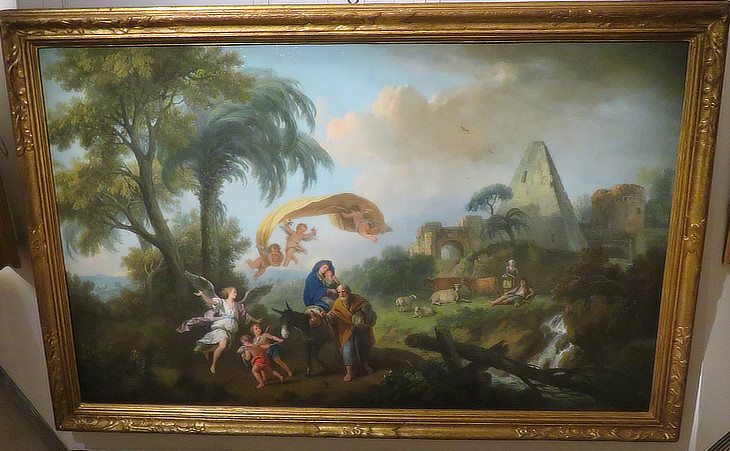
Flight to Egypt and Roman ruins (Piramide di Caio Cestio and Sepolcro dei Plauti) (on display at Palazzo Cipolla in the former vault of Cassa di Risparmio di Roma)
This XVIIIth century painting combines three genres so that the painter can show his talent in all of them: a religious subject, an exotic landscape and a selection of Roman ruins.
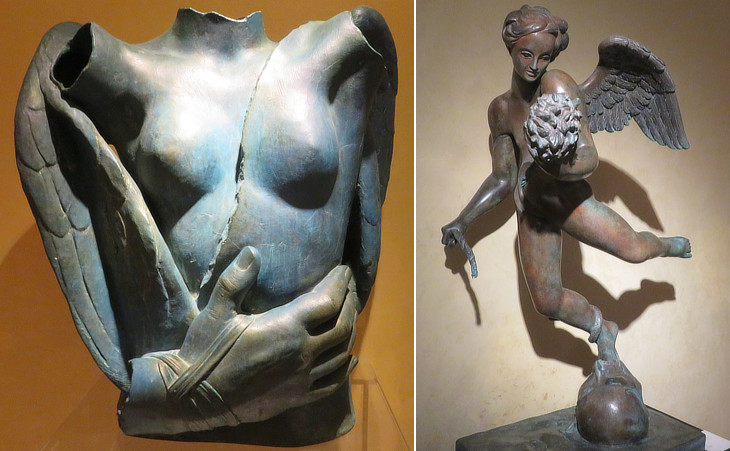
(left) Igor Mitoraj - Winged Eros with Hand (2004); see another statue by Mitoraj at Agrigento; (right) Alba Gonzales - Hamlet's Angel (2008)
Fondazione Roma continues to increase its collection by selected purchases of works by modern artists.

(left) Palazzo della Banca Commerciale Italiana on the site of Palazzo Bonaccorsi; (right) Palazzo Verospi (the image used as background for this page shows a detail of its capitals)
The process of demolition and reconstruction of the buildings on the eastern side of Via del Corso was a very painful one and it was completed only in 1922
with the inauguration of Galleria Colonna which replaced Palazzo Spada Piombino.
Banks played a major role in this process as they competed to have their headquarters or their Roman branch along Via del Corso.
Palazzo della
Banca Commerciale Italiana was designed by Luca Beltrami in 1919. Credito Italiano, another important bank, bought Palazzo Verospi; the building was not affected by the enlargement of the street because it was located on its western side (the eastern one was pulled down to make room for a department store);
yet it was modified to fit the requirements of the bank: a storey was added and the ground floor windows were turned into doors, thus modifying the original design of the façade by Girolamo Rainaldi and Onorio Longhi, which was very similar to that of Palazzo Sciarra.

Fondazione Roma at Palazzo Colonna di Sciarra: horse race along Via del Corso showing Palazzo Verospi and Colonna Antonina by Jan Miel (1650)
The horses, without jockeys, traditionally started the race at Piazza del Popolo and galloped down the Via del Corso to the finish in Piazza Venezia. In this painting, however, they appear to be galloping in the direction towards the Piazza del Popolo. Via del Corso, originally called via Lata, was renamed after this annual event, which included additional celebrations hosting masquerades and allegorical carriages. In the courtyard of Palazzo Verospi it is possible to see the Verospi Jupiter, which is now in the Vatican Museum; at the time, it was the centrepiece of the family's collection of antiquities. For the race the palace façade was decorated with draperies. Jan Miel belonged to the group of Flemish painters called the Bentvueghels. They privileged the depiction of scenes involving ordinary people.

(left) Palazzo Marignoli; (right) detail of its façade
The Convent of Penitent Whores (that none may perish in Rome who have a mind to be saved) called Sancta Maria Magdalena in Corso; where many of those poor Magdalens have led such penitential Lives, as the bloody Walls of their Cells, caused
by their frequent disciplining, shewed to
all Rome in a conflagration of that Monastery that Paulus Quintus himself being informed of it, would needs be carried thither, to see those Bloody Chambers from the Street, and having seen them, wept for
Joy.
Richard Lassels' The Voyage of Italy, or a Compleat Journey through Italy in ca 1668
Since the XVth century many prostitutes lived and worked in the streets between Via del Corso and Piazza di Spagna; today these streets are part of the shopping district of Rome, but in the XVIIIth century they were a temptation for the foreign travellers who lived in the Strangers' Quarter (read James Boswell's 1765 account of how he could not resist temptation).
The popes tolerated and even authorized prostitution, but they supported initiatives meant to redeem prostitutes; in 1520 Pope Leo X assigned a small church near Via del Corso to Compagnia della Carità per le Donne Convertite,
a brotherhood which helped prostitutes who wanted to abandon their trade; in 1585 the church was rebuilt and dedicated to St. Mary Magdalene; it was damaged by fire in 1617 (you may wish to see it in a 1588 Guide to Rome).
The church and the adjoining nunnery were closed in 1798; a fine painting by il Guercino depicting St. Mary Magdalene at Jesus' tomb with two angels (it opens in another window) which was in the church was moved to Musei Vaticani. The street leading from Via del Corso to Piazza S. Silvestro is still called Via delle Convertite.
Palazzo Marignoli was designed by Salvatore Bianchi in 1878-1883; it occupies the site of the former nunnery and church and in addition that of some other buildings; it now belongs to an insurance company. The façade was redesigned in 1889 by Giulio Podesti when Via del Corso was enlarged.
Next plate in Book 4: Palazzo Ruspoli sul Corso.
Next step in Day 1 itinerary: Dogana di terra (Piazza di Pietra).
Next step in your tour of Rione Colonna: Dogana di terra (Piazza di Pietra).
Next step in your tour of Rione Trevi: Chiesa di S. Marcello.
Excerpts from Giuseppe Vasi 1761 Itinerary related to this page:
Piazza e Palazzo di Sciarra
Dal palazzo del Principe di Carbognano della nobilissima famiglia Colonna di
Sciarra prende questa piazza il suo nome, ed è molto frequentata dalla nobiltà; e
cittadinanza per le botteghe del caffè, specialmente per quella del Veneziano, in cui
si trovano oltre l'esquisite bevande calde, e fredde, anco de' canditi, e confetture
particolari.
|


