All images © by Roberto Piperno, owner of the domain. Write to romapip@quipo.it.


Notes:
Page revised in June 2026.
All images © by Roberto Piperno, owner of the domain. Write to romapip@quipo.it.
Notes:
Page revised in June 2026.
 Piazza del Popolo
Links to this page can be found in Book 2, Map B1, Day 1 and Day 3, View C5 and Rione Campo Marzio.
The page covers:
The plate by Giuseppe Vasi
Today's view
Piazza del Popolo
Porta del Popolo
Obelisco Flaminio (Obelisk to Rameses II)
S. Maria del Popolo
- Cappella Chigi and other side chapels
S. Maria dei Miracoli and S. Maria in Montesanto
Palazzo Sterbini and Via Laurina

Giuseppe Vasi chose Piazza del Popolo for the opening etching of his 1752 book on the squares of Rome; he had two possible options
for showing the square; he eventually did not make a choice because in the book he depicted Piazza del Popolo from its southern end and in a
small etching in the title page he showed it from its northern end.
The main etching focused on S. Maria del Popolo and
Porta del Popolo and on the long queue of carriages waiting to make their entrance to Via del Corso during the Roman carnival. J. W. Goethe described in Italian Journey this unusual traffic jam in January 1788: As evening draws near, more and more people press into the Corso.
The carriages have come to a standstill long ago. It can happen that, when night falls, they haven't been able to budge for two hours. (..) When one coachman backs, all those behind him have to back too. The guards start cursing and threatening him. (..) Either he must get back into line or drive into a side street,
but these are usually already full of standing carriages, which came too late to get into the Corso,
because the vehicles there had already ceased to circulate (translation by W. H. Auden and Elizabeth Mayer - Collins).
A similar scene was described by Charles Dickens in an account of his arrival in Rome in January 1845: We entered the Eternal City, at about four o'clock in the afternoon, by the Porta del Popolo, and came immediately on the skirts of the Carnival. We did not, then, know that we were only looking at the fag end of the masks, who were driving slowly round and round the Piazza until they could find a promising opportunity for falling into the stream of carriages, and getting, in good time, into the thick of the festivity.
C. Dickens - Pictures from Italy - 1846.

Small etching in the title page of Book II
April 1740. The first
entrance of Rome is prodigiously striking. It is
by a noble gate, designed by Michel Angelo, and
adorned with statues; this brings you into a large
square, in the midst of which is a vast obelisk of
granite, and in front you have at one view two
churches of a handsome architecture, and so much
alike that they are called the twins; with three
streets, the middlemost of which is one of the
longest in Rome.
Thomas Gray - Letters from France and Italy in 1739-1741
The streets are well built and well paved, narrower, in general, than those in London, and wider than those in Paris; but as the houses are not too high, they are light and airy, often very long and straight, and not unfrequently terminating with an obelisk, a fountain, or a church. Such are the three streets which diverge from the Porta, or rather Piazza del Popolo; the Corso, anciently the Via Lata, terminating at the foot of the Capitol; the Strada del Babuino, ending in the Piazza' de Espagna, and the Strada de Ripetta, anciently the Via Populi, leading to the Tiber.
John Chetwode Eustace - A Classical Tour through Italy in 1802
The small etching showed the Tridente (hayfork), the three streets ideally departing from the obelisk at the centre of the square: Via del Babuino leading to Piazza di Spagna (left), Via del Corso leading to Piazza Venezia (centre) and
Via di Ripetta leading to Porto di Ripetta (right). Prior to the development of railway this was the first view of Rome for travellers coming from the north.
This plate is rather academic, whereas Giovanni Battista Piranesi, a contemporary etcher, chose a different viewpoint resulting in a less formal scene
(you may wish to see it in an another window).
The view of the main etching is taken from the green dot in the 1748 map below, that of the small etching from the blue dot. In the description below the plate Vasi made reference to: 1) the obelisk and the fountain; 2) S. Maria del Popolo; 3) Porta del Popolo; 4) S. Maria dei Miracoli. The small map shows also 5) S. Maria in Montesanto; 6) Palazzo Sterbini; 7) Via Laurina.


The view in March 2010
During the annexation of Rome to the French Empire several projects were developed to redesign Piazza del Popolo in conjunction with the opening of large gardens on the Pincio, the hill overlooking the square; the changes were eventually completed by architect Giuseppe Valadier in 1818, after the return to Rome of Pope Pius VII and the restoration of the Papal State.

Piazza del Popolo seen from Porta del Popolo in June 2010 (early morning)
The first footstep within the venerable walls will have
shewn the stranger the name and the magnificence of
Augustus, and the three long narrow streets
branching from this obelisk, like the theatre of
Palladio, will have imposed upon his fancy with
an air of antiquity congenial to the soil.
John Cam Hobhouse - Dissertations on the Ruins of Rome - 1818
The redesign of Piazza del Popolo had a minor impact on the view of the Tridente; the comparison between today's image with the etching by
Vasi shows that the bell towers of the almost twin churches were built at a later time: in 1758 that of S. Maria in Montesanto
(left) and in 1765 that of S. Maria dei Miracoli (right). The design of the Tridente was imitated in some small towns of the Papal State, e.g. Genzano.

The eastern half of Piazza del Popolo and Terrazza del Pincio behind it
The stranger (..) may ascend at once by the new road winding
up the Pincian mount, and enjoy from that eminence the view of a city, which, whatever may be
the faults of its architectural details, is, when
seen in the mass, incomparably the handsomest
in the world. Hobhouse
Valadier enlarged the square by adding two large half circles flanked by identical buildings which were much criticized for their unassuming design; the overall size of the square was deemed to be excessive in relation to those of the churches and of the obelisk.
Piazza del Popolo is a preferred location for the final rally of a political campaign, but in 1825 it was the scene of the gruseome beheading of two Italian patriots.

Statues portraying a personification of Rome between the rivers Tiber and Aniene by Giovanni Ceccarini; at their sides two columns with "rostra"
The original French project included the erection of Dea Roma, a statue of a personification of Rome which decorated Villa Medici on Terrazza del Pincio; this idea was scrapped after the return of Pope Pius VII, but the overall decoration of the square continued to be marked by a celebration of Ancient Rome, which in the past the popes had avoided, unless it was accompanied by some references to the Christian religion.

(left) Spring by Filippo Gnaccarini; (centre) Summer by Alessandro Massimiliano Laboureur; (right) Neptune between two tritons by Giovanni Ceccarini
In conclusion one could say that there are two distinct Piazza del Popolo; one on a north-south axis with a Renaissance/Baroque character and one on an east-west axis which has a typical neoclassic design; they have in common the obelisk, but otherwise they seem to ignore each other.

Galleria Chiaramonti (a new section of the Vatican Museums which was built by Pope Pius VII): fresco celebrating the Pincio gardens (see a decorative relief of that period outside S. Maria del Popolo)

Decoration by Gian Lorenzo Bernini; FELICI FAUSTOQ(UE) INGRESSUI = (to celebrate) the happy and propitious arrival
The inner side of Porta del Popolo (the outer side is shown in another page) celebrates the arrival in Rome of Queen Christina of Sweden in 1655, but the decoration is actually a celebration of Pope Alexander VII, because the six mountains and the star are heraldic symbols of the Pope. In the festoon Bernini united oak branches (another heraldic symbol of the Pope) with ears of wheat, supposedly a symbol of the Vasa (or Wasa), the Swedish royal family.

(left) Northern side (of the obelisk); (centre) southern side; (right) western side
In 1586 Domenico Fontana, at the request of Pope Sixtus V, relocated a standing obelisk from the side of S. Pietro to the centre of the square in front of it;
the successful completion of the move led the Pope to order the restoration and relocation of three other ancient obelisks in the frame of an overall redesign of Rome.
In 1589 one of the two obelisks which stood on the ground of Circus Maximus was moved to Piazza del Popolo and placed at the junction point of the Tridente.

(left) Original inscription (identical to that on the obelisk of Piazza di Montecitorio); (centre) tip of the obelisk with the bronze cross and the heraldic symbols of Pope Sixtus V; (right) XIXth century fountains with copies of the Egyptian lions at the foot of the ramp of Campidoglio
The obelisk was erected in Heliopolis and it celebrated Pharaoh Rameses II and his father Seti I;
it was brought to Rome by Emperor Augustus.
Whensoever the Plague is in
Rome, this Church is made one of the seven in the place
of Saint Sebastian, with all the indulgences to it belonging,
and it alwaies carries that title.
Fynes Moryson - An Itinerary: Containing His Ten Years Travel Through .. Italy (in 1594)
The obelisk was relocated to Piazza del Popolo because Pope Sixtus V
wanted to highlight the importance of S. Maria del Popolo, which he had decreed could replace S. Sebastiano as the seventh basilica to be visited by pilgrims. You may wish to see all the obelisks of Rome in one page.
Prior to the relocation of the obelisk the centre of the square was marked by a fountain designed by Giacomo Della Porta in 1570. It was the first of a series of fountains for
the distribution of Acqua Vergine, an ancient Roman aqueduct which was reactivated by Pope Sixtus IV and then ameliorated by Pope Gregory XIII; the fountain was slightly moved towards Via del Corso to make room for the obelisk. In 1823 Giuseppe Valadier designed four small fountains surrounding the obelisk. The old fountain was
relocated opposite S. Pietro in Montorio; in 1940 it was moved to Piazza Nicosia and slightly modified. Valadier added also a small public fountain with an interesting ancient sarcophagus near one of the new buildings.
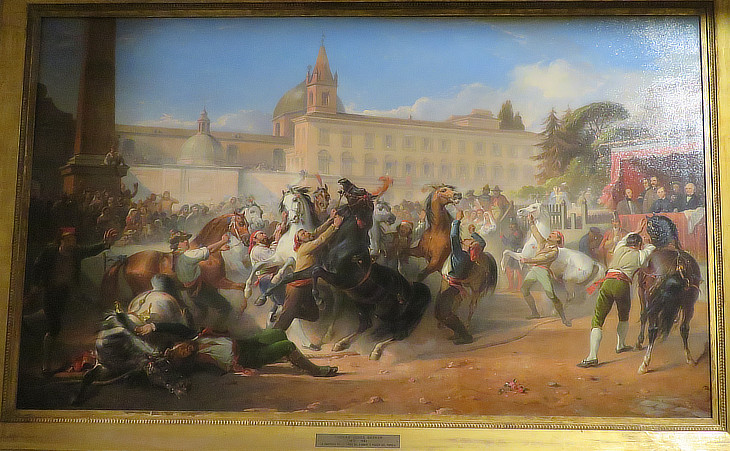
The start of the Carnival Race at Piazza del Popolo by Thomas Jones Barker (Fondazione Roma Collection)
How the Corso ever is cleared for the race that takes place at five, or how the horses ever go through the race, without going over the people, is more than I can say. But the carriages get out into the by-streets, or up into the Piazza del Popolo, and some people sit in temporary galleries in the latter place, and tens of thousands line the Corso, on both sides, when the horses are brought out into the Piazza - to the foot of that same column which, for centuries, looked down upon the games and chariot-races in the Circus Maximus. At a given signal they are started off. Down the live lane, the whole length of the Corso, they fly like the wind: riderless, as all the world knows: with shining ornaments upon their backs, and twisted in their plated manes: and with heavy little balls stuck full of spikes, dangling at their sides, to goad them on. Dickens

(left) Façade; (right) detail of the main portal with the coat of arms of Pope Sixtus IV
For a long time the reference to popolo (people) was believed to be a corruption of pioppo (poplar); in recent years records have been found which indicate that the church was built in 1099 at the expense of the
municipal authorities and that therefore the church was called Sancta Maria Populi Romani.
The medieval church was entirely rebuilt for the Jubilee Year 1475 by Pope Sixtus IV; the design of the façade and of most of the decoration of the
interior is attributed to Andrea Bregno and his assistants.
In 1655-1661 Bernini redesigned in part the façade and the interior; you may wish to see the façade as it appeared in a 1588 Guide to Rome.

(left) Domes of the church and of Cappella Cybo and bell tower; (right) interior
Neere to the Gate del Popolo lies the said Church of that
name, under the Altar whereof the bones of Nero were
laid, which, they say, were kept by spirits, till Pope Pascall
by revelation from the blessed Virgin had warning to cast
the bones into Tiber. Moryson
I passed the evening at St. Maria del Popolo, heretofore Nero's sepulchre, where his ashes lay many years in a marble chest. To this church joins the monastery of St. Augustine, which has pretty gardens on Mons Pincius, and in the church is the miraculous shrine of the Madonna.
John Evelyn's Diary and Correspondence - 1644
The church, initially a chapel, was built by Pope Paschal II in the early XIIth century on the site of a Roman mausoleum inside which a sarcophagus was assumed to contain the ashes of Emperor Nero. Later on another sarcophagus along Via Cassia became known as the tomb of the Emperor. In the late XIXth century several Roman tombs were found in the two towers at the sides of Porta del Popolo.
Returning from this Villa by the
back door which leadeth to the
Porta del Populo, I stept into the
Church of Madonna del Populo. This Church hath been
much beautified of late by Pope
Alexander the VII, because of some
of his ancestors buried here.
Richard Lassels' The Voyage of Italy, or a Compleat Journey through Italy in ca 1668
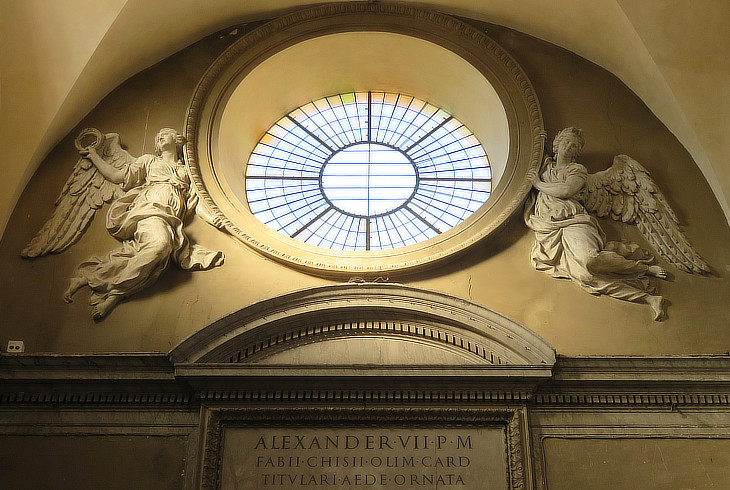
The counterfaçade has a dentilled cornice, a segmental arched pediment and a dedicatory inscription commemorating the thorough rebuilding of the ancient church that Pope Alexander VII initiated as Fabio Chigi, Cardinal Priest of the basilica, and its consecration in 1655 as newly elected Pope. The rose window is supported by two stucco angels sculpted by Ercole Ferrata in 1655-58 under the guidance of Bernini. The one on the left holds a wreath in her hand.
Rev. Jeremiah Donovan - Rome Ancient and Modern - 1843
The decoration of the counterfaçade is a simpler version of that which Bernini had designed for S. Maria in Aracoeli for Pope Urban VIII in 1634.

Stucco statues: (left) St. Clare holding the monstrance with which she repelled an attack of the Saracens by Ercole Ferrata; (right) St. Scolastica by a sculptor of Bernini's circle; at the death of Scolastica, St. Benedict in his cell saw the soul of his twin sister rise to heaven in the form of a dove
The original 15th-century architecture was largely preserved by Bernini who only added a strong stone cornice and embellished the arches with pairs of white stucco statues portraying female saints. The first two pairs on the left and the right are medieval monastic founders and reformers, the rest are all early Christian saints and martyrs. Their names are written on the spandrels of the arches with gilt letters. Donovan
The statues follow the pattern which Bernini established in 1645 in the Vision of St. Teresa in the Cornaro Chapel at S. Maria della Vittoria. Other works of art in S. Maria del Popolo by pupils of Bernini can be seen in a page covering Baroque Angels. The redesign of the church included also some new frescoes.

(left) Main altar; (right) icon of the Virgin Mary
March the 20th, 1659, wee went to the Porte del Popolo, at which Church there was exposed the Picture of the Virgin Mary upon the Altar, which the Catholickes beleeve was painted by the hand of St Luke. The Arme also of St Luke was carryed about in procession... Here wee Heard extream good musicke (see the beautiful organ which Bernini designed in 1657).
Francis Mortoft's Journal of his Travel
In 1472 the church was assigned to the Augustinians and a deep presbytery was built for the monks to attend ceremonies (it can be seen in the small map). Bregno designed an altar to house a miraculous image of the Virgin Mary which Pope Gregory IX donated to the church in 1235. It was previously in S. Giovanni in Laterano and it is dated XIIth century, although the tradition says that it was an acheiropoieta image, i.e. it was not painted by human hand. In 1627 the main altar was completely redesigned at the initiative of Pope Urban VIII (the old altar was relocated to the Baptistery chapel). As a consequence the presbytery was completely separated from the rest of the church . It contains two funerary monuments by Andrea Sansovino to Cardinal Girolamo Basso della Rovere, nephew of Pope Sixtus IV and best known for having promoted the decoration of Basilica della Santa Casa di Loreto and to Cardinal Ascanio Sforza, brother of Ludovico Sforza, Duke of Milan.

(left) Baptistery chapel: relief portraying St. John the Baptist and St. Peter (School of Bregno - from the old altar - see an altar by Bregno in the Cathedral of Siena); (right) Cappella del Presepio (Crib): painting by Bernardino Pinturicchio (you may wish to see another painting by Pinturicchio at S. Maria in Aracoeli)
The first Altar on the Right-hand is the Presepe, of which my Father has the Drawing: In a very good Manner. 'Twas before he painted the Library of Sienna.
Jonathan and Jonathan Richardson - Account of Some of the Statues, etc. in Italy - 1722
The della Rovere, the family of Pope Sixtus IV and of Pope Julius II had their family chapel at
S. Maria del Popolo; this explains why so many coats of arms of this family can be seen in the church, including those of Cardinal Domenico della Rovere who built a palace in Borgo aka Palazzo dei Penitenzieri.
Similar to S. Maria sopra Minerva, S. Maria del Popolo is a museum inside a church because it houses works by Pinturicchio, Raphael, Caravaggio, Carracci and many other artists of the Renaissance and of the XVIIth century.

(above) Balustrade of the Baptistery chapel with the coat of arms of Cardinal Domenico della Rovere; (below) detail of a gravestone in the nave
The church houses many examples of the change in taste which occurred between the early Renaissance and the XVIIth century; in the former period art was aimed at defining patterns of elegance and beauty in a harmonic frame for an aesthetic pleasure, in the latter period it was aimed at conveying strong emotions to the believer, even by a gruesome representation of Death, e.g. in the monument to Bartolomeo Gisleni.

Tombstones in the floor of the nave: (left) Alfonsina Orsini (d. 1520), widow of Piero de' Medici and grandmother of Catherine, Queen of France, with the coats of arms of the two families; (right) Paolo Montorio (d. 1581) from Narni, a prelate and a relative of the Cesi family with a similar coat of arms
Here lie buried many great scholars and artists, of which I took notice of this inscription
Hospes, disce novum mortis genus; improba felis, Dum trahitur, digitum mordet, et intereo. Evelyn
The inscription quoted by Evelyn (Visitor, learn about a new kind of death; a dishonest cat, while being caressed, bites my finger, and I die) was one of the Roman curiosities which the most learned travellers were fond of. It was first discussed by Scipione Ammirato, an Italian historian and philosopher in a small 1583 treatise in which it was compared to the death of Anacreon, a Greek philosopher who died by choking on a grape seed. The inscription attracted also the attention of Johann Caspar
Goethe, who in 1740 regarded it as a wise warning not to exceed in playing with cats. His son however did not mentioned it.
Today the inscription is covered by the pews and the part containing the name of the dead is lost, but we know that he was a Spanish priest and that he passed away in 1507, aged 41.

Relief portraying the Virgin Mary between St. Augustine and St. Catherine of the Wheel (School of Bregno)
When the interior of the church was redesigned by Bernini a number of funerary monuments and other reliefs were removed. Some of them can be seen in the narrow corridor which leads to the sacristy. The relief shown above was commissioned by Guglielmo De Pereris, Uditore di Rota, i.e. one of the judges of Tribunale della Rota Romana, the highest civil court of the Papal State. Guglielmo de Pereris commissioned Bregno other reliefs for S. Pietro Vecchio which eventually ended up at S. Pietro Ispano at Boville.
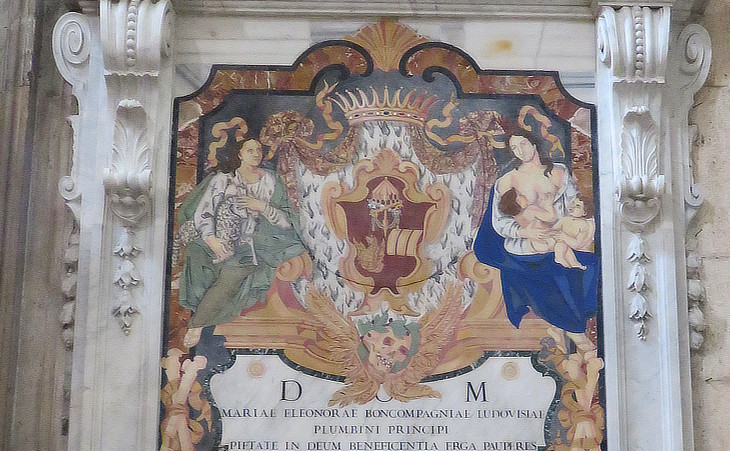
Monument in the counterfaçade depicting Humility and Charity and designed by Domenico Gregorini to Maria Eleonora Boncompagni Ludovisi, Princess of Piombino, a small port in Tuscany; see the upper and the lower parts of the monument in separate pages
Alfonsina Orsini chose to be buried at S. Maria del Popolo, rather in one of her family chapels, out of devotion for the sacred image on the main altar and the same applies to Maria Eleonora Boncompagni Ludovisi. She was Princess of Piombino, a fiefdom of Stato dei Presidi, on her own, a rare case of matrilinear succession as she inherited Piombino from her mother Ippolita Ludovisi, wife of Gregorio Boncompagni, Duke of Sora. Maria Eleonora was born in 1686 in her family palace at Isola del Liri, near Sora and she spent most of her life in Rome. She succeeded her mother in 1733 and she managed to retain the fiefdom of Piombino during the Polish Succession War, a very turbulent period of Italian and European history which saw the Kingdom of Naples and the Granduchy of Tuscany being assigned to new monarchs. Maria Eleonora married Antonio Boncompagni, her uncle, and her son Gaetano Boncompagni Ludovisi inherited both Sora and Piombino.

(left) Cappella Chigi; (right) mosaics of the dome by Luigi da Pace from Venice, based on cartoons by Raphael
In a chapel of the Ghisi, are some rare paintings of Raphael, and noble sculptures. Evelyn
Agostino Chigi, a very rich banker who was on friendly terms with Pope Julius II,
chose S. Maria del Popolo for his family chapel, which was designed by Raphael, but it was left unfinished. Pope Alexander VII,
a descendant of Agostino Chigi asked Bernini to complete it. He did the same for another Chigi chapel at S. Maria della Pace, but in that case he assigned the task to Pietro da Cortona, rather than to Bernini (who was asked to design a Chigi chapel in the Cathedral of Siena). The image used as background for this page shows a coat of arms of Flavio I Chigi, a nephew of the Pope, who was appointed titular cardinal of S. Maria del Popolo and supervised the construction of the chapel.
Dan Brown set an episode of his novel Angels and Demons in this chapel; read some remarks on its accuracy.

Cappella Chigi: statues portraying four Prophets: (left to right) Daniel by Bernini; Jonah by Lorenzetto (based on a drawing by Raphael who was also involved in the decoration of the villa of Agostino Chigi near the River Tiber); Habakkuk and the Angel by Bernini; Elijah by Lorenzetto
Here
I saw the famous statue of Jonas
made by the command of Raphael
Urbin, who shewed the sculptors of
his time how perfectly he possessed the theory of sculpture, if he would but
have dirtyed his fingers with that
dirty art. Lassels
The decoration of the chapel was strictly linked to the theme of the Resurrection. It had an octagonal shape and the dome too was partitioned into eight sectors because according to St. Augustine the Resurrection was symbolized by the number eight. The four Prophets portrayed in the statues either foretold the Resurrection of Jesus or performed resurrections themselves. Daniel and Jonah were often portrayed in early Christian sarcophagi. Bernini redesigned also the monuments to Sigismondo and Agostino Chigi and the decoration of the floor of the chapel. A separate page covers the monument to Maria
Flaminia Odescalchi Chigi immediately outside Cappella Chigi.

Baptistery Chapel: (left) receptacle for the Holy Oil; (right) monument to Cardinal Francesco Abbondio Castiglioni; inscription: "expecto donec veniat immutatio mea" (I will wait till my change come - Job 14:14)
Over the altar of the last chapel, at this side, is a Baptism of Christ, by P. Rossi: the baptismal font, to the left of the altar, and the receptacle for the holy oils, to the right, are adorned with handsome cinquecento reliefs. To the right is the monument of Card. F. A. Castiglione , who died in 1568 , and whose bust is placed over his urn of pavonazzetto. Donovan
The Baptistery chapel was redesigned at the initiative of Cardinal Flavio Chigi. Some reliefs of the old main altar were assembled to form two small cupboards. The monument to Cardinal Castiglioni reflects a pattern which was introduced by Michelangelo, especially in the design of the sarcophagus (see the monument to Cecchino Bracci at S. Maria in Aracoeli).

Cappella Basso della Rovere: (left) altarpiece by Pinturicchio; (right) monument to Giovanni Basso della Rovere, brother-in-law of Pope Sixtus IV and father of Cardinal Gerolamo Basso della Rovere, with a monochrome fresco by Pinturicchio and his assistants
The altarpiece of the next chapel, representing the Holy Family with S. Augustin, and the frescos on the ceiling and side-walls, illustrative of the life of the B. Virgin, are all by Pinturicchio. To the right is the monument of G. della Rovere, who died in the year 1483, and whose statue lies on a sort of couch. The fresco beneath relates to the Passion of our Lord. Donovan
The white and gold decoration which frames the paintings and the statues was very popular at the end of the XVth century (see an earlier example at Tempio Malatestiano in Rimini).
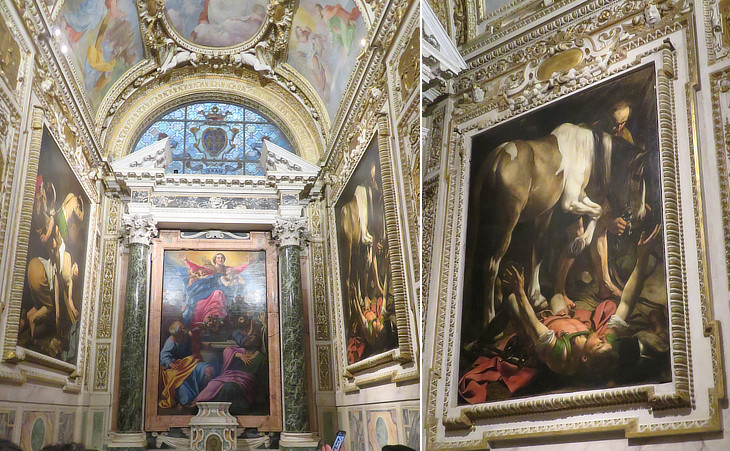
Cappella Cerasi: (left) overall view with the Assumption of Mary by Annibale Carracci above the altar; (right) Conversion of St. Paul by Caravaggio see the Crucifixion of St. Peter in another page
In the chapel de Cerasii is a piece of Caravaggio. Evelyn
The fate and
careers of Caravaggio and Annibale run strangely parallel. At about the time Caravaggio
fled from Rome, never to return, Annibale retired from life stricken by a deep melancholia, and during his last year hardly touched a brush. In his later canvases we can
follow a progressive accretion of mass and sculptural qualities coupled with a growing
economy in compositions. The Assumption of the Virgin for the Cerasi
Chapel in S. Maria del Popolo is a characteristic work of his fully developed Roman
manner. Here for the first and only time Annibale and Caravaggio worked
on the same commission, and the visitor to the chapel naturally lets his eye wander from
one master to the other. In such a comparison Annibale's Assumption may appear tame
and even laboured, but it is worth observing that, just as in Caravaggio's Conversion of
St. Paul and his Crucifixion of St Peter it is the overpowering bulk of Annibale's
figures that dominates the canvas. In spite of this triumph of the massive sculptural figure,
Annibale's Assumption shows that he never forgot the lesson learnt from Titian and
Correggio. By fusing Venetian colour with Roman design, a painterly approach with
classical severity of form, Annibale demonstrated in practice - as was correctly seen in
his own day - that these old contrasts, about which so much ink had been spilt in
theoretical discussions of the sixteenth century, were no longer irreconcilable.
Rudolf Wittkower - Art and Architecture in Italy 1600-1750.
Cappella Millini was redesigned in ca. 1623 and it contains elements of dismantled funerary monuments of the late XVth century. In 1638 Alessandro Algardi portrayed Cardinal Garcia Millini in the act of praying and a similar statue was made by Pierre-Étienne Monnot some seventy years later. The chapel contains a number of busts portraying other members of the family. The Millini or Mellini were one of the most important families of the civic Roman nobility strongly present in city offices and engaged in the exercise of the arms at the service of the pope or of other sovereigns. They had a palace in Via del Corso, another one in Via dell'Anima and a villa on Monte Mario.
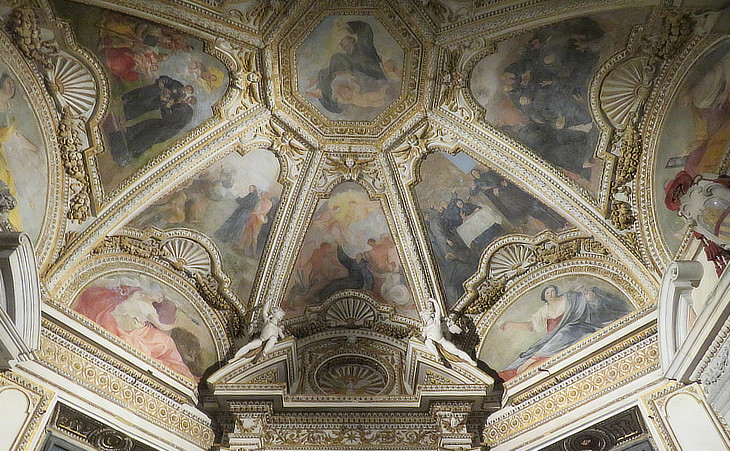
Cappella Millini: ceiling by Giovanni di S. Giovanni, aka Giovanni Mannozzi (ca 1623)
The frescos on the ceiling, now ruined by humidity, are by Giovanni di S. Giovanni. Donovan
Very different from the Bolognese was the Florentine position. Matteo Rosselli, made sure that the typically Florentine qualities of elegant design and bright local colour remained for a time unchallenged. He educated the
foremost artists of the next generation, among whom may be mentioned Giovanni
Mannozzi, called Giovanni da San Giovanni (1592-1636), ... (..) These artists responded in various ways to the rarefied atmosphere of the Florentine court.
(..) Giovanni da San Giovanni had a more healthy temperament. An artist
capable of handling very large fresco commissions, even the experience of Rome did not rid him of Florentine idiosyncrasies.
Although his light touch, translucent colours, and the ease and brilliance of his production make him one of the most attractive Florentine painters of the Seicento. Wittkower
The frescoes have been carefully restored and they depict episodes of the life of St. Nicholas of Tolentino and allegories of virtues.

Cappella Millini: (left) funerary monument to Cardinal Mario Millini (d. 1756); (right) monument to Cardinal Savio Millini (d. 1699) by Pierre-Étienne Monnot
In the works of a Monnot, a Theodon, a Legros, we sense something of the typically
French biensiance and linear grace. In spite of these un-Roman qualities, however, the
artists just mentioned absorbed so much of the Roman Baroque spirit that one feels inclined to talk of them as semi-Romans. Wittkower
The very lengthy inscription celebrating the deeds of Cardinal Mario Millini was written contra votum, i.e. against his wish, but his heirs chose to highlight all the positions he had been appointed to. He was promoted to the cardinalate in 1747 at the request of Empress Maria Theresa of Austria, whom he represented before the Holy See.

(left) Cappella Cybo with an altarpiece by Carlo Maratta (it opens in another window with a portrait of Cardinal Alderano Cybo by Maratta); (right) Monument to Cardinal Alderano Cybo by Francesco Cavallini
In 1676 Cardinal Alderano Cybo was appointed Secretary of State (a sort of Prime Minister) by Pope Innocent XI. In addition to the trust of the Pope he enjoyed that of King Louis XIV of France. He regarded himself as a likely Pope and he felt that the family chapel in S. Maria del Popolo needed to be redesigned and embellished. The chapel had been founded by Cardinal Lorenzo Cybo, nephew of Pope Innocent VIII, and was decorated with works by Bregno and Pinturicchio. In 1682 Carlo Fontana, the leading architect of the time was charged with the redesign of the chapel. In 1687 when it was inaugurated nothing of the old one was still there.

Cappella Cybo: (left) coat of arms of the Cybo-Malaspina, Dukes of Massa and Princes of Carrara; (right) gravestone of Cardinal Alderano Cybo making reference to his being the Dean of the Sacred College and the Bishop of Ostia
The new chapel stood out for its lavish decoration, but the hopes of Cardinal Cybo did not materialize. His 1698 coat of arms at Santa Aurea, the cathedral of Ostia, can be seen in the Hall of Fame of this website. Notwithstanding the money he spent for the chapel, he left a fortune to his heirs who possessed Massa and Carrara, two small towns in northern Tuscany. The Malaspina are best known for having protected Dante during his long exile. The poet wrote with reference to one of them: O, I have never been through your lands, but where do men live throughout Europe, to whom they are not known? The fame that honours your house, proclaims its lords abroad, and proclaims their country, so that he, who has never been there, knows it.
Purgatory - Canto VIII - translation by A. S. Kline.
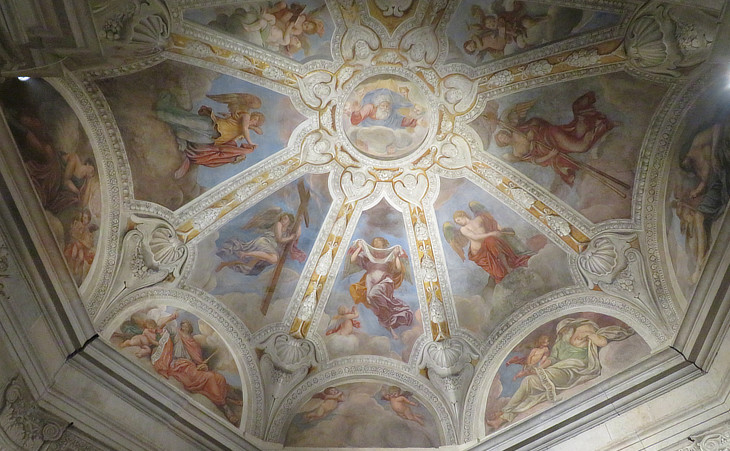
Chapel of the Crucifixion: ceiling
The first chapel which we next meet, in the left aisle, is that of the Crucifixion; and the paintings to the left and right, and on the ceiling, relating to that great mystery, are, according to Titi, by Fiammingo. Donovan
Filippo Titi wrote in 1674 a detailed account of the works of art in the churches of Rome. Fiammingo, i.e. Flemish painter, in this case was referred to Pieter van Lint (1609-1690) from Antwerp who worked in Rome in 1633-1640 before returning to his homeland. His son Hendrik Frans spent most of his life (1684-1763) in Rome where he became a leading landscape painter. In the ceiling Pieter van Lint portrayed the angels holding the symbols of the Passion, a subject which a few years later was depicted in the statues of Ponte Sant'Angelo.

The two churches seen from the obelisk: (left) S. Maria in Montesanto; (right) S. Maria dei Miracoli
Concurrently with S. Maria in Campitelli and the facade of S. Andrea della Valle ran
the work of S. Maria di Monte Santo and S. Maria de' Miracoli in the Piazza del Popolo. Here Rainaldi had to show his skill as a town-planner.
His task consisted of creating an impressive piazza which would greet the traveller on
entering Rome by the Porta del Popolo. From the Piazza del Popolo three main streets
radiate between the Pincio and the Tiber, each of them leading into the heart of the
city. The decisive points were the two front elevations, facing the piazza between these
streets. At these points Rainaldi planned two symmetrical churches with large and impressive domes as focusing-features from the Porta del Popolo. But since the sites were unequal in size, the symmetry which was here essential was not easily attained. By
choosing an oval dome for the narrower site of S. Maria di Monte Santo and a circular
dome for the larger one of S. Maria de' Miracoli, Rainaldi produced the impression from
the square of identity of size and shape. On 15 March 1662 the foundation stones of
both churches were laid. In 1673 Bernini replaced Rainaldi as architect of the left-hand
church, S. Maria di Monte Santo; Carlo Fontana, as clerk of works, completed the
building by the Holy Year 1675. Rainaldi himself remained in charge of S. Maria de'
Miracoli, which was executed mainly between 1675 and 1679, again with Fontana's
assistance. (..) Bernini probably had a formative influence on the solution of Rainaldi's most pressing
problem. Bernini always had the beholder foremost in mind and the optical impression
a structure would make on him from a given viewpoint. One wonders, therefore,
whether Rainaldi would ever have devised the pseudo-symmetrical arrangement of
these churches without the impact of Bernini's approach to architecture. Wittkower
Pope Alexander VII promoted several initiatives to improve the section of Via del Corso from
Piazza Colonna (where his family palace was located) to Piazza del Popolo (e.g. the demolition of Arco di Portogallo, an ancient arch which impaired the passage). In 1661 he commissioned Carlo Rainaldi the design of two churches at the northern end of the street so that they would provide a monumental entrance to Rome in conjunction with the gate and the obelisk.

(left) S. Maria in Montesanto; (right) Monument to Marquis Benedetto Gastaldi (design by Carlo Fontana, statues of the Virtues by Antonio Raggi) in S. Maria dei Miracoli
The two churches are not identical; S. Maria in Montesanto was built first and it has an elliptical dome, whereas that of S. Maria dei Miracoli is circular (you may wish to see the two domes from Villa Medici). Another reason why they are not identical is that the space available for their construction was different.
To the left, in the tribune, is the tomb of Card. Gastaldi, with his bust in bronze by Lucenti, and statues of Faith and Hope by Raggi and to the right is that of his brother, whose bronze bust is also by Lucenti, and the Justice, and Prudence by the same Raggi. Donovan
The construction of the two churches was mainly financed by Cardinal Girolamo Gastaldi, a member of a wealthy Genoese family, who obtained to be buried with
his brother at the side of the main altar of S. Maria dei Miracoli.

(left) S. Maria dei Miracoli; (right) its bell tower which is attributed to Girolamo Theodoli
This pretty church is situate in the piazza del Popolo, between the Corso and the Ripetta, and derives its name from a Madonna that existed in the old church, on the same site, in the XIV. century. (..) It is preceded by a graceful portico of travertine, the columns of which support an entablature and pediment, decorated with travertine statues by Lazzaro Morelli and others. Its interior is circular with side chapels and a tribune but it contains no painting worthy of notice. Donovan
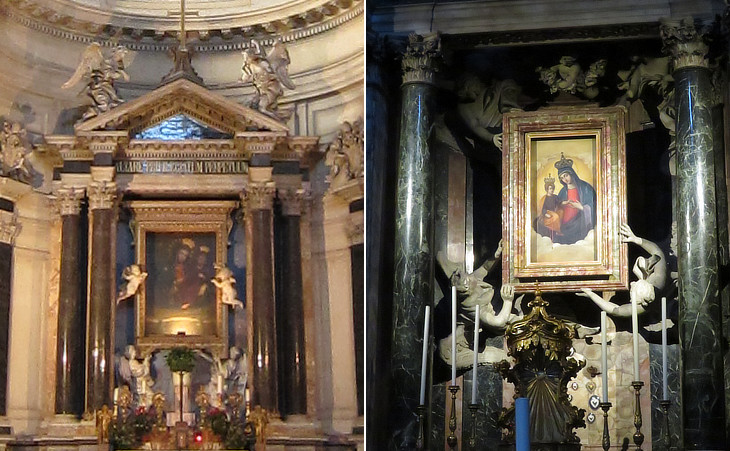
Main altars inside: (left) S. Maria in Montesanto; (right) S. Maria dei Miracoli
The church is called in Montesanto, because it substituted for a small church of the Carmelites of Montesanto in Sicily (see a large church of the Carmelites at Palermo). (..) The great altar has four columns of verde di Corsica and over the altar is the Madonna del Carmine, painted on wood. (..) The two angels that support the Madonna dei Miracoli over the great altar are by Raggi, who also sculptured the three angels above the pediment. Donovan

(left) Palazzo Sterbini; (right) Via Laurina with an inscription indicating the level of the 1598 flood and a medieval relief (enlarged in the inset) portraying two pilgrims
Palazzo Sterbini is an XVIIIth century building in Via del Babuino which belonged to the Boncompagni (who owned nearby Palazzo Boncompagni Cerasi); it was decorated with busts of Roman emperors; it was bought by the Sterbini, a family known for Cesare Sterbini who wrote the libretto for Rossini's il Barbiere di Siviglia. The Sterbini had also a small Renaissance palace in Rione Ponte.
Opposite Palazzo Sterbini a short street leads to Via del Corso; during the Middle Ages and probably until the 1475 Jubilee Year, the access to Via del Corso was obstructed by the ruins of some ancient funerary monuments; pilgrims had to make a detour and pass through this street which for this reason was named Via Peregrinorum.
In the late XVIIth century, when the pilgrims accessed Via del Corso from its new monumental entrance, the street was renamed Via Laurina, after Laura d'Este, niece of Cardinal Mazarin and mother-in-law of King James II of England, because she made donations to nearby Collegio di S. Orsola.
Next plate in Book 2: Obelisco cavato di sotto le ruine.
Next step in Day 1 itinerary: Chiesa di S. Carlo al Corso.
Next step in Day 3 itinerary: Piazza di Spagna.
Next step in your tour of Rione Campo Marzio: Porta del Popolo.
Excerpts from Giuseppe Vasi 1761 Itinerary related to this page:
Chiesa di S. Maria del PopoloSi slarga all'entrare di questa porta una gran piazza, ornata di un maraviglioso Obelisco antico e
di varj tempj, e fontane. A sinistra della detta porta appoggia la chiesa di s. Maria del Popolo, la quale
fu eretta l'anno 1099. da Pasquale II. per cancellare la nefanda memoria di Nerone, le di cui ceneri quivi
negli orti di sua famiglia Domizia stettero sepolte. Ed essendo poi nell'anno 1227. riedificata dal Popolo
Romano, prese di questo il nome; e perchè si continuasse la devozione verso la ss. Vergine
Gregorio IX. riposevi l'immagine della medesima, che stava nella celebre cappella di Santa Sanctorum:
E in forma di basilica a tre navi, e fu data in cura ai Frati Agostiniani della congregazione di Lombardia.
Giulio II. adornolla di pitture e di marmi; ed Alessandro VII. la rinnovò con disegno del Bernini.
|