All images © by Roberto Piperno, owner of the domain. Write to romapip@quipo.it.


Notes:
Page revised in October 2020.
All images © by Roberto Piperno, owner of the domain. Write to romapip@quipo.it.
Notes:
Page revised in October 2020.
 in the Churches of Rome
This page deals with baroque sculptures following the same pattern: they are funeral monuments, usually on the side walls of chapels and they show the dead in the act of praying behind a kneeling-stool.

Cappella Cornaro in S. Maria della Vittoria
A famous example of these sculptures can be seen at Cappella Cornaro in S. Maria della Vittoria, where Gian Lorenzo Bernini portrayed the members of the Cornaro, a very important Venetian family, behind a kneeling-stool (albeit a modern viewer might think they are in a theatre box). Busts in the act of praying became quite common in the XVIIth century in many European countries.
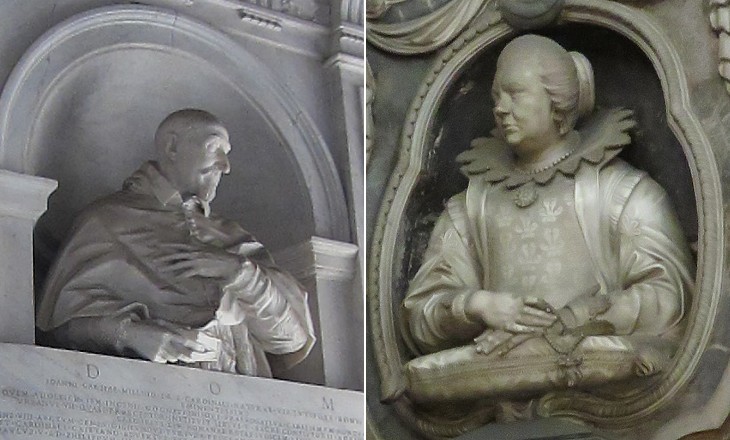
The change towards showing not much more than the bust of the dead, but behind a kneeling-stool (or just behind the top of it), was introduced by Alessando Algardi in his Monument to Cardinal Garcia Millini. Algardi did not sculpt the kneeling-stool, but in seeing the statue we get the impression that it is a full body statue of which we see only the upper part. The Cardinal is shown with his prayer book and in the act of beating (gently) his breast. The idea suggested by this monument was immediately developed in a clearer way, usually by sculpting a cushion before the bust: you can see this in a monument by Giuliano Finelli in S. Caterina da Siena a Magnanapoli. Finelli who started his career with Gian Lorenzo Bernini, ended it by adhering to the recommendations of Accademia di S. Luca for "classical" art.
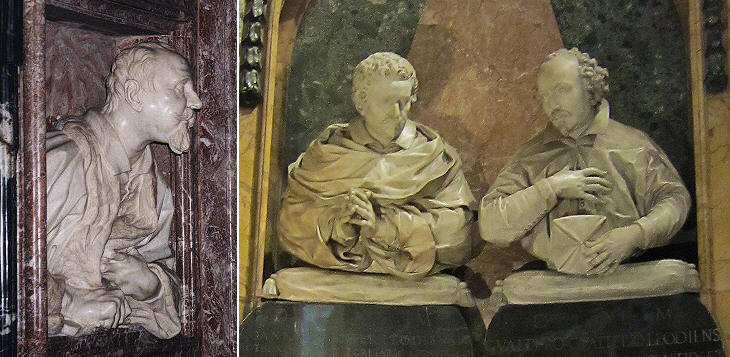
(left) Monument to Gabriele Fonseca (1661)
by Gian Lorenzo Bernini in S. Lorenzo in Lucina; (right) Monument to Johannes Savenier (1638) by Alessandro Algardi
and Monument to Cardinal Gualtiero Gualteri de Castro (1659) by Ercole Ferrata in S. Maria dell'Anima
Bernini sculpted personally the Monument to Gabriele Fonseca, a wealthy Portuguese doctor, in S. Lorenzo in Lucina. It is a portrait full of life, typical of Bernini's style. In the church of S. Maria dell'Anima we can compare a work by Alessandro Algardi, the leader of the classical school, with a work by Ercole Ferrata, one of Bernini's best scholars. The intense devotion of the young man, represented in a very classical way, makes somewhat melodramatic the attitude of the Cardinal.
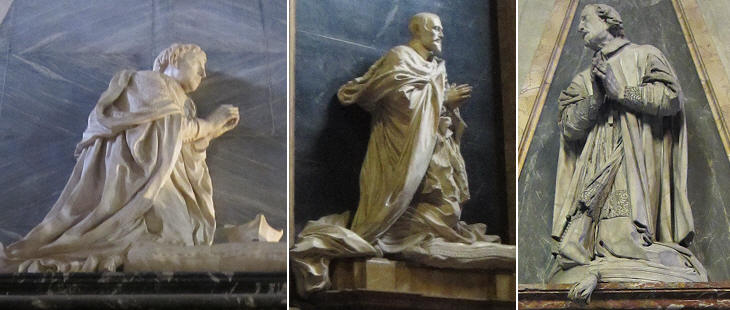
(left) Monument to Cardinal Domenico Pimentel (1654) sculpted by Ercole Ferrata and designed by Gian
Lorenzo Bernini in S. Maria sopra Minerva; (centre) Monument to Cardinal Marzio Ginetti (1675) by Antonio Raggi in S. Andrea della Valle; (right) Monument to Archbishop Carlo di Montecatini (1699) by Domenico Guidi in S. Maria in Aquiro
In some monuments in large chapels or in the naves of the church we see the full body of the dead in the act of praying, either as a statue or a high relief. The monument to Cardinal Pimentel
was designed by Bernini and
executed by his scholars. This position of the dead will show up again in Bernini's Monument to Pope Alexander VII. As in many other cases the themes and ideas suggested by Bernini were used by other architects and sculptors.
Carlo Fontana designed the Ginetti Chapel and he asked Antonio Raggi, a scholar of Bernini,
to portray Cardinal Ginetti in a position very similar to that of Cardinal Pimentel.
Domenico Guidi is one of the few sculptors of the XVIIth century who did not work for Bernini. He
was the preferred pupil of Alessandro Algardi and at his death he inherited his "customers".
For many years he had a very busy workshop as he offered his services at a very competitive
price. A monument by him can be seen in S. Maria in Aquiro.
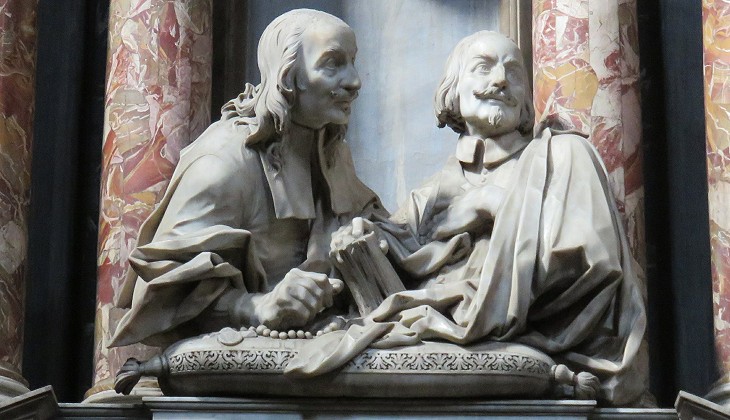
Monument to Ercole e Giovan Luigi Bolognetti (1686) by Lorenzo Ottoni in Chiesa di Gesù e Maria
In the church of Gesù e Maria the monuments of the Bolognetti family Bolognetti are in the nave. Giorgio Bolognetti, bishop of Rieti, had contributed to such an extent to the cost of the decoration of the church that he was allowed to erect the monuments for his family in the nave: for this reason the church was also called il Cappellone (the large chapel). The distance from the altar, however, impacts on the effect of the monuments and the relatives of Monsignor Bolognetti, seem more involved in social talks between themselves, than intent on praying. Lorenzo Ottoni was a scholar of Ercole Ferrata and his works can be found in many towns of the Papal State, e.g. at Pesaro.
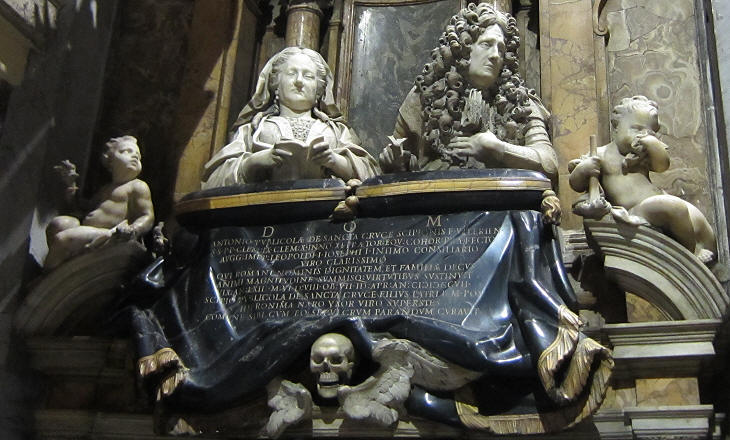
Monument to Marquis Antonio Publicola Santacroce and his wife Girolama Nari (1709)
by Lorenzo Ottoni in S. Maria in Publicolis
In general Ottoni showed strict links with Bernini's school, but he was also influenced by the growing relevance of French artists and more in general of France on Roman society, as we can see in another monument in the little church of S. Maria in Publicolis. The church was a sort of family chapel of Marquis Santacroce, who lived nearby. As we can see he dressed in the French way and wore a wig. While the marchioness is portrayed in a very stiff attitude, the marquis beats his breast like the cardinals of Algardi and Ferrata.
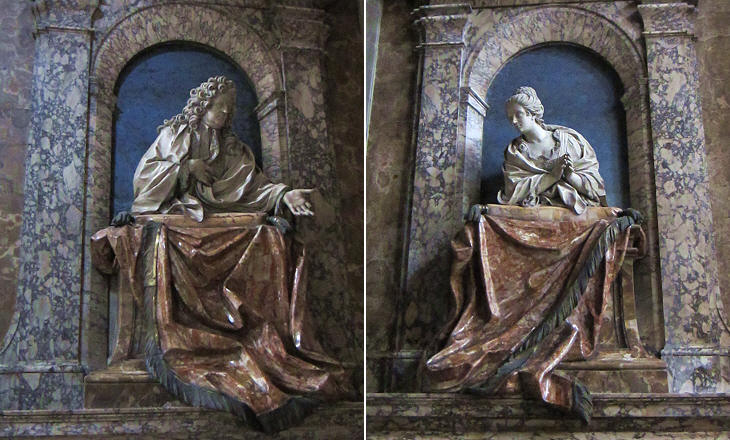
Monuments to Giovanni Andrea Giuseppe Muti and Maria Colomba Vincentini Muti (1725) by Bernardino Cametti in S. Marcello al Corso
The XVIIIth century was a very disenchanted time, even in Rome. Acts of contrition were no longer popular and the rich were more interested in minuets. This showed up also in funerary monuments. Giovanni Andrea Muti and his wife had a palace near SS. Venanzio e Ansovino, but they preferred to buy a chapel in the more fashionable church of S. Marcello al Corso. The monuments designed for the Muti by Bernardini Cametti are formally very similar to those built in the XVIIth century, but the spirit is different. The viewer has the impression that the husband is inviting his coy wife to dance.
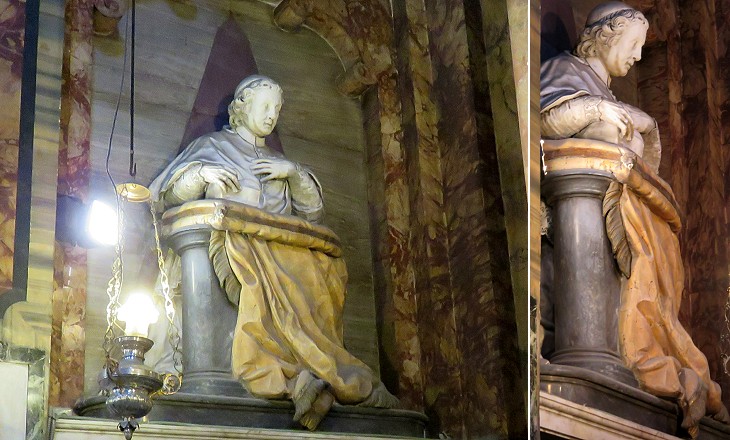
Monument to Cardinal Pier Luigi Carafa (1759) by Paolo Posi and Pietro
Bracci in S. Andrea delle Fratte (it is shown also in the image used as background for this page)
In general the Baroque period in Rome is considered ended by 1750, so Paolo Posi who worked in Rome mainly after 1750 is not mentioned in many books and essays about Baroque Rome: he designed however some funerary monuments which for the use of colour and different materials belong to the baroque tradition: in particular his monument to Maria Flaminia Odescalchi Chigi in 1771 can be regarded as the last baroque tomb in Rome. Paolo Posi was not a sculptor, but rather a particular kind of architect in the sense that he designed ephemeral architectures for celebrations. The monument to Cardinal Carafa was designed by him, but the statue of the Cardinal was sculpted by Pietro Bracci.
Other pages dealing with Baroque sculpture:
Monuments showing the dead in a medallion
Representation of Death in Baroque sculptures
Baroque Angels
Three chapels by Gian Lorenzo Bernini
Bernini's Exiled Statue
Three busts by Alessandro Algardi
Baroque Monuments to the Popes
Baroque High Reliefs
Statues Close to Heaven
Embittered Andrew (the statues in the Octagon of S. Pietro)
Laughing Masks
The Last Baroque Tomb
Playing with Colours
A Directory of Baroque Sculpture