
All images © by Roberto Piperno, owner of the domain. Write to romapip@quipo.it.


Notes:
Page revised in May 2025.
All images © by Roberto Piperno, owner of the domain. Write to romapip@quipo.it.
Notes:
Page revised in May 2025.
 Chiesa di S. Andrea della Valle
Links to this page can be found in Book 7, Map C3, Day 4 and Day 5, View C7 and Rione Sant'Eustachio.
The page covers:
The plate by Giuseppe Vasi
Today's view
S. Andrea della Valle (and Abate Luigi)
Fontana di Borgo
Palazzo Valle
Palazzo Caffarelli Vidoni
SS. Sudario de' Savojardi
S. Giuliano dei Fiamminghi
S. Maria in Monterone
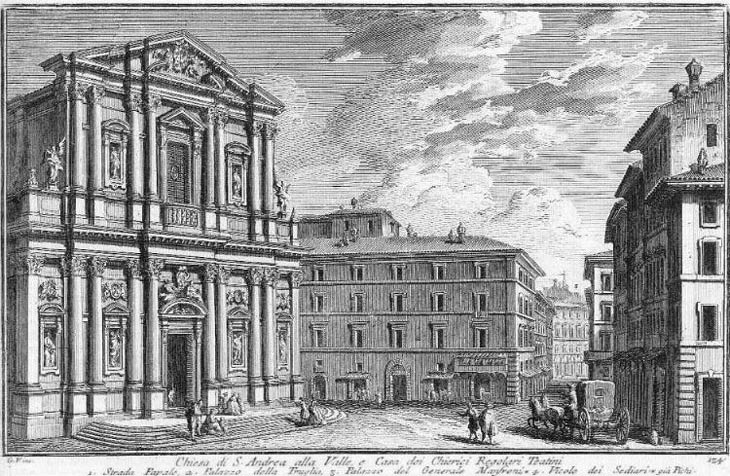
This 1756 etching by Giuseppe Vasi shows a section of Strada Papale, actually a series of streets from Ponte S. Angelo to il Gesù which were crossed by the solemn procession which accompanied the newly-elected pope
from S. Pietro to S. Giovanni in Laterano.
The street was rather narrow and notwithstanding a small square in front of the church, it did not allow a view of the tall façade of S. Andrea della Valle as that drawn by Vasi.
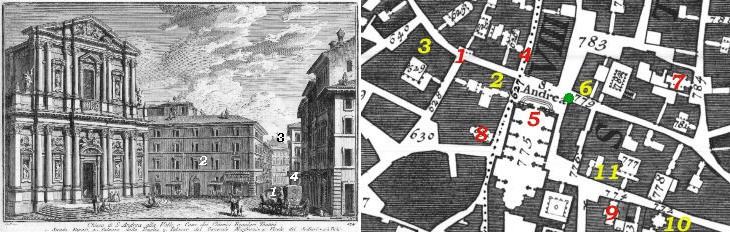
The view is taken from the green dot in the 1748 map below.
In the description below the plate Vasi made reference to: 1) Papal Street; 2) Palazzo della Truglia; 3) Palazzo del Generale Manfroni; 4) Vicolo de' Sediari (chair-makers), a very narrow street leading to Archiginnasio della Sapienza.
The small map shows also: 5) S. Andrea della Valle; 6) Palazzo Valle; 7) S. Maria in Monterone; 8) S. Elisabetta dei Fornari;
9) SS. Sudario de' Savojardi; 10) S. Giuliano de' Fiamminghi; 11) Palazzo Caffarelli Vidoni. The dotted line in the small map delineates
the border between Rione Parione (left) and Rione Sant'Eustachio (right).
In the plate covering Palazzo Massimi alle Colonne Vasi showed in more detail Palazzo del Generale (Ludovico) Manfroni, a Renaissance building which is best known as Palazzo di Girolamo Pichi, its founder.
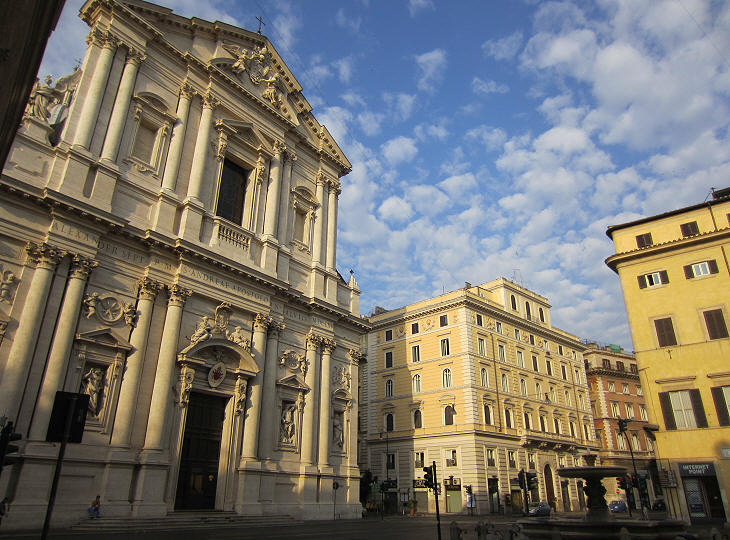
The view in June 2011
In the late XIXth century this section of Strada Papale was enlarged by pulling down the buildings which were not regarded as having a significant historical or artistic value and it was renamed Corso Vittorio Emanuele II; Palazzo Trulli (or della Truglia) was demolished and replaced by a building which was aligned with the façade of S. Andrea della Valle and situated at a greater distance from the church; also the small church of S. Elisabetta dei Fornari which adjoined Palazzo Trulli was pulled down; it belonged to the brotherhood of the German bakers and it was one of many churches belonging to a guild.
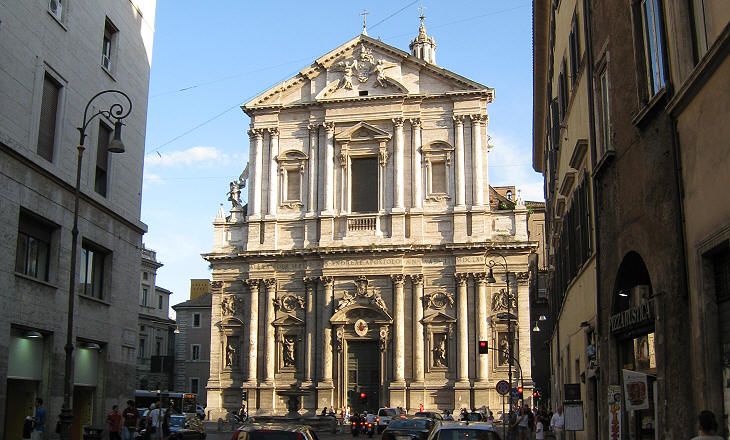
The façade seen from Corso Rinascimento in June 2009
In 1936-1938 a new large street (Corso Rinascimento) replaced Vicolo dei Sediari; this street brought an additional wave of traffic right to the front of the church, but it also allowed a better view of the façade designed by Carlo Rainaldi in 1655-1665. Vasi showed in his plate statues also in the two upper niches, which now are empty and he also showed two angels at the sides of the upper part of the façade, while today there is only one of them. It is possible that at Vasi's time the decoration of the façade was completed with ephemeral cardboard or plaster statues.
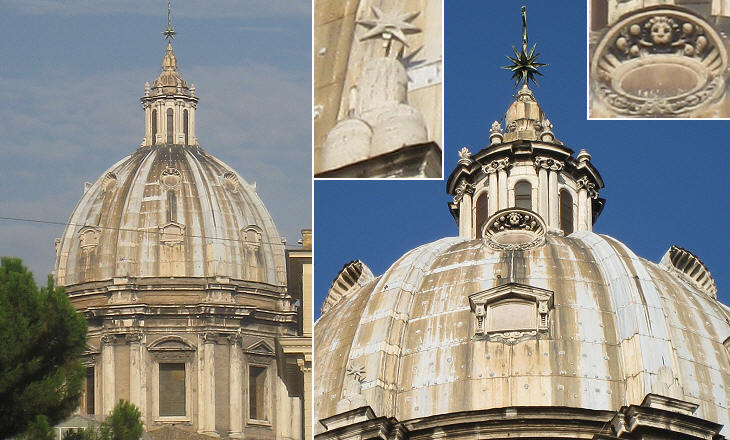
(left) The dome seen from Area Sacra di Largo Argentina (the image used as background for this page shows it from another viewpoint); (right) the upper part of the dome with details showing three mountains with a star and a lion between pears, heraldic symbols of Cardinal Alessandro Peretti, nephew of Pope Sixtus V (similar symbols can be seen on the dome of S. Pietro)
From the Minerva I went to Saint Andrea della Valle, a fine Church belonging to the Theatins. Its built
upon the place where the Theater of
Pompey stood anciently and where
in latter times stood the pallace of the family of the Piccolominis and
perchance this was the reason why
two Popes of that family, to wit,
Pius Secundus and Pius Tertius are
now buried in this Church.
Richard Lassels - The Voyage to Italy - 1668
The Theatines belonged to a religious order founded in the XVIth century with the aim of restoring respect and admiration for the Roman Catholic Church by adopting an austere lifestyle and by fighting the teachings of Martin Luther. Pietro Carafa, Bishop of Chieti (Lat. Teate), one of the founding members of the order, was elected Pope Paul IV in 1555.
In 1582 the order was bequeathed a palace which included a small church by Costanza Piccolomini d'Aragona, Duchess of Amalfi, with the obligation of building a large church dedicated to St. Andrew,
the patron saint of Amalfi; in 1591 the first stone of the new church was laid; in 1608 Cardinal Alessandro Peretti commissioned Carlo Maderno the completion of the church with
the erection of the second largest dome of Rome.

Façade: (left) Coat of arms of Cardinal Francesco Peretti between Hope and Strength by Giacomo Antonio Fancelli; (right) coat of arms of Pope Alexander VII
The dome was completed in 1622; Maderno designed a façade similar to that of S. Susanna, but his project was not entirely followed by Carlo Rainaldi who completed the church at the request of Francesco, another Cardinal Peretti, during the pontificate of Pope Alexander VII.
The church is called della Valle because it is located near Palazzo Valle and to distinguish it from other historical churches of Rome dedicated to St. Andrew, e.g. S. Andrea delle Fratte and S. Andrea al Quirinale.
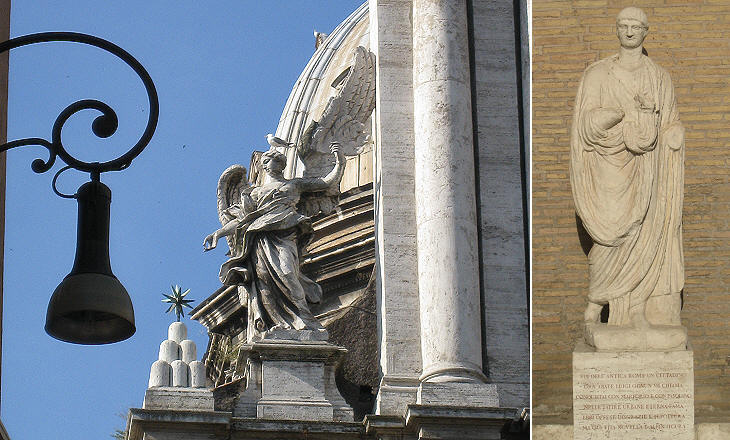
(left) Angel by Ercole Ferrata on the left side of the façade (the nearby six mountains with a star are one of the heraldic symbols of Pope Alexander VII); (right) Abate Luigi, one of the Talking Statues of Rome
Rainaldi decided to replace the volutes designed by Maderno to link the lower section of the façade to the upper one with two statues of angels; when the first statue was placed on the façade it was so criticized that Ercole Ferrata, its sculptor, refused to work on the other one.
An ancient statue known as Abate Luigi stands in the street to the left of the church; it is made up of the body of a statue portraying a senator or an emperor and of the too small head of another statue; together with Pasquino (which is not far away),
Madama Lucrezia, il Babuino, il Facchino
and Marforio, Abate Luigi voiced the views of the Romans on the papal government.
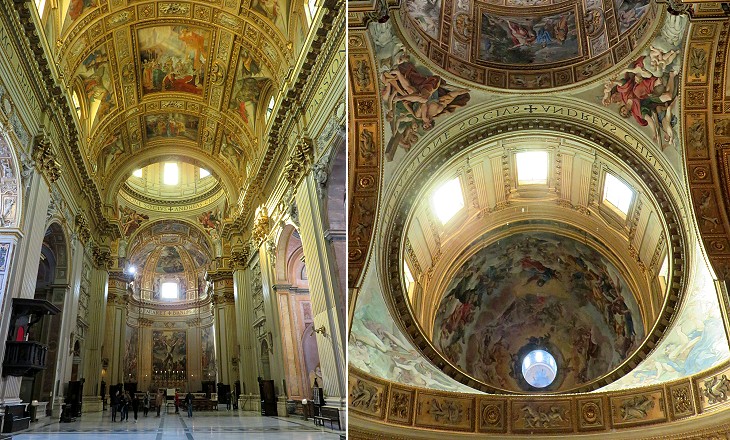
(left) Interior; (right) dome painted by Giovanni Lanfranco (see one of his canvasses at Palazzo Corsini)
with pendentives by il Domenichino
The
Cupola was painted by Cavalier
Lanfranco; the corners under the Cupola and the tribune are of
the hand of Domenichino. (..) In fine, take all this Church together, and it is one of the neatest
Churches (except the Basilicas)
that are in Rome being of the Architecture of Maderna. Lassels
This Church is a very Noble one, and very
Light; the Grand Cupola of Lanfranco and the Tribunal, or Mezzo Cupola of Dominichino with the Angels, and Ornaments, appear at one View as one enters the Church; and
being very Bright, and Gaily Painted, strike
the Eye, and give a vast Pleasure from the
mere Beauty of the Colours. Both these Masters have here shewn how Great they were;
particularly Lanfranco for This kind of Painting, which is Fresco, and at a vast Distance;
Certainly no Man ever carry 'd This to a greater Perfection. 'Tis Strong, and Beautiful, and
to make it appear so Below where the Beholder was to be placed, 'tis amazing to see what
Art has been us'd in making every thing so
Gross, and Hard, so Rude, and even Disagreeable, when one comes where he was when
he painted it.
Jonathan and Jonathan Richardson - Account of Some of the Statues, etc. in Italy - 1722
The interior is not divided into naves. This layout suited the delivering of homilies by leading members of the order from a high pulpit. The Theatines were known for being proficient preachers. The homilies were accompanied by music and on special occasions by short theatrical pieces, especially during Lent.
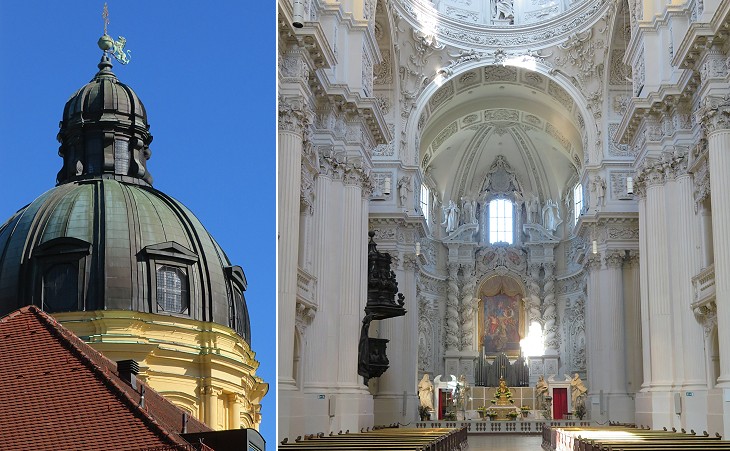
Theatinerkirche in Munich: (left) dome; (right) interior
The design of S. Andrea della Valle had an influence on that of other churches of the Theatine Order. That at Munich was built in 1663-1690 and, similar to S. Andrea, it is characterized by a dome and a single large nave. It was designed by Agostino Barelli who was also involved in the construction of Schloss Nymphenburg, a countryside palace of the Bavarian Electors.
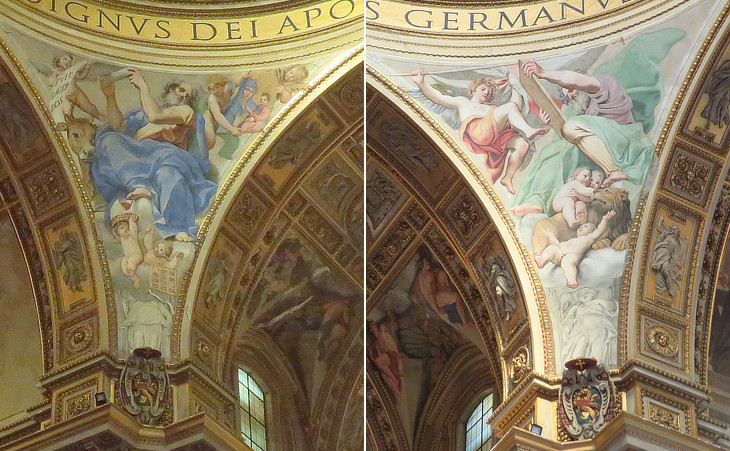
Pendentives by Domenichino (see his pendentives at S. Carlo ai Catinari): (left) St. Luke; (right) St. Mark
In my early rambles through Rome, without book or guide, among many churches which I entered at hazard, there was one whose delightful fresco paintings drew me into repeated visits. Afterwards when, at the recommendation of several artists, I eagerly inquired for the church of St. Andrea della Valle, I was surprised to find it an old acquaintance and Domenichino the unknown cause of my admiration. His splendid fresco paintings occupy the angles between the arches that support the dome. (..) The attitude, drapery, and countenance are sublime, and the colouring fresh and beautiful, and worthy the rival of Guido.
Rembrandt Peale - Notes on Italy, written during a tour in the years 1829 and 1830.
Domenichino was probably acknowledged as the leading artist in
Rome, and (..) we find him beginning to turn in a different direction. In his most important
commission of the next decade, the pendentives and choir of S. Andrea della Valle
(1624-28), this arch-classicist seemed to be tempted by the new Baroque trend. This is
clearly visible in the first portion of the work, the Evangelists on the pendentives, where
a strong Correggesque note is added to the reminiscences of Raphael and Michelangelo.
It may be supposed that Domenichino wished to outshine his rival Lanfranco, who (..) was given the commission for the dome.
Rudolf Wittkower - Art and Architecture in Italy 1600-1750 Publ. 1958
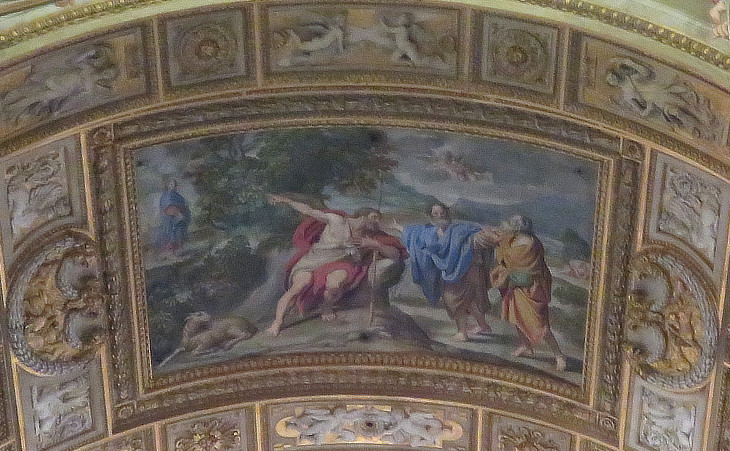
A detail of the ceiling of the apse by Domenichino (see the whole ceiling in another page). It portrays St. Andrew and St. John the son of Zebadee, passing near St. John the Baptist, who, on seeing the Redeemer at a distance, exclaims: "Behold the Lamb of God, who taketh away the sins of the world."
A development towards the Baroque will also be noted in the celebrated scenes from the life of St Andrew in the apse of the church. While the single incidents are still strictly separated by ornamented ribs, the stage is widened and on it the figures move in greater depth than formerly, some of them in beautiful co-ordination with the rich landscape setting.(..) The next important step in Lanfranco's career, the painting of the dome of S. Andrea della Valle, 1625-28, opens up a new phase of Baroque painting. Correggesque illusionism on the grandest scale was here introduced into Roman church decoration. Wittkower
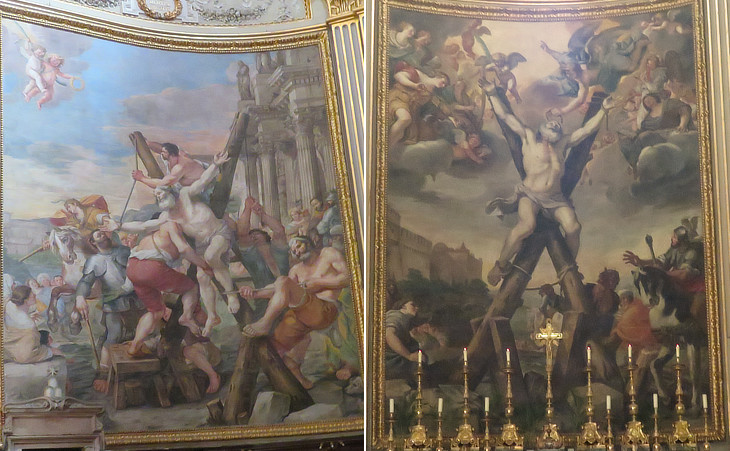
Paintings by Mattia Preti in the apse (see his later works at Valmontone and Valletta): (left) St. Andrew is placed on the Cross (in the background a Roman temple similar to that of Minerva in the Forum of Nerva); (right) Glory of St. Andrew (see the statue by François Duquesnoy in S. Pietro)
The reversal of values, the return to a dry and archaizing Bolognese manner, the emphasis on design, and the almost complete turning away from Venetian colour characterize the 1640s. (..) Even a man of a different calibre, the young Mattia Preti, in spite of his originality and vigour, paints the frescoes in the apse of S. Andrea della Valle in 1650-51 essentially in the manner of Domenichino. Wittkower
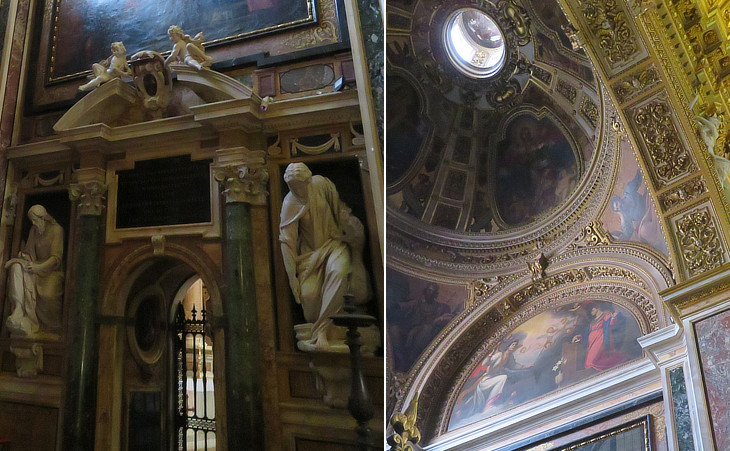
Cappella Barberini: (left) right side with statues of St. Martha by Francesco Mochi and St. John the Evangelist by Ambrogio Buonvicino: the two small angels are a very early work by Gian Lorenzo Bernini; (right) paintings by Domenico Cresti, il Passignano
24th February 1645. The Barberini have in this place a chapel, of curious incrusted marbles of several sorts, and rare paintings.
John Evelyn's Diary and Correspondence
The neat Chappel of the Barberini made by
Pope Urban the VIII while he was
but yet Cardinal, is built upon the
very place where S. Sebastian was
beaten and thrown into a Sink
after he had been shot. There had
been formerly a little Church built
upon this place, and over this sink,
but Sixtus Quintus gave leave it
should be pulled down, upon condition a Chappel of the new designed Church should be built in place
of it. Lassels
The artists employed by Cardinal Maffeo Barberini for the design and decoration of his chapel were among those who were working for Pope Paul V at Cappella Paolina in S. Maria Maggiore, where also lots of coloured marbles were employed.
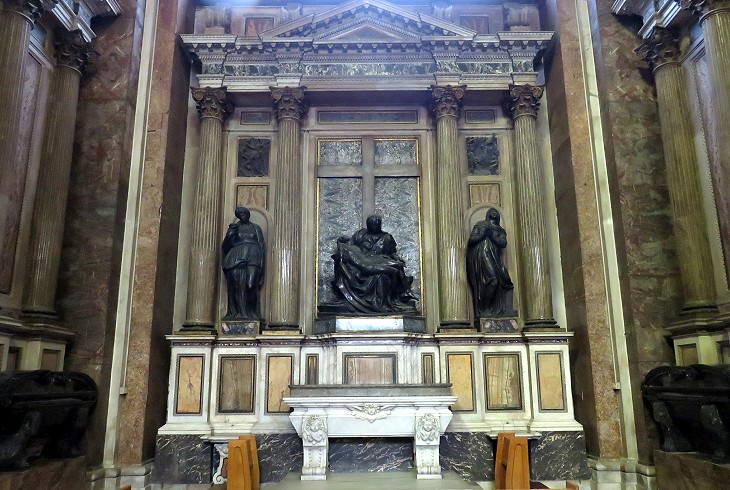
Cappella Strozzi which was decorated with 1616 bronze copies of statues (Pietà and two statues from the Monument to Pope Julius II) by Michelangelo
The Strozzi were a family of Florentine bankers. The Roman branch of the family acquired a chapel at S. Andrea della Valle in the early stages of the construction of the church, which was near their palace. It was designed in a very Renaissance style to the point that some art historians suggested it was based on a project by Michelangelo.
In other pages you can see Cappella Rucellai, a monument by Domenico Guidi, a marble altarpiece by Antonio Raggi and a funerary monument also by Antonio Raggi. The church houses the Monuments to Pope Pius II and Pope Pius III from S. Pietro Vecchio.
The first act
of Tosca, a popular opera by Giacomo Puccini, is set in a chapel of the church (the second act takes place at Palazzo Farnese and the third one at Castel
Sant'Angelo).
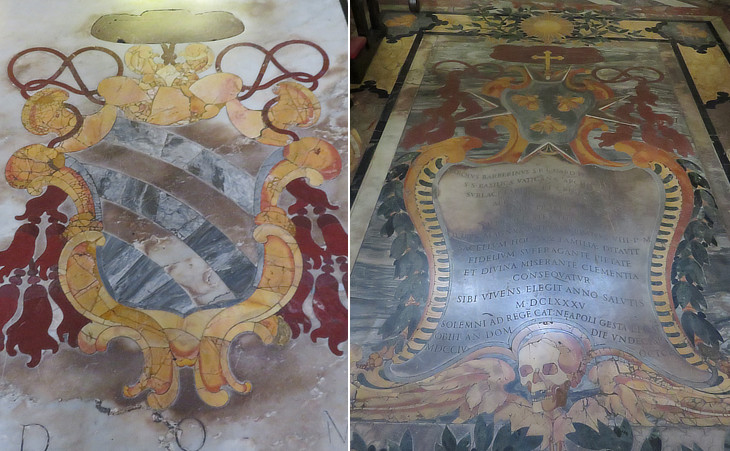
Marble inlay tombstones: (left) Cardinal Ulderico Carpegna (d. 1679) in the nave; (right) Cardinal Carlo Barberini (d. 1704) inside Cappella Barberini with a typical reminder of Death
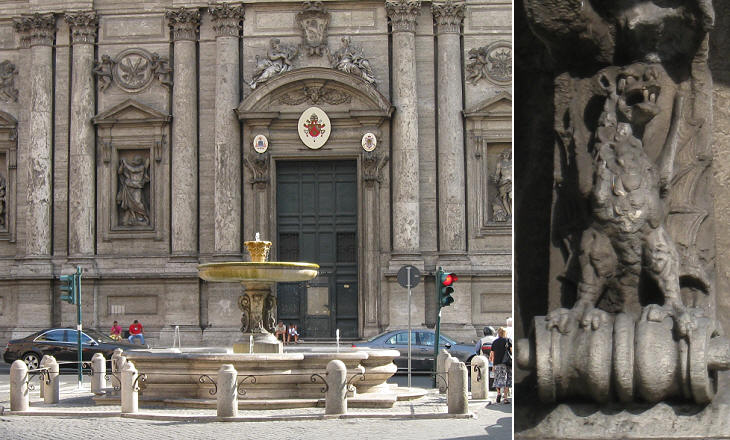
(left) The fountain; (right) detail showing a dragon, one of the heraldic symbols of Pope Paul V
In 1958 a fountain which previously was located opposite S. Giacomo in Scossacavalli was reassembled in the square near S. Andrea della Valle. It is attributed to Carlo Maderno by contemporary writers, but according to other sources it was designed by Giovanni Vasanzio; it was famous for its high spouts, similar to the fountains of Piazza S. Pietro.
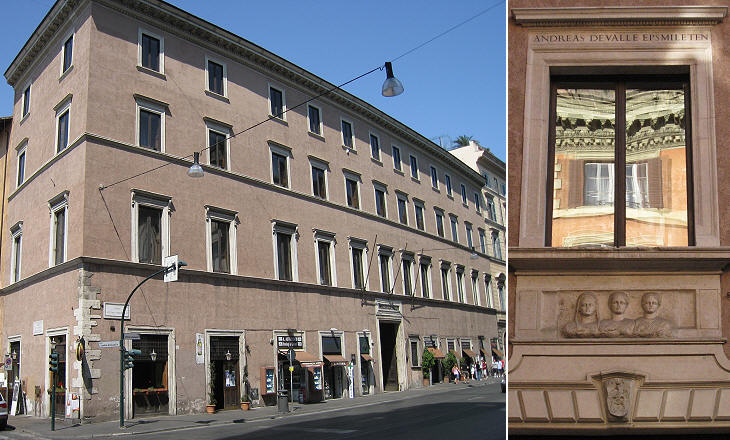
(left) Main façade; (right) decoration of the rear entrance including an ancient funerary relief
The palace was built in ca 1520 for Cardinal Andrea della Valle (whose name is written at the top of some windows; he was bishop of Mileto, a town in southern Italy). The palace is slightly curved; it was enlarged in the XVIIth century and the main entrance was relocated; in the following century a storey was added; Giorgio Vasari attributes the design of the palace to Lorenzo Lotti aka Lorenzetto, a friend of Raphael, but today there are doubts about Vasari's statement.
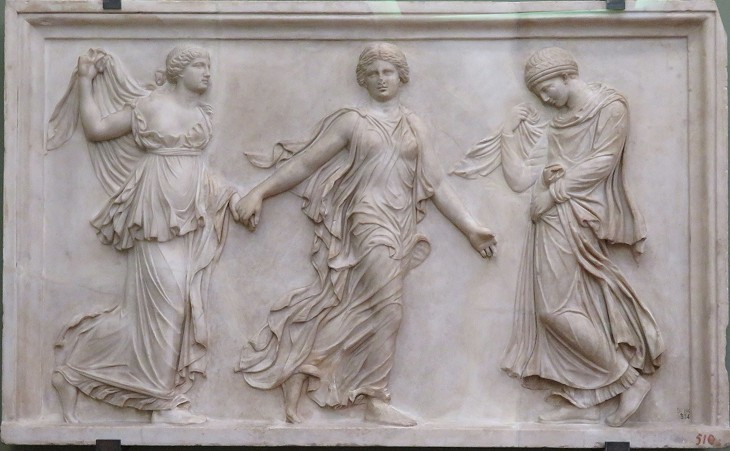
Florence - Galleria degli Uffizi: relief showing three dancers from the Valle collection
Cardinal della Valle had a large collection of ancient statues and reliefs which embellished his palace until 1584 when it was sold to Cardinal Ferdinando de' Medici who utilized it to decorate his villa and which eventually were moved to Florence.
Pietro della Valle (1586-1652) is known for having travelled through Egypt and Asia and in particular for his account of his stay at Isfahan and for the description of some monuments he visited in his journey, e.g. the Mausoleum of Oljeitu at Soltaniyeh.
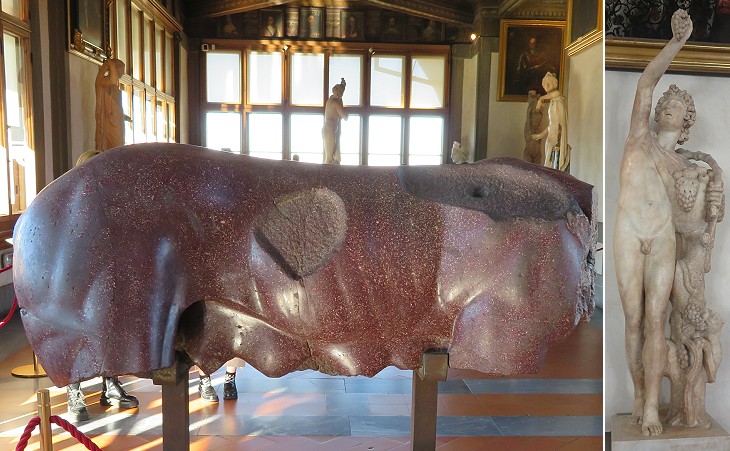
Florence - Galleria degli Uffizi: works of art from the Valle collection: (left) porphyry she-wolf (stripped of its Renaissance additions); (right) young satyr
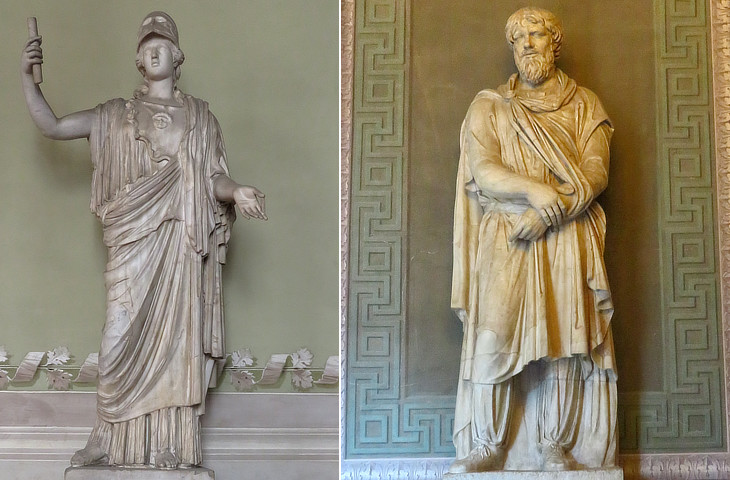
Florence - Galleria Palatina: works of art from the Valle collection: (left) Athena, similar to the Giustiniani one; (right) Dacian prisoner, most likely from the Forum of Trajan
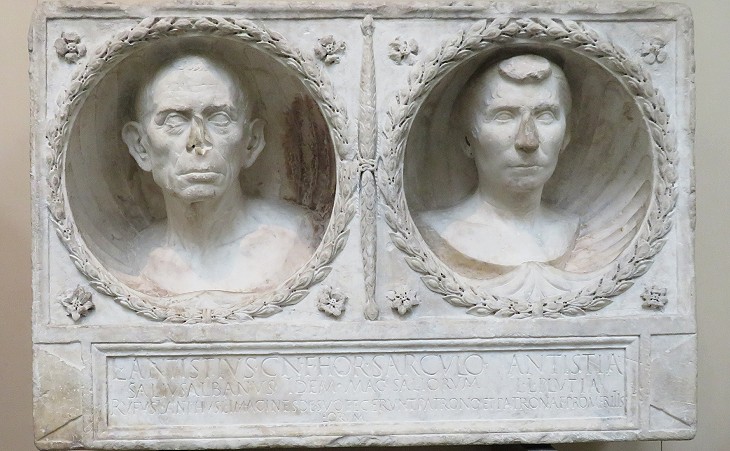
British Museum: funerary relief (late Ist century BC) of Lucius Antistius Sarculo and his wife and freedwoman (former slave) Antistia from the Valle collection
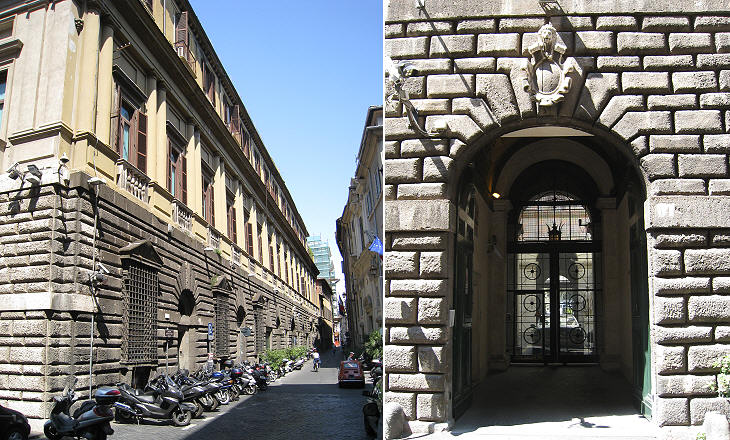
(left) Original façade in Via del Sudario; (right) entrance
Similar to Palazzo Valle, Palazzo Caffarelli was built at the beginning of the XVIth century: the design of the ground floor
(almost the only part not modified in the following centuries) was attributed to Raphael on the basis of the letters R. V. written on a corner of the façade; they were interpreted as meaning Raphael Vrbinas (from Urbino), but today they are thought to be a reference to Cardinal Pietro Vidoni who enlarged and modified the building in the XIXth century.
Art historians believe Lorenzetto was involved in the design of the palace, which was given a second façade along Corso Vittorio Emanuele at the end of the
XIXth century.
The Caffarelli built another palace on the Campidoglio Hill towards the end of the XVIth century. They are chiefly known because of Cardinal Scipione Caffarelli, nephew of Pope Paul V
Borghese. The Vidoni had an elegant funerary chapel at S. Maria della Vittoria.
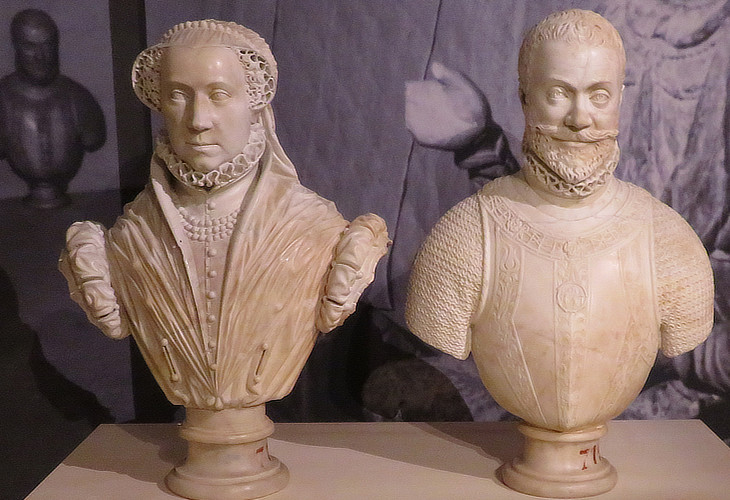
Turin - Royal Museums: busts of Emmanuel Philibert, Duke of Savoy and of his wife Margaret of Valois by an unknown sculptor (ca 1570)
In the XVth century the Duchy of Savoy was considered a minor state with little say in Italian affairs and bound to become sooner or later part of the Kingdom of France. Emmanuel Philibert became Duke in 1553 but at the time most of his fiefdoms were occupied by France. He decided to fight for Emperor Charles V and his son King Philip II of Spain (the bust shows him wearing the collar of the Order of the Golden Fleece, the highest Habsburg chivalric order). In 1557 he won a decisive battle at Saint-Quentin which eventually led to the Peace of Cateau-Cambresis in April 1559. In July 1559 he married Margaret of Valois, sister of King Henri II of France to re-establish good relations with his powerful neighbour. In 1563 he moved the capital of the Duchy from Chambéry to Turin and he promoted the use of Italian as official language. In 1961 an heir of the Dukes of Savoy became the first King of Italy.
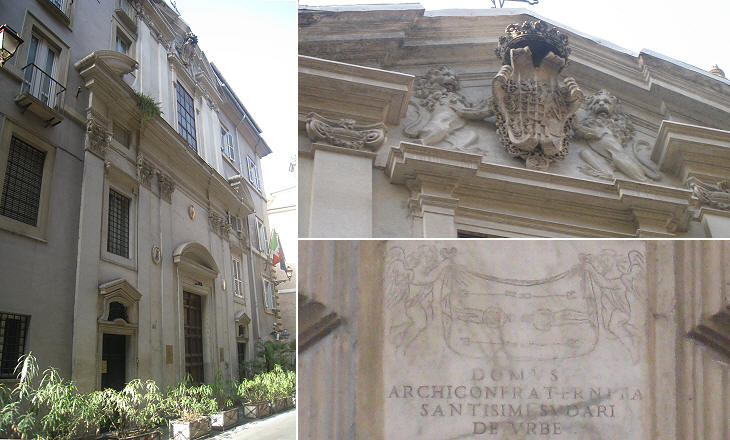
(left) Façade; (right-above) lions supporting the coat of arms of Savoy; (right-below) property tablet on an adjoining building showing the Holy Shroud
The church of the Savoyards and Piedmontese living in Rome was dedicated to the Holy Shroud (It. sudario or Sacra Sindone), the main relic of their country (Emmanuel Philibert moved it to Turin from Chambéry in 1578). The church was built in 1605, but the façade was completed in 1687 by Carlo Rainaldi.
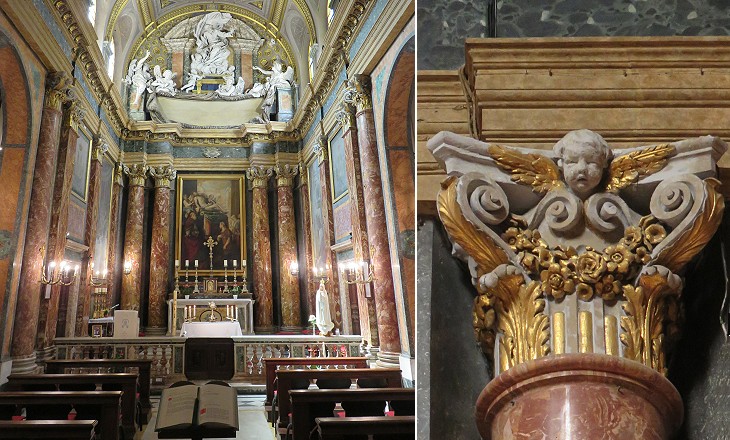
(left) Interior; (right) a capital
The church was deconsecrated in 1801-1814 when it was used as a stable. It was properly restored in 1871 when it was placed under the patronage of the King of Italy. The interior has a very colourful decoration, similar to other Baroque churches, with unusual and highly elaborate capitals.
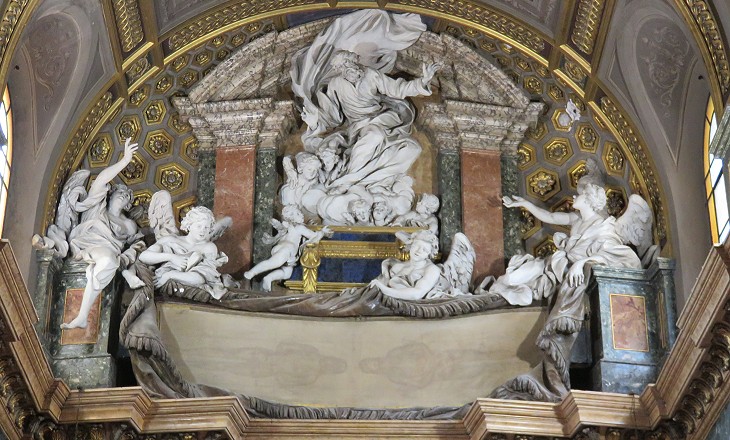
Stucco angels holding a copy of the Holy Shroud
Pope Alexander VII was presented with a copy of the Holy Shroud by a nun of the Savoy family. He in turn donated it to the Savoyard/Piedmontese community. A complex stucco group was designed by Antonio Gherardi, a painter known for the ceiling of S. Maria in Trivio, but also an architect (Cappella di S. Cecilia at S. Carlo dei Catinari), to properly exhibit the copy of the Holy Shroud. The statues were made by Pietro Mentinovese in 1689.
You may wish to see a directory of national churches in Rome.
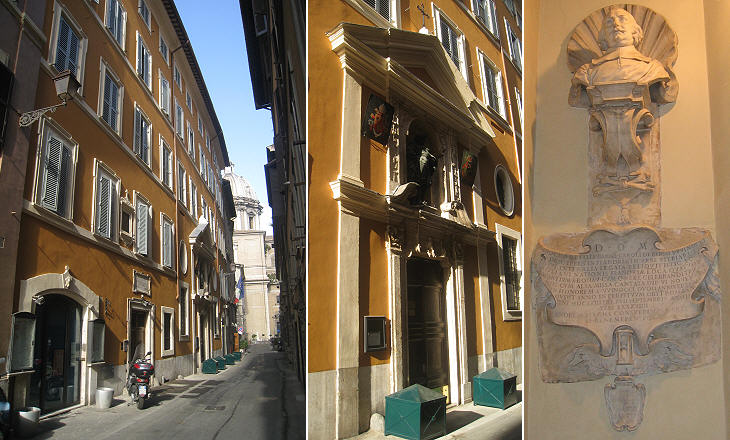
(left) Via del Sudario and the Flemish hostel; (centre) façade; (right) monument to Winnoch de la Wiel, the inscription says he made a bequest to the church and therefore was entitled to periodical masses for the repose of his soul, including a yearly "cantata" mass
Flemish merchants in Rome founded a brotherhood and built a small chapel and a hostel for pilgrims in the XIth century. At the end of the XVth century the two buildings were largely renovated. Emperor Charles V, who was born in the Flemish city of Ghent, became a member of the brotherhood when he visited Rome in 1536.
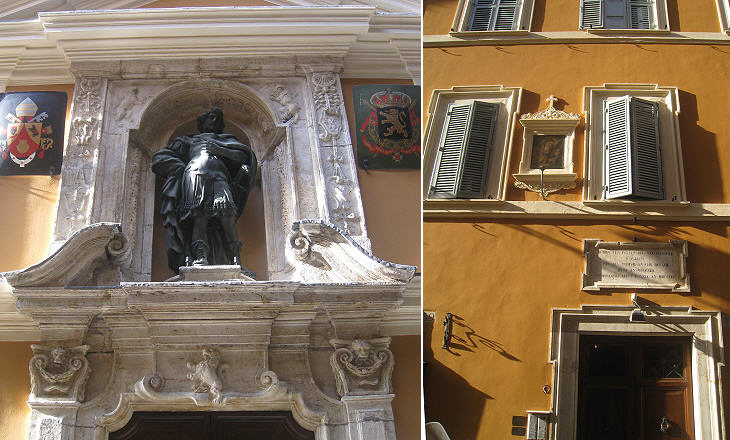
(left) Detail of the portal with the bronze copy of a wooden statue of St. Julian the Hospitaller by Judocus van Haerts; (right) detail of the hostel
The church is dedicated to St. Julian the Hospitaller, who according to one of the many versions of his life was born in today's Belgium (learn more about him). The decoration of the church is based on lions, the heraldic symbol of the County of Flanders; the reference to the Flemish was lost in 1815, when Flanders became part of the Netherlands. After 1830 the chapel was called S. Giuliano dei Belgi, but in 1975 King Baudoin of Belgium restored its original name. A (lost) hostel for pilgrims coming from Liège, the main town of the French-speaking part of Belgium, was founded in 1699 in Rione Campo Marzio.
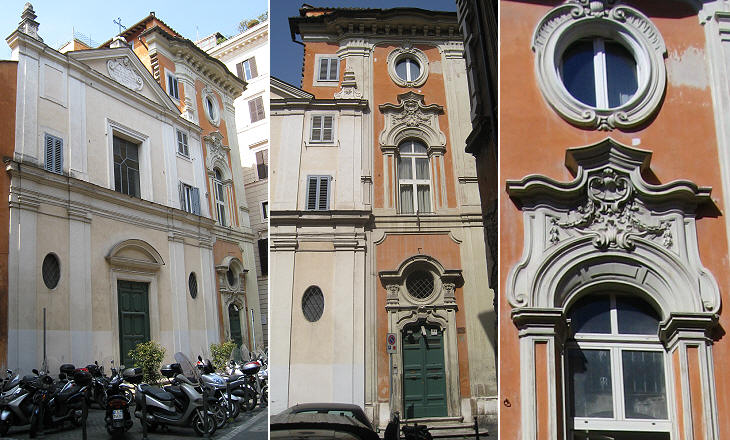
(left) S. Maria in Monterone; (centre/right) Convent of the Mercedarians
The church of S. Maria in Monterone (after the name of a family from Siena) is mentioned in very old documents; it was rebuilt in 1682. In 1728 it was assigned by Pope Benedict XIII to the Mercedarians, the members of the Order of the Blessed Virgin Mary of Mercy, who, similar to the Trinitiarians, had the objective of ransoming Christian slaves in Muslim countries. In Rome the order was represented by very few members and for this reason the convent adjoining the church is perhaps the smallest one in Rome; it was designed by Francesco Bianchi. You may wish to see the gruesome Monument to Cardinal Stefano Durazzo inside the church.
Next plate in Book 7: S. Silvestro al Quirinale.
Next step in Day 4 itinerary: Archiginnasio della Sapienza.
Next step in Day 5 itinerary: Chiesa dell'Arciconfraternita delle Stimmate di S. Francesco.
Next step in your tour of Rione Sant'Eustachio: SS. Benedetto e Scolastica.
Excerpts from Giuseppe Vasi 1761 Itinerary related to this page:
Chiesa di s. Andrea della Valle
Prese un tal nome questa magnifica chiesa dalla valle in cui siede; o secondo altri dal palazzo della famiglia
Valle, che è ivi presso. Fu eretta ad istanza di D. Costanza Piccolomini, la quale donò ai chierici regolari
Teatini un palazzo, che quivi aveva, e però fu principiata l'anno 1591. dal Card. Alfonso Gesualdo
Napoletano col disegno di Pietro Paolo Olivieri; e fu seguitata dal Card. Alessandro Montalto, e
poi terminata dal Card. Francesco Peretti suo nipote, col disegno di Carlo Maderno; il prospetto però è del
Cav. Rainaldi.
|


