
All images © by Roberto Piperno, owner of the domain. Write to romapip@quipo.it.


Notes:
Page revised in March 2026.
All images © by Roberto Piperno, owner of the domain. Write to romapip@quipo.it.
Notes:
Page revised in March 2026.

During the XVIIth century and to a greater extent during the XVIIIth century
the wealthiest Roman families invested their money in apartment blocks which were rented to the members of the emerging middle class (see a page on Flats for Rent in XVIIIth century Rome).
Before that period the main landlords of Rome were religious congregations, guilds and associations of foreigners living in Rome.
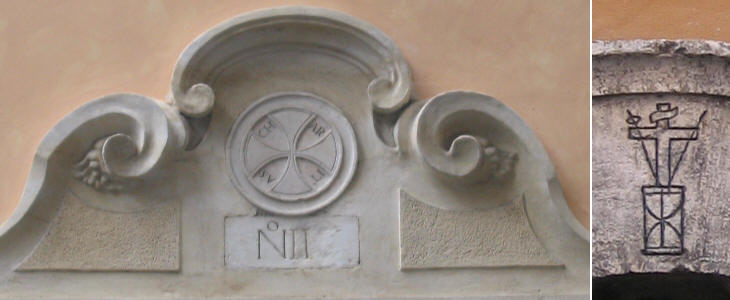
Tablets of Congregazione dell'Orazione e Morte near the church by the same name (left) and
near S. Salvatore della Corte (right)
The ownership of a building was usually indicated by a small tablet bearing the name of the landlord and the number of the asset. In many cases the tablets were decorated with a small relief which in the case of Congregazione dell'Orazione e Morte made it unnecessary to write the name. A cross inscribed in a circle with the word CH-AR-IT-AS or a death reminder hour-glass may not mean a lot today, but in the past they were a clear indication of the landlord.

In a limited number of instances the tablets were accompanied (or replaced) by a fresco. Houses belonging to the "Spanish Nation" (as the Spanish community in Rome was called) were marked with an elaborate coat of arms which is likely to have been painted between 1580 and 1585 during the pontificate of Pope Gregory XIII whose heraldic symbol can be noticed at the top of the frescoes and when King Philip II of Spain ruled also over Portugal, because there is a reference to that kingdom at the centre of the coat of arms.

Tablets making reference to: (left) Spedale di S. Giovanni (Arciconfraternita del SS. Salvatore)
(tablet near S. Agata); (right upper corner)
S. Eufemia (lost) (tablet near S. Egidio); (centre) S. Maria Maddalena al Quirinale (lost) (tablet near Casa di Lorenzo Manilio); (lower right corner)
association of the inhabitants of Brescia living in Rome (tablet near S. Anna dei Bresciani, their lost church)
The tablets bring to mind landlords who no longer exist: Arciconfraternita del SS. Salvatore was in charge of running Spedale di S. Giovanni; S. Eufemia was an institution caring for young women; S. Maria Maddalena al Quirinale was a nunnery; the association of the inhabitants of Brescia in Rome still exists, but its church was pulled down in the XIXth century.
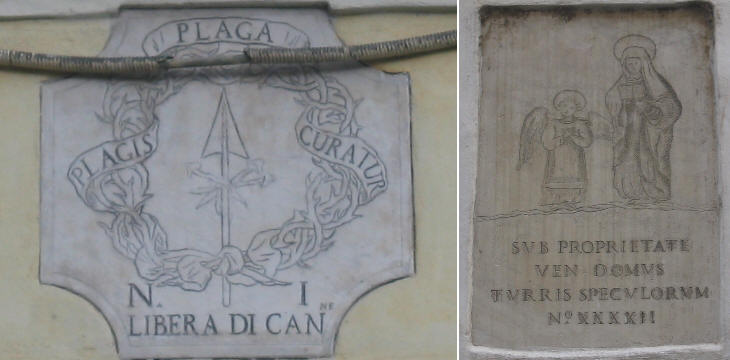
(left) Tablet on a house belonging to Congregazione delle Cinque Piaghe near S. Filippo Neri; (right) tablet on a
house belonging to Monastero di Tor de' Specchi near Via Giulia
The meanings of some tablets require researching to be properly understood: Plagis Plaga Curatur (the wound is cured by the wounds) is a reference to the Five Wounds of Jesus Christ (the four marks left by the Crucifixion plus that caused by St. Longinus on Jesus' side): this was the motto of a congregation which gave assistance to those who suffered from gout and in particular from podagra (gout of the foot). This disease was called the illness of the rich because it was caused by the intake of protein rich foods and alcohol. The members of the congregation said prayers in which they praised each of Jesus' wounds and asked for help.

(left) Tablets on a house in Via dei Coronari which belonged to Misericordia dei Fiorentini a S. Giovanni Decollato and later on to SS. Celso e Giuliano; (right) tablet near S. Giovanni dei Fiorentini
The Florentine Nation had a large number of properties: the income of some of them was specifically meant to support Misericordia dei Fiorentini, a charity having as its symbol the head of St. John the Baptist. In Via dei Coronari the new landlords of a building did not dare to remove a relief showing the saint's severed head. Most buildings near S. Giovanni dei Fiorentini belonged to the community (the image used as background for this page shows another tablet marking a Florentine property).

(left) Tablet on a house near S. Grisogono which belonged
to S. Maria in Portico (in Campitelli); (centre) tablets on houses near S. Giovanni dei Fiorentini which belonged to Basilica di S. Pietro; (right-above) tablet on a house near Monastero di Tor de' Specchi which belonged to S. Maria in Monserrato; (right-below) tablet with the symbol of the guild of S. Eligio dei Fabbri near the church by the same name
The quarters of Rome where one can find several tablets indicating the ownership of the buildings are those which have retained to a greater degree their XVI/XVIIth century appearance: Ponte, Regola, Parione and Trastevere.
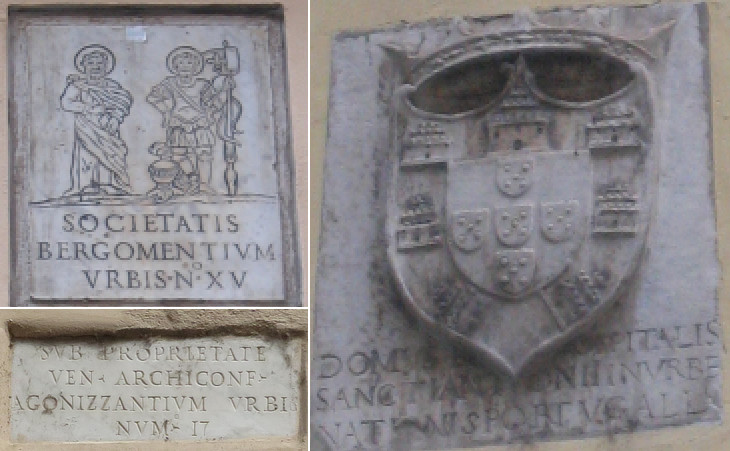
(left-above) Tablet on a house which belonged to Collegio dei Bergamaschi portraying Sts. Bartholomew and Alexander; (left-below) tablet on a house in Trastevere which belonged to Confraternita di S. Maria degli Agonizzanti; (right) tablet on a house which belonged to Spedale di S. Antonio dei Portoghesi near the church by the same name
The houses in general are rather modest: sometimes they are the result of an investment strategy and one can find houses belonging to the same landlord one next to the other; in other circumstances the property was most likely bequeathed by a member of the congregation/national community/guild.

Tablets in houses of Trastevere which belonged to: (left to right) Stimmate di S. Francesco;
Nazione Picena; S. Maria dell'Orto; Spedale di S. Spirito
The tablets provide interesting records to assess the importance/wealth of many institutions: the tablet bearing the symbol of Spedale di S. Spirito is very unassuming, but its number (CXIII-113) is an indication of how rich this hospital was.

Private houses: (upper section): house of the lawyer Pietro Jacomelli (PETRUS IACOMELLIUS I(uris) U(triusque) D(octor) in Trastevere; (central section)
house of Desiderio Pagnoncelli in Trastevere; (lower section) house built in 1553 by Agustino Sere near Palazzo Farnese
Private houses of the XVIth/XVIIth century usually belonged to noble families and
were marked with their coats of arms. When the landlord did not have a coat of arms he wrote his own name on the lintels of the door or below the windows: Pietro Jacomelli added to his name I.U.D. to mean that he was a lawyer both in civil and canon law.


