All images © by Roberto Piperno, owner of the domain. Write to romapip@quipo.it.


Notes:
Page revised in December 2024.
All images © by Roberto Piperno, owner of the domain. Write to romapip@quipo.it.
Notes:
Page revised in December 2024.
 II - Baroque and Neoclassical Monuments
 You may wish to read a page on Medieval and Renaissance Monuments first.
Gian Lorenzo Bernini was asked by Pope Urban VIII not only to design a monument to him, but to define a pattern for the monuments to be placed in S. Pietro, which at that time was finished from a structural point of view but completely empty as far as statues and monuments are concerned. The size of S. Pietro was such that the approach followed for the papal monuments at Cappella Sistina and Paolina in S. Maria Maggiore would have been extremely expensive in S. Pietro as it required filling a wall up to the ceiling with columns, marbles, statues and reliefs.

Monument to Pope Urban VIII in S. Pietro
The tomb of Urban VIII established the new type of the papal monument. Looking back via Guglielmo della Porta's tomb of Paul III to Michelangelo's Medici Tombs, Bernini achieved an ideal balance between a commemorative and a ceremonial monument, and it is this concept that many later sculptors endeavoured to follow with more or less success.
Rudolf Wittkower - Art and Architecture in Italy 1600-1750 Penguin Books 1958
Bernini moved the
Monument to Paul III into a deep niche (in the southern side of the apse) framed by two columns and the coat of arms of the pope. He then designed the Monument to Urban VIII
following the same pattern, but revising the proportions of the elements and increasing the vertical lines. He introduced a dramatic element
by showing a bronze Angel of Death in the act of tearing the name of the pope (see Representation of Death in Baroque Sculpture for more details on this topic).
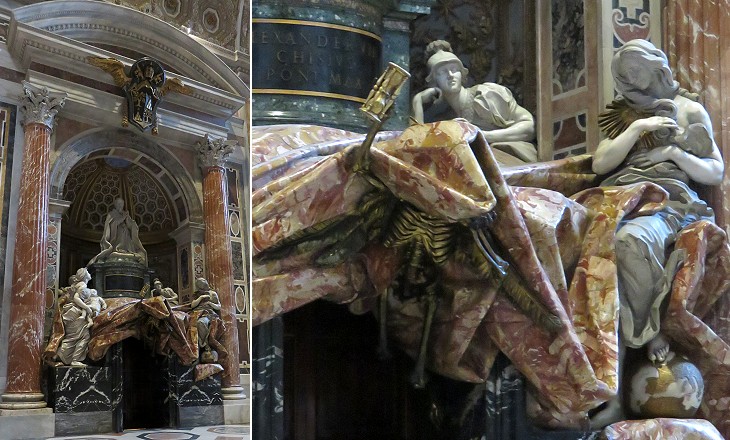
A dramatic representation of Death marks also the Monument to Pope Alexander VII designed by Bernini in 1678, when he was 80. The niche chosen for the monument had a door which allowed direct access to the area under the dome and which was needed as an alternative to the distant doors of the façade. Bernini built upon this constraint and modified the pattern of the Monument to Urban VIII, while maintaining its overall pyramidal shape. The Monument is built around the relation between the statue of the Pope portrayed bareheaded and in the act of praying on his knees and a representation of Death in the form of a winged skeleton in the act of showing to the Pope a clepsydra (or hour-glass, a wasp-waisted reversible glass with two bulbs containing enough sand to take a definite time in passing from upper to lower bulb) to tell him that his life is over.

Reliefs in the Monuments to Pope Leo XI by Alessandro Algardi (1652) and Pope Innocent XI by Pierre Etienne Monnot (1701) in S. Pietro
Alessandro Algardi was the only sculptor in Rome, whose talent could match that of Bernini and while Bernini was completing his Monument to
Urban VIII, Algardi was commissioned a Monument to Pope Leo XI. Algardi followed the pattern defined by Bernini, but he refrained
from using bronze or coloured marbles and he preferred
to give life to the lower part of the Monument (below the statue of the Pope and between the statues of the two Virtues) by inserting a relief (a kind of sculpture he was very good at) with episodes
of the Pope's life (related to his role in convincing Henry IV of France to embrace the Roman Catholic faith). A relief had already been used by Bernini for a Monument to Countess Matilda of Tuscany.
The episodes shown in the
monuments of the Popes often relate to political and military events (in the Monument to Innocent XI, Monnot celebrated the Liberation of Vienna from the Turks in 1683).
Another element common to all the monuments is the coat of arms of the pope, which is always located at the top of the niche. See some of them with drawings by Filippo Juvarra:
Alessandro Algardi - Coat of arms in the Monument to Leo XI
Gian Lorenzo Bernini - Coat of arms in the Monument to Alexander VII
Pierre Etienne Monnot - Coat of arms in the Monument to Innocent XI
Angelo de' Rossi - Coat of arms in the Monument to Alexander VIII

Charity by Ercole Ferrata in the Monument to Pope Clement IX (1671) in S. Maria Maggiore and the Monument to Pope Gregory XIII (1723) in S. Pietro by Camillo Rusconi with the portrayal of Religion (I know his deeds and faith) and Magnificence
The statues of the Virtues which accompanied the statue of the pope had for a long time a standardized iconography which made the viewers’ understanding of “who’s who” easier”. Charity was always portrayed in the act of offering her breast to a child, with another child waiting at her foot. Some Baroque monuments show also some animals, either associated with the Virtues (a dog usually accompanied Faith, a lion Strength, a remora - suckerfish - Prudence) or with the heraldic symbols of the pope (the dragon of Gregory XIII).

S. Pietro: (left) Monument to Pope Innocent XII designed by Ferdinando Fuga (1745). The statues were executed by Filippo della Valle and show the Pope between Charity and Justice; (right) Monument to Pope Benedict XIV by Pietro Bracci showing the Pope between Wisdom and Disinterestedness
It may be well to turn to a few specific problems and discuss from another angle the change that took place from the High to the Late Baroque. The papal tomb remained, of course, the most important sculptural task right to the end of the eighteenth century. Its history is a touchstone not only for assessing the contributions of the leading sculptors, their style, and the quality of their work, but also for an appreciation of the profound spiritual development that occurred at this period. (..) In the course of the seventeenth century the political influence of the Papacy had been gradually waning, and this is reflected in the papal monuments of the period. (..) They show a considerably weakened energy of the blessing gesture and a shrinking of volume; this process went on, though not without interruption, until Filippo della Valle made his Innocent XII a fragile old man rather than the symbolic head of Christianity. (..) Allegory was, of course, not banned from eighteenth-ccntury monuments, but it underwent a change. (..) Disinterestedness refuses with violent gestures to accept any of the treasures from an overflowing cornucopia. Wittkower

Virtues: (left to right) Humility by Bartolomeo Pincellotti (1737) in S. Maria sopra Minerva, Religion by Antonio Canova (1792) in
S. Pietro, Strength by Camillo Rusconi (1717) in S. Ignazio and by Bertel Thorwaldsen (1831) in S. Pietro
Towards the end of the XVIIIth century the whole Baroque iconography fell under heavy criticism and it was redefined so that the Neoclassical statues of the Virtues (or of other allegories of human behavior) have little in common with the corresponding Baroque statues of the Virtues. The bodies of the Virtues became rigid, the dresses changed, the traditional distinctive elements were abandoned. Strength in particular went through a radical change and the female Mars by Rusconi became the female Hercules by Thorwaldsen.

(left) Monument to Pope Clement XIII (1792); (right) Angel of Death and Mildness (the lion) (in 1798 he depicted these subjects in the Monument to Maria Christina of Austria in Augustinerkirche in Vienna and in 1817 he depicted a pair of naked winged angels in the Monument to the Last Stuarts in S. Pietro)
Antonio Canova (1757-1822) had between 1780 and 1820 the same role of Bernini in the XVIIth century in revisiting the Monument to the Pope. He was commissioned more or less at the same time two monuments: the Monument to Pope Clement XIII in S. Pietro and the Monument to Pope Clement XIV in SS. Apostoli. The monument in S. Pietro has some points in common with that to Alexander VII because also Canova portrayed the Pope in the act of praying on his knees. Apparently the most striking difference between Bernini and Canova is the Angel of Death whom Canova portrayed as a naked youth in a languid posture. The Angel is combed like the Apollo of Belvedere to signal the link with the Classical world, but the statue has also another reading clue, more profane and to some extent admitted by Canova himself who used to say "I cannot represent what I do not like".

Monument to Pope Pius VII (1831)
Thorvaldsen is unquestionably a great artist, preeminently distinguished in relief, (..) yet it must be acknowledged that the monument before us, the
only one probably which he shall have left in Rome,
although possessing considerable artistic merit in the
parts, does not, as a whole, harmonize into unity of
design or grandeur of effect, (..) owing
perhaps in part to its not being proportioned to
the extent and height of the locality, and in part
to the direction of the light from the opposite window, which does not furnish sufficient contrast of
shade to throw the figures into imposing relief.
Rev. Jeremiah Donovan - Rome Ancient and Modern and its environs - 1842.
The great name of Thorwaldsen will naturally attract attention to the monument of Pius VII.; but it is hardly worthy the genius of this illustrious artist. The figures are good, but, as a whole, the design is formal and rectangular, and leaves an impression on the mind that the sculptor had not put his heart into his work.
George Stillman Hillard - Six Months in Italy in ca 1847-1848
Bertel Thorvaldsen was the undisputed successor to Antonio Canova as the leading sculptor in early XIXth century Europe. He lived in Rome for almost forty years and he had the privilege (notwithstanding the fact he was a Lutheran) to design and execute the monument to a pope in S. Pietro. He was appointed Principe dell'Accademia di S. Luca for the years 1827 and 1828. See a bronze copy of his statue of Jason.
The image used as a background for this page shows a detail of the Monument to Pope Leo XI by Algardi.
Move to Part one - Medieval and Renaissance Monuments
Move to Part three - Lists of the Monuments
Other pages dealing with Baroque sculpture:
Statues in the act of praying
Representation of Death in Baroque sculptures
Monuments showing the dead in a medallion
Baroque High Reliefs
Baroque Angels
Three chapels by Gian Lorenzo Bernini
Bernini's Exiled Statue
Three busts by Alessandro Algardi
Statues Close to Heaven
Embittered Andrew (the statues in the Octagon of S. Pietro)
Laughing Masks
The Last Baroque Tomb
Playing with Colours
A Directory of Baroque Sculpture