
All images © by Roberto Piperno, owner of the domain. Write to romapip@quipo.it.


Notes:
Page revised in January 2020. The photos were taken in 2005 and 2019.
All images © by Roberto Piperno, owner of the domain. Write to romapip@quipo.it.
Notes:
Page revised in January 2020. The photos were taken in 2005 and 2019.
 - Italian cultural and artistic influence
 You may wish to read an introduction to the Holy Roman Empire of the German Nations first.
In the XVIIIth century the European
leading country in artistic and more broadly cultural matters was undoubtedly France.
A symbol of this change of leadership from Rome to Paris can be seen in Gian Lorenzo Bernini's
1665 journey to Paris: he had been called there by King Louis XIV who wanted him
to design the main façade of the Grand Carrè du Louvre of which three sides had already been
completed.
It was an offer Bernini, then aged 67, could not refuse: relationships between the young and ambitious
King of France and Pope Alexander VII had been very tense. Bernini was very well received, but after he returned to Rome he learnt that the king's interest for the Louvre was fading as he was
keener on developing his new residence in Versailles. The King wanted to promote French architects and artists; in 1666 he founded
in Rome the French Academy where young French artists were sent to study the monuments of
ancient Rome and then return to France. A few years later he commissioned two plaster casts of the reliefs of Colonna Traiana, one for the students of the academy in
Rome and one for those in Paris.
Strong economic reasons were behind the decline of Rome and the growth of Paris as main European artistic centre: the popes had drained all the resources of their
state to pour them into the embellishment of Rome. Pope Alexander VII left to his successors a very difficult
financial situation which led to a dramatic containment of all expenditures. Louis XIV started in Versailles a similar cycle
of great investments, the cost of which his successors had eventually to bear.
Notwithstanding this, Vienna continued in general to prefer Italian artists: there was a long tradition of cultural exchanges with Italy,
but there were also political reasons behind it: the state of almost continuous war with France and Louis XIV's hand behind the Ottoman
Siege of Vienna made France very unpopular.
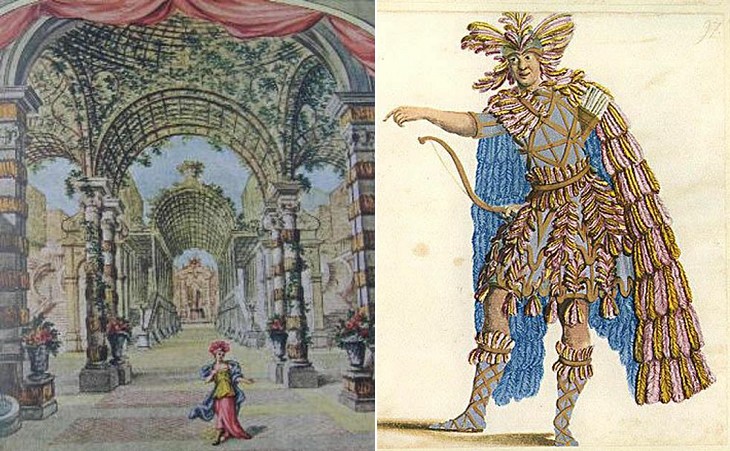
Scenery and a costume by Ludovico Burnacini (Vienna, Nationalbibliothek)
Melodrama and in general theatrical performances were a field of art where Italians had the leadership: Bernini was also a
scenery designer and he was occasionally asked to organize celebrations and parties; Filippo Juvarra earned his living in Rome as a scenery designer for the private theatre of the Ottoboni.
In Vienna Ludovico Burnacini from Mantua (1636-1707) was in charge of staging melodramas and organizing
imperial entertainments; in particular in 1668 he designed the scenery for Il Pomo d'Oro (The Golden Apple) an opera by Antonio Cesti which was first performed for the marriage of Emperor Leopold I with Margaret Theresa of Spain. He designed 24 very complex scenes and created new stage machinery. He continued his activity until the end of the century. He also advised on the design of the Graben Pestsaule.
Walche (Italian) was widely spoken in at the court of Vienna (to learn more about this word see an Italian street in Prague) and Italian artists did not need to learn German to live and work there. The instructions Burnacini gave
for the staging of melodramas were written in Italian and the melodramas themselves were sung in Italian. This usage continued until the end of the XVIIIth century with famous operas with music by Wolfgang Amadeus Mozart and Italian libretto by Lorenzo Da Ponte.
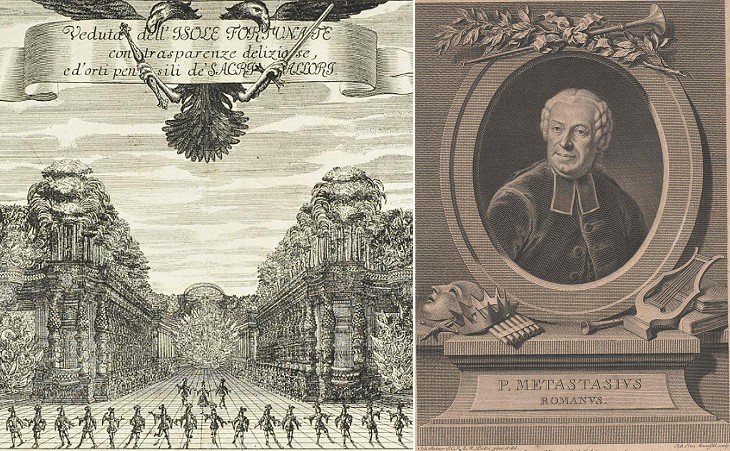
(left) Scenery for "Angelica vincitrice su Alcina" (two personages of "Orlando Furioso", a poem by Ludovico Ariosto), an outdoor performance of an opera by Johann Joseph Fux (music) and Pietro Pariato (libretto) which was staged in September 1716 by Ferdinando Galli di Bibbiena for Emperor Charles VI in celebration of the birth of his son Leopold; (right) portait of Pietro Metastasio in a late XVIIIth century engraving
(September/October 1716) Don't fancy, however, that I am infected by the air of these popish countries; I have, indeed, so far wandered from the discipline of the church of England, as to have been last Sunday at the opera, which was performed in the garden of the Favorita; and I was so much pleased with it, I have not yet repented my seeing it. Nothing of that kind ever was more magnificent; and I can easily believe what I am told, that the decorations and habits cost the emperor thirty thousand pounds Sterling. The stage was built over a very large canal, and, at the beginning of the second act, divided into two parts, discovering the water, on which there immediately came, from different parts, two fleets of little gilded vessels, that gave the representation of a naval fight. It is not easy to imagine the beauty of this scene, which I took particular notice of. But all the rest were perfectly fine in their kind. The story of the opera is the enchantment of Alcina, which gives opportunities for great variety of machines, and changes of the scenes, which are performed with a surprising swiftness.
Letters of the Right Honourable Lady Mary Wortley Montague: Written during Her Travels in Europe, Asia and Africa to Persons of Distinction, Men of Letters, &c. in Different Parts of Europe
Ferdinando Galli di Bibbiena (1657-1743) and other members of his family took over from Burnacini as scenographers of the imperial entertainments. In particular Ferdinando excelled in the use of perspective "tricks" which increased the apparent size of the scenes. Emperor Charles VI created the position of "His Majesty's First Theatrical Engineer" to attract the best Italian scenographers.
I arrived, for the first time (in 1753), in the capital of Austria, at the age of eight-and-twenty, well provided with clothes, but rather short of money. (..) The only letter of recommendation I had was from the poet Migliavacca, of Dresden, addressed to the illustrious Abbe Metastasio, whom I wished ardently to know. I delivered the letter the day after my arrival, and in one hour of conversation I found him more learned than I should have supposed from his works. Besides, Metastasio was so modest that at first I did not think that modesty natural, but it was not long before I discovered that it was genuine, for when he recited something of his own composition, he was the first to call the attention of his hearers to the important parts or to the fine passages with as much simplicity as he would remark the weak ones. I spoke to him of his tutor Gravina, and as we were on that subject he recited to me five or six stanzas which he had written on his death, and which had not been printed. Moved by the remembrance of his friend, and by the sad beauty of his own poetry, his eyes were filled with tears, and when he had done reciting the stanzas he said, in a tone of touching simplicity, 'Ditemi il vero, si può far meglio'? (Tell me the truth. Is it possible to do better?) I answered that he alone had the right to believe it impossible. I then asked him whether he had to work a great deal to compose his beautiful poetry; he shewed me four or five pages which he had covered with erasures and words crossed and scratched out only because he had wished to bring fourteen lines to perfection, and he assured me that he had never been able to compose more than that number in one day. He confirmed my knowledge of a truth which I had found out before, namely, that the very lines which most readers believe to have flowed easily from the poet's pen are generally those which he has had the greatest difficulty in composing.
The Memoires of Casanova, by
Jacques Casanova de Seingalt. Translation by Arthur Machen
Pietro Metastasio was one of the greatest Italian poets of the XVIIIth century; he was appointed Caesarean Poet
by Emperor Charles VI in 1730 and for the rest of his long life (he died in 1782) he wrote poems and librettos for
the delight of the imperial court, all in Italian. A monument to him was erected in Minoritenkirche, the church of the Italian community in Vienna (and in Rome, where he was born in a modest house in 1698, in Piazza della Chiesa Nuova).
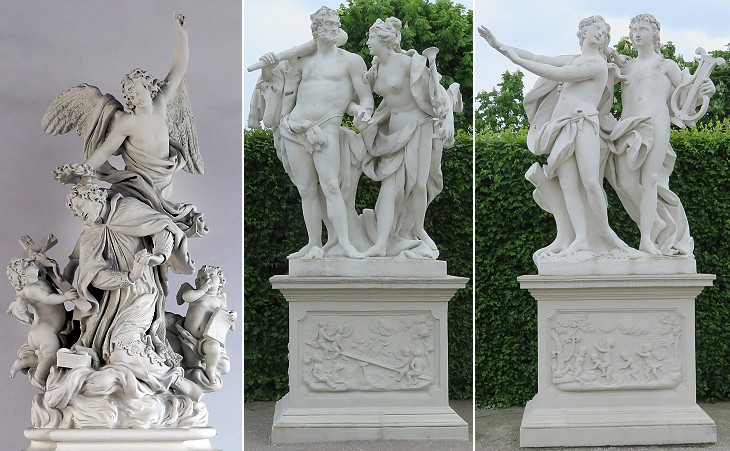
Belvedere Palace and Gardens: (left) St. John Nepomuk (1724) by Johann Jacob Schoy; (centre) Hercules and Deianira, his spouse; (right) Apollo and Daphne in the Belvedere Gardens
Sculpture is another field where Italian influence can be noticed well into the XVIIIth century. St. John Nepomuk was portrayed in Vienna in many rather unassuming statues in the early XVIIIth century, but that by Schoy stands out for its very "Berninian" design (see Bernini's Ecstasy of St. Theresa). Some of the statues which embellish the Belvedere gardens depict subjects which were already conceived by sculptors in Rome, but they lack the dramatic tension of their Roman predecessors, especially in the case of Apollo and Daphne by Bernini (the image used as a background for this page shows a detail of that statue).
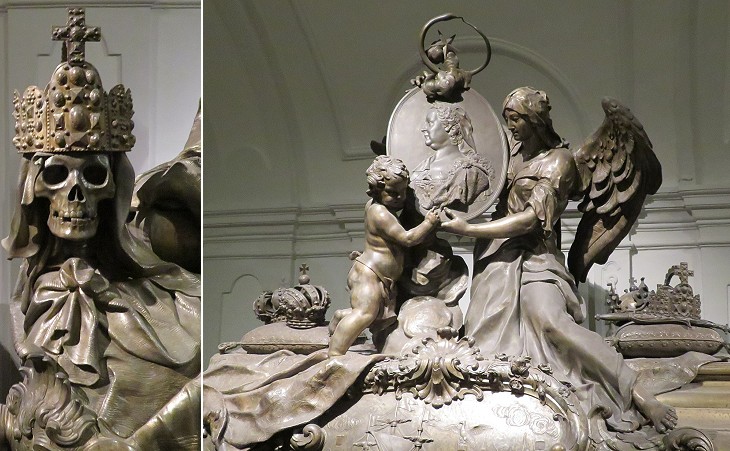
Details of the monuments to Emperor Charles VI (left) and to his wife Elisabeth Christine of Brunswick (right) by Balthasar Ferdinand Moll in
Kapuzinergruft
The Capuchin Church in the Neu markt is only remarkable for containing the burial Vault of the Imperial family. It is shown by torch light under the guidance of a Capuchin brother. (..) The most splendid is that of Maria Theresa, her husband Francis and her son Joseph II.
A Handbook for travellers in southern Germany by J. Murray - 1837
In general there are not many funerary monuments in Vienna and most of them are very simple, even in the Capuchins's crypt.
The few which have a complex decoration show the influence of Italian patterns in
some gruesome reminders of death and in the use of medallions to portray the
dead.
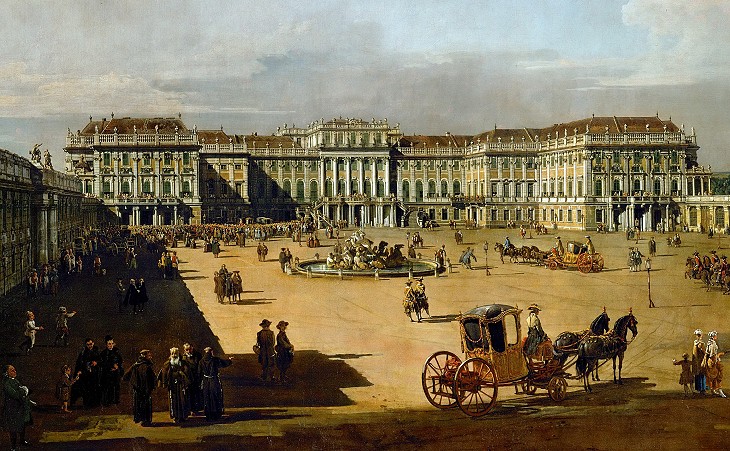
Kunsthistorisches Museum: Detail of a view of Schonbrunn Palace by Bernardo Bellotto
In January 1759 Bernardo Bellotto, a Venetian painter, settled in Vienna. He was the nephew of Antonio Canal, best known as Canaletto, a renowned painter of city views, and Bellotto signed his works as Bernardo Canaletto. He stayed in Vienna until January 1761 when he left for Munich with a letter of commendation by Empress Maria Theresa. He painted 13 very accurate large views of the city, which are the best depiction of the era of Maria Theresa.
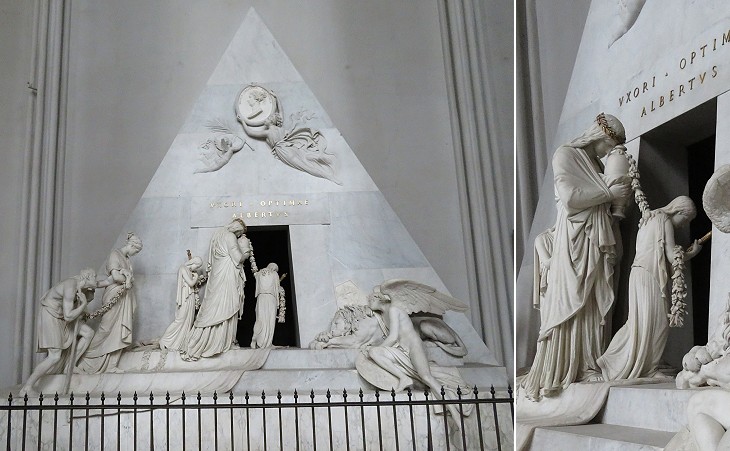
Antonio Canova: Monument to Maria Christina of Austria in Augustinerkirche
When dealing with Italian artistic influence in Vienna, one cannot omit a masterpiece by Antonio Canova.
A pyramid of greyish marble 28 ft high, and connected by 2 broad steps with a long and solid base, is placed against the wall of the church. In the centre of the pyramid is an opening representing the entrance of the funeral vault and two melancholy groups are slowly ascending towards it. The first consists of Virtue bearing the urn which contains the ashes of the deceased to be deposited in the tomb, and by her side are twin little girls carrying torches to illuminate the gloomy sepulchre. Behind them Benevolence ascends the steps supporting an old man, who seems scarcely able to totter along, so rapidly is he sinking beneath age, infirmity and grief. A child accompanies him, folding its little hands and hanging down its head in infantine sorrow. On the other side couches a melancholy lion and beside him reclines a desponding genius. (..) There is nothing strained or affected in the allegory. An air of soft and tranquil melancholy pervades the whole composition and the spectator, without being very forcibly struck at first, feels pensiveness and admiration growing upon him. The figure of the old man whom Benevolence supports to the grave of his benefactress is exquisite: his limbs actually seem to totter and the muscles of his face to quiver with agitation. The composition is a most elegant one and pure and chaste throughout. (..) It is by far the best of Canova's monuments.
John Russell - A Tour in Germany, and Some of the Southern Provinces of the Austrian Empire - 1825
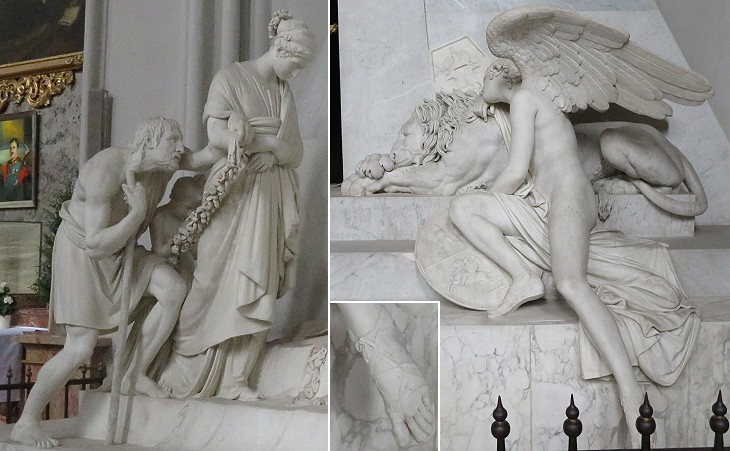
Antonio Canova: Monument to Maria Christina of Austria in Augustinerkirche: details (you may wish to compare the sandal of the winged Genius with other ones)
In 1798 Canova was commissioned a monument to Maria Christina, the favourite child of Empress Maria Theresa, married to Duke Albert von
Sachsen Teschen. Canova had developed some ideas based on using a pyramid as the focal point in a monument
dedicated to the great Venetian painter Titian, which was never built. Bernini, in Cappella Chigi in S. Maria del Popolo, following original sketches by Raphael, had designed monuments where the portrait of the dead, inscribed in a medallion,
was placed on a pyramidal shape and he set a pattern for several other monuments.
Canova replaced the
symbolic pyramidal shape with an actual one, the most ancient
funerary monument. Above the entrance he wrote a simple dedication to Maria Christina (Uxori Optimae Albertus, Albert to his excellent wife), whose portrait stood
towards the top of the monument. To the right of the entrance Canova placed two
statues which had already given him glory, the naked angel and the sleeping lion of his 1792 monument to Pope Clement XIII.
The individual features of the monument were not terribly new, but the overall design was.
Vienna houses another masterpiece by an Italian sculptor: the Salt cellar by Benvenuto Cellini.
Pages in this section of the website in recommended order:
Introduction: the Holy Roman Empire of the German Nations
Renaissance Vienna
The 1683 Siege of Vienna
XVIIth century churches
XVIIth century palaces
Monuments celebrating the end of plagues
The walls of Vienna
Sacred images
XVIIIth century churches
XVIIIth century palaces
Fountains
Italian cultural and artistic influence
A political manifesto: Karlskirche
Churches without the walls
Palaces and Villas without the walls
A day in the countryside: Perchtoldsdorf
in other sections of this website:
Vindobona, Roman Vienna
Belvedere Palace


