
All images © by Roberto Piperno, owner of the domain. Write to romapip@quipo.it.


Notes:
Page revised in October 2020.
All images © by Roberto Piperno, owner of the domain. Write to romapip@quipo.it.
Notes:
Page revised in October 2020.
 - Remarks on "Angels and Demons"
The menus of nearly all Italian restaurants abroad offer Spaghetti
Bolognaise, or Spaghetti Bolognese and (when the
owner knows a bit of Italian) Spaghetti alla Bolognese.
With all its popularity abroad this dish does not belong to the Italian cooking tradition.
Spaghetti, a thinner kind of maccaroni are so described by J. W. Goethe (Naples, May 29, 1787):
The macaroni, the dough of which is made from very fine flour,
kneaded into various shapes and then boiled, can be bought everywhere and in all the shops
for very little money. As a rule, it is simply cooked in water and seasoned with grated cheese.
The diet of the inhabitants of Naples heavily relied on this simple and economic dish. The hard wheat grown
in southern Italy was particularly apt for this kind of pasta.
Bologna, in addition to be called la dotta (the learned) is also known as la grassa (the fat) due to its
rich cooking: the wheat grown in northern Italy is less suited for manufacturing spaghetti or maccaroni (which can be stored
for a very long time), while it is excellent for pasta fresca, such as tagliatelle, lasagne, ravioli, tortellini
and the likes which are all usually served with a rich meat-based sauce called ragù alla bolognese.
By combining the Neapolitan spaghetti with the Bolognese ragù you get Spaghetti alla Bolognese: they can taste
very good, but they are not very representative of Italian cooking.
Dan Brown, before his most acclaimed novel The Da Vinci Code, wrote in 2000 an almost identical novel,
Angels and Demons, which is set in Rome, rather than Paris: in a foreword
note he states: References to all works of art, tombs, tunnels, and architecture in
Rome are entirely factual (as are their exact locations).
In my view
he cooked for his readers a very tasty Spaghetti Bolognaise-type novel, which here and there may lead them astray.
Much of the plot of Angels and Demons is about a XVIIth century scientific
academy, Accademia degli Illuminati (enlightened); in the novel, today's academy members are seeking revenge on the Catholic Church for the persecutions
members of the academy suffered in the past.
Galileo Galilei is quoted as having
been a member of the academy and clues hidden in
his writings guide Dan Brown's hero (a sort of Indiana Jones) through the churches of Rome.

Palazzo Cesi and inscription commemorating Federico Cesi
A worn-out 1872 inscription in Palazzo Cesi sheds some light on Roman scientific academies:
| Il principe Federico Cesi Romano che stretto da persecuzioni maligne mantenne l'ardore della scienza investigatore illustre della natura, dell'Accademia de'Lincei fondatore in questo palazzo di sua famiglia accolse le dotte adunanze e l'amico suo Galilei. | The Roman Prince Federico Cesi who, notwithstanding evil persecutions retained the scientific ardour, illustrious researcher of nature, of the Accademia dei Lincei founder, in this palace belonging to his family hosted the learned meetings and his friend Galilei. |
Federico Cesi (1585-1630) founded the academy in 1603 when he was just 18 and he named it
after the lynx, the animal with the reputation of having keen sight; so the metaphoric meaning of Illuminati (enlightened, a very popular term in the following century) is not
so distant from the academy name chosen by Prince Cesi: they both deal with sight.
Members of the academy had different views on the Copernican theory, and Galilei's views supporting it were challenged
by other academy members. The academy was under the patronage of Pope Urban VIII, whose nephew Cardinal Francesco
Barberini was an academy member too.
The death of Prince Cesi marked the end of the
academy he had founded. The aim of the academy and its name were resurrected several times in the
following centuries.

Palazzo Corsini: coat of arms of Accademia dei Lincei, recent books published by the Academy, and staircase designed by Ferdinando Fuga which leads to the library
Currently Accademia (Nazionale) dei Lincei is housed in Palazzo Corsini and makes use of nearby la Farnesina for meetings and conferences. An Accademia degli Illuminati does exist in Rome, but its foundation is very recent and it smells of business, rather than science.
| Chapter 33 - Advice for helicopter pilots .. | .. not wishing to crash themselves into the Tyrrhenian Sea. |
| The .. chopper (from Fiumicino)... sliced northwest ... His eyes found ... the crumbling ruins of the Roman Coliseum. As the chopper headed north, Langdon spied the Roman Forum. | .. in the novel the "chopper" from Rome
Fiumicino airport is heading towards St Peter's; the directions given
in the book are (very) broadly applicable to a flight from Rome Ciampino airport. Judge by yourself in an
(old) map of the environs of Rome: Fiumicino is near the letter T and Ciampino near H. The fact that the Coliseum is seen while going towards St. Peter's makes sense only by assuming Rome Ciampino is the starting point. |
| Chapter 34 - Maybe a mismatch with 'Euromarathons' ... | ... cardinals are not night birds |
| At 7 p.m. .. the oldest and most secretive political ritual in the world would begin. The cardinals would not be released until they decided who among them would be the next Pope. | In the complex and often very heated meetings which take place in the frame of the
European Community, a practice has developed to arrange them at the eleventh hour before a
deadline for agreement. Everybody knows that each country will stick to its
position until that moment and that only during the night a compromise will be reached. This does not apply to conclaves: cardinals make two scheduled attempts to elect the pope in the morning and two in the afternoon: in the evening they pray and eventually go to bed. More on the conclave. |
| Chapter 35 - Crusades, the more ... | ... we forget them, the better |
| Each (Swiss guard) wielded the traditional 'vatican long sword' - an eight-foot spear with a razor-sharp scythe - rumored to have decapitated countless Muslims while defending the Christian crusaders in the fifteenth century. | The Swiss Guard corps were founded by Pope Julius II in 1506 for his personal protection. The seventh and last Crusade took place in 1270. |
| Chapter 36 - Foreign languages .. | ... can be rather tricky |
|
'Signore' the guard urged, pointing to his watch again' Spazzare di cappella'.
...'You're leaving to sweep the chapel?' ...'We sweep for electronic bugs'. | Here and there the novel is "spiced" with some Italian sentences.
Unfortunately they confuse the Italian reader rather than enlightening him. Spazzare is a transitive verb, so the preposition di (of) is not required; besides it is not used to say that a room is being cleared of electronic devices; bonificare (to reclaim) is the appropriate term. In addition cappella is a colloquial word for foreskin, so it is preferable to make its meaning not subject to erroneous interpretations by adding the name of the chapel. |
| Chapter 47 - The Italian Army may not enjoy ... | ... a high reputation, but maybe that's too much! |
|
When Carlo turned sixteen, he was obliged by Italian law to serve two years of
reserve military training. ...he refused to fire a gun, so the military taught him how to fly a medical helicopter. | The compulsory draft never involved such a young age,
nor was it so long (only in the Navy the draft reached two years). When eventually in the 1970s a law introduced alternative forms of service on moral grounds, these did not include flying medical helicopters. |
| Chapter 61 - The Italian Catholic kings ... | ... were excommunicated |
|
...he passed the tomb of one of Italy's Catholic Kings. The sarcophagus, like
many in Rome, was askew with the wall, positioned awkwardly. ...Christian tombs
were often misaligned with the architecture so they could lie facing east * * * Langdon jumped. He was back in the Pantheon. He turned to face an elderly man in a blue cape with a red cross on the chest. The man gave him a gray-toothed smile. [...] "Can I help you?" Langdon asked, his heart beating wildly. "Actually I thought perhaps I could help you. I am the cicerone here." The man pointed proudly to his city-issued badge. "It is my job to make your visit to Rome more interesting." | King Victor Emmanuel II, Garibaldi, Mazzini and the other
leaders of the unification of Italy, all regarded the Pope and the priests as
manipulators of popular superstition for their own profit and did not care if they were excommunicated by Pope Pius IX. The tombs of King Victor Emmanuel II and of his son King Umberto I are located in a very logical way inside two opposite niches: they do not face east, nor does the Pantheon which is on a north (entrance)/ south (altar) axis. * * * The clothing of the elderly man has nothing to do with a cicerone or tourist guide. The blue cape with the red cross (well, actually a white cross in a red field) is the "uniform" of the monarchists keeping guard near the tombs of the Italian kings. The white cross in a red field was part of the coat of arms of the Italian royal house. |
| Chapter 62 - May Raphael's body rest in peace .. | ...and not be carried across Italy |
|
Vittoria studied the grave and then read the one-sentence description plaque beside Raphael's tomb.... 'I just read it. Raphael's body was relocated to the Pantheon in 1758. It was part of some historic tribute to eminent Italians.' 'Where was Raphael's body in the 1600s?' 'Urbino.' | Raphael was buried in the Pantheon from the very beginning. Because many visitors were querying that they were not able to locate the plaque quoted in the novel, authorities have placed a short notice spelling out that the body of Raphael never moved from the Pantheon. |

Pantheon: Bust of Raphael; visitors are informed that Raphael was buried there in 1520; Tomb of Umberto I, King of Italy
| Chapter 64 - There are so many churches in Piazza del Popolo... | ... that one gets confused |
| The Church of Santa Maria del Popolo stood ... on the southeast corner of the piazza. The church's front stairs were ventaglio - a welcoming, curved fan. She ascended the main portico to the church's sole wooden door. | There are three churches in Piazza del Popolo, all dedicated to Mary; S. Maria del Popolo is on the northeast corner of the square, its stairs have a rectangular shape, it does not have a portico and finally it has three doors. The description in the novel fits S. Maria in Montesanto. |
| Chapter 65 - Exchanging a banker .. | ... for a pope. |
| The grime-covered plaque ... read: COAT OF ARMS OF ALEXANDER CHIGI WHOSE TOMB IS LOCATED IN THE SECONDARY LEFT APSE OF THIS CATHEDRAL | Bernini, at the request of Pope Alexander VII,
introduced several changes to the architecture and decoration of S. Maria del Popolo and
several coats of arms of the Pope celebrate them, but his tomb is not in the family
chapel inside the church, where the Chigi buried Agostino, a very
wealthy banker who lived a century before the pope and a patron of Raphael. Pope Alexander VII is buried in S. Pietro in a monument designed by Bernini. |
| Chapter 65 - Let's not get ... | ... too excited! |
| Langdon's eyes were transfixed on the pyramids. What are pyramids doing inside a Christian chapel? | It is true that Bernini, based on plans by Raphael, designed a pyramid for the tomb of the banker Agostino Chigi, but this is just one of many funerary monuments where a pyramid is shown behind the dead. You may wish to see the tomb quoted in the novel and other tombs with pyramids. |
Much of the novel is about the four traditional components of the world: earth, air, fire and water. Unfortunately, in the novel, the heirs of the XVIIth century academy refer to these elements in a direct and gruesome way which could not be farther from the culture of the academy's first members.
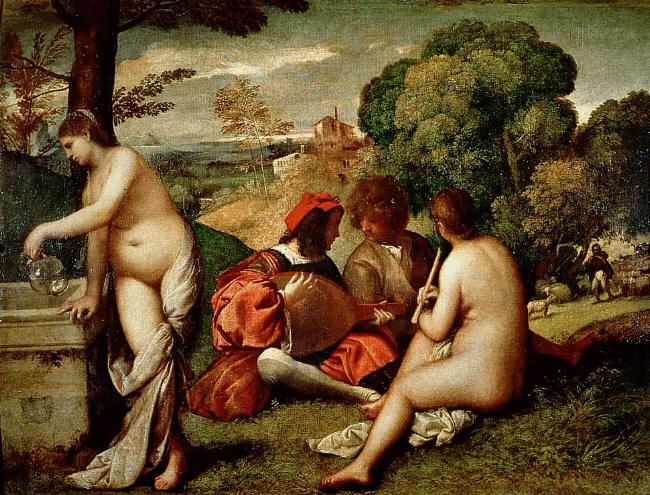
Giorgione or Tiziano - Concerto campestre (countryside concert) - Louvre - Paris
This painting is an excellent example of the indirect way the four elements were referred to by Renaissance artists.
The name given to the painting describes the immediate perception one has of what the portrayed
characters are doing. But that perception is accompanied by another one, that there is
something strange, mysterious in the apparently idyllic scene.
We ask ourselves why the woman on the right is naked: she is Earth and she directly sits
on the ground as if she were part of it. The woman on the left does not seem very interested in what is going on:
her aloofness is a reminder of the coldness of Water, which she is getting from a well. Of the two men, one has a very
ruffled hair: in the quartet he represents Air; the other man plays a mandola: music is a
creative art and Fire is the great creator. So the painting could very well be called The
Four Elements and also The Four Seasons because Water with its coldness is a metaphor of Winter, Air is the breath of Spring, Fire the heat of Summer and Earth is
Autumn, when the fields are naked.

Manet - Déjeuner sur l'herbe (picnic) - Gare d'Orsay - Paris
This famous painting by Manet was initially rejected by the Paris Salon mainly for the nakedness of the woman on the left: naked odalisques or slaves were often portrayed by academic painters, but the nakedness of this middle-class woman was a scandal. This painting too has hidden references to the four elements: the two women can be easily associated to those in the previous painting: a flying bird (top/centre) and a small fire (behind the boat) tell which man is Air and which is Fire.
| Chapter 72 - Bernini thought he was embellishing Rome ... | ... but we are told he was working in Vatican City |
| ..the poem says the elements are spread across Rome. St Peter's Square is in Vatican City. Not Rome. ...Most maps show St Peter's Square as part of Vatican City, but because it's outside the walled city, Roman officials for centuries have claimed it as part of Rome. | The notion of Vatican City derives from the 1870 annexation of Rome by the Kingdom of Italy. Pope Pius IX abandoned his usual residence in town and retreated to the palace adjoining St. Peter's Square. Vatican City was created by the 1929 Lateran Treaty. At the time of Bernini it was part of Rione Borgo. |
| Chapter 72 - Don't waste your time waiting to see.. | ...a Swiss Guard patrolling St Peter's Square |
| The guard shrugged. 'The only reason I know about it is because I'm usually on piazza duty. I know every corner of St. Peter Square... I patrol .. it every day'. | Although St Peter's Square is part of Vatican City, an agreement assigns to the Italian police responsibility for patrolling it and in general for all related security measures. |
| Chapter 72 - It is not always easy to say ... | ... which wind is blowing |
|
'It's in the center, directly where that line is pointing. It's not really a sculpture.
It's more of a ... block.' ...'A relief!' 'It's also known as Respiro di Dio' 'Breath of God?' 'Yes! Air! And it was carved and put there by the original architect! (Bernini) | St Peter's Square was not paved with stones by Bernini, but only at a later moment. XVIIIth century prints of the square do not show evidence of the square being paved yet. In 1817 some circular slabs were placed at intervals from the obelisk to mark its shadow at specific days. Most likely at the same time eight identical slabs were placed round the foot of the obelisk as a sort of mariner's compass. They show a gushing wind, its name and the direction it blows from. |
| Chapter 73 - Geometry ... | .. what an awkward science. |
| Two fountains flanked the obelisk in perfect symmetry. Art historians knew the fountains marked the exact geometric focal points of Bernini's elliptical piazza. | St Peter's Square has an elliptical shape, but it is not an
ellipse: it was drawn by placing two circles side by side (with a partial overlap). Timothy K. Kitao, Circle and Oval in the Square of Saint Peter's: Bernini's Art of Planning., New York University Press, 1974. The author notes that the "Ellipse" in St. Peter's Square is composed of circular arcs and is not an ellipse. From page 34: "The ovato tondo was, in short, the standard oval in architectural practice-at least in Bernini's Italy. The true ellipse was not unknown.. but awkward to plot." The foci of the circles are marked by porphyry slabs and they do not coincide with the fountains. |

Piazza S. Pietro: inscription near the obelisk: porphyry slab marking one of the foci of the square
| Chapter 84 - Bernini's St. Teresa and the ... | ... chronology of the popes. |
|
The note indicated that the famous Bernini sculpture, The Ecstasy of St. Teresa,
shortly after its unveiling, had been moved
from its original location inside the Vatican. .. Pope Urban VIII had rejected The Ecstasy of St. Teresa as too sexually explicit for the Vatican. He had banished it to some obscure chapel across town. | The lavishly decorated Cornaro Chapel in S. Maria della Vittoria
can hardly be regarded as an obscure chapel across town. Pope Urban VIII died in 1644, while Bernini started
working on The Ecstasy of St. Teresa in 1647. It is only in the XVIIIth century that members of that libertine society first observed that the statue had some 'sexual' notes. |
| Chapter 88 - That is definitely ... | ... a metropolitan legend |
|
Twenty years ago, construction of the subway terminal had created a stir
among art historians who feared digging beneath Piazza Barberini might topple the multiton obelisk that stood in the center.
City planners had removed the obelisk and replaced it with a small fountain
called the Triton. * * * "The church is on Piazza Barberini," Olivetti said... | The Barberini had in their gardens an obelisk, which in 1822 was moved
to the Pincio by Pope Pius VII.
It was never located in the Piazza, where Bernini placed his Triton. * * * Santa Maria della Vittoria is not on, or even near Piazza Barberini, but more or less 500 yards from there. The church cannot even be seen from Piazza Barberini. |
| Chapter 90 - Beware: these words could cost you ... | ...a slap in the face |
|
... the women had been inside the church ....when some man had appeared
and told them the church was closing early. 'Hanno conosciuto l'uomo?' Vittoria demanded. 'Did you know the man?' The women shook their heads. The man was a straniero crudo, they explained... | In the way the question is written in Italian it conveys the impression that the women are
being asked if they ever had sexual intercourse. L'uomo without a specification like
quell'uomo (that man) means manhood rather than a single man. Italians and foreigners as well can be maleducato (ill-mannered), scortese (impolite), rude (rude) but not crudo (raw) because in Italian this adjective applies to fish and meat only. |
| Chapter 100 - Geography, yet another ... | .. awkward science. |
| ... Bernini's Fountain of the Four Rivers glorified the four major rivers of the Old World - The Nile, Ganges, Danube, and Rio Plata. | Mr Rumsfeld is known for his remark about a
New Europe supporting the war in Iraq and an Old Europe opposing it: some objected that
Great Britain and Italy could hardly
be classified as New Europe, but he did not amend his statement. It is therefore difficult to blame Dan Brown if he has followed such a glorious example by including Rio (de la ) Plata, the river between Uruguay and Argentina, among the major rivers of the Old World. |
| Chapter 102 - If you wish to properly see Piazza Navona ... | ... choose another time. |
| The piazza (Navona) was deserted (at 10 p.m. in spring). | Never, never, never. |
| Chapter 104 - Don't waste your money .... | ... tossing coins in the wrong fountain. |
| The bottom (of Fountain of the Four Rivers) was slippery, made doubly treacherous by a stratum of coins thrown for good luck. | Coins are thrown for good luck only and exclusively in Fontana di Trevi. |
Let me say no more on the final 33 chapters in order not to disclose how the novel ends.
The two images used as a background for this page show the angel of Castel Sant'Angelo
(chapter 107) and a marble inlay depicting a skeleton in Cappella Chigi in S. Maria del Popolo (Chapter 65).
In addition to the
monuments/locations shown or having a link in this page, the following is a list of
other monuments quoted in the book which you can find in this web site.
You can find:
Apostolic Palace (chapter 39)
Belvedere Courtyard (chapter 46)
Royal Staircase (chapter 47)
Habakkuk and the Angel in S. Maria del Popolo (chapter 70)
S. Maria della Vittoria (chapter 91)
Piazza Navona (chapter 102)
Ponte Sant'Angelo (chapter 106)
il Passetto (chapter 112)
Isola Tiberina (chapter 125)
I owe the following additional remarks on the conclave to the courtesy of Rev. Niels B. Johansen.
| Chapter 36 - Venturing on thin ice... | ...one may repeatedly fall. |
| Il camerlengo? Olivetti scowled. The camerlengo is only a priest here. He is not even canonized. He is the late Pope's hand servant. | The camerlengo is always a Cardinal, since the 15th century. He is not the Popes' hand servant. And nobody can be canonized (officially proclaimed a Saint) if he is still alive! |
| Chapter 36 - The Roman Catholic Church is not ... | ... a Corporation. |
| ...it is true that Vatican rule dictates the camerlengo assume chief executive office during conclave, but it is only because his lack of eligibility for the papacy ensures an unbiased election. | The camerlengo is eligible... and he does not assume chief executive office (whatever this can mean in the structure of the Roman Catholic Church). |
| Chapter 36 - The camerlengo has no business ... | ... in the dead Pope's Office. |
| Conclave begins in forty minutes. The camerlengo is in the Office of the Pope preparing. | The Office (or study) of the Pope is sealed immediately after he is proclaimed dead, until a new Pope has been elected. |
| Chapter 42 - Ineligible? ... | ... not quite so. |
| .. by Vatican Law the cardinal had to be inside the Sistine Chapel when the vote took place. Otherwise, he was ineligible. | Any male catholic is eligible. If the person elected resides outside Vatican City, the norms contained in the Ordo Rituum Conclavis are to be observed. |
| Chapter 42 - A lengthy job description ... | ... for a position which does not exist. |
| Cardinals often joked that being appointed The Great Elector was the cruelest honor in Christendom. The appointment made one ineligible as a candidate during the election, and it also required one spend many days prior to conclave poring over the pages of the Universi Dominici Gregis reviewing the subtleties of conclave's arcane rituals to ensure the election was properly administered. | There is no such office (or honor) as "The Great Elector". And again: any male catholic is eligible. |
| Chapter 47 - Up and down ... | for too many cardinals. |
| As the camerlengo arrived at the top of the Royal Staircase, he felt as though he were standing on the precipice of his life. Even from up here he could hear the rumble of activity in the Sistine Chapel below-the uneasy chatter of 165 cardinals.. | The top of the Royal Staircase is at the same level as the Sistine Chapel. The maximum number of Cardinal electors is 120. |
Read What Dante Saw.
Read What Goethe Saw.
Read What Lord Byron Saw.
Read What Charles Dickens Saw.
Read What Mark Twain Saw.
Read What Henry James Saw.
Read What William Dean Howells Saw.
Read Their Travel Journals (excerpts from journals by British and American Travellers in 1594-1848).


