
All images © by Roberto Piperno, owner of the domain. Write to romapip@quipo.it.


Notes:
Page revised in June 2020.
All images © by Roberto Piperno, owner of the domain. Write to romapip@quipo.it.
Notes:
Page revised in June 2020.
 Piazza delle Quattro Fontane
Links to this page can be found in Book 2, Day 2, Map A3, View B7, Rione Trevi and Rione Monti.
The page covers:
The plate by Giuseppe Vasi
Today's view
Le Quattro Fontane
S. Carlo alle Quattro Fontane
The Cloister
Palazzo Albani (and Dionysus Ludovisi)
SS. Anna e Gioacchino
Palazzo Galloppi

This 1752 etching by Giuseppe Vasi shows the crossroads between Strada Felice which linked SS.Trinità dei Monti with S. Maria Maggiore and Strada Pia which linked Porta Pia to Palazzo del Quirinale. They were both opened in the second half of the XVIth century. In ca 1588 Pope Sixtus V asked the owners of the properties on the corners of the crossroads to "cut" them in order to obtain a small octagonal square which was eventually embellished with four fountains.
The location is excellent for observing a feature of the two streets: they had at their ends a monument which attracted the attention of the viewer. Strada Felice had at its ends SS. Trinità dei Monti and an obelisk and Strada Pia had Porta Pia, the gate designed by Michelangelo, and two large statues in Piazza del Quirinale.
The views were improved in the following centuries by placing obelisks opposite SS. Trinità dei Monti and in Piazza del Quirinale and by building the monumental rear façade of S. Maria Maggiore.
The view is taken from the green dot in the small 1748 map here below.
In the description below the plate Vasi made reference to: 1) Le Quattro Fontane; 2) S. Carlo; 3) Palazzo Albani;
4) S. Maria Maggiore (rear façade). The small map shows also 5) Palazzo Galloppi; 6) SS. Anna e Gioacchino.
The dotted line in the small map delineates
the border between Rione Trevi (left/above) and Rione Monti (right/below).
In 1771 Vasi depicted the view towards S. Maria Maggiore from Quattro Fontane in a larger etching.


The view in August 2009; (left) Palazzo Albani; (centre) Strada Felice leading to S. Maria Maggiore; (right) S. Carlo alle Quattro Fontane
Basically the view is unchanged; however, because the crossroads is among the busiest ones within the walls of the city, it is no longer advisable to follow a suggestion made by Giovanni Pietro Bellori in his 1672 guide to Rome. He recommended visiting this spot to breathe its fine air and to enjoy the ponentino, the western breeze which at sunset mitigates the heat of Rome's summer days.

Fountains on the Porta Pia side of the square: (left) wall surrounding the Barberini Gardens: Fidelity or Diana or a nymph representing a river of one of the four parts of the world;
(right) Palazzo Albani: River Arno or River Aniene (a tributary of the Tiber) or a river of one of the four parts of the world
One of the first decisions taken by Pope Sixtus V was to improve the city's supply of water; he built Acqua Felice, an aqueduct which carried water to the Esquiline, Viminal and Quirinal hills. It was completed in 1587 and it ended near Strada Pia.
The next step needed to reach the Pope's objective was to distribute the water through a net of public fountains; many of them such as those in Piazza dei Monti and in Piazza d'Aracoeli were directly built by the Papal State; others were built by private citizens in return for the right to a water supply for their own properties.
The latter procedure was followed for the four fountains at the corners of Piazza delle Quattro Fontane; the lack of official records has made it difficult to ascertain what their statues represent.
The only statue which is related to Pope Sixtus V is that on the wall surrounding the Barberini property; it portrays a reclining woman holding three pears (a heraldic symbol of the Pope); next to her the water flows from three mountains (another heraldic symbol). The identification with Fidelity was suggested by the presence of a dog, whereas that with Diana by a small moon on her hair. A more comprehensive theory which explains the meaning of all four statues says that they are the equivalent of Bernini's later Fontana dei Quattro Fiumi; in the form of a nymph or of a river god, the statues are meant to represent generic rivers of the four parts of the world which were known at the time. This opinion is conceptually supported by the fact that there is a broad alignment between the statues and the four cardinal points.

Fountains on the Quirinale side of the square: (left) S. Carlo al Corso: River Tiber or a river of one of the four parts of the world;
(right) Palazzo Galloppi: Juno or Strength or a nymph representing a river of one of the four parts of the world
Two of the fountains have in the background an elaborate stucco tree; this was added at a later period when the fountains were included in large buildings (S. Carlo and Palazzo Galloppi); the trees were meant to be a reminder of the gardens which once stood behind the fountains. The she-wolf near the supposed statue of the Tiber was added in the XXth century to support this identification.
You may wish to see I Quattro Canti, a square with four fountains at Palermo which was designed shortly after Piazza delle Quattro Fontane.
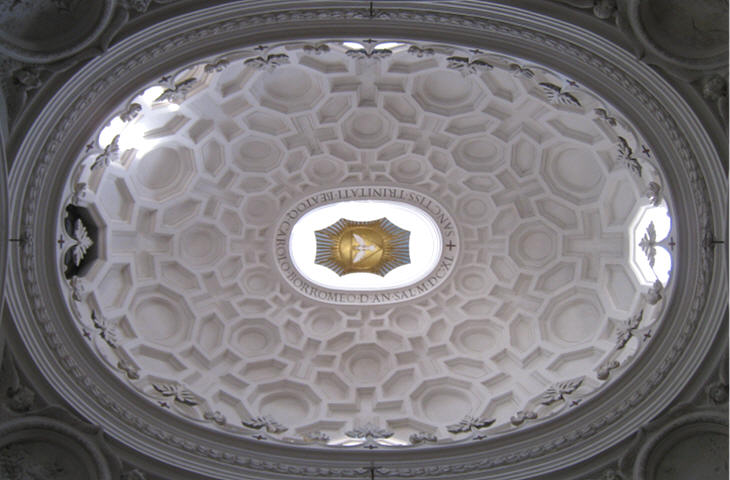
1640 stucco ceiling; the inscription dedicates the church to the Holy Trinity and to St. Charles Borromeo (you may wish to see a page with other ceilings of the Roman churches)
S. Carlo is also known as S. Carlino (the small S. Carlo) because the church is said not to
exceed the size of one of the pillars supporting the dome of S. Pietro; the comparison is probably due to the fact that the decoration of the pillars by Gian Lorenzo Bernini was contemporary to the construction of the church.
S. Carlo was the first major work by Francesco Borromini, Bernini's great rival. In 1634, when he was asked by the Spanish Trinitarians to design for them a monastery and a church in a small property near Piazza delle Quattro Fontane, Borromini had already a certain amount of experience in the construction of buildings, but he had never acted on his own; he first worked as assistant to his uncle Carlo Maderno and later on to Bernini in the construction of nearby Palazzo Barberini. He realized the opportunity which was given to him by this commission to the point that he chose not to be paid for his work.
The interior of the church was completed by 1640 whereas the exterior was left unfinished for many years.
Borromini was held in low regard during Neoclassicism and all through the XIXth century; yet his works show an in-depth knowledge of the ancient monuments which the architect used to develop new designs. The elliptical dome of S. Carlino was decorated with coffers which the ancient Romans used to lighten the weight of vaults: their shape is octagonal as in Terme di Diocleziano or in Basilica di Massenzio; Borromini inserted among them coffers having the shape of the Trinitarian cross.

(above) Ceiling of Cappella Barberini with the coat of arms of Cardinal Francesco Barberini; (below) examples of stucco decorations
Confronted with a very tight budget, Borromini made use of his ingenuity and of his mastering of stucco (see also his chapel in Palazzo di Propaganda Fide). Because of his practical experience Borromini was able to personally follow all aspects of the construction and decoration of the church; according to a chronicle written by a Trinitarian father Borromini could teach their trade to bricklayers, stucco decorators, carpenters, stone cutters and smiths. The cost was in part borne by Cardinal Francesco Barberini, nephew of Pope Urban VIII, to whom a small chapel is dedicated.

(left) Lower part of the façade; (right) niche with the statue of St. Charles Borromeo by Antonio Raggi where angels act as architectonic elements, a feature which Borromini used also at S. Giovanni in Laterano
On the 12th November 1644: The church of St. Carlo is a singular fabric for neatness, of an oval design, built of a new white stone; the columns are worth notice.
John Evelyn's Diary and Correspondence
The lower part of the façade is a sort of summary of Borromini's views on architecture: a penchant for convex and concave lines, the use of angels as an architectonic element, the design of novel shapes for niches and windows and very elaborate mouldings. Evelyn noticed the columns which span two stories, similar to the pilasters designed by Michelangelo at Palazzo dei Conservatori.
Unfortunately the narrowness of Strada Pia does not allow a proper appreciation of the high façade; a few yards away along the same street and a few years later, Bernini built S. Andrea al Quirinale and he took this factor into account by designing a lower façade.

Upper part of the façade
The façade was completed by Bernardo Castelli, a nephew of Borromini, who followed the initial design of his uncle.

(left) The cloister; (right-above) a decoration with the symbol of the Trinitarians; (right-below) detail of the balustrade which you can see in the image used as background for this page
The small monastery adjoining the church has a tiny cloister where Borromini proved again his ingenuity in designing novel shapes as the right/reverse columns
of the balustrade show (he used them also at S. Giovanni dei Fiorentini).
The Order of the Trinitarians was founded in 1198 with the primary objective of ransoming Christians who had fallen into Muslim hands; this objective is clearly shown in a mosaic near S. Maria in Domnica. The Order was reorganized in the late XVIth century, but after a few years it split along "national" lines, in the sense that there were Spanish Trinitarians and French Trinitarians.
A letter written by Lady Mary Wortley Montagu (1689-1762) to a friend shows that not everybody was glad to be ransomed. Lady Montagu was the wife of the English Ambassador to the Ottoman Empire: she lived for two years in Constantinople where she happened to be acquainted with the wife of an important pacha. This lady revealed that she was a Spanish woman belonging to a noble family. The ship she was travelling on with her brothers was captured by Algerian corsairs. She was brought to Constantinople and she ended in the harem of a young pacha. A few years later her family was able to trace her and sent an appropriate ransom; her master told her she was free to go, but the woman knew that
the high and thick walls of a nunnery were waiting for her in Spain and she preferred to stay with the pacha who married her.

(left) Side along Via delle Quattro Fontane; (right-above) heraldic symbol of the Del Drago inside the palace; (right-below) detail of a window with the heraldic symbols of the Albani
Palazzo Albani is today known as Palazzo del Drago because it was bought in 1858 by Queen Maria Christina of Spain for her daughter Maria de los Milagros who was the wife of Filippo Del Drago, Prince of Mazzano, a very small town near Faleria; today the palace belongs to Princess Maria Laudomia del Drago. The original building was designed by Domenico Fontana, the leading architect at the time of Pope Sixtus V, for the Mattei di Paganica who had a palace in Rione Sant'Angelo and wanted a second healthier residence on the Quirinal. The façade of the palace along Via delle Quattro Fontane was shorter than it is today; the building was enlarged in the early XVIIIth century and again in the late XIXth century.

Courtyard: (left) portico; (right) fountain made up of ancient materials
In 1664 the palace was bought by Cardinal Camillo Massimo, an avid collector of antiquities (in particular ancient coins) and works of art. He spent a fortune to improve his collection. His heirs were forced to sell most of it because of the debts he made.

Archaeological Museum of Madrid: mosaics owned by the Massimo (see other mosaics depicting chariots or other mosaics owned by the Massimo)
Many pieces of the collection were bought by the Farnese and some of them were moved to Madrid by Charles of Bourbon when he became King of Spain in 1759. They are now on display at the Archaeological Museum and at the Prado Museum (see a Ganymede and Jupiter - it opens in another window), but some pieces of the collection can still be seen in the courtyard of the palace.

(left) Façade in the courtyard; (right) details of the window decoration
The original building was meant to be the casino (small building) of a villa, but it was turned into a town palace after 1719 by Alessandro Specchi and Filippo Barigioni for Carlo Albani, Prince of Soriano and nephew of Pope Clement XI. The loggia in the courtyard was closed and redesigned in line with the fashion of the time, so that it is in sharp contrast to the plain exterior of the building. It retains the ochre painting which characterized most Roman buildings until the early 1990s (you may wish to see some of the changes which occurred in recent years).

Museo Nazionale Romano a Palazzo Altemps: Ludovisi Dionysus
A very large statue of Dionysus accompanied by a satyr was found in 1594 during the initial phases of the construction of the palace. It was bought by Cardinal Ludovico Ludovisi, nephew of Pope Gregory XV, to decorate his villa and it became one of the most admired pieces of his collection. It was restored and the missing parts (the arms, the lower legs and most of the panther) were added. It is a IInd century AD copy of a Greek statue of Apollo with his right forearm resting on the head. The addition of a satyr and a panther and the apparent drunkenness of the god turned Apollo into Dionysus.
The statue, together with two bronze statues found at S. Silvestro al Quirinale, was most likely a decorative element of the Baths built by Emperor Constantine on the Quirinal, but it was moved there from a prior location.
Ludovisi Dionysus was for a long time a unique portrayal of the drunken god, but similar statues which decorated monumental fountains and baths were eventually found in south-western Turkey (you may wish to see that found at Sagalassos or a mosaic at Antioch).

(left) Entrance to the monastery of S. Carlo by Francesco Borromini; (centre) entrance to SS. Anna e Gioacchino; (right) entrance to the Belgian Pontifical College (until 1972)
In the XVIIIth century there were at least seven monasteries aligned along Strada Pia. Almost at the same time as the construction of S. Carlo alle Quattro Fontane, the Carmelites built next to it a small monastery and a church dedicated to Sts. Anne and Joachim. The church was inside the monastery and it did not have a façade, although it had a direct access from the street. In 1846 the monastery and the church were acquired by the Belgian Pontifical College. The church houses the tombs of several Belgian soldiers who served in the Papal Army and fell at Mentana in 1867 during the pontificate of Pope Pius IX.

(left) Main entrance to Palazzo Galloppi and in the inset coat of arms of Giuseppe Volpi (Foxes) di Misurata; (centre) side entrance to Palazzo Galloppi; (right) balcony of Palazzo Galloppi;
its railing has at its centre a cock (It. gallo), heraldic symbol of the Galloppi
In the early XVIIIth century Palazzo Galloppi which stood opposite the monastery of S. Carlo was largely modified with two new portals which are similar to that designed by Borromini for the monastery. The name of the palace is reported by Giovan Battista Nolli in his 1748 map of Rome. It is also known as Palazzo Volpi di Misurata because it was bought in 1939 by Giuseppe Volpi di Misurata, a businessman and diplomat who made a fortune in the early electric power plants; in 1920 he was nominated Count of Misurata, a town in today's Libya; being a very recent aristocrat he placed his newly designed coat of arms on one of the portals (a rampant fox and a Muslim star and crescent).
Next plate in Book 2: Piazza Barberini.
Next step in Day 2 itinerary: Chiesa di S. Andrea Apostolo e Noviziato de' Padri Gesuiti.
Next step in your tour of Rione Trevi: Palazzo Barberini.
Next step in your tour of Rione Monti: Chiesa di S. Bernardo alle Terme.
Excerpts from Giuseppe Vasi 1761 Itinerary related to this page:
Palazzo AlbaniCorrisponde questo vasto palazzo su la strada felice, e su la strada pia di monte cavallo; facendo nobilissimo prospetto nella piazza, che dicesi delle quattro fontane. E' questo ornato di quadri, statue, e monumenti antichi, onde il gentilissimo Lettore troverà piacere, se da quel custode ricercherà di Vederle.S. Carlo alle quattro fontane
Nell'altro angolo della riferita piazza si vede la detta chiesa con il convento de' frati riformati della Mercede
Spagnoli, ingegnosamente ricavata con magnificenza, sebbene in poco sito dal Cav. Borromini. Nella chiesa
evvi il quadro a destra dipinto da Giuseppe Milanese, quello nella cappella, che siegue, da Gio Domenico Perugino,
e quello nell' altare maggiore è del Mignardi Franzese, il quale dipinse ancora la ss. Nunziata sopra la porta; quello
nella cappelletta contigua è del Romanelli, e l'altro nella cappella, che siegue, è del suddetto Perugino.
|


