
All images © by Roberto Piperno, owner of the domain. Write to romapip@quipo.it.


Notes:
Page revised in July 2020.
All images © by Roberto Piperno, owner of the domain. Write to romapip@quipo.it.
Notes:
Page revised in July 2020.
 Chiesa di S. Bernardo alle Terme
Links to this page can be found in Book 7, Map A2, Day 2 and Rione Monti.
The page covers:
The plate by Giuseppe Vasi
Today's view
S. Bernardo alle Terme
The Roman Hall

This plate is one of the smaller views which Giuseppe Vasi added to the standard 20 plates of each book. In Book 7 which covered the Friaries and was published in 1756 he had to add nine smaller views in order to properly cover the topic. Alle Terme is a reference to Terme
(Baths) di Diocleziano, because the church was built inside a hall of the ancient baths.
The view is taken from the green dot in the 1748 map below. In the description below the plate Vasi made reference to: 1) S. Bernardo alle Terme;
2) Strada Pia. Strada Pia is covered in another page. The small map shows S. Susanna, a nunnery which stood opposite S. Bernardo. The dotted line delineates the border between Rione Trevi (above) and Rione Monti (below).
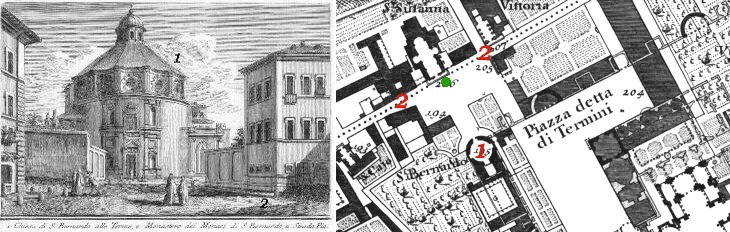

The view in August 2009 and enlargement of the street (Via Torino) leading to S. Maria Maggiore
12th November 1644. We saw Dioclesian's Baths, whose ruins testify the
vastness of the original foundation and magnificence. (..) The Church of St. Bernardo is made out
of one only of these ruinous cupolas, and is in the form
of an urn with a cover.
John Evelyn's Diary and Correspondence
The lantern of the dome was demolished in the XIXth century because its weight endangered the stability of the Roman structure, so that the building does not have any longer the shape of an ancient funerary urn.
In 1872 part of the land belonging to the monastery was acquired by the Italian State for opening a new street between Strada Pia
(today's Via XX Settembre) and S. Maria Maggiore.
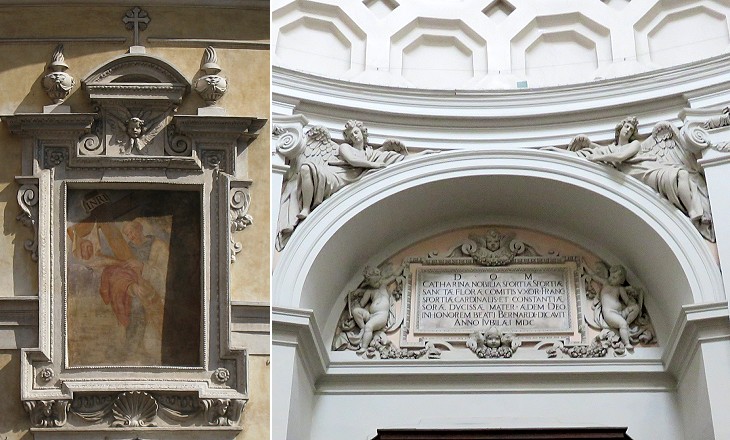
Stucco decoration: (left) frame of a fresco on the façade which portrays St. Bernard of Clairvaux holding the Cross to which the Veil of Veronica is attached; (right) rear façade with inscription celebrating the completion of the church in the 1600 Jubilee Year
The ancient Roman hall was turned into a church in 1596 at the initiative of Caterina Nobili, a niece of Pope Julius III and the widow of Sforza I Sforza, Count of Santa Fiora, a tiny state which included Proceno in northern Latium and other territories in southern Tuscany. The church and the adjoining monastery were her gift to Abbot Jean de la Barrière who in 1586 founded a new branch of the Cistercian order. In 1592 the Abbot came under suspicion of having supported the Huguenots and later on he was placed under a sort of house arrest in the new monastery where he died in 1600.
The church was dedicated to St. Bernard of Clairvaux, one of the first members of the Cistercian order.
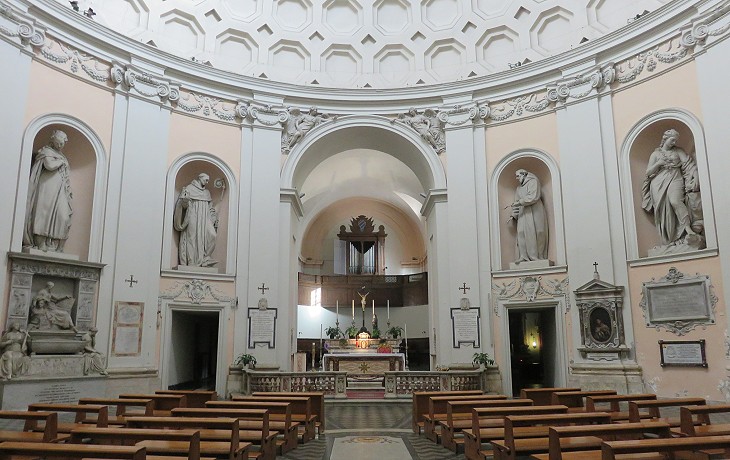
Interior
The design of the interior was influenced by that of Pantheon, the ancient temple which originally housed statues of gods inside niches in the wall. The church had no windows and it received light from the opening in the dome. The decorative elements of the building (including those of the drum, one of which you can see in the image used as background for this page) and the statues are made of stucco, a material which was widely employed and technologically improved during the XVIIth century as one can see at S. Andrea al Quirinale, not far from S. Bernardo.
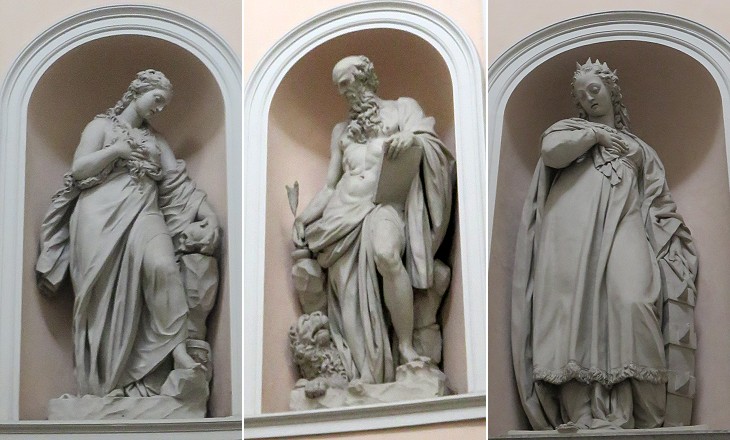
Stucco statues by Camillo Mariani (1600): (left) St. Mary Magdalene; (centre) St. Jerome; (right) St. Catherine of the Wheel
Camillo Mariani's work was of great consequence in revitalizing Roman sculpture. He was born in Vicenza. (..)
Shortly after his arrival in Rome he executed his masterpieces, the eight simple and noble
monumental stucco figures of saints in S. Bernardo alle Terme, in which the
Venetian nuance is obvious for anybody to see; but it is strengthened by a
new urgency and a fine psychological penetration which make these works stand out a
mile from the average contemporary production and ally them to the intense transitional style in painting in which we found crystallized the true spirit of the great reformers.
Rudolf Wittkower - Roman Art and Architecture 1600-1750 Penguin Books 1958
Camillo Mariani came to Rome towards the end of XVIth century and the eight large statues he made for S. Bernardo alle Terme recall works by Veronese, Titian and in general by the Venetian school. In Rome he trained Francesco Mochi who became a leading sculptor to the point of being asked
by Gian Lorenzo Bernini to work at the decoration of S. Pietro.
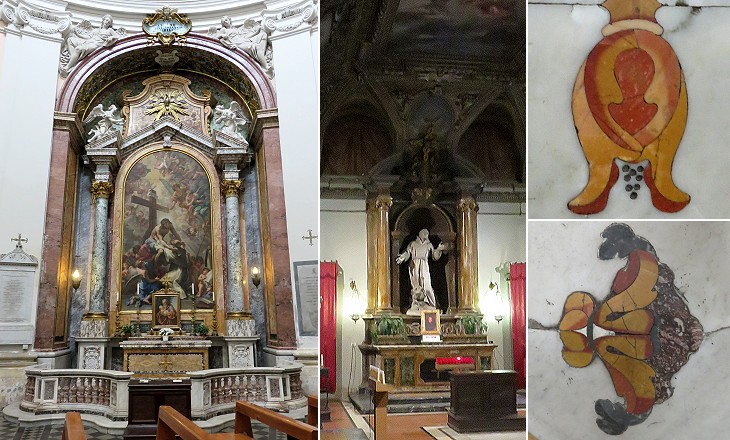
(left) Altar to St. Bernard; (centre) Chapel of St. Francis; (right) marble inlays on the balustrades of the altars
The use of stucco, rather than marble, and in general the design of S. Bernardo alle Terme complied with the austere lifestyle requested of the Cistercian monks by Jean de la Barrière. During the course of the XVIIth and early XVIIIth century however this approach was relaxed slightly and the church was embellished with altars which were decorated with marbles.
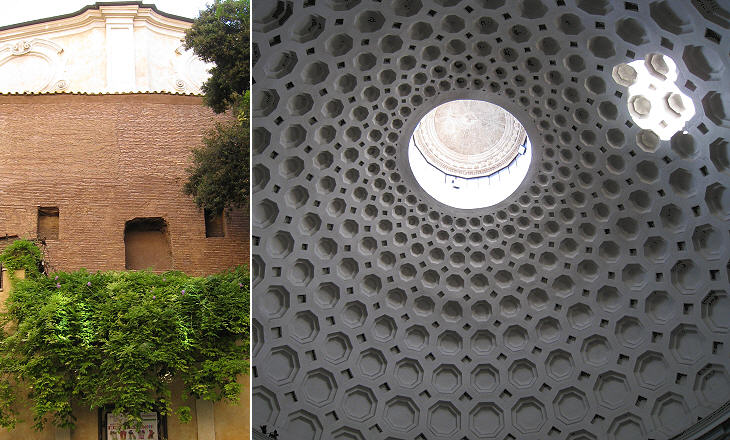
(left) Ancient Roman wall seen from Via Torino; (right) interior of the dome
The ancient circular hall was located at the south-western corner of the baths: an identical building was located at their south-eastern corner. It is thought that they were used for exercising or playing ball games (sphaeristeria) or for resting. The shape of the concrete coffers of the vault is similar to that at Tempio della Pace (Basilica di Massenzio), which was built in the same period.
Next plate in Book 7: Chiesa della SS. Trinità.
Next step in Day 2 itinerary: Piazza di Termini.
Next step in your tour of Rione Trevi: Chiesa di S. Niccolò da Tolentino.
Next step in your tour of Rione Monti: Chiesa e Monastero di S. Susanna.
Excerpts from Giuseppe Vasi 1761 Itinerary related to this page:
Chiesa di S. Bernardo a TerminiNon prima dell'anno 1598. fu ridotto in chiesa quest'ammirabile avanzo delle Terme Diocleziane, in onore di s. Bernardo, e accanto vi fu eretto il monastero per li monaci del medesimo Santo, della riforma però fatta dal venerabile D. Gio. Barriero abate Furiense di Tolosa, il corpo del quale giace a sinistra dell'altare maggiore. È questa di figura circolare, e vi sono stati adattati delle nicchie ed altari d'intorno, ornati di stucchi, e di pitture. Il Cav. Odazj vi fece li due gran quadri, e Cammillo Mariani da Vicenza le otto statue di stucco collocate nelle nicchie; la statua però di s. Francesco, ed altro nella cappella laterale sono lavori in marmo di Giacomo Antonio Fancelli. Nell'orto di detto monastero si vedono delle rovine delle medesime Terme in forma di teatro, e vi fu adattata una cappella dedicata a s. Caterina. |


