All images © by Roberto Piperno, owner of the domain. Write to romapip@quipo.it.


Notes:
Page revised in January 2024
All images © by Roberto Piperno, owner of the domain. Write to romapip@quipo.it.
Notes:
Page revised in January 2024
 along the ancient aqueducts
In this page:
Via Appia Pignatelli
Tempio della Salute
Villa dei Sette Bassi
Aqua Claudia and Anio Novus
Acqua Felice
Tor Fiscale (Campo Barbarico) and Tempio della Fortuna Muliebre
Monte del Grano
Porta Furba
It. porta means door, gate so one may believe Porta Furba to be one of the openings in the Walls of Rome. It is a gate in the sense that it has the appearance of a gate, but the walls of Rome are miles away.

(left) 1909 map of the sites covered in this page (black numbers): 1) Junction between Via Appia Pignatelli and Via Appia Nuova; 2) Tempio della Salute; 3) Villa dei Sette Bassi; 4) Aqua Claudia; 5) Acqua Felice; 6) Tor Fiscale; 7) Monte del Grano; 8) Porta Furba. The blue numbers indicate monuments covered in other pages: 1)
S. Urbano; 2) Cecilia Metella; 3) Villa dei Quintili;
(right) coat of arms of Pope Innocent XII Pignatelli
This walk starts at the junction between Via Appia Pignatelli and Via Appia Nuova (Le Capannelle) where a coat of arms celebrates the improvements made by Pope Innocent XII to an existing path which linked Via Appia Nuova to ancient Via Appia and to Porta S. Sebastiano; from the inscription "Ab inundantibus imbribus in securitatem" we learn that the path was subject to being flooded; the improvements were made for the Jubilee Year 1700.
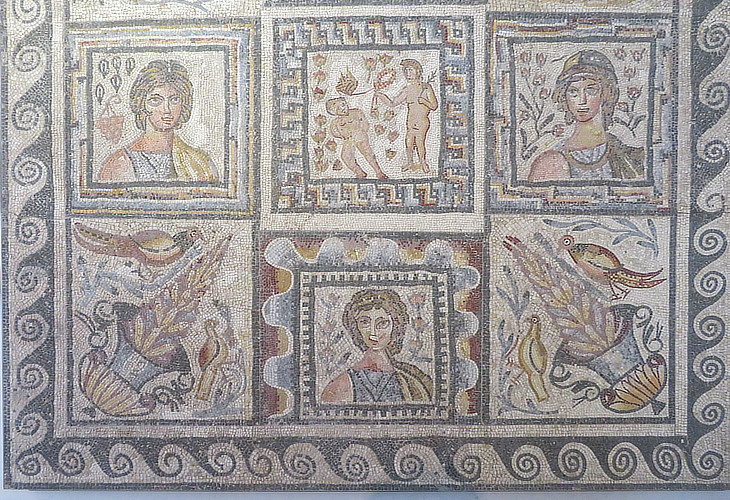
Museo Nazionale Romano: floor mosaic from near Le Capannelle (IVth/Vth century AD), perhaps part of a mausoleum: it depicts (in a very sketchy way) the Four Seasons and an athlete receiving the wreath of victory
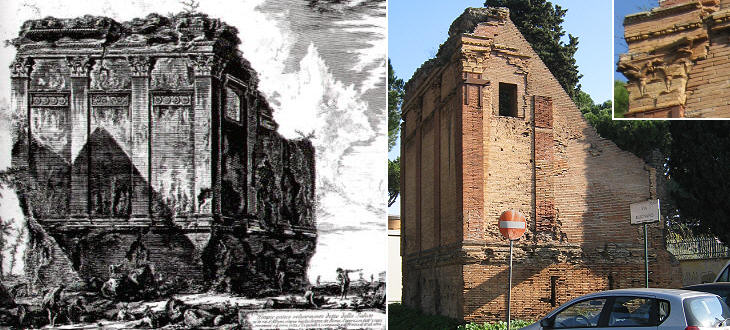
(left) Etching by Giovanni Battista Piranesi; (right) Tempio della Salute; (inset) brick capital
Tempio della Salute is the name given by Giovanni Battista Piranesi to a IInd century AD Roman tomb along Via Appia Nuova approximately one mile from its junction with Via Appia Pignatelli. The comparison between the etching by Piranesi and the actual monument shows how Piranesi dramatized the view by exaggerating the size of the ancient building and by adding some picturesque elements such as the shadow of a pyramid. The tomb is similar to other brick tombs along nearby Via Appia Antica.
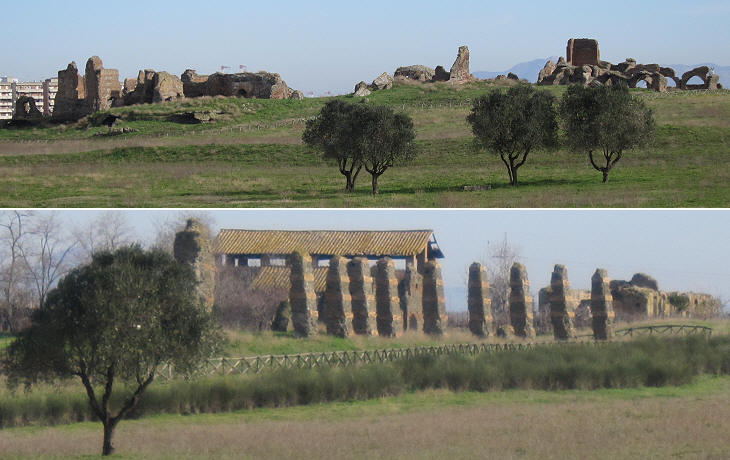
(above) View of the three main buildings; (below) ruins of the "carceres" which marked the starting line of the private circus
Roma Vecchia (Old Rome) was the name given to a series of imposing ruins spread between Via Appia Antica and
Via Tuscolana (the latter runs almost parallel, 2 miles north of the former). They were thought to be the remaining evidence of a
town which existed before Rome. Archaeological research has attributed these ruins to large villas built in the IInd century AD; Villa dei Quintili is located near Via Appia Antica, while Villa dei Sette Bassi borders on Via Tuscolana.
Sette Bassi is a corruption of Septimius Bassus, an owner of the villa at the time of Emperor Constantine. The wealth of the landlords is testified to by the presence of a private circus for chariot races; the carceres (cages) from which the chariots started the race were placed on a staggered line to take into
account the impact of the circus curve (see how they were opened in a floor mosaic at Lyon).

(above) View of the private aqueduct; (below) an isolated building which is thought to have been a guesthouse
The villa was supplied with water by a short aqueduct which branched off Aqua Claudia, the imposing aqueduct which carried water to the imperial palaces on the Palatine hill; this leads to the belief that the initial owners of the villa were relatives or close friends of Emperors Hadrian and Antoninus Pius, as the construction of the villa has been dated to their reigns.
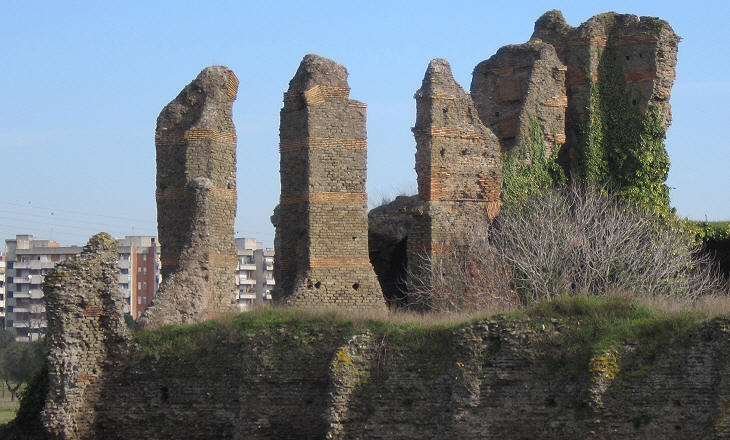
Ruins of building "A"
The main buildings are located near Via Tuscolana; the first one had a square shape with rooms around an internal courtyard with porticoes; the other two were added a short time later and they included reception halls and baths.

Reliefs portraying two labours of Hercules which were found near Villa dei Sette Bassi, now at Museo Pio-Clementino
(Ist century AD)

Collezione Torlonia: Sarcophagus depicting the labours of Hercules which was found in the Torlonia estate of "Roma Vecchia"
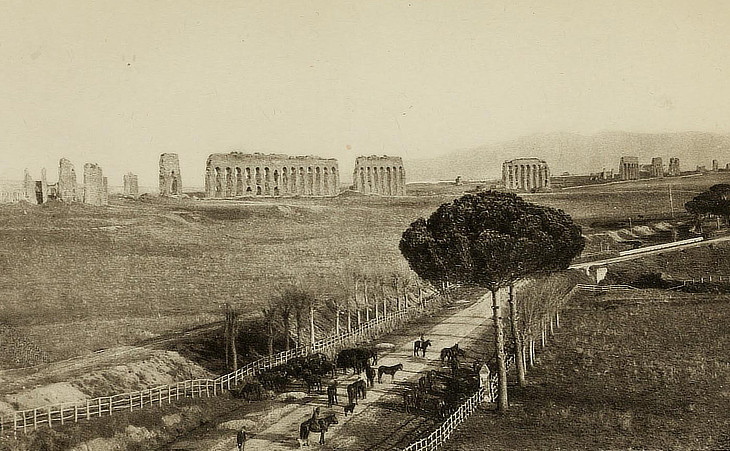
Illustration from "Ave Roma Immortalis" by Francis Marion Crawford - 1898; it shows the "Aqua Claudia" aqueduct and the Roman Campagna
Dim in the clouds, the radiant aqueducts
Turn their innumerable arches o'er
The spacious desert, brightening in the sun,
Proud and more proud, in their august approach:
High o'er irriguous vales and woods and towns,
Glide the soft whispering waters in the wind,
And here united pour their silver streams
Among the figured rocks, in murmuring falls.
John Dyer - The Ruins of Rome - 1740
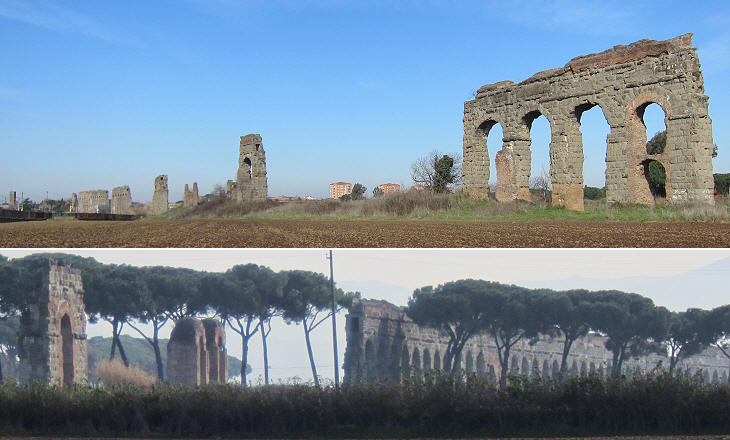
Views of Aqua Claudia: towards Tor Fiscale (above) and towards Villa dei Sette Bassi (below)
The ruins of the aqueducts were a common feature of all Grand Tour paintings showing the Roman countryside; in particular the ruins of Aqua Claudia, the aqueduct initiated by Emperor Caligula and completed by Emperor Claudius were depicted in the background of J. W. Goethe's portrait by W. Tischbein.
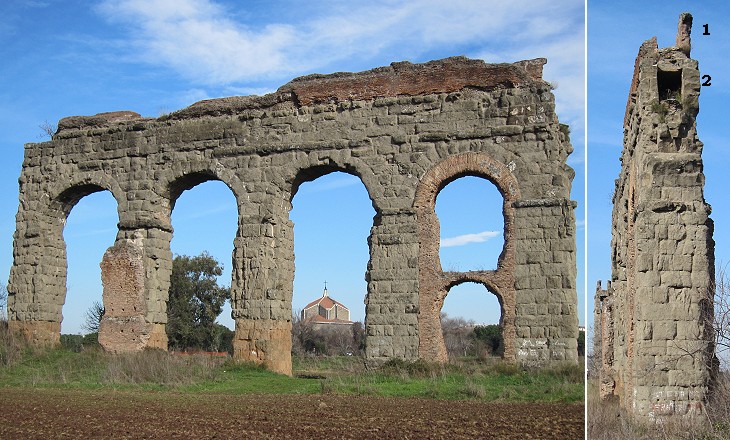
(left) Arches at Parco degli Acquedotti; (right) image showing the two water conduits: 1) "Anio Novus"; 2) "Aqua Claudia"
The arches carried the water of Aqua Claudia and Anio Novus from
springs near Subiaco in the Apennine Mountains. The two aqueducts joined together some seven miles east of Rome; the completion of the aqueducts was celebrated with a triumphal arch, which eventually was turned into
Porta Maggiore, one of the gates of Rome.
Ancient engineers did not neglect the artistic aspect of the aqueducts; they employed different kinds of stones to obtain colour effects (which have been taken into account in the design of a modern church near the aqueduct).
For the construction of very long aqueducts (45 miles in the case of Aqua Claudia), the Romans developed a series of instruments which anticipated those utilized by modern topographers; because the movement of water was due to gravity, it was necessary to ensure conduits had an appropriate and constant gradient throughout the whole length of the aqueduct: the gradients of Roman aqueducts ranged between 2 and 4:10,000; measurement equipment had to be very precise and foundations and arches very solid to achieve this level of tolerance.

Musei Vaticani: porcelain vase donated by German Emperor Wilhelm I to Pope Pius IX with a view of the aqueducts

Acqua Felice at Parco degli Acquedotti
Similar to an ancient Roman Emperor, Pope Sixtus V (Felice Peretti) gave his name to a new aqueduct he built immediately after his election in 1585; Acqua Felice (It.) and Aqua Claudia (Lat.) run parallel towards Rome for many miles, but the low arches of the modern aqueduct are not as evocative as those of the ancient one.
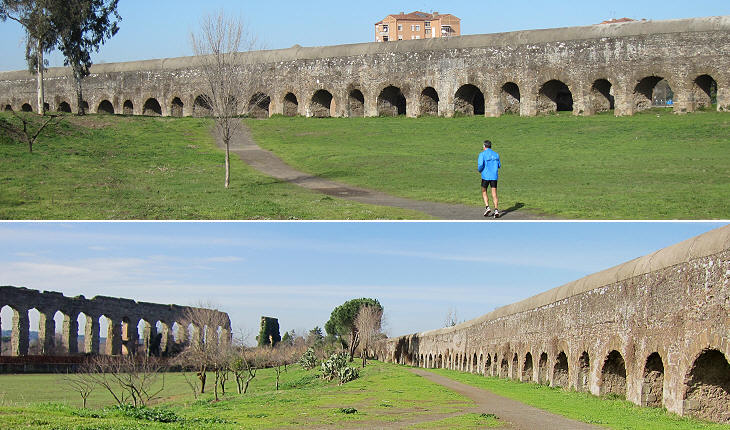
(above) Acqua Felice at Parco degli Acquedotti; (below) Aqua Claudia - Ist century (left) and Acqua Felice - XVIth century (right) near Tor Fiscale
Acqua Felice, by bringing water to the northern hills of Rome (Esquilino, Viminale, Quirinale), helped their development and increased the value of Villa Peretti, the Pope's large estate between S. Maria Maggiore and Piazza di Termini. It ended with a monumental fountain.
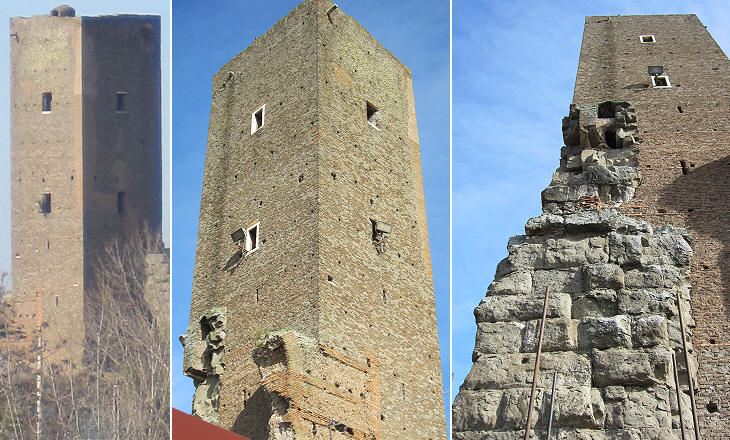
(left/centre) Tor Fiscale; (right) arch of Aqua Claudia upon which Tor Fiscale was built
Tor Fiscale is one of the highest medieval towers one can see in the Roman countryside; it was built above an arch of Aqua Claudia; the area where it stands was known as Campo Barbarico, because during the Greek-Gothic War, the Goths established their camp in this location and they fortified it by closing the arches of the aqueduct; the conduits were damaged in order to turn them into battlements. At the end of the war Rome was so impoverished and its population so reduced that Aqua Claudia was not repaired.
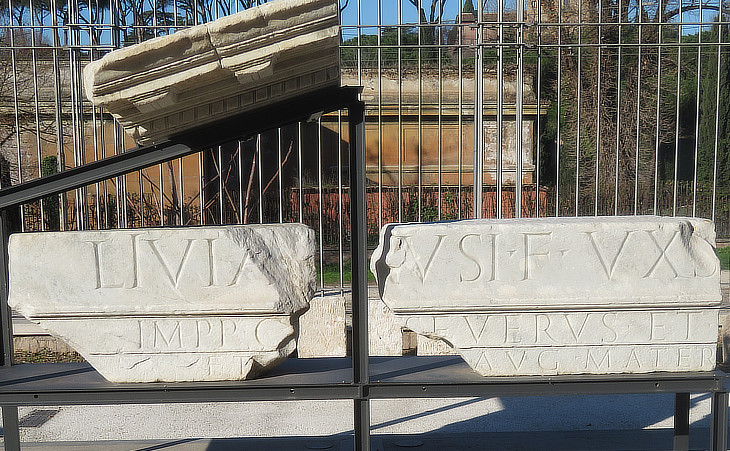
Parco Archeologico del Celio: fragments of a temple found in 1831 in the Torlonia estate near Tor Fiscale
The inscription is completed as follows: Livia [D]r.usi f (ilia) uxsor [Caesaris Augusti -]. /
/ Impp. C[aes]s Severus et Anto[ninus Augg. et Geta nobilissimus Caesar] /
et [Iulia] Aug(usta) mater Aug[g. - restituerunt]. It suggests that a temple built by Livia, third wife of Emperor Augustus, was restored by Emperor Septimius Severus, his two sons Geta and Caracalla and their mother Julia Domna.
The finding was immediately associated with a famous episode of the history of Ancient Rome which is related to Coriolanus, a Roman commander thus named because of his conquest of Corioli, a town of the Volsci. He subsequently entered into conflict with the tribunes of the plebs and was banished from Rome. In revenge he accepted to lead a Volscian army against Rome, but outside Porta Latina he was met by his mother Veturia and his wife Volumnia together with the matrons of Rome who pleaded him not to destroy the city. He accepted and returned to the Volscian capital where he was killed. The Romans built a temple on the site of the meeting; it was dedicated to Fortuna Muliebris on account of the services of the matrons of Rome in saving the city from destruction.

Monte del Grano (Hill of Wheat for its resemblance to a "modius", the Roman bushel)
I remember that a Mile from St. John Gate, beyond the Aqueducts, in the Place call'd Monte del Grano there was a mighty solid and ancient Heap of unhew'd Stones and Flints, which a Workman manfully undertaking, threw down, and getting in, made Way to the middle Part, till he found a large Marble Urn, on which was a Bass Relieve reprelenting the History of the Ravishing of the Sabine Women, and on the Cover were two Humane Figures lying along, one of which represents Alexander Severus, the other his Mother Julia Mammea. There were Ashes preserv'd in the Urn, which is now in the Palace of the Capitol where the Conservators sit.
Flaminius Vacca's 1594 account of discoveries of antiquities which took place in his lifetime, as quoted in "The Travels of the Learned Father Montfaucon from Paris thro' Italy - 1712"
Monte del Grano is an ancient large circular mausoleum which was deprived of its travertine decoration in the XIVth century; it is located on the northern side of Via Tuscolana; some archaeologists believe it was built for Emperor Alexander Severus, who, not far from this site, built an aqueduct.
A corridor leads to a large underground hall where a sarcophagus with an assumed portrait of the Emperor and of his mother was found in the XVIth century. The sarcophagus contained the Portland Vase (now at the British Museum).

Etching by Giovanni Battista Piranesi showing the sarcophagus which was found at Monte del Grano; the box was decorated with a relief showing scenes from the life of Achilles
A large sarcophagus found at the close of the XVI.
century in an ancient sepulchre, now Monte del
grano, about three miles from the porta S. Giovanni, to the left on the way to Frascati, a little beyond the Porta Furba. It contained a beautiful vase of coloured glass with basreliefs representing the marriage of Jupiter, under the form of a serpent,
with Proserpine, which became the property of the
Barberini family, but was purchased by the Duke
of Portland, by whom it was presented to the British
museum, where it is now known as the Portland
vase. The sarcophagus measures 9 feet 7 inches in
length, 3 feet 10 inches in breadth 5 and 5 feet in
height and the two figures, at the top , on a well
worked couch, are sometimes said to represent Alexander Severus and his mother Mammaea, but they
bear no likeness to their medals, and, as Winkelmann observes, the man represented here is at least
fifty, and Alexander Severus was murdered before he was thirty. The basreliefs, on the four sides,
are of various degrees of merit.
Rev. Jeremiah Donovan - Rome Ancient and Modern - 1843
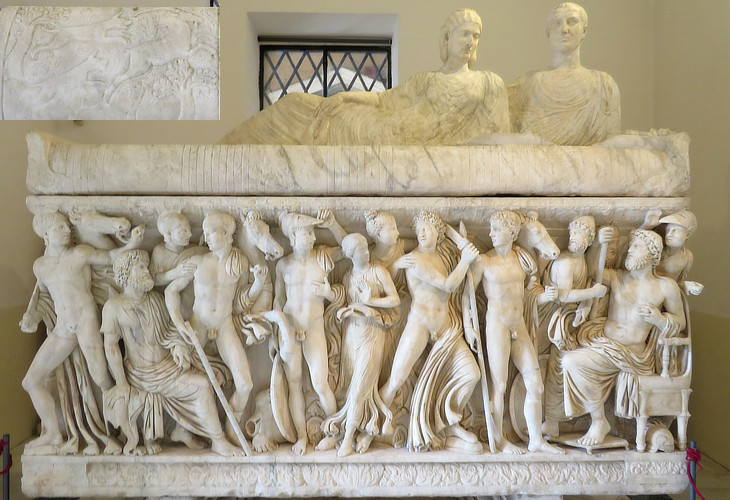
Musei Capitolini: the actual sarcophagus; (inset) detail of the embroidered cushion which is very similar to one from Perge
The front, which displays considerable spirit, and a knowledge of the nude, represents the contest between Achilles and Agamemnon for the fair Briseis. Agamemnon is seated to the right, Menelaus to the left, at the Council of the assembled Greeks and in the centre is Achilles, whose uplifted arm, wielding his naked sword, is witheld by Minerva, while the trembling Briseis is terrified by his violent transport. Donovan
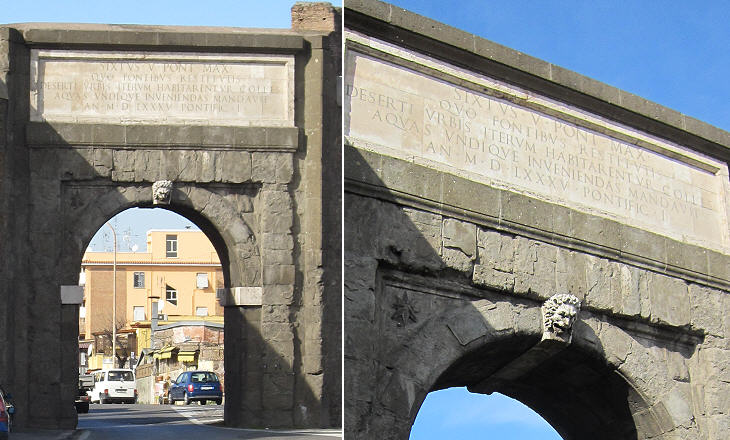
(left) Porta Furba; (right) inscription and heraldic symbols of Pope Sixtus V
Pope Sixtus V celebrated the completion of Acqua Felice with a long inscription on the arch which crossed Via Tuscolana;
the appellation of Furba, given to the arch/gate is obscure; the Italian adjective furbo means cunning and it does not seem very applicable to a gate; perhaps it was referred to cunning brigands, who robbed the passers-by at the gate.
Pope Sixtus V celebrated the completion of its aqueduct in a similar way near Porta S. Lorenzo.
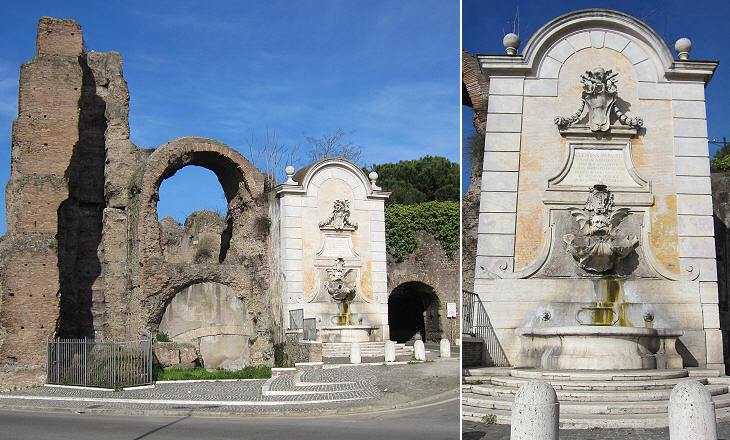
Aqua Claudia (you may wish to see it in a 1909 watercolour by Yoshio Markino) and fountain built by Pope Clement XII
A fountain built by Pope Sixtus V at Porta Furba was restored by Pope Clement XII in 1734; on that occasion it was entirely redesigned
perhaps by Luigi Vanvitelli (see a page showing other small fountains built
by Pope Clement XII).