
All images © by Roberto Piperno, owner of the domain. Write to romapip@quipo.it.


Notes:
Page revised in December 2023.
All images © by Roberto Piperno, owner of the domain. Write to romapip@quipo.it.
Notes:
Page revised in December 2023.
 Frascati
"Frascati is a paradise" J. W. Goethe - Italian Journey - September 12, 1787
The name of the town derives from the rural huts made with tree branches (It. frasca) built by the inhabitants of Tuscolo, when their town was destroyed
by the Romans in 1191. Medieval Tuscolo stood on the site of ancient Tusculum, which according to tradition was founded by Telegonus, son of Ulysses and Circe.
Frascati became an important town in the second half of the XVIth century after Alessandro Ruffini, a prelate of the papal court, and Cardinal Marco Sittico Altemps, nephew of Pope Pius IV, built villas at Frascati or between the town and Monte Porzio Catone.
Their example was followed by the most important Roman families and in 1620 there were already 14 villas around Frascati.
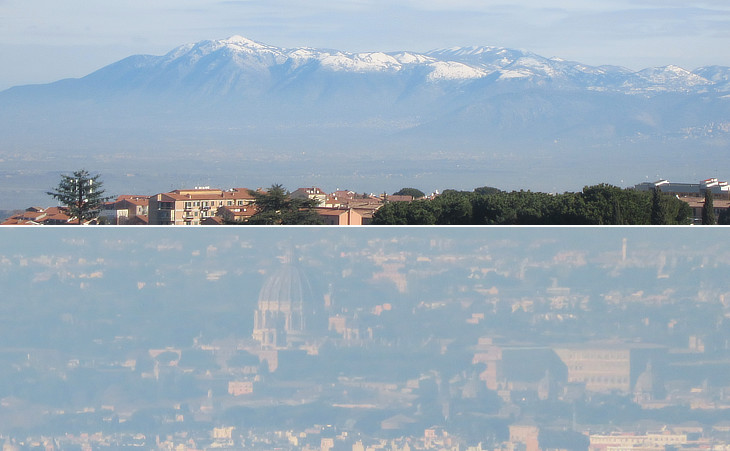
Views from Frascati: (above) Monte Gennaro; (below) Rome and S. Pietro
Cardinal Ippolito d'Este and Cardinal Alessandro Farnese preceded Ruffini and Altemps in building large villas respectively at Tivoli and Caprarola, but their selection of the location was due to the fact that they were governor of the town (d'Este) or had large fiefdoms in the area (Farnese).
The choice of Frascati as a location for summer retreats was based on other factors: a commanding view which ranged from the Apennines to the Tyrrhenian Sea, the availability of water, the woods which covered the hill behind the town and the fact that Cicero and other famous ancient Romans had their villas near Tusculum. Spending the villeggiatura at Frascati or in nearby locations became customary for the wealthiest families and for the popes too, who still spend the summer at Castelgandolfo.
After lunching at the inn, we took a donkey excursion to the remains of Tusculum, about two miles distant, occupying the summit of the hill on the lowest spurs of which Frascati is situated. The road led through woodlands and pastures (..) and opened widening prospects as we ascended. Here are many interesting ruins, especially the remains of a theatre, most of the seats of which were hewn from the living rock. (..) It is difficult, however, for any one to look at a dead ruin upon a spot from which so living and glorious a landscape may be seen. On one side are Rome, crowned with the dome of St. Peter's, and the Campagna, a motionless sea of green, which imperceptibly flows into the living blue of the Mediterranean. On the opposite side are the Alban valley (..) and the ridge of Alba Longa,- a landscape as exhilarating from its variety and picturesque contrasts as that towards Rome is impressive from its vastness and monotony.
George Stillman Hillard - Six Months in Italy in 1847-1848
Tusculum was located at the top of the hill behind Frascati. It was linked to Rome by a road and it gave its name
to a part of the Alban hills. The villas built by the cardinals are collectively known as Ville Tuscolane and they were in part embellished
with marbles and columns found at Tusculum or in the ancient villas. You may wish to visit Museo Tuscolano, in the former stables of Villa Aldobrandini, which houses some interesting findings from Tusculum.
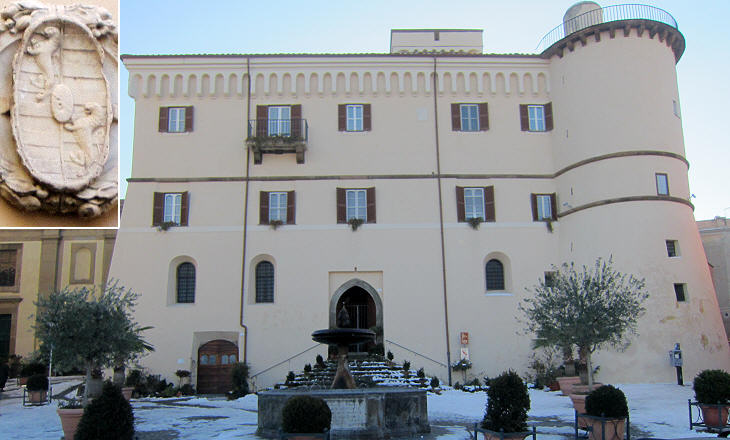
Rocca di Frascati (Bishop's Palace) and in the inset coat of arms of Cardinal Guillaume d'Estouteville
The fortifications of Frascati were relatively minor, although the town was surrounded by walls. Its defence was mainly based on a small fortress controlling the road from Rome. It was built by Cardinal Guillaume d'Estouteville, perhaps the richest cardinal of his time and the Dean of the Sacred College for more than twenty years (1461-83). It was turned into the residence of the bishops by Pope Paul III. Frascati (Tusculum) was one of the six suburbicarian dioceses of Rome and it was assigned to one of the most senior cardinals.
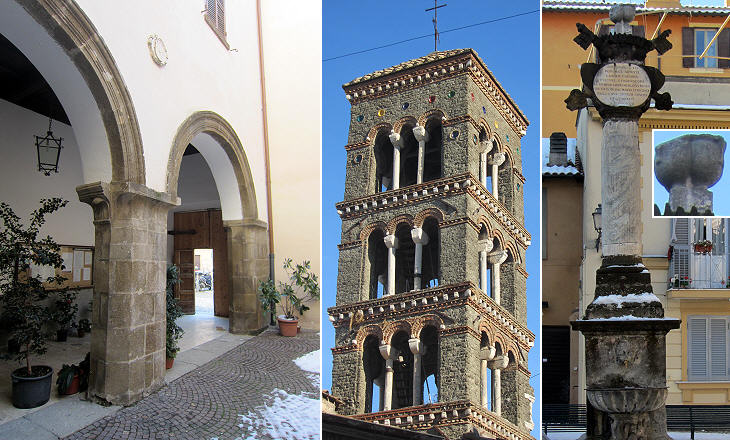
(left) Interior of the Bishop's Palace; (centre) 1305 bell tower of S. Rocco; (right) 1693 monument bearing the heraldic symbols (three pots)
of Pope Innocent XII and those of Carlo Colonna, Governor of Frascati
(a "cipollino" column) in the former market square
Frascati, Nov. 15. 1786. The company are all in bed, and I am writing with Indian
ink which they use for drawing. We have had two beautiful
days without rain, warm and genial sunshine, so that summer
is scarcely missed. The country around is very pleasant; the
village lies on the side of a hill, or rather of a mountain, and
at every step the draughtsman comes upon the most glorious
objects. The prospect is unbounded - Rome lies before you,
and beyond it, on the right, is the sea, the mountains of
Tivoli, and so on. In this delightful region country houses
are built expressly for pleasure, and as the ancient Romans
had here their villas, so for centuries past their rich and
haughty successors have planted country residences on all the
loveliest spots. For two days we have been wandering about
here, and almost every step has brought us upon something
new and attractive.
J. W. Goethe - Italian Journey - translation by Charles Nisbet
In the summer of 1943 General Albert Kesselring, commander of the German troops in Italy established his headquarters at
Villa Falconieri near Frascati. This led to the town being heavily bombed on September 8 by the Allies. Most of the medieval quarter behind
the fortress was destroyed with the exception of the bell tower of S. Rocco. The town was bombed again after the Allied landing at Anzio in January 1944.
Carlo Fontana's nephew, Girolamo, designed the academic two-tower
facade of the cathedral at Frascati; in spite of its traditional
scheme it is typical for this phase of the Late Baroque by virtue of its slow rhythm and an
accumulation of trifling motifs.
Rudolf Wittkower - Art and Architecture in Italy 1600-1750 Penguin Books
Pope Innocent XII promoted the erection of a large cathedral which was completed in time for the Holy Year 1700 (the bell towers are a later addition). It is interesting to note the use of a local dark volcanic stone (pietra sperone) to highlight the structure of the building; the use of dark stones can be seen in other churches near Frascati (e.g. the Cathedral of Albano) and in other parts of Latium (e.g. at Gradoli). The Cathedral was hit by bombs and its interior was almost completely destroyed, but the façade was not damaged.
It was designed by Girolamo Fontana, nephew of
Carlo Fontana, the most important Roman architect at the end of the XVIIth century.
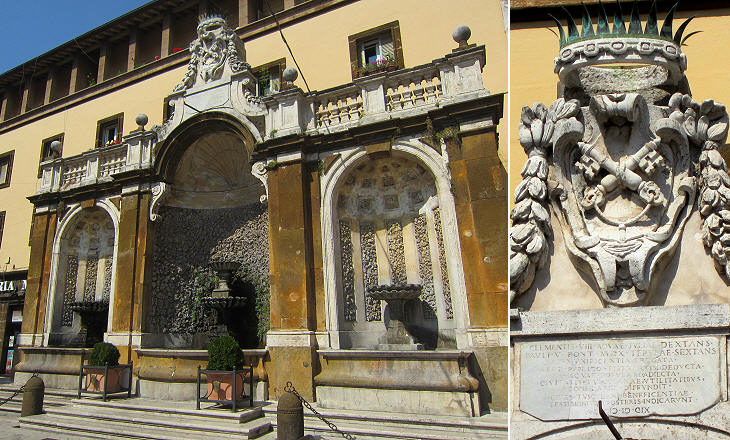
(left) Main fountain; (right) coat of arms of Frascati and inscription on a previous fountain
The square in front of the Cathedral was embellished by a fountain in style with the façade and similar to a Roman nymphaeum. It incorporated a 1619 inscription which celebrated the completion of two aqueducts built by Pope Clement VIII Aldobrandini and Pope Paul V Borghese to provide Frascati (and the many fountains of their family villas) with an ample supply of water.

Chiesa del Gesù: (left) façade; (right) detail of its decoration
In 1693 Carlo Fontana was commissioned the enlargement of an existing Jesuit church. His project however was too expensive and the construction of the new building was postponed. The church was eventually enlarged on the basis of a project by Father Gregorio Castrichini. Similar to il Gesù in Rome and other Jesuit churches throughout the world (see that at Valletta, Malta), the façade was embellished with the head of a cherub.
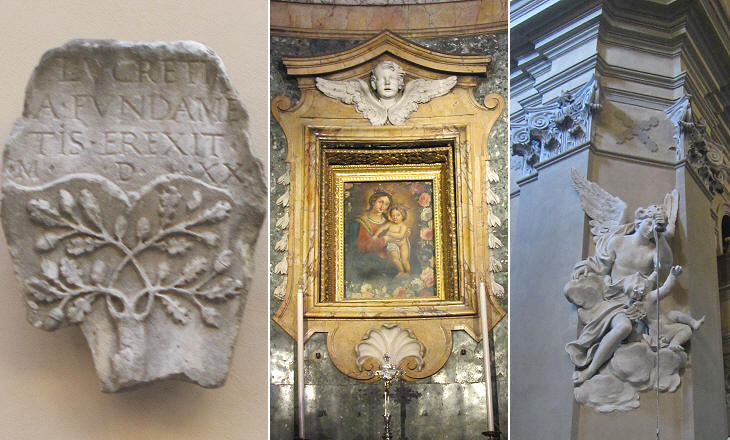
(left) 1520 coat of arms of Lucrezia della Rovere previously on the portal of the old church and now in the Bishop's Palace;
(centre) Chiesa del Gesù - interior: marble altar in one of the chapels; (right) Chiesa del Gesù - interior: stucco statue and heraldic symbols of
Olimpia Aldobrandini (stars and stripes)
The Jesuit church replaced a previous one which was founded by Lucrezia Della Rovere, niece of Pope Julius II. In line with the Jesuit tradtion of sumptuously decorating their churches, the interior of Chiesa del Gesù has many rich altars and statues. A large bequest from Olimpia Aldobrandini, the last of her family, paid for the renovation of the church.

Chiesa del Gesù: illusory domes by Andrea Pozzo and Antonio Colli
In 1685 Father Andrea Pozzo painted an illusory dome at S. Ignazio in Rome. It was meant to be replaced by an actual dome, but it met with such an appreciation that it became a permanent feature of the church. Father Pozzo was asked to paint the ceiling and the apse of the Jesuit church at Frascati. Because at the time he was busy with the decoration of Jesuitenkirche in Vienna, the execution of the paintings at Frascati was entrusted to Antonio Colli, one of his assistants (other examples of illusory paintings can be seen in a page on Baroque Ceilings).
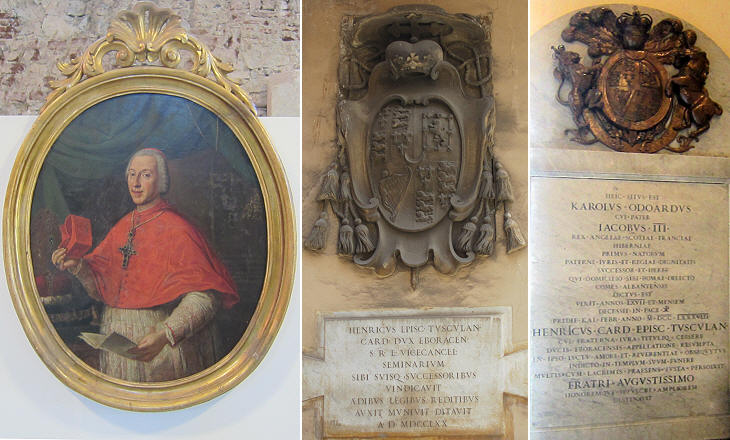
(left) Portrait of Cardinal Henry Benedict Stuart; (centre) 1770 coat of arms of Cardinal Stuart celebrating the construction of
a seminary in a street of Frascati; the coat of arms shows both the royal crown and the cardinal's hat; (right) tomb of Charles Edward Stuart
(aka Bonnie Prince Charlie) in the Cathedral of Frascati; today the tomb contains only the "praecordia" (heart and other inner parts of the body)
Frascati is an agreeable village on the declivity of a hill, about twelve miles from Rome. It is a bishop's see, and always possessed by one of the six eldest Cardinals. At present it belongs to the Cardinal Duke of York, who, whether in the country or at Rome, passes the greatest part of his time in the duties and ceremonies of a religion, of whose truth he seems to have the fullest conviction; and who, living himself in great simplicity, and not in the usual style of Cardinals, spends a large proportion of his revenue in acts of charity and benevolence.
John Moore - A View of Society and Manners in Italy - 1781
I was introduced to Cardinal York by an Irish gentleman residing in Rome. (..) When my friend told him that my grandfather fell in the Stuart cause, the recollection of that cause drew a tear into his eye, an emotion to which he is very subject. He says little, and in that little there is nothing. His face is handsome, smooth, ruddy, without a wrinkle, except on the forehead. He stoops much and walks with difficulty. (..) His dress was an alternation of red and black. (..) After dinner a little dog came on the table to play a few tricks, when the cardinal, turning to me, said very significantly, "This is a King Charles's dog." On his carriages he has the regal crown under the cardinal's hat: but he never assumed, like his brother, the title of Majesty.
Joseph Forsyth - Remarks on Antiquities, Arts, and Letters in Italy in 1802-1803
Henry Benedict Stuart was born at Palazzo Muti Balestra in Rome in 1725. He was created Duke of York by his father James and Cardinal by Pope Benedict XIV in 1747. In 1761 he became Bishop of Frascati, where he spent most of his life, taking active part in the embellishment of the town.
In 1788, following the death of his brother Charles Edward, Henry declared himself Henry IX of Great Britain, France and Ireland, but he never challenged the authority of King George III, by whom he received a pension in the last years of his life. Together with his father and brother he was eventually buried in S. Pietro in a monument designed by Antonio Canova.
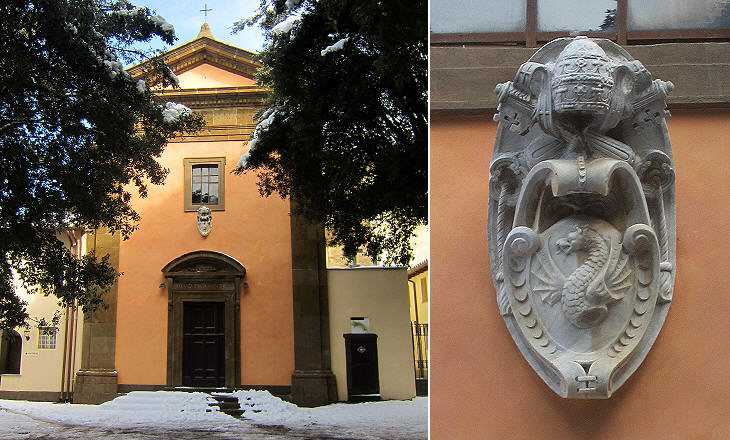
(left) Chiesa dei Cappuccini; (right) coat of arms of Pope Gregory XIII who in 1574
allowed the Capuchin Order to establish monasteries in countries other than Italy
The neat design of the Capuchin church of Frascati offers a striking contrast with that of the Jesuits or the Cathedral. It is located in what was a thick wood on the hill behind the town. This because at the origin the order was meant for hermits and therefore all monasteries were built out of town and on high ground (in Rome too).
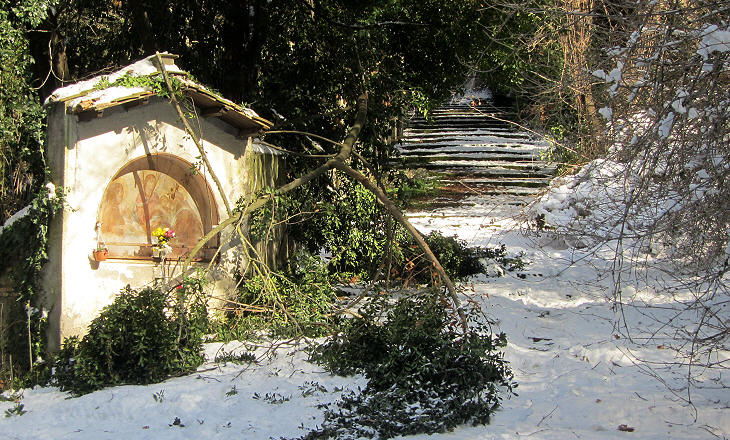
Ramp leading to Chiesa dei Cappuccini
I must acknowledge, I
have not seen the famous villas at Frascati and Tivoli,
which are celebrated for their gardens and water-works. I intended to visit these places; but was
prevented by an unexpected change of weather, which
deterred me from going to the country. On the last
day of September the mountains of Palestrina were
covered with snow; and the air became so cold at
Rome, that I was forced to put on my winter cloaths.
This objection continued, till I found it necessary to
set out on my return to Florence.
Tobias Smollett - Travels through France and Italy in 1765
Some of the images which illustrate this and the other pages on Frascati were taken in February 2012, shortly after an unusually heavy snowstorm.
The image in the background of this page shows a modern fountain depicting a cask of wine, as Frascati is renowned for its white wine (more about wine in the area).
Read William Dean Howells' account of his visit to Frascati in 1908.
Move to page two: Villa Mondragone, Villa Taverna, Villa Aldobrandini and Villa Torlonia
Move to page three: Villa Lancellotti, Villa Falconieri and other villas or
Visit Museo Tuscolano inside the Aldobrandini stables.
Next step in your tour of the Environs of Rome: Grottaferrata
Excerpts from Giuseppe Vasi 1761 Itinerary related to Frascati:
Giuseppe Vasi
|


